Merged Applicability of Bazant's model to the real world

Am I wrong or this gif that MT posted before shows horizontal displacement of the core?

[qimg]http://img709.imageshack.us/img709/666/initialtilt175230b.gif[/qimg]

It shows initial tilting.

The movement is prior to North face perimeter separation.

LHS is NE viewpoint
RHS in N viewpiont (sauret)
 
The gif is replicating the actual geometry of the tilt as measured from the videos and it is then showing the movement of the interior structure through the tilt.

Your attempt to say the video shows that there is no way the columns could line up has no basis.

Using the same geometry as the .gif (if you wish), could you knock up a quick CAD diagram showing how symmetrically double-hinged core columns could meet axially at the impact point? Thanks
 
Using the same geometry as the .gif (if you wish), could you knock up a quick CAD diagram showing how symmetrically double-hinged core columns could meet axially at the impact point? Thanks

The gif already shows you what will happen.

The only difference would be the bifurcation (scissor portion) of the column, but the positions of the hinges will be in the envelope of the column in the gif, which shows intersection. The upper and lower hinges will impact.
 
The gif already shows you what will happen.

The only difference would be the bifurcation (scissor portion) of the column, but the positions of the hinges will be in the envelope of the column in the gif, which shows intersection. The upper and lower hinges will impact.

The gif shows column ends passing through each other and occupying the same physical space.

In an earlier post you said there would be two plastic hinges, each towards the ends of each column length, causing the 'knob' of each hinge to impact the other. Now you seem to suggesting otherwise. You're being very unclear. I'm not certain that even you can picture what you believe. Or even whether you have pictured anything resembling a physical collapse mechanism.

If you don't know CAD tools, then a hand sketch will do fine. Over to you.
 
The gif shows column ends passing through each other and occupying the same physical space.

In an earlier post you said there would be two plastic hinges, each towards the ends of each column length, causing the 'knob' of each hinge to impact the other. Now you seem to suggesting otherwise. You're being very unclear. I'm not certain that even you can picture what you believe. Or even whether you have pictured anything resembling a physical collapse mechanism.

If you don't know CAD tools, then a hand sketch will do fine. Over to you.

I think you are the one who needs to do a little work here to picture what I am saying.

I am not suggesting anything different than I did before. Look at the buckled shape in Dr. Bazant's first paper if you can't picture it mentally. There are three hinges in the buckled column shape. One in the middle and one at each end.

The column would buckle and have a scissor shape with the middle hinge being at its center and moving outside of the straight column envelope, but the upper and lower hinges stay within the column envelope seen in the .gif. Since the column envelopes intersect during the fall the hinge areas would also.

I use CAD tools every day in work but there is no need for that here. It is a simple concept, especially with the .gif showing you that the small tilt does not cause the columns to misalign.
 
Last edited:
I think you are the one who needs to do a little work here to picture what I am saying.

I am not suggesting anything different than I did before. Look at the buckled shape in Dr. Bazant's first paper if you can't picture it mentally. There are three hinges in the buckled column shape. One in the middle and one at each end.

The column would buckle and have a scissor shape with the middle hinge being at its center and moving outside of the straight column envelope, but the upper and lower hinges stay within the column envelope seen in the .gif. Since the column envelopes intersect during the fall the hinge areas would also.

I don't know how to make it any clearer to you.
Kind of sounds like your describing a "perfect world" case to me. Almost like Bazant's case for most probable collapse arrest.

:rolleyes:
 
Last edited:
Kind of sounds like your describing a "perfect world" case to me. Almost like Bazant's case for most probable collapse arrest.

:rolleyes:

Take a look at the .gif that Major Tom posted above. That is pretty much what the trajectory of the column fall would be with the small tilt. There is no perfect or imperfect about it. The columns would not miss each other with the actual geometry of the fall.

The .gif trajectory analysis and my explanations are more than sufficient to understand that the columns would not misalign and that there should have been a serious impact and deceleration in a natural collapse.

Anyone who doesn't get this doesn't want to get it, as it is quite clear at this point.
 
Last edited:
Kind of sounds like your describing a "perfect world" case to me. Almost like Bazant's case for most probable collapse arrest.

:rolleyes:

He is. His tactics have not changed in recent posts and seem to go back years in his personal presentations.

The debating trick he is using is based on two premises:
  • He presumes that the structures remain rigid so that the geometry of the tilt says that the top bits of column stay on top of the bottom bits; AND
  • No matter how the bendy bits bend the bent top bit will land on and remain on top of the bent bottom bits.
(My use of simple layman English is deliberate.)
Both those premises are dubious. They are not universally wrong but both are independently highly improbable . Not quite impossible but close to it for what actually happened. It serves "truthers" to limit reality to that one scenario because it leads to the conclusion "something must have removed a bit of column". Therefore "demolition" - their predetermined outcome. Sadly from their point of view there is at least one alternate scenario and the history of recent posts in this thread will show Tony avoiding that alternate because it does not favour his preferred outcome.

That alternate is that the top block bit of each column is bypassing - sliding past - not contacting end for end - its corresponding lower portion of column. And such bypassing says "no demolition needed" so truthers need to avoid considering that alternative at any cost.

So we have all these "explanations" and graphics to show how the falling columns would impact with their lower portions.

Just a little bit of consideration of what really happened on 9/11 reveals the "bypass" mechanism as a valid, indeed more likely, alternate than "end for end axial contact". So that makes the premise under "Missing Jolt" dubious at best AND further simple steps in logic see "Missing Jolt" self destruct.

But let's stay with the first step for now by considering one simple but rarely recognised fact. That fact is that the top block was falling in the period immediately before where Tony looks for his jolt.

And that leads to an unavoidable conclusion that, because the top block was falling few if any columns were in end for end axial contact and transferring a significant load.

The majority of columns were already out of end for end axial contact. It must be "the majority" because the top block was falling. And the minority, if any, which had end for end axial contact were too few to support the top block - because the top block was falling. And the exact number of columns in the "majority" or the "minority" matters not.

Now so far we are on common ground with the lead in to "Missing Jolt" and the alternate scenario. We have not eliminated demolition removal of bits of column - yet.

Let's see what was happening. So why were the majority of columns not bearing significant load? There are two principal reasons for that plus one other possible we allow for if we are into open honest debate:

The two principle reasons are:
  • Some columns were cut by the initial; aircraft impact;
  • Other columns have failed and no matter how they got there the opposing ends are already bypassing each other. Remember the top block is falling.

    And the third possibility is that
  • the bit of column has been removed by demolition devices - and at this stage of the logic we must leave that option on the table.

As for the minority of columns, if any, which still have axial end for end loading. Those columns must be in the process of failing under gross overload. Remember that the top block is falling.

So what happened is straight forward if I say it once more - "Remember that the Top Block is Falling". How it got to that status/stage is a question of detail about the mechanism of the "initial collapse".

So that is a good "staging point" in logic from where we can examine what really happened.

And the point I have made several times in recent days. All the calculations in the world are of no value unless they are applied to a valid model of what really happened.
 
Ozeco41, your entire premise is refuted by the fact that all of the Verinage demolitions show a significant deceleration when it would be expected at the impact between the upper and lower sections of the building.

If WTC 1 were to somehow be able to collapse naturally, without the upper section decelerating at any time, it would be a severe exception to the rule.

Additionally, the aircraft impacts can only account for about 15% of the columns being damaged and for the upper section of the building to accelerate at the rate observed in a natural way an additional 75% of the structural integrity would need to be bypassed, so that 90% of the structural integrity would be completely ineffective. I call that extremely improbable and that is why I do not believe in a natural collapse scenario.

It is easy to understand why you don't want to get into actual figures and values with the argument you are trying to make.
 
Last edited:
I think you are the one who needs to do a little work here to picture what I am saying.

I am not suggesting anything different than I did before. Look at the buckled shape in Dr. Bazant's first paper if you can't picture it mentally. There are three hinges in the buckled column shape. One in the middle and one at each end.

The column would buckle and have a scissor shape with the middle hinge being at its center and moving outside of the straight column envelope, but the upper and lower hinges stay within the column envelope seen in the .gif. Since the column envelopes intersect during the fall the hinge areas would also.

I use CAD tools every day in work but there is no need for that here. It is a simple concept, especially with the .gif showing you that the small tilt does not cause the columns to misalign.
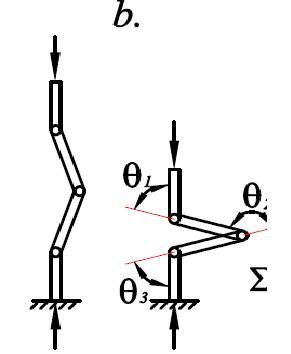
I'm well aware of the Bazant diagram, but it's an idealised representation that allows calculations to be performed, not a realistic description of what happened :

bazanthinge.jpg


In practice there would be varying degrees of damage, or manufacturing variations in the material, that would pre-dispose certain columns to hinge off-centre at the weakest point. Welds might break. Bazant couches his description of the hingeing with such caveats,

"... if we assume, optimistically, the ends to be fixed ..." ,

"This curve is an optimistic upper bound since, in reality, the plastic hinges develop fracture" and so on.

Your version of hingeing assumes the steel to be folded at precisely 180° precisely in the middle, and precisely 90° at identical distances from each end at the moment of impact. In reality there is no justification for this assumption.

Go ahead. Draw just one column in 2D to represent what you still appear to believe happened.
 
Last edited:
Ozeco41, your entire premise is refuted by the fact that all of the Verinage demolitions show a significant deceleration when it would be expected at the impact between the upper and lower sections of the building.
Tony, I don't know how many times I have pointed this to you, but vérinage demolitions are applied to buildings with parallel load-bearing walls. The structure is thus radically different. Therefore...

If WTC 1 were to somehow be able to collapse naturally, without the upper section decelerating at any time, it would be a severe exception to the rule.
... is a strawman argument.
 
Ozeco41, your entire premise is refuted by the fact that all of the Verinage demolitions...
Hogwash. I am describing the specific features of the WTC1 and WTC2 collapses on 9/11. They were not Verinage.

Tony it is obvious that you do not want to engage in reasoned discussion and your evasive posts with their various styles of false claims seem to show that you lack the ability to clearly analyse either the structural realities or the logic of a reasoned post.

With that in mind I am posting for the interest of other members. The thread is available to you to either rebut my claims or present your own or both. It is highly unlikely that I will fall for the obvious "truther trap" of following your attempted derailment tracks.

Remember that I am writing about WTC1 and 2 specifically and at the stage when the top block started to fall. And there are unavoidable consequences of that status of the falling top blocks. Consequences you seem determined to deny.
 
Last edited:
Hogwash. I am describing the specific features of the WTC1 and WTC2 collapses on 9/11. They were not Verinage.

Tony it is obvious that you do not want to engage in reasoned discussion and your evasive posts with their various styles of false claims seem to show that you lack the ability to clearly analyse either the structural realities or the logic of a reasoned post.

With that in mind I am posting for the interest of other members. The thread is available to you to either rebut my claims or present your own or both. It is highly unlikely that I will fall for the obvious "truther trap" of following your attempted derailment tracks.

Remember that I am writing about WTC1 and 2 specifically and at the stage when the top block started to fall. And there are unavoidable consequences of that status of the falling top blocks. Consequences you seem determined to deny.

You have no basis for denying the applicability of the Verinage demolitions to the Twin Tower collapses.
 
You have no basis for denying the applicability of the Verinage demolitions to the Twin Tower collapses.

Please answer all of the following questions...


1) Verinage applies lateral displacement, which minimises the chances of vertical support structure collision. Correct ?

2) Impact is therefore between upper and lower floor assembly over the maximum sufrace area. Correct ?

3) The impulse upon impact is directly linked to the amount of energy required to fail either the vertical supporting structure, or the attachment of the floor structure to the vertical support structure. Correct ?

WTC 1...

4) The energy required to fail the floor truss supports is low when compared to a structure with more common beam frame floor construction ? (Mechanical floor regions for example) Correct ?

5) Upper perimeter sheets passed in front of or behind lower perimeter sheets. Correct ?

6) Perimeter sheets passing each other by implies either deformation of the non-rigid structure, or lateral displacement. Correct ?

7) If a floor from the upper section detached and dropped onto the floor below, the impact would not create any significant externally observable vertical movement of the upper section. Correct ?

Please don't quote the entire post, but instead format your answers such that each question is in an isolated set of quote /quote tags.
 
Last edited:
You have no basis for denying the applicability of the Verinage demolitions to the Twin Tower collapses.
As I said Tony I will not fall for truther tricks:
...It is highly unlikely that I will fall for the obvious "truther trap" of following your attempted derailment tracks...
The extraordinary claim that WTC Towers collapse must match the characteristics of the Verinage demolition technique is your claim. Not mine.

It is not my burden to disprove the claim. Rather it is your burden to prove it. I note that once again you are not prepared to address the simple facts of WTC 9/11 collapse which I have posted.
 
I'm well aware of the Bazant diagram, but it's an idealised representation that allows calculations to be performed, not a realistic description of what happened :

[qimg]http://i250.photobucket.com/albums/gg274/sap-guy/bazanthinge.jpg[/qimg]
Okay, this is a start, but you are making a quantum unqualified leap by saying it is not realistic.

In practice there would be varying degrees of damage, or manufacturing variations in the material, that would pre-dispose certain columns to hinge off-centre at the weakest point. Welds might break. Bazant couches his description of the hingeing with such caveats,

Not nearly enough to preclude a jolt in a natural collapse.

There isn't really a weakest point but there is a weakest direction, or what we call the least radius of gyration or the direction of the lowest moment of inertia and it just determines the direction of buckling and would have no effect on whether or not there was a jolt.

"... if we assume, optimistically, the ends to be fixed ..." ,

"This curve is an optimistic upper bound since, in reality, the plastic hinges develop fracture" and so on.

If you notice he didn't say the hinges don't form, but that they might develop fractures. That will also have no effect on whether a jolt would occur or not.

Your version of hingeing assumes the steel to be folded at precisely 180° precisely in the middle, and precisely 90° at identical distances from each end at the moment of impact. In reality there is no justification for this assumption.

There is a lot of justification for my assumption. Columns buckle in the direction of the least radius of gyration and they tend to fold at the center of the sine wave that develops due to the mechanics of the situation.

Go ahead. Draw just one column in 2D to represent what you still appear to believe happened.

Something quite similar to Dr. Bazant's representation, that you were kind enough to show here, is precisely what I would draw.
 

Back
Top Bottom
