Merged Applicability of Bazant's model to the real world

This makes sense.

It seems you're absolutely determined to avoid a very simple issue Tony. So, if you wish, let's be more accurate as Major_Tom has suggested :

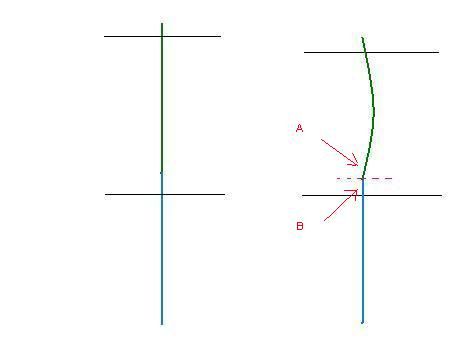
zamboticolumn2.jpg


The splice is about to break at the dotted line. Please tell us how column ends A and B can ever again meet axially once the column has straightened. It's abundantly clear that the only thing they cannot meet axially is each other, right?

If this principle is wrong please demonstrate how it is wrong. You've done enough handwaving, nitpicking and evasion, thanks.

(For what it's worth, Major_Tom, the principle is exactly the same as the previous sketch)
 
It seems you're absolutely determined to avoid a very simple issue Tony. So, if you wish, let's be more accurate as Major_Tom has suggested :

[qimg]http://i250.photobucket.com/albums/gg274/sap-guy/zamboticolumn2.jpg[/qimg]

The splice is about to break at the dotted line. Please tell us how column ends A and B can ever again meet axially once the column has straightened. It's abundantly clear that the only thing they cannot meet axially is each other, right?

If this principle is wrong please demonstrate how it is wrong. You've done enough handwaving, nitpicking and evasion, thanks.

(For what it's worth, Major_Tom, the principle is exactly the same as the previous sketch)

You show the column buckling above Point A and you forgot to put a point at the next intersection above it. Let's call it Point C where the upper plastic hinge would form. That is the point that would collide with Point B.

The problem for your attempted explanation is that you need to shift the entire building section to the side to keep Points B and C from colliding. The geometry of the tilt shows that it could not cause anywhere near the misalignment necessary to keep Points B and C from colliding. If the collapse were natural and buckling had occurred between Points B and C, as you show, Points B and C would have collided and a significant deceleration would have been observed.

It is interesting that you mention handwaving while not even attempting to explain why the column would buckle and how the splice would break to begin with. The slenderness ratio of a 9 foot column is so low that buckling is essentially impossible. By needing the splice to break you are backing yourself into supporting a demo explanation here as Major Tom has observed.
 
Last edited:
You show the column buckling above Point A and you forgot to put a point at the next intersection above it. Let's call it Point C where the upper plastic hinge would form. That is the point that would collide with Point B.

I'm showing elastic buckling resulting in breakage of the lower splice. The upper splice would serve equally well. It doesn't matter in order to illustrate the point we're discussing.

You would have two plastic hinges forming symmetrically at points B and C? OK.

Take your idea and run with it ... knock together a quick diagram that shows how this mechanism results in a 1 storey collapse with pure axial impact between column ends.

Meanwhile - how many WTC core column remnants show evidence of double plastic hingeing?
 
I'm showing elastic buckling resulting in breakage of the lower splice. The upper splice would serve equally well. It doesn't matter in order to illustrate the point we're discussing.

You would have two plastic hinges forming symmetrically at points B and C? OK.

Take your idea and run with it ... knock together a quick diagram that shows how this mechanism results in a 1 storey collapse with pure axial impact between column ends.

Meanwhile - how many WTC core column remnants show evidence of double plastic hingeing?

You are trying to have it both ways now and are talking in circles. The only way the splices of the core columns at the 98th floor of WTC 1 could fail naturally is for the columns to buckle, and to do that they have to develop the upper and lower plastic hinges, and in that case they would have had a hard impact with a significant observable deceleration.

However, the chances for buckling of a 9 ft. length of steel of the cross section of most of the core columns at the 98th floor were nil, even at 650 degrees C.

Buckling can thus be ruled out for several reasons: no double plastic hinges, no jolt, and almost no chance of it occurring due to a low slenderness ratio. So, it appears the only way the core column splices on the 98th floor could fail was with what Major Tom mentioned, concerning charges being used to laterally displace the columns at the splices.
 
Last edited:
You are trying to have it both ways now and are talking in circles. The only way it could happen naturally is for the columns to buckle and develop the upper and lower plastic hinges and in that case they would have had a hard impact with a significant observable deceleration.

The reason the columns don't show double plastic hinging is because the columns did not buckle and the collapse wasn't natural.

What probably did happen on the 98th floor was what Major Tom mentioned concerning the charges to laterally displace the columns at the splice.
No, he is not talking in circles Tony. I don't think he is even falling for the trap you are trying to set by limiting the available options to the ones that suit your predetermined outcome.

The situation is, as I have put it several times and without the presumption of demolition which you are attempting to impose, that there are two options. You have tried to impose a third. Since you propose it I will address it later.

Now, for the two main options:
  • The first is the "no demolition" one that natural processes caused the ends of columns to overlap and the top block then fell without a measurable/significant jolt.
  • The second is that some "unnatural cause" ie human intervention removed a section of column to allow the top part to fall. However we dress up the detail that is the option you are proposing.
Your option is only one of two options despite your unwillingness to consider the other.

Now the "natural processes" option would see the top part of a column bypassing the bottom part. And, no matter how much pseudo engineering talk you dress up your protests with, a natural buckling failure will not leave surfaces which will butt end for end to transfer load. And even if some remote coincidence did cause such a pair of complementary surfaces to be created it would be the exception to the rule. And standing alone in that relationship of axial contact, the overwhelming weight of the falling structure would easily cause it to fail AND without a significant jolt.

I am well aware of the bald assertions in those claims and can back them up with reasoning whenever there is a legitimate status of debate which requires me to provide that back up. That will not arise until you have at least stopped your pussyfooting evasions and described how the "unnatural causes" to which you attribute this situation could avoid any jolt in the full distance you claim there was no jolt.

Addressing the false third option which you claim:
You show the column buckling above Point A and you forgot to put a point at the next intersection above it. Let's call it Point C where the upper plastic hinge would form. That is the point that would collide with Point B....
So your "third option" is that whatever buckling processes contributed to "natural causes" fall of the top block the ends of columns created by buckling would create end for end axial contact sufficient to cause a significant measurable jolt. You have to be kidding! whatever rounded twisted shape a buckled column end forms it would need a jugglers skill to keep the top bit balanced on the bottom bit.
 
Now the "natural processes" option would see the top part of a column bypassing the bottom part. And, no matter how much pseudo engineering talk you dress up your protests with, a natural buckling failure will not leave surfaces which will butt end for end to transfer load. And even if some remote coincidence did cause such a pair of complementary surfaces to be created it would be the exception to the rule. And standing alone in that relationship of axial contact, the overwhelming weight of the falling structure would easily cause it to fail AND without a significant jolt.

Not when the structure below has tremendous reserve strength.

Addressing the false third option which you claim:

So your "third option" is that whatever buckling processes contributed to "natural causes" fall of the top block the ends of columns created by buckling would create end for end axial contact sufficient to cause a significant measurable jolt. You have to be kidding! whatever rounded twisted shape a buckled column end forms it would need a jugglers skill to keep the top bit balanced on the bottom bit.

The hinge areas of fully buckled columns are not shaped in a way which would cause a load to just slip off without impact. Additionally, the impact itself causes deformation which tends to flatten even fully rounded surfaces. Your claim here has no basis.
 
Last edited:
The hinge areas of fully buckled columns are not shaped in a way which would cause a load to just slip off without impact. Additionally, the impact itself causes deformation which tends to flatten even fully rounded surfaces. Your claim here has no basis.

Tony if you have the material properties, section properties (built up etc), geometry etc I can run the critical buckling for you. Let me know if I can help.

Derek
 
Tony if you have the material properties, section properties (built up etc), geometry etc I can run the critical buckling for you. Let me know if I can help.

Derek
With his real CD deal? Does Tony use thermite like you, or does he use explosives? This is funny, out of millions of engineers, two have the real CD deal, but neither can define how, how much, how, or who did it.

BTW, paper has more heat energy than thermite, and plastic has ten times the heat energy. Looks like the fire you guys play down did it! Failure for 9 years take a special kind of engineer.


As an engineer myself, how are you guys going to tie this nonsense into a reality based argument for CD? Got any math to go with it?
 
Last edited:
Then the questions contained in #1153 of some other thread should not be a problem for you, should it?

Derek, you and Tony have the CD delusion. You and Tony have to prove it! Use those thousands of other engineers and dolts AE has to help you guys with your problem. YOUR PROBLEM.

Derek, you have to answer the questions, you can't be just asking questions like the dolt Avery in his idiotic fictional Loose Change Film. You are an engineer, you have to answer you own questions and prove your own claims. Do it! Or you will have 10 years of failure.

Bazant's model does well in the real world; when will you even try to present your scenario of what happened. Talk does not make it happen, real papers in real journals could be a start. Heiwa had the guts (ignorance most likely) to send his letter in to a real journal and it was called nonsense and delusional. So far your ideas and Tony's are in the same boat, but not official labeled in a real journal.

Publish or perish. When will you try? Bazant took two days, you guys can't do anything in 9 years. Passengers on Flight 93 figured out 911 in minutes; what is your problem. Bazant's model, do you have one?
 
hmm

The third side would be the sine and that is vertical not horizontal. The horizontal shift is the difference between the adjacent side and the hypotenuse. For a 2,484 inch length hypotenuse, the difference between it and the adjacent side at 1 degree is about .375". For 3 degrees it is about 3.5".

Tony, I hear what you are saying. Please show your math, as i did. I have no issues with being shown up with my math being wrong. I just want to understand the concept. Thanks.
 
Tony if you have the material properties, section properties (built up etc), geometry etc I can run the critical buckling for you. Let me know if I can help.

Derek
You cannot help him by applied engineering. The topic is marginal to the OP here in that Bazant in his paper with Zhou 2002 identified "column on column axial contact" as a conservative assumption for Bazant's purposes at that time. It was and remains a valid assumption for those purposes even though it is not true in the detail of how the WTC Twin Towers fell. But it is not true when Tony uses it to support his flawed hypothesis in "Missing Jolt".

The missing jolt hypothesis faces numerous points of rebuttal which are fatal to it. Two of those are being put on the table here.
  • The first is that Tony has to assume that removal of portions of column by "unnatural causes" (his euphemism for demolition) is the only possible reason for "no jolt". His pre-conceived finding of "demolition" relies on it. BUT it isn't the only "no jolt" scenario. There are several mechanisms which would flow from "natural causes" of impact damage plus fire damage and result in a "no jolt" outcome. Tony is fighting a rearguard action in an attempt to deny this reality.
  • The second issue is that Tony's "no jolt" scenario does not have any concluding point - it merely defers appearance of a jolt until some undefined situation beyond the scope of his investigation. And, if we ever get Tony to progress debate we can address that second fatal flaw in his hypothesis.
So both those are fatal to his hypothesis and neither rely on section properties or critical buckling. They rely on pure and simple thinking through and identifying the possibilities of what could happen in two scenarios. It is a stage or two before calculations. So your offer of help is of no use at this stage. In fact, if Tony was to accept it, he would have to define the scenario that he wants it applied to. And clarifying either his scenario or our alternate one is the last thing he needs at this stage. :)

Then the main purpose of this series of discussions relative to this thread "Applicability of Bazant's model to the real world" is that we have identified an area where the assumptions of the Bazant and Zhou modelling do not apply to the real world. AND the example we have used to demonstrate that limitation, where someone has taken Bazant and Zhou beyond the boundaries of validity, happens to be Tony Szamboti with his "Missing Jolt" paper. I'm sure that the irony will appeal to some members. ;)
 

How truthy, a new 911 truth cult tactic!
Place a random number in your post, take that number and subtract it from itself and you have the total number of pieces of evidence 911 truth has to support any and all of their moronic claims.

Where is your model to prove you point? I can see by your statement at AE, here is part of it,
... a more complete and thorough FEA survey than the one I performed will help erode the credibility of the 9-11 report of record, and provide political pressure to bring those responsible for the 9-11 murders to trial.
, your model may not be as applicable as Bazant's model is to the real world. You seem politically motivated; real engineering work should not be politically influenced.

... AND the example we have used to demonstrate that limitation, where someone has taken Bazant and Zhou beyond the boundaries of validity, happens to be Tony Szamboti with his "Missing Jolt" paper. I'm sure that the irony will appeal to some members. ;)
yes

Your post beats Dereks constant SPAM. And you knew that. Good night
 
Last edited:
Tony, I hear what you are saying. Please show your math, as i did. I have no issues with being shown up with my math being wrong. I just want to understand the concept. Thanks.

The math is nothing more than straightforward trigonometry and I think what I showed is more than enough for anyone familiar with trig. I'll explain a little further.

The horizontal shift is the difference between the hypotenuse and the adjacent side of a right triangle. In this case the width of the building is the hypotenuse and its projection onto the adjacent is what we get using the cosine of the angle. In other words, when the width is tilted down we want to know how much its horizontal distance changed.

The building width was 207 feet or 2,484 inches.

Cosine (1 degree) = adjacent/hypotenuse

.99985 = adjacent/2,484 inches

adjacent = .99985 x 2,484 inches = 2,483.627 inches

hypotenuse - adjacent = 2,484 - 2,483.627 = .373 inches

For 3 degrees

Cosine (3 degree) = adjacent/hypotenuse

.99863 = adjacent/2,484 inches

adjacent = .99863 x 2,484 inches = 2,480.597 inches

hypotenuse - adjacent = 2,484 - 2,480.597 = 3.403 inches

This would be the horizontal shift at the opposite side of the building from the hinge of any tilt which was the north face in the case of WTC 1. The core columns would experience even less of a shift as the width there was 60 to 147 feet less. In the case of the core at 3 degrees the shift would have been just .082 to 2.417 inches. This shows the columns would not miss each other due to the tilt.
 
Last edited:
Tony if you have the material properties, section properties (built up etc), geometry etc I can run the critical buckling for you. Let me know if I can help.

Derek

Derek, of course the core column cross sections varied depending on the row they were in, but lets do a corner core column which there were four of.

Here are the parameters for CC501A98 which was a 14WF426F42.

The material was steel of course and had a minimum yield of 42,000 psi.

The section was a wide flange weighing 426 lbs./ft. with flange dimensions of 16.695" wide x 3.033" thick and web dimensions of 12.624" long and 1.875" thick between flanges.

Cross sectional area was 124.94 sq. inches.

The column would have been spliced three foot up from the floor so we want to do an analysis on a 9 foot or 108 inch long column with this cross section and fixed-fixed end conditions.

Performing a hand calculation for fixed end conditions with an effective length factor of .70 at ambient temperature, I get a Pcr of 122 million lbs.

If I use fixed end conditions with an effective length factor of .70 at 650 degrees C, I get a Pcr of 81 million lbs.

If I use pinned end conditions with an effective length factor of 1.0 at ambient temperature, I get a Pcr of 59 million lbs.

If I use pinned end conditions with an effective length factor of 1.0 at 650 degrees C, I get a Pcr of 40 million lbs.

Now the entire 12 story upper section of WTC 1 weighed about 69 million lbs., so even with the conservative use of pinned end conditions and a temperature of 650 degrees C the buckling load for just the four corner core columns is 160 million lbs. or about 2.3 times the weight of the entire upper section. This says Bazant's model has no basis in reality whatsoever and this is why I have told anyone who thinks these columns would buckle easily that they are dreaming. It isn't happening ever.

Now lets see if there was a chance of compressive rupture failure.

The total area of the core columns at the 98th floor was 2,645 sq. inches and the perimeter was 3,682 sq. inches. Even if we remove the entire south wall the area is still 5,405 sq. inches and the stress is 12,762 psi. The core columns yielded at an average of about 40,000 psi and the perimeters at about 65,000 psi. Now even if every single column got to 600 degrees C where steel loses half its strength the required failure stress is still 20,000 psi and for the perimeters it is 32,500 psi. So that can't happen either and it is unlikely that more than only a couple of columns got that hot.

It is looking more and more like the only possible way to have the 98th story fail is to blow the core column splices with some sort of device. In reality we shouldn't even be discussing whether Bazant's model has any credibility, because it is not hard to show it doesn't.

 
Last edited:
Derek, of course the core column cross sections varied depending on the row they were in, but lets do a corner core column which there were four of.

Here are the parameters for CC501A98 which was a 14WF426F42.

The material was steel of course and had a minimum yield of 42,000 psi.

The section was a wide flange weighing 426 lbs./ft. with flange dimensions of 16.695" wide x 3.033" thick and web dimensions of 12.624" long and 1.875" thick between flanges.

Cross sectional area was 124.94 sq. inches.

The column would have been spliced three foot up from the floor so we want to do an analysis on a 9 foot or 108 inch long column with this cross section and fixed-fixed end conditions.

Performing a hand calculation for fixed end conditions with an effective length factor of .70 at ambient temperature, I get a Pcr of 141 million lbs.

If I use fixed end conditions with an effective length factor of .70 at 650 degrees C, I get a Pcr of 81 million lbs.

If I use pinned end conditions with an effective length factor of 1.0 at ambient temperature, I get a Pcr of 59 million lbs.

If I use pinned end conditions with an effective length factor of 1.0 at 650 degrees C, I get a Pcr of 40 million lbs.

Now the entire 12 story upper section of WTC 1 weighed about 69 million lbs., so even with the conservative use of pinned end conditions and a temperature of 650 degrees C the buckling load for just the four corner core columns is 160 million lbs. or about 2.3 times the weight of the entire upper section. This is why I have told anyone who thinks these columns would buckle easily that they are dreaming. It isn't happening ever.

It is looking more and more like the only possible way to have the 98th story fail is to blow the core column splices with some sort of device. This says Bazant's model has no basis in reality whatsoever.

650 C, wow, surely not thru the steel this size....how deep at this temp, lump?? Or what exposure time at this gas temp? That's impossible for thru the steel, that's too much steel!

9' - another wow, nice slenderness ratio. No built up on the section, I assume? Do you have a photo or link? Do you know the steel designation (A36, A572 etc) exactly?

I'll run the range of end conditions, just let me know re: my inquiries and I'll email you what I get and how I got it.

Thanks,
Derek
 
Last edited:
650 C, wow, surely not thru the steel this size....how deep at this temp, lump?? Or what exposure time at this gas temp? That's impossible for thru the steel, that's too much steel!

9' - another wow, nice slenderness ratio. No built up on the section, I assume? Do you have a photo or link? Do you know the steel designation (A36, A572 etc) exactly?

I'll run the range of end conditions, just let me know re: my inquiries and I'll email you what I get and how I got it.

Thanks,
Derek

The core column cross sections were released by NIST in 2007. Lon Waters modeled the cross sections at his website here http://wtcmodel.wikidot.com/nist-core-column-data

While there were many built up columns in the lower areas, there was no need for it at the 98th floor level in the Towers. Standard wide flanges were more than sufficient.

About 60% of the core columns were A36 with a 36 ksi min. yield strength. The other 40% were 42 ksi or above, with one at 45 ksi, and another at 50 ksi.
 
Last edited:
... It is looking more and more like the only possible way to have the 98th story fail is to blow the core column splices with some sort of device. In reality we shouldn't even be discussing whether Bazant's model has any credibility, because it is not hard to show it doesn't.
CD, the delusion that never stops.

Some sort of device. Better call the FBI.

Attacking Bazant's model shows your engineering skills are skewed by your delusions. 9 years and no Pulitzer? I am sure now that Derek, who has no clue what happen on 911 and he introduces his talks with that fact, the only fact he has in his talks, is here is will add to the delusions and you guys will have the next super-nano smoking gun; WAIT, loaded gun, Jones new insane epiphany, a loaded gun, no more smokers, we got the loaded gun, or was it loaded diaper to hold this much BS.

Start your own delusion thread, further attacks on Bazant's model only exposes your ignorance in engineering and inability to make reality based conclusions. OMG, you guys are going for the decade of failure! And I think you will make it.

Write a letter to the journal like Heiwa, I need some more humor next month, or in 6 months. Good luck 911 truth, going for 10 years of failed idiotic lies and delusions, you will make it.
 
...You seem politically motivated; real engineering work should not be politically influenced.
...a point I have not commented on previously on the Internet - any forum IIRC - but the conduct of many alleged professionals in supporting dishonest "truther" objectives would be in breach of relevant professional ethical standards and expectations.
... AND the example we have used to demonstrate that limitation, where someone has taken Bazant and Zhou beyond the boundaries of validity, happens to be Tony Szamboti with his "Missing Jolt" paper. I'm sure that the irony will appeal to some members. ;)
yes

Your post beats Dereks constant SPAM. And you knew that. Good night
thumbup.gif

There is no problem rebutting Tony's paper in any reasonably conducted debate. He et al have made it clear that they have no intention in joining in reasoned debate. And I think I have pressed the matter as far as is appropriate within this topic. To pursue it further would only attract more spamming evasions. So I may let it go now unless there is some point of nonsense raised which requires rebuttal. :rolleyes:
 
No, he is not talking in circles Tony. I don't think he is even falling for the trap you are trying to set by limiting the available options to the ones that suit your predetermined outcome.

This is precisely the point. Tony will not allow chaotic collapse as it's far too disturbing for his deluded 'theory' .


  • The second is that some "unnatural cause" ie human intervention removed a section of column to allow the top part to fall. However we dress up the detail that is the option you are proposing.


Interestingly, any CD by whatever means (and let's hope he limits his own possibilities to high explosive cutter charges) would leave column ends bevelled, thus precluding axial impact. The column ends would be bound to slide off each other when they meet. Duh.

So your "third option" is that whatever buckling processes contributed to "natural causes" fall of the top block the ends of columns created by buckling would create end for end axial contact sufficient to cause a significant measurable jolt. You have to be kidding! whatever rounded twisted shape a buckled column end forms it would need a jugglers skill to keep the top bit balanced on the bottom bit.

Quite. I was looking forward to Tony's diagrams showing the columns twisted into a flat horseshoe with little curls at each end, and able to provide 180° impact. Horizontal tangents would be involved ;) He can't have this, of course, so CD is the only other possibility? Er, no.
 
Last edited:
The problem for your attempted explanation is that you need to shift the entire building section to the side to keep Points B and C from colliding. The geometry of the tilt shows that it could not cause anywhere near the misalignment necessary to keep Points B and C from colliding. If the collapse were natural and buckling had occurred between Points B and C, as you show, Points B and C would have collided and a significant deceleration would have been observed.

Utter bull flops in a great stinking pile.

The only way you are going to get points B and C to collide is the ensure that the upper section falls straight down.

Aint gonna happen.

We're talking about an office building here. Weight is randomly scattered across all the floors above the break. A nasty great aluminum structure was just rammed into the building, further randomizing the load in such a way that there were great masses of material in someplaces, far less in others.

And then there were the fires.

They cause steel to expand, you know, right? This is going to misallign the surviving columns even further.

Of course, because of the impact of the aircraft, some big chunks were missing out of both blocks.

I see no way that that sucker is going to fall down with any precision onto its old footprint.

The slenderness ratio of a 9 foot column is so low that buckling is essentially impossible. By needing the splice to break you are backing yourself into supporting a demo explanation here as Major Tom has observed.

Here in our time/space continuum, you can cause railroad tracks to buckle by sticking nickels between the ends of the tracks while they are cold and letting the sun hit them. A friend of mine killed about a hundred or so people that way once. Put a trainload of armored vehicles and their crews down a slope into a river.

Now, if just sunlight can make steel expand enough that it will buckle, what is a few hundred pounds of burning paper and plastic and kerosene or diesel going to do?
 

Back
Top Bottom