Merged Applicability of Bazant's model to the real world

Knowing someone's real name and background does have something to do with credibility in a discussion.

In this situation dual citizenship might cause a motivation beyond a desire for the plain truth of the matter and might be a conflict of interest. At that point one would need to ascertain what a person's true motivation was from other information. Most people wonder about the other party's motivations when engaged in a debate with them. It is only natural.

Motivation doesn't matter, math does.
 
Not so Bill.
We know that the "Top Block" started to fall and therefore sufficient columns had been compromised so that the remaining ones could not carry the load.

This is a semantic sleight of hand. The point Bill was making was that the top is unlikely to "fall" through the remaining 85% columns below. In reality, if this scenario actually occurred, and there was a sudden give of some of the weakest columns, there might be a sudden asymmetrical slumping or crunching down (which, in any case, would be met by the intact structure below) but not a free fall as if through air.

That statement is true whether you are pro-demolition OR anti demolition. Both sides depend on the "Top Block" falling. They may differ on why it fell.

This is not true. Neither your first statement, nor this. The CD argument, at least outside of this forum, is not dependent on an upper block falling at all. In fact, it argues that any descent of an upper portion through the lower is only possible by removing the resistance the lower would present, not that some upper block is needed to do this.
 
This is a semantic sleight of hand. The point Bill was making was that the top is unlikely to "fall" through the remaining 85% columns below. In reality, if this scenario actually occurred, and there was a sudden give of some of the weakest columns, there might be a sudden asymmetrical slumping or crunching down (which, in any case, would be met by the intact structure below) but not a free fall as if through air.


This is not true. Neither your first statement, nor this. The CD argument, at least outside of this forum, is not dependent on an upper block falling at all. In fact, it argues that any descent of an upper portion through the lower is only possible by removing the resistance the lower would present, not that some upper block is needed to do this.

Don't be ridiculous.
nono.gif
 
?

I can only assume you don't understand the CD theory, or you don't understand what controlled demolition does.
 
I wouldn't have a clue. "Enough" is what we know. Whether "demolitionists" who say it was "helped along" OR no demolition folks who say "that's the way it happened".
I'm puzzled why you ask the question - the top block fell. Both sides of the debate know that. So compromising of columns should be common ground as a premise for rational debate.

I am interested in both why it fell with little evidence for fire induced column failure causing the propagation of the collapse initiation across the building, as well as why the collapse progressed without a deceleration. Both issues are important to the debate.

Unfortunately, both of these problems are fully explained by controlled demolition, whereas no natural collapse theory has yet been able to provide a satisfactory explanation.
 
Last edited:
I am interested in both why it fell with little evidence for fire induced column failure causing the propagation of the collapse initiation across the building, as well as why the collapse progressed without a deceleration. Both issues are important to the debate.

Unfortunately, both of these problems are fully explained by controlled demolition, whereas no natural collapse theory has yet been able to provide a satisfactory explanation.
Total nonsense backed up with nothing. Bazant reply yet?

Present evidence to prove your post! You can't.


The fact is CD looks like a gravity collapse because the big energy source to destroy buildings in CD is GRAVITY. List your 95 percent engineers and show us their statement of support for CD on 1,2, and 7.

Bazant proves your ideas are delusional. Without evidence of CD, you are in a fantasy world based on failed opinions and lies.

How does your jolt fit into Bazant's model?
 
Last edited:
Originally Posted by Tony Szamboti
As I already stated, the tilt does not produce the misalignment necessary for the columns to miss each other by its rotation either. A 1 degree tilt produces less than an inch of horizontal shift over 207 feet.

The horizontal shift would be the difference between the adjacent side and the hypotenuse of a 1 degree angle in a right triangle.

The towers were 207 feet on a side above the ninth floor and 207 feet is equal to 2,484 inches.

Take the cosine of 1 degree and multiply it by 2,484 inches to get the length of the adjacent side. Then subtract that from the hypotenuse which would be 2,484 inches and you will have your answer.
OK, that's where I started, although I was doing a different function and using the tangent. (not to mention I had a calculator that used radians, not degrees, which was part of my problem) Technically, it's not a right triangle, because if the thing tilts, you'd have to calculate an arc, but that's beyond me. Right triangle is close enough for jazz.

OK, so the cosine of 1 degree is .0.9998476951563913, and multiplying that times the hypotenuse I get 2483.6216747684757" for the length of the second side.

Using the Pythagorean Theorem, I get the third side to be ~43". Checking the math, this bears out. Again, please correct me if I'm wrong.

A^2 + b^2 = c^2
Small side^2 + adjacent side^2 = hypoteneuse^2
43.351776^2 + 2483.6216^2 = [2,484^2] OR 6,170,256

1879.376482354176 + 6168376.623379768 = 6170255.999862122 ~6171256
Square root of the number on the right gives me ~2,484 (2483.9999)

If I try this with your number of "less than an inch," I can't make it work. As far as I can tell, for a 1 / 89 / 90 triangle, with the short side being 1", side B would be 57.289963" and the hypotenuse would be 57.298687".

Again, please show the errors in my math above. I just can't validate your statement using my limited knowledge of trig.

And, again, the towers were built in 3 dimensions, so the swing could have been north/south or east/west or, more likely both over that entire span.

Thanks.

I welcome corrections from all comers; it's been a while since I have done this stuff.

ETA - I just noticed where you said "subtract that [the adjacent side] from the hypotenuse" to get the third side. Are you using some different rule of thumb that I don't know?

 
Last edited:
I wouldn't have a clue. "Enough" is what we know. Whether "demolitionists" who say it was "helped along" OR no demolition folks who say "that's the way it happened".
I'm puzzled why you ask the question - the top block fell. Both sides of the debate know that. So compromising of columns should be common ground as a premise for rational debate.

I am interested in both why it fell with little evidence for fire induced column failure causing the propagation of the collapse initiation across the building,...
We should be agreed that "enough" columns failed. The difference should be in "what caused them to fail". There seems to have been little debate about how a cascade failure operates. Not the place to debate it here given the topic is "Applicability of Bazant's model to the real world". :)

... as well as why the collapse progressed without a deceleration. Both issues are important to the debate....
...yes they are both important. And they are separable. The brief time when the top block was falling, and therefore no significant column on column contact, gives a natural break line between the preceding "what caused the initial collapse" stage and the following "why did the global collapse keep going" stage.
...Unfortunately, both of these problems are fully explained by controlled demolition, whereas no natural collapse theory has yet been able to provide a satisfactory explanation.
Both bald assertions and I call "false":
1) I have never seen a "fully explained...controlled demolition" argument and I have even tried to build one myself. ( I'm also a Military Engineer and one of the best ways to determine tactics is to put yourself in the enemy's shoes - "How would I....?") So if you know where there is one let me know.
2) You left off a bit "...an explanation to satisfy Tony S" :)
I am personally quite comfortable as to how a rolling cascade failure could propagate. In the spirit of openness and full disclosure etc I acknowledge that I cannot "prove" that there were enough element failures to precipitate the initial collapse. But that is several orders closer to "proof" than any claim I have seen from the "truther pro demolition" side for a method of demolition that assisted the other damage and caused the actual collapse mechanism which happened on 9/11. And I make that claim on purely technical grounds without relying on the arguments in the domain of "logistic impossibility". Purely technical - how would the military demolitions engineer achieve it technically.
 
As the top block fell in the initial collapse "...there could not be any significant axial contact of column parts..."

The small tilt in WTC 1 could not cause the columns to miss each other and those who try to make that argument have no basis for it.

I'm beginning to think you are a little dense Tony, or just lacking in mental agility.

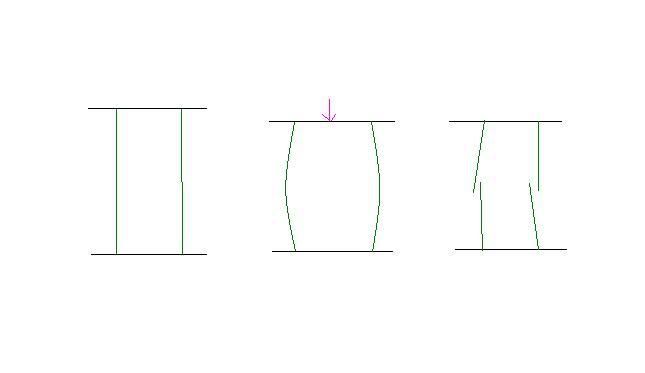
ozeco, I, and others have been asking you to explain for some weeks now how the detached column ends could subsequently make contact. Not using building rotation as the reason they should miss each other, but referring to the fact that the building is falling, however slowly.

That is - the space that was fully occupied by a column has become less than the original column length. However much the column ends now tend to 'scissor' or 'spring' back into position there is no longer sufficient room for the ends to match up. This applies equally to broken welds at a joint - the most likely failure - as to columns that are just plain snapping.

And the space is reducing by definition. Otherwise the building would not be falling.

Sorry for so much bolding, but perhaps it will help you to see the point. Hey, I'll even venture a little diagram in Paint, although my computer graphics skills are close to zero.

szamboticolumns.jpg


There's a little 'pixel creep' in the second column of the first frame, but anyway. Hope that helps.
 
Last edited:
...but referring to the fact that the building is falling, however slowly.

That is - the space that was fully occupied by a column has become less than the original column length. However much the column ends now tend to 'scissor' or 'spring' back into position there is no longer sufficient room for the ends to match up. This applies equally to broken welds at a joint - the most likely failure - as to columns that are just plain snapping...
thumbup.gif
Thank you GlennB.

..and add the option of "folded like a pretzel" for any columns that may have been heated to a weakening temperature. Similar to pgimeno's posted picture.
...And the space is reducing by definition. Otherwise the building would not be falling....
...which is the key point.

Thanks also for the graphics. And, if you think yours are a bit crude, mine are worse. This one, circa late 2007, to explain the core during global collapse:
wtca1.jpg

Now, to be scrupulously open and honest with Tony, the second alternative is that a section of column has been explosively removed. However, and not in support of Tony's claim, there is no place to terminate the removal of columns to prevent the jolt he looks for. Ironically his showing no jolt is more against his "unnatural causes" hypothesis than it is for it.

So we have two options as to how the falling top block situation could arise. Both need further exploration to "prove" one way or the other.

From my perspective my aim in this section of the discussion was to establish that Tony's option of "unnatural causes" was not the only option and that he has no ground for presuming that the lack of jolt proves "unnatural causes".
 
Last edited:
OK, that's where I started, although I was doing a different function and using the tangent. (not to mention I had a calculator that used radians, not degrees, which was part of my problem) Technically, it's not a right triangle, because if the thing tilts, you'd have to calculate an arc, but that's beyond me. Right triangle is close enough for jazz.

OK, so the cosine of 1 degree is .0.9998476951563913, and multiplying that times the hypotenuse I get 2483.6216747684757" for the length of the second side.

Using the Pythagorean Theorem, I get the third side to be ~43". Checking the math, this bears out. Again, please correct me if I'm wrong.

A^2 + b^2 = c^2
Small side^2 + adjacent side^2 = hypoteneuse^2
43.351776^2 + 2483.6216^2 = [2,484^2] OR 6,170,256

1879.376482354176 + 6168376.623379768 = 6170255.999862122 ~6171256
Square root of the number on the right gives me ~2,484 (2483.9999)

If I try this with your number of "less than an inch," I can't make it work. As far as I can tell, for a 1 / 89 / 90 triangle, with the short side being 1", side B would be 57.289963" and the hypotenuse would be 57.298687".

Again, please show the errors in my math above. I just can't validate your statement using my limited knowledge of trig.

And, again, the towers were built in 3 dimensions, so the swing could have been north/south or east/west or, more likely both over that entire span.

Thanks.

I welcome corrections from all comers; it's been a while since I have done this stuff.

ETA - I just noticed where you said "subtract that [the adjacent side] from the hypotenuse" to get the third side. Are you using some different rule of thumb that I don't know?

The third side would be the sine and that is vertical not horizontal. The horizontal shift is the difference between the adjacent side and the hypotenuse. For a 2,484 inch length hypotenuse, the difference between it and the adjacent side at 1 degree is about .375". For 3 degrees it is about 3.5".
 
I'm beginning to think you are a little dense Tony, or just lacking in mental agility.

ozeco, I, and others have been asking you to explain for some weeks now how the detached column ends could subsequently make contact. Not using building rotation as the reason they should miss each other, but referring to the fact that the building is falling, however slowly.

That is - the space that was fully occupied by a column has become less than the original column length. However much the column ends now tend to 'scissor' or 'spring' back into position there is no longer sufficient room for the ends to match up. This applies equally to broken welds at a joint - the most likely failure - as to columns that are just plain snapping.

And the space is reducing by definition. Otherwise the building would not be falling.

Sorry for so much bolding, but perhaps it will help you to see the point. Hey, I'll even venture a little diagram in Paint, although my computer graphics skills are close to zero.

[qimg]http://i250.photobucket.com/albums/gg274/sap-guy/szamboticolumns.jpg[/qimg]

There's a little 'pixel creep' in the second column of the first frame, but anyway. Hope that helps.

It has nothing to do with lacking mental agility. It appears you are trying to use the apparent break in the perimeter columns in certain places when they were being pulled inward to imply that this is what happens when columns buckle. This was not due to the buckling action and would not be occurring in the core.
 
Last edited:
It has nothing to do with lacking mental agility. I am an engineer and need to stay grounded and deal with real world situations. What you show here has no basis in reality.

If you think otherwise, please provide a real world example of ductile steel columns coming apart during buckling, like you show in your sketch.

Where there is a weld half way down. Meanwhile redrawing the sketch to show disconnection at the floor level there would be trivially easy, if that's where you prefer the welds/bolts to be. Want me to do it, or can you just picture it yourself?

To repeat - the reality is that if the building is falling then there is no longer space for broken columns to 'spring' back into their original position and meet their previous mate axially, whatever the failure mode. Except by occupying the same physical space in 3-D, and we'll discount that possibility eh?

But I was fully expecting you to avoid the substance of the issue and you haven't disappointed.

eta: you edited substantially while I was replying. I was not talknig about exterior columns being pulled inwards, but buckling core columns.
 
Last edited:
It has nothing to do with lacking mental agility. I am an engineer and need to stay grounded and deal with real world situations. What you show here has no basis in reality.

Whilst I have no wish to extend this off topic discussion, given that you've ignored previous requests...

Tony, you have so many *jolt* threads in so many locations that I do not understand why you feel the need to spam the same thing in so many places, much like the Heiwa axiom. Perhaps you are still seeking for someone, from either side of *the fence* who still agrees with you.


Now, I would like a few very simple and honest answers from you...

1) Do you agree that video evidence shows minimal impact between upper and lower perimeter sections, with instead upper sheet passing either in front of or behind lower ?

2) Do you agree that any *jolt* would be more pronounced if traced at a point on the top of the hat truss, rather than the NW corner ?

3) Do you agree that movement of the upper section began numerous seconds before release ?

4) Do you agree that neither upper or lower section is perfectly rigid ?

5) Do you agree that there are no questions that you have any reason or excuse to ignore or refuse to answer ?
 
Well the movement downwards of the antenna certainly began before release with all that that implies.

http://www.youtube.com/watch?v=y9-owhllM9k antenna
Yes, it implies 911 truth CD delusion is pure nonsense and with your engineering help femr2, Major Tom, and Tony are exposed as frauds trying to back in CD. Backing in CD when there is no evidence; It is fraud and they lack the insight to understand reality.

By discussing Bazant's model they expose their ignorance in engineering. 9 years of failed ideas, with your help it puts the right touch on their moronic quest to prove CD. Bazant ripped up Heiwa, your last expert, what would he do with these 9 year not a clue guys?

You are as good as all of 911 truth in engineering. Good job.
 
Glen, there is a reason why splices are not placed in the middle of 2 fixed points as you draw.

szamboticolumns.jpg


The location is actually about 3 ft above the flooring for WTC1. Locations of column splices are chosen to avoid the situation you drew while allowing the assembler easy access to weld or bolt each splice.

If you remove the middle picture and add little bombs to snap or just displace the bolted splice, you just drew a demo scenario.

When can you expect the first mini-jolt? When the column end makes contact with the slab, after about 3 ft of falling.
 
Last edited:
Glen, there is a reason why splices are not placed in the middle of 2 fixed points as you draw.

http://i250.photobucket.com/albums/gg274/sap-guy/szamboticolumns.jpg

The location is actually about 3 ft above the flooring for WTC1. Locations of column splices are chosen to avoid the situation you drew.

If you remove the middle picture and add little bombs to snap the splice, you just drew a demo scenario.

FSM help me. Yes. Purposes of illustration only.

To illustrate that once a floor is falling then a detached column end has no way to meet up with its ex-partner end because the space it used to occupy has reduced.

How many more times?
 
Glen, there is a reason why splices are not placed in the middle of 2 fixed points as you draw.

[qimg]http://i250.photobucket.com/albums/gg274/sap-guy/szamboticolumns.jpg[/qimg]

The location is actually about 3 ft above the flooring for WTC1. Locations of column splices are chosen to avoid the situation you drew while allowing the assembler easy access to weld or bolt each splice.

If you remove the middle picture and add little bombs to snap or just displace the bolted splice, you just drew a demo scenario.

When can you expect the first mini-jolt? When the column end makes contact with the slab, after about 3 ft of falling.

This makes sense.
 

Back
Top Bottom