Michael Mozina
Banned
- Joined
- Feb 10, 2009
- Messages
- 9,361
Do you think that was an accurate model for the sun?
In terms of the sun acting as a cathode in space, yes.

Do you think that was an accurate model for the sun?

In terms of the sun acting as a cathode in space, yes.
I see a couple of issues with that, though. How did he decide the voltage? Was the sphere in a vacuum? How did he correct for the differences in size and materials? Wouldn't the box, being cubical or rectangular, change the results? Did he try to keep the experment true to nature, or did he change things to test a specific mechanic?
You cannot accelerate net neutral objects electromagnetically.


Poe's law. I'd have to agree. I still think this is some kind of bizarre roleplay.
I'll ask my earlier question again, rephrased. Photons don't change speed but they can change velocity and momentum. This happens in standard cosmology - they get redshifted continually - not in a one-off Doppler shift. They are subject to the same cosmological forces as matter.
Even if I did accept an electromagnetic rather than gravitational means of accelerating things in the universe - how does it do it to photons?
I was under the impression that experiment was Birkland attempting to model the aurora borealis.
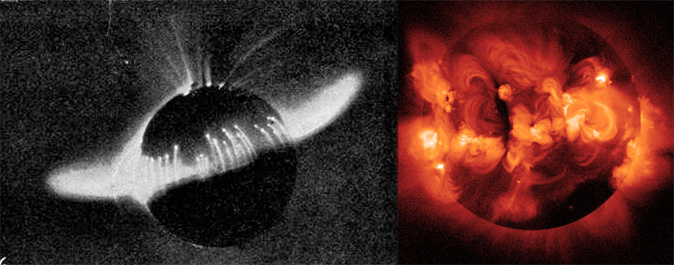
I was under the impression that experiment was Birkland attempting to model the aurora borealis.


Actually, no, I'm going with what I know works in empirical experimentation
Nobody said it had to be a "perfect sphere", or that the inside surface had to be homogeneously charged.
Birkeland already used a "charge separation" model to "simulate" the effect I've described.
His terella was a cathode, and the sides of the box were the anode.
The "current flow" between them is what moves the particles on a continuous basis
What you're doing is "playing with strawman math", oversimplifying the entire process (one charged particle vs. a cathode), and ignoring empirical lab experiments entirely!
Your mathematical theories are always grossly oversimplified.
They ignore empirical experimentation
and they even ignore what is known to "work" in nature
in favor of what Alfven called "pseudoscience".
I suggest you all take a deep breath, reread Birkeland's work in the lab, and notice that his solar wind particles are being constantly accelerated.
When you understand how and why, then you'll have some clue what I'm talking about.

Originally he was trying to figure out what caused the aurora. He bombarded a 'terella' (metallic sphere, with an electromagnet inside) with rays from a cathode and was able to simulate aurora around the poles of the sphere. He then wondered where such rays might come from and figured it was probably the sun that released them. He then conducted a series of experiments where he turned the surface of his sphere into a cathode and the outside box was the anode. Using this configuration, he was able to simulate many of the features we observe in solar atmospheric activity, including continuously accelerated solar wind.
http://query.nytimes.com/gst/abstract.html?res=F50A11FB385F13738DDDAA0A94DA405B838DF1D3
FYI, this is a link to a NY Times article about his solar theories. It's a much shorter read than the previous link to his full body of work.
[qimg]http://www.thesurfaceofthesun.com/images/birkelandyohkohmini.jpg[/qimg]
A lot of features we see in modern satellite images are described and *predicted* by Birkeland over 100 years ago
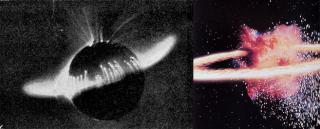
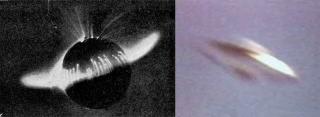

Actually, no, I'm going with what I know works in empirical experimentation and I'm simply ignoring your oversimplifications entirely. Nobody said it had to be a "perfect sphere", or that the inside surface had to be homogeneously charged.

http://arxiv.org/abs/0911.3536
I would assume the redshift is probably related to a time dilation process caused by the acceleration over time. I've seen other "tired light' approaches, but they all suffer from a number of "issues" that tend to be rather problematic in terms of creating a "smooth" effect.
http://arxiv.org/find/astro-ph/1/au:+Brynjolfsson_A/0/1/0/all/0/1

I suggest you all take a deep breath, reread Birkeland's work in the lab, and notice that his solar wind particles are being constantly accelerated. When you understand how and why, then you'll have some clue what I'm talking about. Until then, you're simply not listening, nor are you accepting something that is already *lab demonstrated*.

They ignore empirical experimentation and they even ignore what is known to "work" in nature in favor of what Alfven called "pseudoscience".