Sword_Of_Truth
Penultimate Amazing
- Joined
- May 8, 2006
- Messages
- 11,494
If there were 58 columns, they'd all have to fail at the same time.
That happens in a progressive collapse. This has been explained to you before.

If there were 58 columns, they'd all have to fail at the same time.

There has never been a progressive collapse in a high rise building. The Windsor Tower was not a progressive collapse. It was a series of collapses that took place over the period of an hour or more.That happens in a progressive collapse. This has been explained to you before.
That is an assumption on your part. You don't have any data to back it up.That's what happens at the point in which the overall capacity of the columns is exceeded: all fall at virtually the same time. Load redistribution is a very quick process.


Whaaaa? If there was full support, why was the building falling? It appears to me, from those dots up there in the upper left-hand corner, that the building fell slowly at first, then gathered momentum until it was falling at FFA or close to it. Exactly what you would expect from a natural collapse. No impossible magic therm*te required.Not in those words, but they now claim that their computer model is consistent with the graph which includes a period of FFA that occurred instantaneously. The NIST graph shows a transition from full support to no support at 1.75s.
There has never been a progressive collapse in a high rise building. The Windsor Tower was not a progressive collapse. It was a series of collapses that took place over the period of an hour or more.

And therefore you can't know, so your assertion that it was used doesn't hold water, as there's no known reason to use it. Fact found.No, it's asking for something that is not known to the public.
Where do I say it's wrong??????? You make up too many things.That's NIST's graph. It matches Mr. Chandlers graph. You are assuming it's wrong. That's denial.
The NIST graph lacks the necessary accuracy to show the transition. That doesn't mean the transition was instant. More precise graphs made by others show a gradual transition. And by the way, even these more precise graphs will probably have an accuracy worse than 5% (the accuracy is currently under dispute). That's a tip on how wrong your 0.1% accuracy claim is.Not in those words, but they now claim that their computer model is consistent with the graph which includes a period of FFA that occurred instantaneously. The NIST graph shows a transition from full support to no support at 1.75s.
You are basing your assertion that the resistance was "more than negligible" on a model that doesn't reflect the real world events to enough accuracy, therefore your proof is bogus. Not a semantics issue at all.No. There frame did NOT break apart. It was folding up asymmetrically and was always providing more than negligible [virtually no] resistance. You are going round and round on your semantics merry-go-round.
That's right, it's an assumption on my part because I asked if an engineer could explain how right or wrong it is and none did. It's based on my understanding of how load redistribution works, but I'm not an engineer.That is an assumption on your part. You don't have any data to back it up.
You probably don't realize it, but every time you use that graphic, God kills a kitt... er... I mean, you are making a bogus argument. As I've explained repeatedly to you, the collapse is a chaotic event and NIST's simulation doesn't reflect it accurately.Furthermore, that clearly did not happen in the video simulation or this graphic:
[qimg]http://a.imageshack.us/img824/9343/nistmodelfigure1263.jpg[/qimg]
Were the passengers of Air France Flight 4590 alive, they would probably agree.You mistake "never been" for "impossible to happen".
Hey, I'm getting better at spotting these ridiculous statements Truthers make. Yay me!
ETA: But Glenn, you had that swell chart in there and everything... your post was WAY better than mine. I just got up a little earlier.

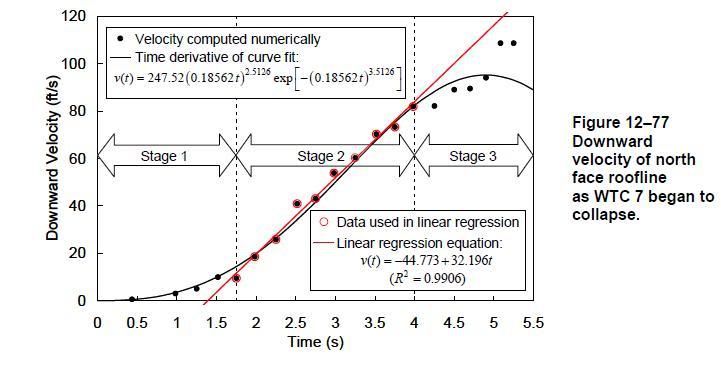
As I've explained repeatedly to you, the collapse is a chaotic event and NIST's simulation doesn't reflect it accurately.

If there were 58 columns, they'd all have to fail at the same time.

There has never been a progressive collapse in a high rise building. The Windsor Tower was not a progressive collapse. It was a series of collapses that took place over the period of an hour or more.
Do you mean that in relation to Christopher7's use of that simulation?In other words, NIST's simulation can have its cake and eat it.

And therefore you can't know, so your assertion that it was used doesn't hold water, as there's no known reason to use it. Fact found.
That, together with the lack of *any evidence whatsoever* of the use of thermite in any structural member of any of the buildings (notably including all of the pieces NIST possess), and that any attempt at proving it, besides being driven by belief, raises serious doubts about its authenticity, leads to think that use of thermite is just an idea that someone made up and that lacks even a bare minimum plausibility.
Mothra is more plausible. There are documentaries where the modus operandi of Mothra can be seen. The Mothra hypothesis counts with the same amount of evidence as the thermite hypothesis, but has the advantage to count with an action mechanism.
Can you demonstrate how thermite could make all the columns fail simultaneously? Can you prove that explosives could do the same?

Hey Dis.
This is one of my simple requests. I have 2 that would move me to the truther camp.
1. show me thermite (any form) cutting through a verticle steel column either horizontally or obliquely.
2. show me it cutting through several within a few seconds of each other.
Very simple. Very cheap. Very easy to do (or it should be). Yet not a single example of it anywhere.

Hey Dis.
This is one of my simple requests. I have 2 that would move me to the truther camp.
1. show me thermite (any form) cutting through a verticle steel column either horizontally or obliquely.
2. show me it cutting through several within a few seconds of each other.
Very simple. Very cheap. Very easy to do (or it should be). Yet not a single example of it anywhere.
Tell that to the Challenger and Columbia astronauts. Oh, and to the guys of Apollo 13 too. They experienced something that had never happened before.

Now now let's be fair... since he wants to claim that something is impossible because it has no equal precedent then by the same logic thermite is a non-starter because no high rise building in history has ever been demolished using thermite. I wonder what happens when you use their own logic against them... hmmm, this could be an interesting game

