Your conclusion (explosives) does not follow from your premise ("Your claim that 'the part of the building underneath had collapsed already' is false."), because you have not established the validity of your premise. You have to prove your premise first.
Your conclusion (explosives) does not follow from your premise ("Your claim that 'the part of the building underneath had collapsed already' is false."), because you have not established the validity of your premise. You have to prove your premise first.
Explosives is the conclusion, not the premise. I have stated that the premise is; The FFA of the north wall is "an object that has no structural components below it". Explosives can do this. Can you think of something else?
The part of the building underneath the upper part of the north wall had not collapsed already.
Explosives is the conclusion, not the premise. I have stated that the premise is; The FFA of the north wall is "an object that has no structural components below it". Explosives can do this. Can you think of something else?
What's the point of asking a question if you won't accept any answer apart from explosive CD?
But here's one engineering-based explanation for you, from NCSTAR 1-9
p 606
'As the interior columns buckled at the lower floors and the corresponding upper column sections began to move downward, the exterior columns buckled inward at the lower floors as a result of floor pull-in forces caused by the downward movement of the building core. The floor connections to the columns had not yet failed in this region, as there were no fires observed on the West side of Floors 19 through 14 at any time during the day, so the floors were intact and able to pull the exterior columns inward.'
ps it's ok to acknowledge that there are other explanations, even if you don't agree with them. Just as we accept that explosive demolition is one possible (but IMO not probable) explanation.
We can leave it at that. But if you are offered answers please have the courtesy to accept that they have been offered, and not act as if they haven't.
Explosives is the conclusion, not the premise. I have stated that the premise is; The FFA of the north wall is "an object that has no structural components below it". Explosives can do this. Can you think of something else?
The part of the building underneath the upper part of the north wall had not collapsed already.
Explosives is the conclusion, not the premise. I have stated that the premise is; The FFA of the north wall is "an object that has no structural components below it". Explosives can do this. Can you think of something else?
The part of the building underneath the upper part of the north wall had not collapsed already.
You keep saying things without establishing their validity. Simply making a claim does not prove the claim.
I wasn't talking about explosives, I was talking about your premise:
This is completely equivalent to the claim you've made just now:
Now do you see which claim, or premise, we're discussing? Stated two different ways above? That's the point you haven't been proving.
Explosives is the conclusion, not the premise. I have stated that the premise is; The FFA of the north wall is "an object that has no structural components below it". Explosives can do this. Can you think of something else?
You haven't proved the premise. You haven't proved the FFA of the north wall with not even a negligible bit of resistance. NIST state that the bottom of the building offered negligible support as the columns buckled, and you claim again and again without proof that there was no such negligible support.
The fact that it fell at FFA for ~100 feet proves there was no resistance over 7 to 8 floors.
NIST, in effect, said the amount of resistance provided by the columns was too small to be considered. i.e. virtually zero. But a progressive collapse is always providing some resistance as Dr. Sunder stated.
Why are you concerned with an amount that is too small to be considered?
You don't need to be an engineer to understand that FFA means falling thru air.
I know what a moment frame is and I can see in the computer model that the moment frames held the exterior walls together as they were designed to do. They did not break apart and were providing resistance well into the FFA portion of the collapse. The computer model is not falling at FFA.
You don't need FFA in a CD, but you do need CD to have FFA, because it can't happen naturally. Nobody here has been able to show in any feasible way how it could.
What evidence is there of failures occurring a dozen floors below the east penthouse? In the videos I only see light through windows one floor below the roofline of the main building.
The following is taken from The National Institute of Standards and Technology's youtube channel.
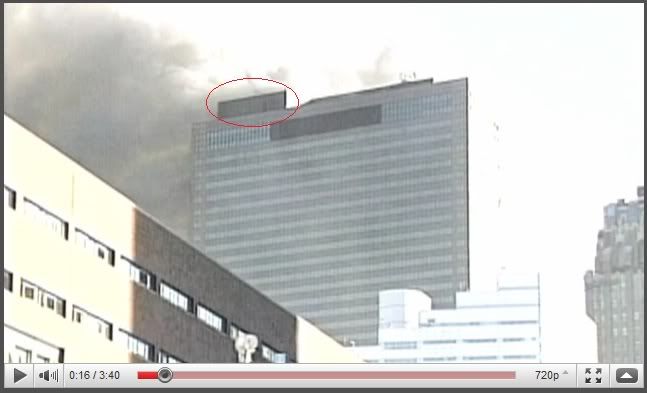
WTC7, just prior to the start of the 16 second collapse sequence. NIST is one of the few youtube vids that show the early part of the collapse sequence. East Mechanical Penhouse is marked.
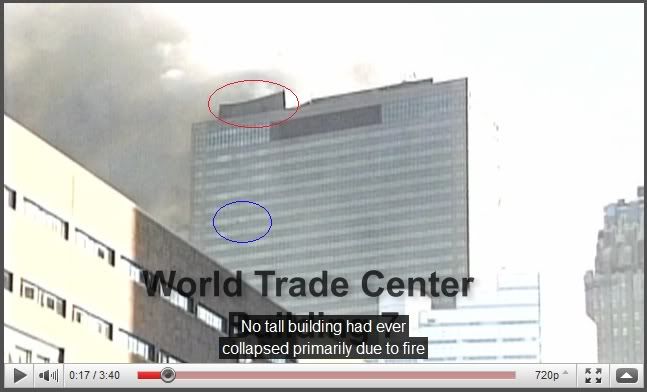
Roofline of the EMP has buckled, the collapse is now underway, and probably has been for a few seconds prior to this. Some damage (circled in blue) has appeared on a window pane several floors directly underneath the collapsing penthouse.
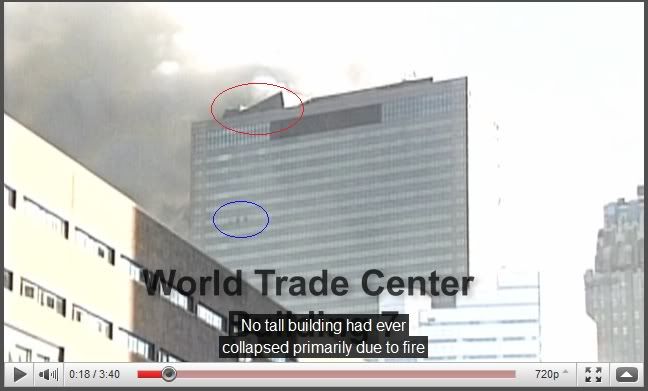
Failure of the EMP continues, the majority of the structure remains on top of the building at this point, however the damage several floors below has gotten worse. three windows appear to be broken. Separated from eachother by intact windows. We know that this is not due to a blast event, because an explosive shockwave powerful enough to rend structural steel would have taken out every window on that floor, possibly others above and below. Explosive shockwaves don't pick and choose what they destroy in this manner.
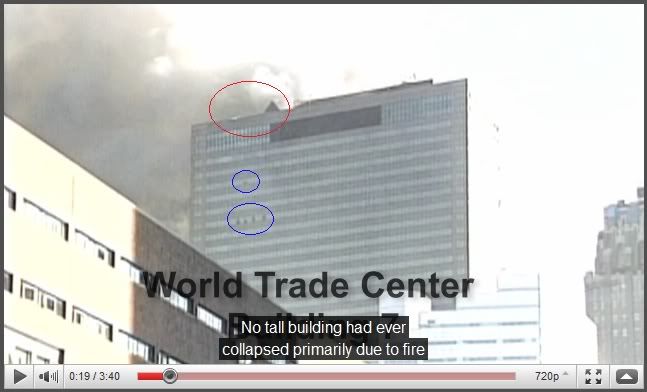
The EMP is almost completely gone by this point. The damage several floors down is worse again. Having eliminated blast events as the cause, and since it started simultaneously with the beginning of the EMPs collapse, a more likely explanation is weakening and failure of nearby structural supports, twisting and distortion of the buildings frame has affected the windows closest to the initial failure. It is obviously this failure deep inside the main body of WTC7 which caused the collapse of the East Mechanical Penthouse and is directly related to the collapse of the building as whole.
Tony "You Must Be a Jew" Szamboti will be unable to provide a satisfactory explanation of these observations that fits a blast scenario (Mr. Randi, I'll take my million in Canadian funds).
You don't need FFA in a CD, but you do need CD to have FFA, because it can't happen naturally. Nobody here has been able to show in any feasible way how it could.
The fact that it fell at FFA for ~100 feet proves there was no resistance over 7 to 8 floors.
NIST, in effect, said the amount of resistance provided by the columns was too small to be considered. i.e. virtually zero. But a progressive collapse is always providing some resistance as Dr. Sunder stated.
Why are you concerned with an amount that is too small to be considered?
This site uses cookies to help personalise content, tailor your experience and to keep you logged in if you register.
By continuing to use this site, you are consenting to our use of cookies.



 The fact that it fell at FFA for ~100 feet proves there was no resistance over 7 to 8 floors.