Debunk Alert: Experiment to Test for Eutectic Reaction

Please post your publications that demonstrate how sample #1 was melted or what created the iron spheres that made up nearly 6% of the WTC dust.

Neils Harrit et al have published a paper and you just hand wave it. Deniers hand wave any proof of thermite/nano-thermite or temperatures of 2800oF as proven in the R.J. Lee Group and USGS reports.

First off, I would not publish a paper on something that I do not have a formal education about. But hey, you feel that is no big deal. It's cool.

Niels Harriet have published their psuedo-science in a sham journal. Why haven't they published their paper in ANY RESPECTABLE journal? There are thousands of journals worldwide. Tell them to pick one.

I'll wait.

Did you not read the rest of the RJ Lee report? It showed that the piece DID NOT experience a temp of more than 1,000 deg. C. So, that rules out thermite in one sentence.

Now, let me guess, you have super-nano-low-temp thermite?
 
Let's assume for a moment that Harrit isn't a complete moron and just take his faulty assertions at face value. 6% of the dust is made up of iron spheres. What produced these iron spheres? Well, Harrit would have you believe thermate did.

So, 6% of the WTC dust is unreacted thermate dust. Let's disregard that some thermate would have to have reacted for it to have any effect on the collapse and just work with the 6%.

A whole bunch of buildings were damaged and subsequently knocked down after 9/11, but let's make it simple for ourselves and just count the one's that collapsed fully on that day: The Twin Towers and WTC 7. We do this because our calculations would be much much harder (impossible) otherwise, and because this way, the error makes your argument better.

Finding values for the mass of the towers is beyond me at the moment. The best I can get is approximations. Based on those, let's use the number 400.000 metric tonnes for the Twin Towers and half that, 200.000 tonnes for WTC 7. If you have better values, please let me know and we'll redo this calculation.

Now, to get a rough value of the amount of "dust", let's first get rid of any large chunks of material. According to the Journal of 9/11 Research, about 350.000 tonnes of steel and other material was removed from Ground Zero. So, to calculate the amount of dust, let's do some simple math: 400.000 + 400.000 + 200.000 - 350.000 = 650.000 tonnes. I realize this is a very high figure, so let's be generous and remove 90% of it. We're left with 65.000 tonnes. 6% of this should be thermate. 6% of 65.000 tonnes is 3900 tonnes.

Now, I realize and admit that the calculations above are very rough, and using no certain figures. However, I strive very hard to err on the side of making the thermate argument plausible. Still, we're left with a ridiculously large mass of thermate in the buildings. To give you an idea of the amount of thermate that equals 3900 tonnes, this weighs about 3600 tonnes.

So, do you believe that there were 3900+ tonnes of thermate in the buildings? If not, how do you explain the iron spheres?

WIN!!


Hey, didn't you hear? They found a boat underneath the WTC site. Maybe is was the source of the thermite!! But, it really was just a battleship PAINTED to LOOK like a really old boat!!
 
No it does not. Gas temperatures do not mean the steel was heated to those temperatures. NIST admitted that the fires lasted about 20 to 30 minutes in any location. That is not anywhere near enough time to heat an insulated beam to 1000oF. The beams has 2 hr fire protection.

Furthermore, it does not explain the melting of the beam. FEMA said that a detailed study needed to be done. NIST did not mention, much less do a detailed study of Sample #1.

OMG, do you not realize what the insides of 7WTC looked like? They were mostly open floor offices with lots of cubicles.

Just because a fire burns in one area for 30 minutes, how big the fire was, and what was burning, can raise the temperature of an entire floor hundreds of degrees.

Now, I will go slow here for you.

If the fire burned on the (we will just say) the 10th floor for 6.5 hours, and was around the same area (the west part just for SNG) just because it moved along the west side of the building, DOESNT MEAN that ONLY that side of the building is VERY HOT. And the flames do not just stay in ONE SINGLE AREA. They spread along the ceiling, and depending on the fire, can reach many many feet away from the seat of the fire.

Does the term "flashover" mean anything to you? It's a pretty interesting event, and one that I don't especially enjoy. It's rather....terrifying. Anyway, try to understand that.

Also, when a firefighter is fighting a fire in a building, one of the first things we do when we enter a room, is we hit the roof area with a steady stream, cooling down the entire roof area. This will instantly cause the fire to subside, so we can find the seat of a fire. Then, once there, we open our nozzle to fog an area with a good, steady flow. This cools the area down, in essence, removing the heat from the fire, which causes it to be snuffed out. Backdraft, the movie, is not very accurate as to what a firefighter actually does.

Anyway, now that hopefully you understand a little more, we can get back to the topic at hand.

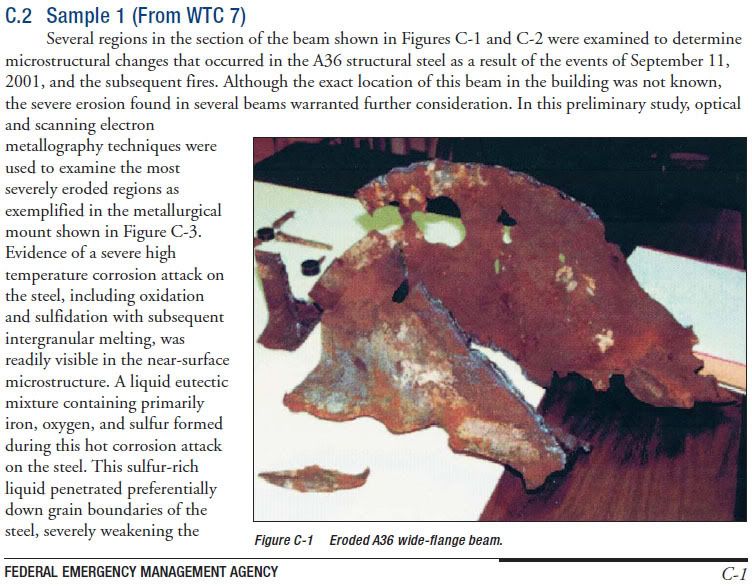
BTW, FEMA even says specifically that the erosion that they saw, was evidence of none other, than a corosive attack

FEMA_appx-C_p1_WTC7-steel-corrosion.jpg
 
one behind blazeshield might be a whole lot quieter:

Acoustical Properties
As an efficient sound-absorbing material, BLAZE-SHIELD II adds value
to the fire protection application in areas where high-noise levels
are anticipated.

http://www.isolatek.com/pdfs/CAFCO BLAZE-SHIELD II Brochure.pdf

HA HA HA!!! You have no idea what a NRC is do you? It is a Noise Reduction Coeffecient.

NRC of .74 is about the same as 1" of fiberglass. 1" ain't **** considering what is going to happen to this stuff when it is blown to kingdom come from the explosion. You know that stuff can be scraped off with a pocket knife, right?

Also, this NRC is for certain frequencies, and it is actually more for low lever noise. Not huge explosions!

No, go back and try again.
 
C7 said:
How did the beam that Mr. Astaneh inspected get heated to 2000oF?
leftysergeant said:
Why on earth would anyone assume it was?
C7 said:
Do you think Mr. Astaneh is stupid?
No, Dr. Astaneh knows his field of expertise better than we or you do. And we respect and support his conclusions that fire and airplane impacts brought down the Twin Towers.
Then you support his statement that the steel he inspected was heated to 2000oF (1100oC) and that it had melted.

meltedbeamwtc7.jpg


BTW: It has not been established that the impact and fires brought the Trade Towers down. That is just a supposition.
 
Then you support his statement that the steel he inspected was heated to 2000oF (1100oC) and that it had melted.

[qimg]http://a.imageshack.us/img408/6533/meltedbeamwtc7.jpg[/qimg]

BTW: It has not been established that the impact and fires brought the Trade Towers down. That is just a supposition.

Really? Heat has been known a time or two to collapse a steel framed building before. Why couldn't it be that?

Leave your arguments from personal ignorance at the door.
 
Niels Harriet have published their psuedo-science in a sham journal.
You are talking out your ass when you say "pseudo-science" and the Bentham Open Chemical Physics Journal is NOT a sham journal. The phony paper was sent to a different journal. Other journals are occasionally scammed. That does not mean they are sham journals. This is just another BS reason to hand wave the thermite paper.

Did you not read the rest of the RJ Lee report? It showed that the piece DID NOT experience a temp of more than 1,000 deg. C. So, that rules out thermite in one sentence.
I read the RJ Lee report and it has nothing to do with the "piece", it was about the dust that was nearly 6% iron spheres.
[FONT=&quot]Pg 17 [pdf pg 21][/FONT]
[FONT=&quot]Various metals (most notably iron and lead) were melted during the WTC [/FONT]
[FONT=&quot]event, producing spherical metallic particles. Exposure of phases to high[/FONT]
[FONT=&quot]heat results in the formation of spherical particles due to surface tension.[/FONT]
[FONT=&quot]Figure 21 [/FONT]
[FONT=&quot]and Figure 22show a spherical iron particle resulting from the[/FONT]
[FONT=&quot]melting of iron (or steel)[/FONT]
[FONT=&quot].[/FONT]
 
Last edited:
C7 said:
It has not been established that the impact and fires brought the Trade Towers down. That is just a supposition.
Really? Heat has been known a time or two to collapse a steel framed building before. Why couldn't it be that?
So what? NIST did not explain how the Trade Towers collapsed and neither has anyone else. Bazant's one dimensional model includes many "assumptions" and it does not explain the collapse of the south tower.
 
OMG, do you not realize what the insides of 7WTC looked like? They were mostly open floor offices with lots of cubicles.

Just because a fire burns in one area for 30 minutes, how big the fire was, and what was burning, can raise the temperature of an entire floor hundreds of degrees.
Many of the floors were offices but the area above the dropped ceiling was open so you are right about the heat spreading out to "pre-heat" beams not directly under the fire. However, the 2 hr fire protection took this into consideration. The hottest gases are directly above the fire and once it passes the beams begin to drop in temperature.

Does the term "flashover" mean anything to you? It's a pretty interesting event, and one that I don't especially enjoy. It's rather....terrifying. Anyway, try to understand that.
Loose the snotty attitude and make an effort to debate like an adult please.
NCSTAR 1-A pg 51 [pdf pg 93]
On Floors 11 through 13 (enclosed offices), the fire likely grew within an office, reaching flashover in several minutes. After about 5 to 15 minutes, the ceiling tile system likely failed and the hot gases created a local hot upper layer. Thermal radiation from this layer ignited adjacent offices. Offices across a corridor likely ignited more slowly.

BTW, FEMA even says specifically that the erosion that they saw, was evidence of none other, than a corosive attack

http://i662.photobucket.com/albums/uu347/911conspiracytv/FEMA_appx-C_p1_WTC7-steel-corrosion.jpg
I have read the FEMA C report. The problem is; NIST did not mention, much less explain how the beam melted.
 
Who put the 'thermitic material' in place?
How did they put it in place?
When did they put it in place?
How much of it was there to cut through a steel beam?
What does the supposed use of thermite to do the job have to do with explosives?
 
Last edited:
HA HA HA!!! You have no idea what a NRC is do you? It is a Noise Reduction Coeffecient.

NRC of .74 is about the same as 1" of fiberglass. 1" ain't **** considering what is going to happen to this stuff when it is blown to kingdom come from the explosion. You know that stuff can be scraped off with a pocket knife, right?

Also, this NRC is for certain frequencies, and it is actually more for low lever noise. Not huge explosions!

No, go back and try again.

also, i belive the upgraded floors had like 3 inches of blazeheild if i remember correct.
 
Who put the 'thermitic material' in place?
How did they put it in place?
When did they put it in place?
How much of it was there to cut through a steel beam?
What does the supposed use of thermite to do the job have to do with explosives?

Dr. Jones, the creator of the theory, admits the most plausible scenario is that the thermite was used for the fuses to Ignite traditional explosives.

TAM:)
 
Who put the 'thermitic material' in place?
How did they put it in place?
When did they put it in place?
How much of it was there to cut through a steel beam?
What does the supposed use of thermite to do the job have to do with explosives?

heres a good place to start:
Demolition access to the World Trade Center towers: Part one - Tenants
http://www.911truth.org/article.php?story=20090713033854249

and another:
Another amazing coincidence related to the WTC
http://911blogger.com/node/13272
There appears to be a remarkable correlation between the floors upgraded for fireproofing in the WTC towers, in the years preceding 9/11/01, and the floors of impact, fire and failure. The fireproofing upgrades would have allowed for shutdown of the affected floors, and the exposure of the floor assemblies and the columns for a significant period of time. Exactly what work was done during that time?
 
put layers upon layers of the thermitic material prof jones found and cover that material with blazeshield.

In order to melt the beam, the thermite will have to be thicker than the beam. That means that blazeshield, not intended as a structural material, is being asked to carry more than the weight of the beam. When ignited, even if the thermite doesn't melt the blazeshield, it'll simply fall apart under the load, and the whole mess will flow downwards away from the beam.

This is far from a trivial problem. The sheer mass of thermite needed places some quite serious constraints on the structural strength of the material used to keep it in contact with the beam while it melts, and the temperatures involved place equally serious constraints on the materials needed. But far more serious is the need to install extremely thick and heavy devices in close contact with the support members; these devices will need to be larger than the support members themselves, at least in some dimensions.

Dave
 
heres a good place to start:
Demolition access to the World Trade Center towers: Part one - Tenants
http://www.911truth.org/article.php?story=20090713033854249

and another:
Another amazing coincidence related to the WTC
http://911blogger.com/node/13272
There appears to be a remarkable correlation between the floors upgraded for fireproofing in the WTC towers, in the years preceding 9/11/01, and the floors of impact, fire and failure. The fireproofing upgrades would have allowed for shutdown of the affected floors, and the exposure of the floor assemblies and the columns for a significant period of time. Exactly what work was done during that time?

OK so your links and bit of a quote might give some info towards the first four questions.
Who put the 'thermitic material' in place?
How did they put it in place?
When did they put it in place?

It leads me to ask you;
Who were the contractors that did the work?
What work did they do?
What evidence do you have that the contractors that did the work put Thermite or Explosives in place?
How did they do the rest of the building?

It doesn't answer;
How much of it was there needed to cut through a steel beam?
What does the supposed use of thermite to do the job have to do with explosives?
 
Last edited:
Then you support his statement that the steel he inspected was heated to 2000oF (1100oC) and that it had melted.

Where did he say that it was melted at that temperature? Give me a link.

It does not appear to me to have been melted by heat. It has sharp edges. This would indicate an attack by hot acid. Definitely NOT any form of thermite.

[qimg]http://a.imageshack.us/img408/6533/meltedbeamwtc7.jpg[/qimg]

BTW: It has not been established that the impact and fires brought the Trade Towers down. That is just a supposition.

No. That is observed fact.
 
Last edited:
The photographs presented in this thread look far more like the type of corrosion and erosion seen in Boiler Firebox Tube Plates and Throat Plates than they do melting due to heat.
 
The photographs presented in this thread look far more like the type of corrosion and erosion seen in Boiler Firebox Tube Plates and Throat Plates than they do melting due to heat.

I would have to ask for a clarification of this point. Do these parts come into contact with flame or hot smoke from fuels like diesel or coal with a high sulphur content, thus an extremely acid environment?
 
In order to melt the beam, the thermite will have to be thicker than the beam. That means that blazeshield, not intended as a structural material, is being asked to carry more than the weight of the beam. When ignited, even if the thermite doesn't melt the blazeshield, it'll simply fall apart under the load, and the whole mess will flow downwards away from the beam.
the upgraded regions in the wtc had like 2.5-3.5 inches of blazeshield. its almost like spray on concrete. im not sure what ya mean by blazeshield carring the weight. the steel is carrying the weight. the blazeshield is just applied to the steel. thats right, it probably will melt!! and thats the point of this observation:
"Dr. Astaneh-Asl said that in some places, the fireproofing melted into a glassy residue."

This is far from a trivial problem. The sheer mass of thermite needed places some quite serious constraints on the structural strength of the material used to keep it in contact with the beam while it melts, and the temperatures involved place equally serious constraints on the materials needed. But far more serious is the need to install extremely thick and heavy devices in close contact with the support members; these devices will need to be larger than the support members themselves, at least in some dimensions.

one might not have to melt the whole column. take for instance:

One piece Dr. Astaneh-Asl saw was a charred horizontal I-beam from 7 World Trade Center, a 47-story skyscraper that collapsed from fire eight hours after the attacks. The beam, so named because its cross-section looks like a capital I, had clearly endured searing temperatures. Parts of the flat top of the I, once five-eighths of an inch thick, had vaporized.

Less clear was whether the beam had been charred after the collapse, as it lay in the pile of burning rubble, or whether it had been engulfed in the fire that led to the building's collapse, which would provide a more telling clue.

The answer lay in the beam's twisted shape. As weight pushed down, the center portion had buckled outward.

''This tells me it buckled while it was attached to the column,'' not as it fell, Dr. Astaneh-Asl said, adding, ''It had burned first, then buckled.''
 

Back
Top Bottom