Moderated Iron sun with Aether batteries...

Status
Not open for further replies.
Where would you expect to find the opaque edge of an RD image in say 171A with respect to the chromosphere?

This obsession with running difference images is really bizarre, Michael. I asked you before, and I'll ask again - why in the world would you look for solid features (like those on your putative solid surface) using image differences? Taking differences is a good way to cancel out all solid features, leaving only those that change.
 
No. The key assumption is that the allegedly solid surface is being seen in profile, which is equivalent to assuming that the line of sight is tangent to the allegedly solid surface. So long as the allegedly solid surface is spherical, the tangent line will not intersect the allegedly solid surface.

What's more, you needn't worry about the observer-at-infinity assumption. The 80000+ km of plasma along the line of sight remains the same even when the observer is at some other distance, such as an astronomical unit, but the calculation becomes slightly harder to visualize.

An observer closer than infinity sees less than half the surface of the sun. That changes the projection seen by the observer, which could invalidate any distances obtained by counting pixels in the projected image. As it happens, the camera was far enough away to justify the observer-at-infinity approximation, so counting pixels is not a bad way to estimate the size of features that are known to be orthogonal to the line of sight.

There is no reason to assume the bright green line near the limb represents a feature that's orthogonal to the line of sight. We're accepting Michael Mozina's 4800 km estimate just for the sake of argument. That 4800 km estimate implies the line of sight passes through 80000+ km of plasma. If the physicists tell me that such transparent plasma is highly improbable, then I'm going to conclude that Michael Mozina's interpretation of the image is highly improbable.
:bunnyface

Also, as far as I can tell---and Mozina seems to be "interested" in other things now---Mozina's actual model even in cross section doesn't have a bright green stripe. A cross section through the actual model (transparent unobtanium and all) has wide, featureless dark band at the edge. The SDO first light seems to have gone down the memory hole.
 
Last edited:
The RD images at 171A and probably FEXX wavelengths will show opaque edges that are 4800Km inside the chromosphere. Planet transits could probably resolve any doubt about transparency/line of sight debates.
 
Taking differences is a good way to cancel out all solid features, leaving only those that change.

But taking differences is a good way to take a surface with minor changes, and turn it into a flat image with bright and dark features on it. If you take an image in which bright features are always adjacent to dark features, and you apply an especially gullible human visual cortex to it---instant mountains!
 
The RD images at 171A and probably FEXX wavelengths will show opaque edges that are 4800Km inside the chromosphere. Planet transits could probably resolve any doubt about transparency/line of sight debates.

Word salad again. Where's that diagram?
 
No. The key assumption is that the allegedly solid surface is being seen in profile, which is equivalent to assuming that the line of sight is tangent to the allegedly solid surface. So long as the allegedly solid surface is spherical, the tangent line will not intersect the allegedly solid surface.

What's more, you needn't worry about the observer-at-infinity assumption. The 80000+ km of plasma along the line of sight remains the same even when the observer is at some other distance, such as an astronomical unit, but the calculation becomes slightly harder to visualize.

An observer closer than infinity sees less than half the surface of the sun. That changes the projection seen by the observer, which could invalidate any distances obtained by counting pixels in the projected image. As it happens, the camera was far enough away to justify the observer-at-infinity approximation, so counting pixels is not a bad way to estimate the size of features that are known to be orthogonal to the line of sight.

There is no reason to assume the bright green line near the limb represents a feature that's orthogonal to the line of sight. We're accepting Michael Mozina's 4800 km estimate just for the sake of argument. That 4800 km estimate implies the line of sight passes through 80000+ km of plasma. If the physicists tell me that such transparent plasma is highly improbable, then I'm going to conclude that Michael Mozina's interpretation of the image is highly improbable.

:bunnyface
(emphasis added)

The important thing to note is that the transparency of a plasma depends on many things, such as its density, temperature, and composition. However, once you decide these, the optical depth is relatively straight-forward to estimate (to within a few percent, say), and you can even estimate how the optical depth varies with wavelength. Further, you can create such a plasma in a lab, here on Earth, and measure the optical depth directly!

Of course there are vast regions of parameter-space in which a plasma's optical depth is far, far greater than 80,000 km (can you think of some?). Unfortunately, for MM's idea, the Sun's photosphere/chromosphere/transition layer plasmas have parameters which are are nowhere near any of these regions ...
 
Last edited:
Wow, thanks very much GM! :)

Given the time delay between my post and yours, would it be reasonable to say that producing RD videos from calibrated, science images is relatively straight-forward, and not particularly time- or resource-consuming? I imagine the file sizes are a good deal bigger, and that there might be some additional overhead for validation, but otherwise?


It's fairly straightforward, yes. The most time consuming part is rendering the output video once the parameters are set up. The resizing probably takes longer than any other part of the processing, so those YouTube size videos actually took longer than if I had made them the size of the original. But then the file sizes would have been much larger, and YouTube is going to shrink them anyway. I'd rather control the quality of the resizing.

Finished file sizes and transfer speeds could be an issue using data closer to the source, sure. It's nice that current home computers have the horsepower to do this stuff even if you have to go drink a cup of coffee while it renders the output. On my first 386? No way. ;)

One thing that's obvious - to me, at least - is that it's very hard to work out where the limb is in RD images, based on the images alone. In hindsight that's not surprising (pixels on, or near, the limb aren't likely to change much in intensity, except in quite localised regions; contrast at the limb is already pretty low in any case).


It seems so. The data used to make most of these types of images is coming from the corona and not so much from lower down in the solar atmosphere. The reason we see an apparently clear line, like the edge of the Sun at the limb, is because some of that higher temperature stuff is going on beyond the maximum curvature. Since the photosphere is cooler than the stuff being imaged, it sort of blocks the view of the hotter stuff beyond. But no, you're not seeing anything in the originals, and certainly nothing in a running difference image, that shows anything below the photosphere.

Keep in mind when seeing the sharp edge at the limb, even on those huge 4096 x 4096 new SDO images, the thickness of the photosphere, barely more than 400 kilometers, is only 1 pixel.

Presumably it would be quite easy to colorise an RD image; e.g. make an RGB one by combining separate R, G, and B ones; or convert a grey scale into a colour one (e.g. 0-20 red; 21-40 yellow; 41-60 green; 61-80 blue; 81-100 black). Also, contrast could be enhanced by stretching.


I haven't recolorized any of these yet, but it would be simple enough to have the program make varying levels of opacity rather than varying levels of white, and overlay that result on a solid color background. That's almost certainly how they process any of the colored running difference imagery we find on the NASA and LMSAL data archives. Everything in the original data probably starts out as a simple continuum of black to white.

A bit of contrast enhancement and brightening is child's play. Looking at some of the material made by the solar research organizations leads me to believe they do more than a bit of that to most of what we see. Again, most of what we see is created to impress the general public.

Now I see MM has written this:

I want quantitative predictions, complete with error bars about the location of the sphere in an RD image at various iron ion wavelengths with respect to the chromosphere. I need numbers. Got numbers?

Do you - or any reader for that matter - know why MM would want to determine "the location of the sphere" from an RD image?!?


I don't have the slightest idea what he's talking about there. I've asked him several times now only to be met with repeated uncivil resistance. *shrug*

Also, given that the chromosphere is very cool, compared with the corona and plasmas which radiate strongly "at various iron ion wavelengths" (presumably the ones SDO's AIA takes images in), how does he expect he - or anyone, for that matter - could determine the location of the chromosphere? I mean, it'd be hard enough to spot in the science images, and as there is little or no change to the chromosphere (except locally) from one time to another, it would be invisible in an RD image (no matter what iron ion wavelength it was taken in).


Good question. One which we have been asking Michael on and off for half a decade. His reply, however it comes out in words, can be roughly translated into, "It looks like it to me therefore it must be."

What am I missing?


Not a thing as far as I can tell. :)
 
Word salad again. Where's that diagram?

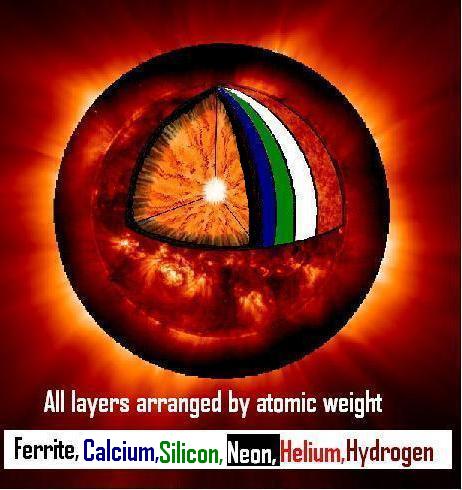
NewModel.JPG


There is a 4800km gap between the surface of the neon layer (what you keep calling a photosphere) and the solid surface. The opaque (GM style) edges of the 171A RD images are about 4800kim *inside* the chromosphere.
 
No. The key assumption is that the allegedly solid surface is being seen in profile, which is equivalent to assuming that the line of sight is tangent to the allegedly solid surface. So long as the allegedly solid surface is spherical, the tangent line will not intersect the allegedly solid surface.

What's more, you needn't worry about the observer-at-infinity assumption. The 80000+ km of plasma along the line of sight remains the same even when the observer is at some other distance, such as an astronomical unit, but the calculation becomes slightly harder to visualize.

An observer closer than infinity sees less than half the surface of the sun. That changes the projection seen by the observer, which could invalidate any distances obtained by counting pixels in the projected image. As it happens, the camera was far enough away to justify the observer-at-infinity approximation, so counting pixels is not a bad way to estimate the size of features that are known to be orthogonal to the line of sight.

There is no reason to assume the bright green line near the limb represents a feature that's orthogonal to the line of sight. We're accepting Michael Mozina's 4800 km estimate just for the sake of argument. That 4800 km estimate implies the line of sight passes through 80000+ km of plasma. If the physicists tell me that such transparent plasma is highly improbable, then I'm going to conclude that Michael Mozina's interpretation of the image is highly improbable.
:bunnyface

Got it. Thanks!
 
The RD images at 171A and probably FEXX wavelengths will show opaque edges that are 4800Km inside the chromosphere. Planet transits could probably resolve any doubt about transparency/line of sight debates.


I made a series of about 600 running difference images from the 171Å wavelength data here...


And as to be expected, since a running difference image is only a graphical representation of a series of mathematical computations, not one single opaque edge in sight.

There is no debate. There is only your unqualified distorted characterization of what's actually going on with this type of solar imagery. And simple physics shows you can't see through 80,000 kilometers of plasma.
 
I don't have the slightest idea what he's talking about there. I've asked him several times now only to be met with repeated uncivil resistance. *shrug*

Why in the world should I be "civil" to you, when you've publicly called me a crackpot in every post for 5 years? How many times have you claimed I didn't have the math skills to balance a checkbook? How many times did you call me a fraud? You call that "civil" conversation?
jaw-dropping.gif
 
Why in the world should I be "civil" to you, when you've publicly called me a crackpot in every post for 5 years? How many times have you claimed I didn't have the math skills to balance a checkbook? How many times did you call me a fraud? You call that "civil" conversation? [qimg]http://www.internationalskeptics.com/forums/images/smilies/mazeguyemotions/jaw-dropping.gif[/qimg]


Your misdirecting the discussion from relevant issues just to complain is noted.
 
Your misdirecting the discussion from relevant issues just to complain is noted.

I'm not trying to misdirect anything. I'm trying to get you to quantify where you think the opaque outlines of RD images will end in relationship to the chromosophere at the limb in the SDO images. It's really a simple calculation in a Birkeland model. What's the big deal if your standard solar theory is so marvelous at making "predictions"?
 
Would someone please tell me what the word "limb" means in this context. I have been looking at these images where there are references to the "limb" but I"m not sure what it means.
 
[qimg]http://www.thesurfaceofthesun.com/images/NewModel.JPG[/qimg]

Finally! That's a 3D image, Michael, and it's NOT what you have been talking about. You were telling us that you want transparent neon and silicon. But this diagram seems to tell us that you want transparent calcium, neon, silicon, helium AND hydrogen. Why didn't you mention this before? So you'd have something to add to Mozina 3.0 after the failure of Mozina 2.0?

There is a 4800km gap between the surface of the neon layer (what you keep calling a photosphere) and the solid surface. The opaque (GM style) edges of the 171A RD images are about 4800kim *inside* the chromosphere.

Like I said, that's not what the 2D projection looks like. Indeed, I see absolutely nothing in the SDO image that I can even charitably imagine could be mistaken for the 2D projection of that 3D sphere picture you put up. How did you get from that 3D model to a 2D projection?
 

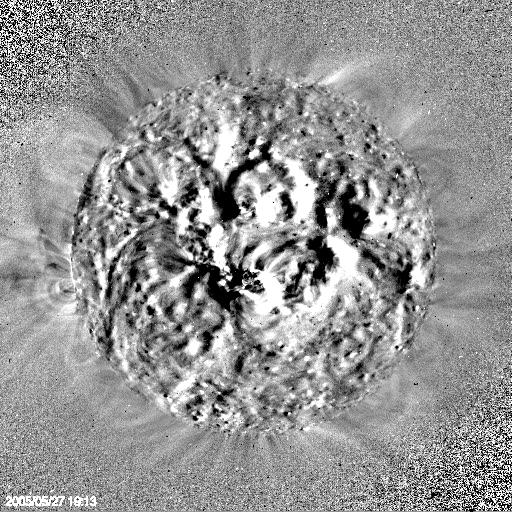
20050527-1913.JPG


This is a SOHO RD image with a HUGE gap between images. There is an overall size and shape to the edges of the image where it become "opaque" (GM definition) and has a relatively sharp outline. Keep in mind that this image was taken a 1 megapixel resolution, whereas the SDO images are 16 megapixel resolution. You get *WAY* more surface detail in 16 megapixel, most of which just looks like short moving coronal loops in the air. When you run the RD feature, you end with the mass movement and surface contours.
 
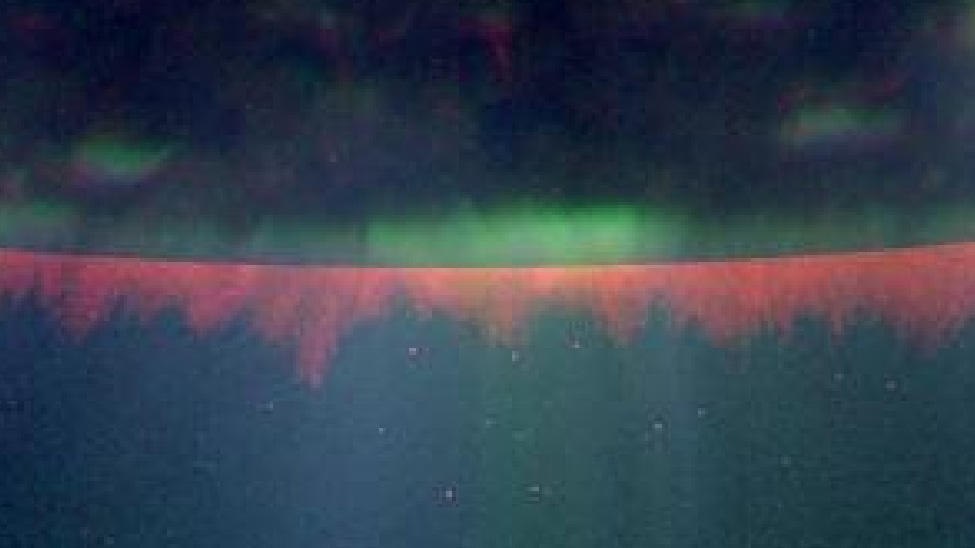
sd01.jpg


Limb "darkening" in this image is the really "opaque" (GM definition region where it becomes really dark under the chromosphere about 4800KM.
 
I often think exactly this.
On the other hand, if it were not for crackpots posting this kind of nonsense, what would become of this forum?

Maybe he is on the JREF pay roll to keep the forum alive and kicking.

It would be pretty boring if every one agreed on every topic.
I certainly have learnt a lot from all MM's nonsense being debunked.:)
If it's time for the lurkers to kick in, I will agree and say that this thread has been very educational. Although MM's knowledge of math and physics seems to be even less than my own casual knowledge, the responses to his woo have been terrific.
 
Status
Not open for further replies.

Back
Top Bottom