
• Security incident: ISF was recently accessed by intruders. Please change your password, and change it anywhere else you used it. Read more

The Fir! The Larch! The Redwood! The mighty Scots Pine!

Joined
Apr 4, 2010
Messages
3,164
Being quite unimpressed with the prevailing orthodoxy regarding historical CO2/temperature interactions, I thought I would turn my attention to the nearer past and the ways the Medieval Warm Period is depicted in the Climate Change literature.

There is a helpful wiki article here
http://en.wikipedia.org/wiki/Descri...arm_Period_and_Little_Ice_Age_in_IPCC_reports
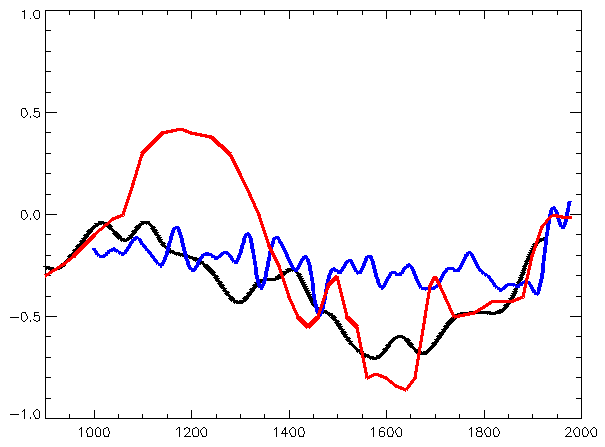
Ipcc7.1-mann-moberg.png

The red shows the view of the IPCC in 1990, the blue shows it in 1999 and the black, the view of an author in 2005 (see wiki articles for more details).

When I was in Iceland for a little while almost 10 years ago I did a little reading on the history and archeology of the arctic readings. I guess you have all heard how medieval documents claim that wheat and apple trees used to grow in Greenland, so I wont repeat that.
I also remember seeing the small tree plantations the icelanders work very hard to try and establish and was told that the Sagas record that when the Vikings arrived "Forests covered Iceland from the mountains to the sea". Despite the very best husbandry efforts by their descendants, the forests are very far from doing that today.

I also remember reading about Northern Greenland archaeological excavations (and my climate panic skepticism dates from then). There is a nice wikipedia summary on Peary Land
http://en.wikipedia.org/wiki/Peary_Land
220px-Pearyland.svg.png


and some interesting comments about the historical periodicity of settlements in that northern area

Peary Land was historically inhabited by three Inuit cultures, during which times the climate was milder than presently:

* Independence I culture (around 2000 B.C., oldest remains dating from 2400 B.C.)
* Independence II culture (800 B.C. to 200 B.C.)
* Thule culture (around 1300 AD)

But even better is this
"One to two million years ago, when climates were warmer, trees such as larch, black spruce, birch, yew, and thuja grew in the northernmost Peary Land."
Although I assuming we don't have to factor in continental drift here.

In light of which I can only say that the IPCC in 1990 was perhaps closest to understanding the extent of the MWP and there is absolutely nothing exceptional about the temperatures we are experiencing today.
 
I am saying the model the IPCC presented in 1990 that showed the MWP as warmer today is closer to actuality.

And it looks like previous warm spells were warmer still.
 
I am saying the model the IPCC presented in 1990 that showed the MWP as warmer today is closer to actuality.

And it looks like previous warm spells were warmer still.
Do you have actual scientific articles to cite (like IPCC)?

Of course there were warmer and colder periods than the MWP in the past. What is your point?
 
Do you have actual scientific articles to cite (like IPCC)?

No, why do you ask?

Do you think the Inuit are in rebellion against the Vegetarian Overlords and going to live up there just to spite everybody?
 
Here's a good summary of the latest research (2009) on the MWP:

http://www.skepticalscience.com/Was-there-a-Medieval-Warm-Period.html

In this study, more than 1000 tree-ring, ice core, coral, sediment and other assorted proxy records spanning both hemispheres were used to construct regional temperature change over the past 1500 years [...]

The Medieval Warm Period found warm conditions over a large part of the North Atlantic, Southern Greenland, the Eurasian Arctic, and parts of North America. In these regions, temperature appears to be warmer than the 1961–1990 baseline. In some areas, temperatures even even as warm as today. However, certain regions, such as central Eurasia, northwestern North America, and the tropical Pacific are substantially cooler.

So the Medieval Warm Period was not a global phenomen. Warmer conditions were concentrated in certain regions. Some regions were even colder than during the Little Ice Age.
 
But even better is this
"One to two million years ago, when climates were warmer, trees such as larch, black spruce, birch, yew, and thuja grew in the northernmost Peary Land."
Although I assuming we don't have to factor in continental drift here.

I'm not sure that you understand the global warming debate.

No one is suggesting that the Earth is warmer now than it has ever been before, or even that (regional) temperatures haven't varied substantially over geological time.

The suggestion is that the Earth is currently experiencing a warming that is not accounted for by any of the other traditional causes such as the Milankovitch cycles and changes in solar output.

In light of which I can only say that the IPCC in 1990 was perhaps closest to understanding the extent of the MWP and there is absolutely nothing exceptional about the temperatures we are experiencing today.

That's rather like seeing a snowstorm on July 4th and saying "there's nothing exceptional about snow; we get it every winter." True -- but we don't get it every summer, which makes a summer snowstorm quite exceptional.
 
1990 predates wide scale climate reconstructions, so any numbers from that time would have been low confidence guesses based on local proxies. Since the late 1990’s there have been more then a dozen wide scale climate reconstructions of the LIA and none of them suggest it was warmer then today.

http://en.wikipedia.org/wiki/File:1000_Year_Temperature_Comparison.png

Apparently however, some medieval anecdotes from people known to be engaging in advertising their new settlement is enough to prove all this is “wrong”.
 
1990 predates wide scale climate reconstructions, so any numbers from that time would have been low confidence guesses based on local proxies. Since the late 1990’s there have been more then a dozen wide scale climate reconstructions of the LIA and none of them suggest it was warmer then today.

http://en.wikipedia.org/wiki/File:1000_Year_Temperature_Comparison.png

Apparently however, some medieval anecdotes from people known to be engaging in advertising their new settlement is enough to prove all this is “wrong”.

Erm, I don't think even Poptech or MHaze would try to claim that the Little Ice Age was warmer than today......
 
But even better is this
"One to two million years ago, when climates were warmer, trees such as larch, black spruce, birch, yew, and thuja grew in the northernmost Peary Land."
Although I assuming we don't have to factor in continental drift here.

Yes, there were periods 1-2 million years ago that were warmer then today. In fact it was warmer then today as recently as 125000 years ago. Of course 125K years ago sea levels rose to 6m (20 feet) higher then they are today.
 
Erm, I don't think even Poptech or MHaze would try to claim that the Little Ice Age was warmer than today......

Mhaze has made the same complaint I.E. he claimed that because the 1990 IPCC report actually suggested the MWP was warmer then today, any newer research that says otherwise should be ignored.
 
Mhaze has made the same complaint I.E. he claimed that because the 1990 IPCC report actually suggested the MWP was warmer then today, any newer research that says otherwise should be ignored.
I think Guybrush Threepwood was just pointing out that you typed LIA when you clearly meant MWP. :)
 
The red and blue lines in the graph end in 1980 or 1985 or so, and the black line in +/- 1960. No matter which line is correct, it doesn't tell us much about how climate today compares to the climate during the Medieval Warm Period.

I am saying the model the IPCC presented in 1990 that showed the MWP as warmer today is closer to actuality.
You do realise that 1990 is about 20 years ago, right? The IPCC didn't know how warm it would be today, because today was still quite a bit into the future. They had their (informed) guesses about how warm it might be today, but today climatologists consider the 1990 worst case predictions to be overly optimistic.
 
Here's a good summary of the latest research (2009) on the MWP:

http://www.skepticalscience.com/Was-there-a-Medieval-Warm-Period.html

Nothing would surprise me less than changes in climate would tend to "oscillate", warming in one area always resulting in some cooling in an other. The difficulty is always to assign the "global temperature" that underpins climate change research. I am not sure if you are aware of the El Nino weather pattern in the Southern Hemisphere, but it involves markedly wetter conditions along western coastal South America with correlates to markedly drier conditions in another area.
Repeating patterns of climate change are thought to be drivers of civilisation collapse or retreat along the South American littoral and could equally explain the Easter Island becoming treeless or being unable to regenerate forests when cut down.
http://www.heritageaid.com/ancientclimate.htm

What your article focuses on is simply the MWP, but ignores the fact that in Peary Land this is a repeating pattern with 400-600 periods when habitation is taken interspersed with periods when habitation is simply impossible. Consider, if you will, that human habitation is a bit like a forest. An established forest ecosystem might be sustained in a climate too cold for it to regenerate again, however, if the temperature drops so low that the forest dies out, the temperature will have to rise much higher before the forest can regenerate. So when the Vikings came to Iceland they would it forested. But once the forest was cut down, the climatic conditions have not warmed up to allow it to regenerate without significant husbandry. Human habitation in Peary Land should follow a similar dynamic, a population might cling on in harsh conditions, but significant warming would need to take place to attract settlers back into a deserted area.

Therefore, the oscillation in habitation in Peary Land seems to me to point to an oscillation of much warmer temperatures around the Atlantic ocean than we know today - a pattern of warming regularly repeating. An oscillation that I am not aware of anyone describing or modeling. If we were to be on the upswing of such oscillation at the moment, could we distinguish it from global warming?

In the end climate science at the moment is like phrenology, with climate scientists earnestly,blindly feeling bumps in a curve and assigning unjustified significance to them. Bumps on the skull are a phenomenon and have a cause, but not necessarily a very interesting one.
 

ISF - Join now!

Every member here is approved by hand. No bots, no spam, just people who care about evidence and honest debate.

Membership is free!

Create your free account

Back
Top Bottom