Moderated Iron sun with Aether batteries...

Status
Not open for further replies.
Emphasis mine. Why in the world is the there an "iron rich shell" around the outside of the explosion RC?

Really?

Are you really, actually asking this question?

Let me ask a list of questions, and see if you can get the answer on your own:

What causes a star to explode as a nova or supernova?
At what point in the stars lifecycle would this occur?
What would be the composition of the star at this point in it's lifecycle?
Bonus Question:
How big of an element can you make via fusion before you start losing energy?
 
In other words, even though brantc went to all the trouble to demonstrate the basic flaw in your argument, and even though I've shown you the satellite images that blow your theory out of the water, you simply ignore them, call them 'gibberish' and go back to pure denial. Yawn.


You don't have the qualifications to understand running difference images. You simply do not. You've had a half a decade to demonstrate that you do. You've failed. So put that issue to bed, Michael. Your web site is a lie from the very first claim, from the very top of the page. A lie. Fraudulent.

For the n-th time, everything in all of those original source images comes from the corona, thousands of kilometers above your mythical solid surface. Nothing in the process of creating running difference graphs can possibly allow you to see something thousands of kilometers away from where the data was gathered. If you see a surface in a running difference image that's called pareidolia or a hallucination. In no case is it related to reality.

I've offered you an opportunity to get down to the nitty-gritty and how do you respond? You run. So you can't make a running difference image. You don't know how they're made. You don't know what they mean. Your opinion on them is worthless. Your argument is crap.

Now like I've said before, you could, if what you're claiming is true and if you could actually back your claims, you could just show I'm wrong. You could kick my ass in front of all these people, show them all that you understand this stuff, make a fool of me. But instead you choose to just cry and whine. Oh, well, I guess there's no argument about who has a better handle on this solar images stuff, is there? :D
 
They're akin to lightening discharges in the atmospheres of a planet. They aren't limited to a single "layer" of the solar atmosphere.


No, that's NOT what it's "designed to do". It is designed to pickup higher energy wavelengths of light from wherever they might occur. There's no guarantee that these wavelengths only occur in some magic layer of the sun's atmosphere or that they are limited to a single position in the solar atmosphere. That image you picked out of the LMSAL video clearly demonstrates that they come up and through the surface of the photosphere RC.


Actually Dr. Neal Hurlburt from Lockheed-Martin Solar and Astrophysics Laboratory has been very specific in explaining that you're wrong. I have personally communicated with him.

So, did someone over there at LMSAL tell you differently? How is it you claim to know more about the intent and results of the TRACE program than the people who designed the equipment and actively participate in the research? How is it you claim to know more about the results than the people at LMSAL whose job it is to acquire and analyze those images?

Your qualifications have been challenged, Michael. Have anything beside your unsupported assertions to back your claim?

:dl:
 
Really?

Are you really, actually asking this question?

Sure. It seems like a legitimate question. A "shell" would certainly tend to explain why we might see an iron rich "ring" from a supernova event.

If you're asking me what I personally thing, Manuel's model of a deteriorating small core of neutron material makes sense to me. Eventually it decays and becomes unstable and goes supernova, leaving a nice ring of heavy elements in it's wake.

The composition prior to explosion would be nearly identical from the outside looking in as it always did. The energy output would probably become unstable for awhile right before explosion, but the "main event" would simply be an explosive discharge and the remaining core simply "exploded", leaving hydrogen and a explosive shell of heavy material that would eventually be "recycled" over time.

Let me ask a list of questions, and see if you can get the answer on your own:

What causes a star to explode as a nova or supernova?

The core become "unstable" because it has deteriorated over time, and no longer has the gravitational force to hold itself together. The neutron material becomes unstable and blows.

At what point in the stars lifecycle would this occur?

It would occur at the very end of the lifecycle when all the neutron material in the core has turned to hydrogen and been expelled by the sun as solar wind. Eventually the small mass becomes unstable and can no longer hold itself together and disintegrates explosively into flying neutrons, that decay into protons, electrons and gamma rays in about 10 minutes or so. I would put on "quite a show" when it went.

What would be the composition of the star at this point in it's lifecycle?

It would outwardly tend to look pretty much the same as it always does, then "boom". It could (probably would) become unstable energetically right before it went supernova, but it may not be a huge change in outward appearance.

Bonus Question:
How big of an element can you make via fusion before you start losing energy?

Iron! :)

Bonus answer to all of your questions too: :)

http://arxiv.org/abs/astro-ph/0511379
 
I've offered you an opportunity to get down to the nitty-gritty and how do you respond?

I haven't yet. You'll need to be a bit patient. IDL is installed on my home PC, and it's a single installation license. I do have a day job you know.

I think before I spend money on a lawyer, I'll spend some time creating a few RD movies for you first and stuff your arrogant attitude right down your throat. We'll then compare them to what NASA has in their daily archives and see what you come up with for the same time period. Like I said, I have a day job, and you aren't my first priority in life, even with that smug arrogant attitude. Chill for a while.
 
Helioseismology depends on a "reflective surface' and it wouldn't work out all were it now for the crust. You can even see it's effect on Nickel ions in the Doppler images Kosovichev has personally created. There's no point in ignoring the *REASON* it works in the first place. You need a reflective surface to do that, and the density of the top of the photosphere is simply way too thin to even begin to explain that reflective process.


And Dr. Kosovichev says you're wrong. His research clearly show that right in the region where you claim a physically impossible solid surface that can only be seen in hallucinations, there is mass moving at somewhere in the neighborhood of 2600 miles per hour. That's some damned fast moving fluid-like solid stuff you've got there, Michael.

Oh, that's right, you've redefined the term "solid" to mean something that, by it's nature, is only and exactly what Michael Mozina declares it to be from moment to moment. And by god that "solid" wholly defies any quantitative description at all. Numbers? Who needs numbers when you can just spew unsupported claims and badmouth and belittle anyone who disagrees with you? :p
 
Sorry, but you onyl got one right. Which leads to why you asked the question in the first place.

You answered them assuming your "theory" was right, yet you were asking the question in regards to the scientific communities current understanding...as if an iron-rich cloud produced in a nova was something that was unexplained or unexpected by current theory.

It is not. WHich leads me to think that you're criticizing the current theory without even understanding what it states or predicts.

What causes a star to explode as a nova or supernova?
When it's burned enough of it's fusion fuel that it becomes unstable. The outer layers blow off as the inner parts collapse on themsleves due to gravity, as the available energy from fusion is no longer enough to coutneract gravitational force.

At what point in the stars lifecycle would this occur?
At the end, when the fusion fuel is mostly gone.

What would be the composition of the star at this point in it's lifecycle?
It would enclude an abundance of heavy elements, specifically iron (as the end-point of energy release for nuclear reactions).

Bonus Question:
How big of an element can you make via fusion before you start losing energy?
This one you got correct.

IN the model you discuss, you talk about the hydrogen core exploding, but that doesn't fit with observation. We find dwarf stars and neutron stars in the center of some nebula, indicating the remnant remaining after the explosion. The idea that the core explodes after a neutron star deteriorates seems to run counter to that. This also does not agree with the idea that it's gravitational force has deteriorated...if that's so, why would there be any remnant remaining? OR are you arguing that gravitational force increases after it blows off a substantial portion of its mass?

Sorry, but I don't see how that model fits with evidence. And you're still completely misrepresenting current theory.
 
I haven't yet. You'll need to be a bit patient. IDL is installed on my home PC, and it's a single installation license. I do have a day job you know.


We've waited over five years so far since you first claimed to have some expertise in the area of running difference images. It's interesting that you would just now actually set about the task of creating one. For god's sake man, you claim to have a method for taking images obtained from thousands of kilometers above the photosphere and processing them into something that allows you to see not only thousands of kilometers away, but all the way through the opaque photosphere! And you haven't actually created more and more and more of these videos yet?

I think before I spend money on a lawyer, I'll spend some time creating a few RD movies for you first and stuff your arrogant attitude right down your throat. We'll then compare them to what NASA has in their daily archives and see what you come up with for the same time period. Like I said, I have a day job, and you aren't my first priority in life, even with that smug arrogant attitude. Chill for a while.


I told you to point out a video we can both make into a running difference video. Do you have a particular video in mind? Then we can compare notes. You'll explain, of course, the specific process you use to get your results. And of course you'll be prepared to explain how it is you can take images of data from the corona, thousands of kilometers above the photosphere, and through some process get a result that lets you see a physically impossible solid surface below that opaque photosphere. We've been waiting over five years for you to explain that particular miracle, too.
 
...there is mass moving at somewhere in the neighborhood of 2600 miles per hour.

Exactly where are you getting these numbers, your back pocket? Citation please....

That's some damned fast moving fluid-like solid stuff you've got there, Michael.

Volcanic material does in fact move through the surface and the atmosphere, but I have no idea what you're even talking about until I see your reference.

Oh, that's right, you've redefined the term "solid" to mean something that, by it's nature, is only and exactly what Michael Mozina declares it to be from moment to moment.

Er, no, a "solid" is a in fact a "solid".

And by god that "solid" wholly defies any quantitative description at all. Numbers?

How about those *NASA* RD images that show the same "persistent features" for days on end? How about that persistent little bugger of a feature under the wave? Data, what data? You ignore the data, the numbers and the pretty little images entirely. Who needs numbers when you operate from pure denial?

Who needs numbers when you can just spew unsupported claims and badmouth and belittle anyone who disagrees with you? :p

Thus spoke the personal attack king of the internet.
 
Exactly where are you getting these numbers, your back pocket? Citation please....


Why, it's in Dr. Kosovichev's helioseismology research, of course. You'd think a fellow like you with a Nobel Prize just barely out of reach would at least take notes. You provided the information yourself sometime in the fall of 2005 if I recall correctly. So Michael, do your own homework. :D
 
Sorry, but you onyl got one right. Which leads to why you asked the question in the first place.

You answered them assuming your "theory" was right, yet you were asking the question in regards to the scientific communities current understanding...as if an iron-rich cloud produced in a nova was something that was unexplained or unexpected by current theory.

It's not the "cloud" that is unexplained, it's that outside shell of iron rich materials that really doesn't fit current theory IMO. If the star simply implodes to create iron (or neutron material) in the center of the core, there's no real reason to believe that the heaviest stuff is going to fly off as some outside "shell" in the explosion. I understand the basic idea of producing iron, but the notion of an outer metal rich shell isn't really congruent with an implosive scenario which should push stuff into a "core". An inner explosion with an outer heavy crust would certainly create a shell around the supernova and a long lasting shock wave where the inertia of the shell fragments is passed along to elements that it slams into.

It is not. WHich leads me to think that you're criticizing the current theory without even understanding what it states or predicts.

Do you have a paper that "predicted" (not posticted) an outer shell of iron rich material? It's possible your criticism is valid, but I've yet to see such a thing prior to more current observations.

What causes a star to explode as a nova or supernova?
When it's burned enough of it's fusion fuel that it becomes unstable. The outer layers blow off as the inner parts collapse on themsleves due to gravity, as the available energy from fusion is no longer enough to coutneract gravitational force.

At what point in the stars lifecycle would this occur?
At the end, when the fusion fuel is mostly gone.

What would be the composition of the star at this point in it's lifecycle?
It would enclude an abundance of heavy elements, specifically iron (as the end-point of energy release for nuclear reactions).

Sure, but why the "shell", rather than say and "lump of central iron"?

Bonus Question:
How big of an element can you make via fusion before you start losing energy?
This one you got correct.

Do I get a cookie? :)

IN the model you discuss, you talk about the hydrogen core exploding, but that doesn't fit with observation. We find dwarf stars and neutron stars in the center of some nebula, indicating the remnant remaining after the explosion.

Well, sure, but not every scenario will necessarily be identical to the one I described. Some cores might become "unstable" for awhile, and the shell might in fact "collapse" in this scenario too, and may even help to stablize the core again. Lot's of things could happen in various scenarios. In almost all scenarios, I would expect the leading materials to typically be rather "iron rich" from the very start.

The idea that the core explodes after a neutron star deteriorates seems to run counter to that. This also does not agree with the idea that it's gravitational force has deteriorated...if that's so, why would there be any remnant remaining?

Well, an unstable core might cause the crust to implode into the core too, and that process may even help replenish the neutron material in the core. You can't simply assume only one thing can occur, and in fact we know from how they look that things happen in very different ways in some circumstances. Size might matter. Overall composition might play a role. The exact physical "blow out" process might make a difference.

OR are you arguing that gravitational force increases after it blows off a substantial portion of its mass?

The core might in fact pick up more gravitation force due to it picking up more raw material that it turns back into neutron material, sure. Anything is possible if core implodes rather than if the core explodes.

Sorry, but I don't see how that model fits with evidence. And you're still completely misrepresenting current theory.

I'm really not trying to misrepresent current theory. Sorry you feel that way.

 
Last edited:
Why, it's in Dr. Kosovichev's helioseismology research, of course. You'd think a fellow like you with a Nobel Prize just barely out of reach would at least take notes. You provided the information yourself sometime in the fall of 2005 if I recall correctly. So Michael, do your own homework. :D

In other words you don't have a reference and you pulled the numbers out of your back pocket. When cornered on the issue, you expect me to do your research. Right.
 
FYI H, My bad on the "assumption" that you wanted me to answer your questions based on a solid surface sun theory. I thought you wanted my explanation of these events. I typically respond to these posts between tech calls and programming tasks at work and sometimes I simply miss the point of the question as I did in this case.
 
You don't have the qualifications to understand running difference images.

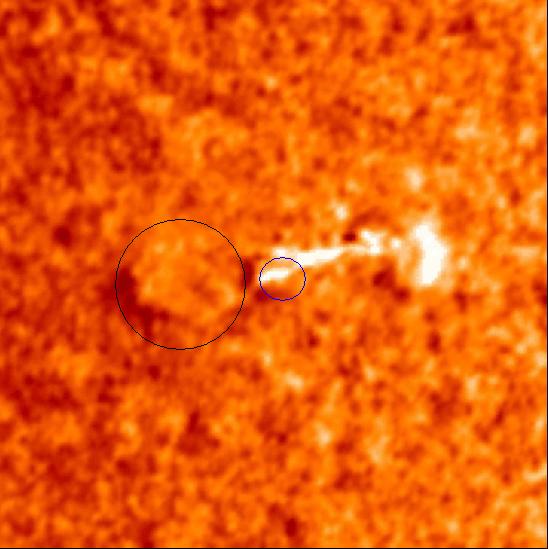
FYI, if I don't have such credentials because you want to see more solar RD images from me, then neither do you. I haven't ever seen you produce a single RD image that you even *CLAIMED* was a "running difference" solar image. Go ahead and start with today's images from any satellite in 171A or 195A wavelength, and create your running difference movie for us to look at.

Then and only then can you can claim to have some qualification. All you don't so far is criticize. I've seen no attempt from you to *EVER* produce a single solar running difference image, let alone attempt to explain anything related to solar physics in the image. Keep in mind that you personally have to produce the movie, and you have to tell us what software package(s) that you used to produce it.
 
Last edited:

I still haven't seen your explanation of that persistent feature in Kosovichev's Doppler image PS.

tsunami1.JPG


It's oh so easy to criticize someone else if you never make an attempt of your own to explain the various features of different images.
 
Oh, and by the way....

After you create your movie, I will expect you to "explain" something related to solar physics and how that process directly relates to something observed in the movie.
 
I still haven't seen your explanation of that persistent feature in Kosovichev's Doppler image PS.

http://www.thesurfaceofthesun.com/images/tsunami1.JPG

It's oh so easy to criticize someone else if you never make an attempt of your own to explain the various features of different images.
Perpetual Student does not need to since Dr. Kosovichev has explained the various features of different images as stated on your web site:
I must note here that Dr. Kosovichev is a VERY, very nice person, but he in NO WAY endorses my views about there being a "solid" surface on the sun. In a recent email from Dr. Kosovichev, he explained these features in the following quote:
"The consistent structures in the movie are caused by stationary flows in magnetic structures, sunspots and active regions.
We know this from the simultaneous measurements of solar magnetic field, made by SOHO. These are not solid structures which would not have mass flows that we see.
These images are Doppler shift of the spectral line Ni 6768A.
The Doppler shift measures the velocity of mass motions along the line of sight. The darker areas show the motions towards us, and light areas show flows from us. These are not cliffs or anything like this. The movie frames are the running differences of the Doppler shift. For the illustration purpose, the sunquake signal is enhanced by increasing its amplitude by a factor 4."
 
Status
Not open for further replies.

Back
Top Bottom