Moderated Iron sun with Aether batteries...

Status
Not open for further replies.
Why? Are you appealing to authority perhaps?

Of course. He's the expert, not you or me. Appeal to appropriate authority is perfectly valid. If not, you can kiss the entire legal tradition of western civilization good-bye. As a non-scientific layperson, my only challenge is identifying the appropriate authority to appeal to. If the choice is between Kosovichev and you, my choice isn't you.


You should believe me because he offered us no relevant way to explain the rigid outlines in the video, just as nobody here will offer us a relevant way to explain those features using a plasma sun model.
Why would he? The outlines aren't rigid, and he explained why they aren't.
 
How would that even be a "fake" RD image? What exactly constitutes a "real" RD image, and why would one particular image manipulation program be "fake" or only one image program "real"?


I'll take that as an implied admission that I am correct in my assessment that you twiddled with a couple of PhotoShop filters. But I already knew that. You see, I happen to understand what it takes to make running difference images the way the good folks at LMSAL make them. I also understand that the fraudulent "running difference" images you supposedly made are most likely just some PhotoShop messing. Mind you, there's nothing wrong with screwing around with PhotoShop. After all, that's how we know UFOs and ghosts and bigfoot is real, too.

Are you going to email me your info?


Sure, right after you let me know how your lawyer responds when you tell him you won't be able to actually support your claim because the you made the images in PhotoShop just like I said you did. They're fakes. :D
 
Well, the problem is that none of you account for that rigid outline under the wave. To his credit Dr. Kosovichev spent many emails with me trying to do so, but he ultimately didn't offer us a physically viable method to explain it. You won't do that either.


I'd be happy to give my opinion on why you think you see things that aren't really there. And my opinion is supported by several thousand of your posts on several Internet forums. But you'd be offended by the truth.

I don't even know what makes you think that *YOU* are qualified to explain a solar RD image. So far all you've done is talk about the technique mathematically and you have outright ignored the solar processes and the specific pixels in specific images. What exactly are your qualifications as it relates to solar physics? I accept that you understand the math related to RD image processing but I see no evidence at all that you know squat about solar physics or solar images in general.


Yes, I understand the math involved in creating the graphs. You don't understand math at all, much less what is involved in producing running difference output. Therefore I'm qualified to say what the running difference graphs show and don't show. You aren't. Your qualifications have been challenged, and you have refused to offer any support for your claim that you are qualified.

Oh, and your ignorance of this issue hasn't gone unnoticed: What method is involved in taking images of data from thousands of kilometers above the photosphere, and processing them in some way that shows surface features below the photosphere? Can we take it that you're going to remain ignorant on that point?
 
Of course. He's the expert, not you or me.

But that expertise is only meaningful if he can offer us an explanation for the rigid aspects of the image. If not, his "expertise" is limited in that aspect and we still need a valid explanation for those rigid outlines in the image. That is essentially where things sit.

Appeal to appropriate authority is perfectly valid. If not, you can kiss the entire legal tradition of western civilization good-bye.

It's actually a fallacy in debate, and also problematic. In this case it's not actually relevant because he offered no viable way to "explain" it. We still need to explain those features of that image. If the expert has no explanation, where does that leave us exactly?

As a non-scientific layperson, my only challenge is identifying the appropriate authority to appeal to. If the choice is between Kosovichev and you, my choice isn't you.

Well, that technically only works if the expert has an explanation to offer us that is physically viable. In this case, no such explanation exists. Now what?

Why would he? The outlines aren't rigid, and he explained why they aren't.

They are certainly more "persistent" than anything in the photosphere. The surface features of the photosphere change over about an 8 minute interval.
 
I'll take that as an implied admission that I am correct in my assessment that you twiddled with a couple of PhotoShop filters.

Are you stating publicly that I fraudulently manipulated the images using any specific program, Photoshop, IDL routines, or otherwise? Yes or no? If so, how did I commit fraud in your opinion?
 
How exactly is attempting to demonstrate the existence of a solid surface a hijack of his thread? I was careful to even point out that wireless transmission of electricity is a demonstrated real process. You seem to have an unusual notion of a hijack.
You have a crackpot delusion that there is an iron "crust" in the Sun with the elements in the Sun stratified.
brantc has a crackpot delusion that there is an solid iron shell in the Sun with Aether batteries.
This is a thread about brantc's crank delusion not yours.
It is a hijack of his thread if he wants to talk about his crank idea (as in the OP) rather than yours. That is why I asked him whether he considered it to be a hijack.

Can I take it that you are OK with answering all the 30-odd outstanding questions on your idea here instead of the other thread?
 
If you start with a conclusion - the features are rigid - and then demand that the expert provides an explanation for why the features are rigid, why do you act surprised when the expert doesn't agree with your conclusion? What explanation do you think he should give for a false conclusion? The question to ask should be - are these features rigid? The answer given by Kosovichev is no. And he explained his answer. QED.
 
Yes, I understand the math involved in creating the graphs.

So what? What do you know about solar physics or satellite images in general?

You don't understand math at all,

You do realize I'll bury you in court for this sort of trash, right?

much less what is involved in producing running difference output.

The only problem in your rant here of course is that I accepted your '"Explanation" of the technique long ago, so we aren't actually arguing over the technique, just the fact you avoid the solar physics entirely.

Therefore I'm qualified to say what the running difference graphs show and don't show. You aren't.

Until you address the physics of what's happening in the image, frame by frame, pixel by pixel, all you've done is address the math and ignored the physics entirely. That's typical of you guys.

Your qualifications have been challenged, and you have refused to offer any support for your claim that you are qualified.

I can demonstrate your ignorance on qualification right here, right now, just by noting that you're bitching about a software program, not a technique and technically speaking it doesn't matter which software one uses to create a basic RD image. That Photoshop rant was your own worst enemy.

By the way, be specific. What did I manipulate in any of those images that constitutes "fraud"?
 
If you start with a conclusion - the features are rigid - and then demand that the expert provides an explanation for why the features are rigid, why do you act surprised when the expert doesn't agree with your conclusion? What explanation do you think he should give for a false conclusion? The question to ask should be - are these features rigid? The answer given by Kosovichev is no. And he explained his answer. QED.

We went back and forth between the terms "rigid" and "persistent" and the difference between the two in our emails so you can take your pick. I believe the term "persistent" is a better term by the way, but he didn't explain that part of his answer which is why it's not on my website. I felt I offered him that statement on my website, but I was highly disappointed at his lack of an explanation for the persistent features in the image. If you look closely, it's not just the circled regions that are persistent under the wave. There are many features under that wave that are unaffected by the wave, and persistent throughout the image that remain "unexplained".
 
You have a crackpot delusion

Ah, the GM style of debate. You got two loaded words in row. How cute.

that there is an iron "crust" in the Sun

No! You continue to ignore the fact I didn't claim the crust or the sun to be made of "iron" and only iron. In fact I have explicitly mentioned to all of you that it is an ordinary crust and not homogeneously any element.

with the elements in the Sun stratified.

The plasma atmosphere is stratified, yes.

brantc has a crackpot delusion

So your technique isn't actually "personal", you just go below the belt all the time when someone disagrees with you, is that it?
 
Last edited:
We went back and forth between the terms "rigid" and "persistent" and the difference between the two in our emails so you can take your pick. I believe the term "persistent" is a better term by the way, but he didn't explain that part of his answer which is why it's not on my website. I felt I offered him that statement on my website, but I was highly disappointed at his lack of an explanation for the persistent features in the image. If you look closely, it's not just the circled regions that are persistent under the wave. There are many features under that wave that are unaffected by the wave, and persistent throughout the image that remain "unexplained".

For the sake of argument, let's say his explanations for the features are unsatisfactory - that in no way constitutes positive evidence for your explanation. You have to provide that yourself.

For instance, in the quoted bit above, you are still starting with a conclusion - i.e., that the features are "under" the wave rather than features "of" the wave. You certainly cannot conclude that based on Kosovichev's (presumed) failure to precisely explain those features. You have to provide some basis for this besides your own desire that it should be so.
 
Hey Michael, I'm still waiting for you to calculate the gravitational pressure for a water bubble using my model. Do you need me to do it for you? Or will you admit that you had no idea what you were talking about when you claimed my model should predict the bubble would crush the air inside it?
 
Hey Michael, I'm still waiting for you to calculate the gravitational pressure for a water bubble using my model. Do you need me to do it for you? Or will you admit that you had no idea what you were talking about when you claimed my model should predict the bubble would crush the air inside it?

On a related note, I'm wondering what's become of brantc: I think all this shouting distracted him, just when he was about to explain his model of gravity - the one which lets a hollow sphere of iron remain stable when Newton thinks it ought to be 10,000 times too heavy to support its own weight.

He may be back, though. He may just be doing some calculations. We can but hope.
 
For the sake of argument, let's say his explanations for the features are unsatisfactory - that in no way constitutes positive evidence for your explanation. You have to provide that yourself.

That's fair enough. We still do need to "explain" that part of the images however.

For instance, in the quoted bit above, you are still starting with a conclusion - i.e., that the features are "under" the wave rather than features "of" the wave.

We both seemed to agree on that point actually, but your right it's an "assumption", albeit based upon hours of analysis. I've long since lost count of the number of times I've watched that video.

You certainly cannot conclude that based on Kosovichev's (presumed) failure to precisely explain those features. You have to provide some basis for this besides your own desire that it should be so.

There has to be a logical explanation for those persistent features. It's not as though they must defy logical explanation or they even should defy logical explanation. There has to be logical reason that those features remain persistent whereas the structures of the photosphere tend to come and go in 8 minute intervals. There must also be a valid reason why the wave distorts the "features"as it passes over them, which IMO favors the "under" rather than the "through" or "over" interpretation of where the features are located in relationship to the wave on the surface of the photosphere.
 
On a related note, I'm wondering what's become of brantc: I think all this shouting distracted him, just when he was about to explain his model of gravity - the one which lets a hollow sphere of iron remain stable when Newton thinks it ought to be 10,000 times too heavy to support its own weight.

Wouldn't that depend a lot upon the surface tension of the crust and the pressure and temperature of the materials inside? That water should have sunk to the bottom too, but the air inside the water shell is stable, even to the point of ejecting water droplets that are injected into the air pocket. If you watched the tablet part, the little air bubbles are eaten by the larger bubble and the water shell is stable. Once in awhile an ejection of water occurs, but the shell and air bubble inside are very stable.
 
Oh, and your ignorance of this issue hasn't gone unnoticed: What method is involved in taking images of data from thousands of kilometers above the photosphere, and processing them in some way that shows surface features below the photosphere? Can we take it that you're going to remain ignorant on that point?

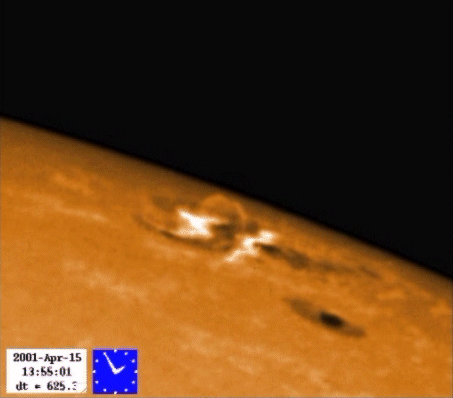
Here's the LMSAL image that demonstrates that the footprints of the loops are located *UNDER*, not above the photosphere. Notice the effect on the surface of the photosphere from the coronal loops passing through it.

15%20April%202001%20WL.gif
 
Wouldn't that depend a lot upon the surface tension of the crust and the pressure and temperature of the materials inside?

I'm having trouble seeing how the electrostatic attraction which, for example, helps water molecules cling together in a soap bubble would help sustain a vast hollow ball of iron. Maybe I mistake your point.

Regarding internal pressure, I rather gathered that brantc's particular model envisages an iron shell constituting virtually the whole of the sun's mass. If there's anything inside, he's yet to divulge what it is.

A really, really impressive Kinder toy perhaps.
 
I'm having trouble seeing how the electrostatic attraction which, for example, helps water molecules cling together in a soap bubble would help sustain a vast hollow ball of iron. Maybe I mistake your point.

There's a bit more going on the video and more to consider at it relates to surface tension and gravitational force at various points inside the sphere. First we should note that the gravitational force in the core of the sphere is actually zero. The lighter elements inside of a shell with some surface tension would naturally tend to collect there.

Regarding internal pressure, I rather gathered that brantc's particular model envisages an iron shell constituting virtually the whole of the sun's mass. If there's anything inside, he's yet to divulge what it is.

Well, it could be relatively "hollow" in terms of average density compared to the outside "shell" as the water bubble analogy demonstrates.

FYI, even a basketball with a hole doesn't necessarily or automatically "collapse" into itself.
 
I'm having trouble seeing how the electrostatic attraction which, for example, helps water molecules cling together in a soap bubble would help sustain a vast hollow ball of iron.

Well, keep in mind that solid metals would have an electrostatic attraction, particularly in an electrically active environment.
 
Wouldn't that depend a lot upon the surface tension of the crust

No. Surface tension doesn't apply to solids, and even in liquids it's fairly weak and doesn't scale with volume. Whereas gravity keeps getting stronger the larger your object becomes. So surface tension is irrelevant to your iron sun model.

and the pressure and temperature of the materials inside?

Um... the pressure was what I calculated to be many orders of magnitude too large. And temperature just makes the problem worse, since it softens materials from their low-temperature strength.

That water should have sunk to the bottom too, but the air inside the water shell is stable

What's the force of gravity for that bubble, Michael? Come on, quantify it. It's not hard to figure out. Is gravity relevant to the water bubble? And if not, how can you compare it to your iron sun model, where gravity clearly will have a major impact?
 
Status
Not open for further replies.

Back
Top Bottom