
-
Security incident: ISF was recently accessed by intruders. Please change your password, and change it anywhere else you used it. Read more
You are using an out of date browser. It may not display this or other websites correctly.
You should upgrade or use an alternative browser.
You should upgrade or use an alternative browser.
Australia
- Thread starter Akhenaten
- Start date
Akhenaten
Heretic Pharaoh

Cheers, mate. I figured it would be something along those lines.
I have little knowledge of the type of weapons of which you speak.

I have little knowledge of the type of weapons of which you speak.
HawaiiBigSis
List Management

Yeah, the wikipedia article indicated that the venom is basically "stinging" to the human, so a normal-sized person wouldn't need antivenom, I imagine, but another platypus might not fare so well.Cheers, mate. I figured it would be something along those lines.
Oddly enough, when I was a young sprite, platypi struck me as being the absolute unequivocal proof of both evolution and plate tectonics. Those were both presented as fairly unlikely theories when I was in grammar school (well, not so much evolution, although it was presented more as a theory, on the way to being fact). But to me, looking at a globe, looking at animals that only existed in one place, or were so perfectly adapted to their current locale, but were clearly related to other -- also perfectly adapted to their current locale -- animals, I didn't understand why it couldn't be considered absolutely so.
It was an education in the scientific method for me, and have been reasonably pleased to know that my childhood beliefs continue to have merit.
BTMO
Overlord of the Underthings

- Joined
- May 1, 2009
- Messages
- 2,521
Yeah, the wikipedia article indicated that the venom is basically "stinging" to the human, so a normal-sized person wouldn't need antivenom, I imagine, but another platypus might not fare so well.
Apparently, it hurts like hell.

Lucian
Illuminator

- Joined
- Jan 26, 2009
- Messages
- 3,257
Yeah, the wikipedia article indicated that the venom is basically "stinging" to the human, so a normal-sized person wouldn't need antivenom, I imagine, but another platypus might not fare so well.
Oddly enough, when I was a young sprite, platypi struck me as being the absolute unequivocal proof of both evolution and plate tectonics. Those were both presented as fairly unlikely theories when I was in grammar school (well, not so much evolution, although it was presented more as a theory, on the way to being fact). But to me, looking at a globe, looking at animals that only existed in one place, or were so perfectly adapted to their current locale, but were clearly related to other -- also perfectly adapted to their current locale -- animals, I didn't understand why it couldn't be considered absolutely so.
It was an education in the scientific method for me, and have been reasonably pleased to know that my childhood beliefs continue to have merit.
I hope our Australian friends don't take this the wrong way, but my theory about their fauna is this: if the creation story in Genesis were true, the critters of Australia prove that God got guano-faced, stinking drunk during the creation, and thought that if he hid all the really weird stuff in Australia, maybe no one would notice.

You been listening to Robin Williams?I hope our Australian friends don't take this the wrong way, but my theory about their fauna is this: if the creation story in Genesis were true, the critters of Australia prove that God got guano-faced, stinking drunk during the creation, and thought that if he hid all the really weird stuff in Australia, maybe no one would notice.

Lucian
Illuminator
- Joined
- Jan 26, 2009
- Messages
- 3,257
You been listening to Robin Williams?
No. Oh, God, how disturbing.
Damien Evans
Up The Irons

Oh I thought that was the storm....oh wait beaches....none of them there either
So Bay Beaches don't count?
And the Storm aren't the most arrogant. We're the most thuggish.
softstuff
Scholar

- Joined
- Aug 30, 2009
- Messages
- 110
That's an interesting insight. Despite being brought up in inner Sydney I've spent all my adult life more-or-less in the sticks, and it's never really occurred to me that some people would (with quite good reason, now that I think about it) be genuinely fearful of the critters that they might encounter.
I have to confess to mostly being a 'pick-it-up-and-waggle-it' person. My bad.
Upon moving to Australia I decided I'd pick up a book on spiders, given that I didn't know which ones were deadly and it might be a good idea if I found out. About 7 or 8 pages into the tome I gave up. I find it to be infinitely more sensible given my poor memory and general anxiety just to avoid the buggers entirely.
My coming closer to a snake was based on 3 ideas I had about it... I'm not generally afraid of them, they don't tend to bother you if you don't get too close or annoying, it wasn't large, colourful or rattly. I have no doubt that someone will come on here and tell me that it was most likely the "Great Snake of Instant Painful Death", but I'm working with what small knowledge I have here!
I think moving here I vastly underestimated how different the local fauna would be. I lived previously in Turkey, and have found 6 inch long insects on my pillow, but the sheer volume of down right odd and deadly critters over here is something else.
All I know about snakes is to give them a wide berth. Size, colour and rattliness are not much help in figuring out if it's a baddie or not http://en.wikipedia.org/wiki/Pseudonaja
332nd
Penultimate Amazing

- Joined
- Sep 27, 2006
- Messages
- 11,278
Yeah, the wikipedia article indicated that the venom is basically "stinging" to the human, so a normal-sized person wouldn't need antivenom, I imagine, but another platypus might not fare so well.
Oddly enough, when I was a young sprite, platypi struck me as being the absolute unequivocal proof of both evolution and plate tectonics. Those were both presented as fairly unlikely theories when I was in grammar school (well, not so much evolution, although it was presented more as a theory, on the way to being fact). But to me, looking at a globe, looking at animals that only existed in one place, or were so perfectly adapted to their current locale, but were clearly related to other -- also perfectly adapted to their current locale -- animals, I didn't understand why it couldn't be considered absolutely so.
It was an education in the scientific method for me, and have been reasonably pleased to know that my childhood beliefs continue to have merit.
Heh. First time I saw a platypus it struck me that "platypus" means HOLYCRAPWTFBBQ!??!?!?! in some ancient language.
BTMO
Overlord of the Underthings
- Joined
- May 1, 2009
- Messages
- 2,521
I hope our Australian friends don't take this the wrong way, but my theory about their fauna is this: if the creation story in Genesis were true, the critters of Australia prove that God got guano-faced, stinking drunk during the creation, and thought that if he hid all the really weird stuff in Australia, maybe no one would notice.
Nope, not offended at all. I think you are probably right.
Incidentally, with the exception of some obvious exceptions like the kangaroo, the wallaby, the wombat, the numbat and the platypus, most Australian animals are incredibly well named - if you need insanely obvious descriptions of animals.
Here are couple for you to ponder over. You probably haven't seen these before, but see if you can guess what these animals look like. I will provide descriptions at the end of the post just in case you can't work them out.
1. The Red Bellied Black Snake.
2. Brown Snake.
3. Blue Tongued Lizard.
4. Wedge Tailed Eagle (I admit this one is a bit harder).
5. Blue Ring(ed) Octopus.
Worked them out? Ok. Scroll down for the descriptions.
1. It is a snake. It is black, except for its belly. Which is red.
2. It is a snake. It is brown. Incidentally, a friend of mine was bitten by one of these 21 hours after arriving in Australia on holiday. She was in intensive care for four days. They are dangerous...
3. It is a lizard. When it opens its mouth, you can see its tongue. Which is blue. It pokes its tongue out to scare other animals...
4. It is a bird. An eagle, in fact. Its tail is ... wedge shaped. Actually, I can't think of an eagle that doesn't have a wedge-shaped tail. Hmmmmm...
5. 8 legs. Small blue rings all over its body - which only become visible when it is in a bad mood. Please note - these things are incredibly dangerous. Bites regularly kill people. The animal would easily fit in the palm of your hand!
arthwollipot
Limerick Purist Pronouns: He/Him

Yeah, and we have a Great Sandy Desert (it's great, and sandy), the Snowy Mountains (which are snowy) and Shark Bay (where there are sharks).

Damien Evans
Up The Irons
Australia is Obvious Land then?
Been reading up on a relative of mine that had to face a lot of accusations ranging from malpractice to rort. Does The Age have a tendency to go all dramatic?
Yes. They're also big fans of whiney.
Akhenaten
Heretic Pharaoh
What about Botany Bay where there are plants.
It actually goes further than that.
Botany Bay only received that name when Captain James Cook RN; FRS, wrote up the journal that he prepared from the log of HMS Endeavour.
The name was bestowed in honour of the naturalist (botanist) Joseph Banks, whom the Admiralty had appointed to accompany Cook on his journey of discovery and exploration, and his assistant, Daniel Solander.
The original name given by Cook in the log to what is now Botany Bay was the even more obvious 'Sting Ray Harbour'.
One section of the bay is, to this day, known as Quibray Bay.
Akhenaten has spent many, many hours fishing for lizards (flathead, or Platycephalidae) on the sandflats of Quibray Bay.
Other place names related to these events include Cook's River, which flows into Botany Bay and provided a source of fresh water for Endeavour, Bankstown, originally the source of this river, and Cape Solander, further to the South.
Last edited:
BTMO
Overlord of the Underthings
- Joined
- May 1, 2009
- Messages
- 2,521
Yeah, and we have a Great Sandy Desert (it's great, and sandy), the Snowy Mountains (which are snowy) and Shark Bay (where there are sharks).
Tried to post this last night, but the forum seemed to have been broken...
------
Then it gets obscure.
There is the sulfur crested cockatoo (a large white bird with yellow feathers on its head), the cone shell (it is sort of .... cone shaped. And a shell).
Then we have the box jelly fish (a cniderian that is squarish), the bottle nose dolphin (it's an alcoholic), the quoll (description obvious), the flying fox (kind of a vegan vampire) and the carpet snake (a floor covering).
Science is a passion of mine...
Akhenaten
Heretic Pharaoh
Nope, not offended at all. I think you are probably right.
Incidentally, with the exception of some obvious exceptions like the kangaroo, the wallaby, the wombat, the numbat and the platypus, most Australian animals are incredibly well named - if you need insanely obvious descriptions of animals.
Here are couple for you to ponder over. You probably haven't seen these before, but see if you can guess what these animals look like. I will provide descriptions at the end of the post just in case you can't work them out.
1. The Red Bellied Black Snake.
2. Brown Snake
Akhenaten said:On the contrary, Old Bob, I've been reading along. Just don't have any similar experiences to share (or with the war stories either), so I haven't said anything. I am curious what Akhenaten finds out about snakes.
That's very nice of you, and quite heartening. Thank you. I'll bet you DO have some stories though. Don't forget that not EVERYTHING in this thread needs to be verified, so there's a bit of "artistic" licence granted
Anyway, it's snake time! I'll start with two of our most popular garden varieties, since others have mentioned them already.
Eastern Brown Snake

© Snake Catchers Brisbane
Red-bellied Black Snake
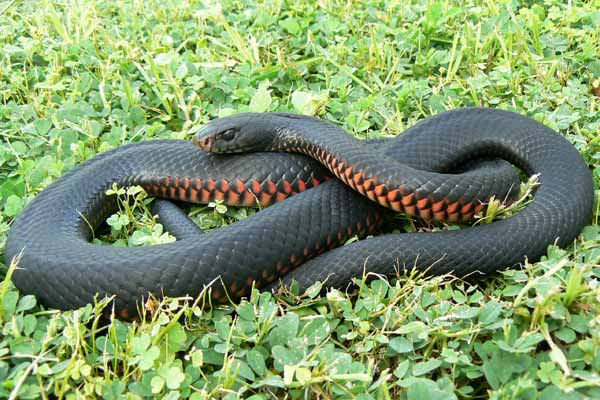
© Wildlife Qld
Distribution Map

© Imhotep's Maps for Chaps - all your cartographic needs in one convenient location. Pharaoh shops here!
As you can see from the maps above, the range of the Red-bellied Black snake lies totally within the range of the Eastern Brown Snake. You might think that would cause some problems, given that both are known to eat other snakes.
The fact is though, that they don't usually bump into each other, and from what I've observed it's because they have slightly different preferences for habitat.
The area depicted on the right-hand map contains most of what passes in Australia for mountains, including what we call the Great Dividing Range. In most areas, however, it's not so much a mountain range as a dissected plateau. As such, it contains at least two distinct habitats; the plateau itself and the valleys and gorges of various watercourses.
Up on top of the plateau, it's hot and dry in Summer, cool and dry in Winter. Open sclerophyl forest mainly. Down in the valleys, it's generally moist for most of the year, and the temperature range is much less severe. A lot of temperate rainforest
As a side note, they've re-created this effect on a small scale in the Botanical Gardens in Canberra. Arthwollipot is probably a more recent visitor than I, and may have pics to share. (hint
Anyway, back to the snakes.
In Summer, snakes can be found just about anywhere, but I've noticed that if you're following a creekline and you're right down near the water, you're far more likely to encounter a Black than a Brown, while up on top of the ridges and in the more open areas of the plateau, the situation is reversed. In both areas, the prey available to opportunists like snakes is fairly similar, with the notable exception of frogs, which are (perhaps obviously) more common near the water.
In Winter, Brown Snakes become fairly inactive, but you can still find Black Snakes doing their thing down in the moist, warmish leaf litter.
It seems to me that the slightly warmer temperatures and available food are things that give the Black Snake some advantages in Winter, as well as keeping them within their niche. I can't say what it is that keeps the Browns where they are, but whatever the mechanism, it seems to have been in place long enough that even the colours the two species have evolved reflect their preferred environments - brown for the open, sandy uplands and black for the dark, shadowed valleys.
Having made these observations, I have to point out that urban growth is stuffing things up as usual. I made the point that snakes are opportunists, and like others of their ilk, such as foxes, dingoes and seagulls, they have discovered that people will provide all kinds of things for them to eat. So they've moved in with us.
Here's an interesting titbit from the CSL Antivenom Handbook
Brown snakes are common throughout mainland Australia, in essentially all habitats, including urban areas. They are not present in Tasmania or the islands off the southern coast of Australia, such as Kangaroo Island (SA). They are relatively common in some urban and metropolitan areas. Hundreds of brown snakes are removed from houses and other properties each year in some capital cities and >10% of these snakes are found inside the house!
Where I lived as a kid, south of Sydney, NSW, this item would more likely have referred to Red-bellied Black Snakes.
What I mean to say, when saying that urbanisation has stuffed things up, is not that it's harmed the snakes at all, but it's mixed up their distribution because they both seem equally happy to move in wherever we go. Yay! (?) I think something similar is going on with the Currawongs, but that's for another post.
Sciency Stuff
Eastern Brown Snake
Kingdom: Animalia
Phylum: Chordata
Class: Reptilia
Order: Squamata
Suborder: Serpentes
Family: Elapidae
Genus: Pseudonaja
Species: P. textilis
Fun Fact
CSL Antivenom Handbook
The venom is multicomponent and includes powerful presynaptic neurotoxins, procoagulants and possibly both cardiotoxins and direct nephrotoxins. There is no myolytic activity. The venom of the common brown snake is the second most potent snake venom in the world.
Apparently the most potent venom comes from Taipans. Guess where they come from.
Red-Bellied Black Snake
Kingdom: Animalia
Phylum: Chordata
Class: Reptilia
Order: Squamata
Suborder: Serpentes
Family: Elapidae
Genus: Pseudechis
Species: P. porphyriacus
Fun Fact
Wikipedia
Although the Red-bellied Black Snake has the most toxic venom of the genus pseudechis, bites from Red-bellied Black Snakes are rarely lethal because of immediate medical attention. Tiger Snake antivenom is used to treat bites from red-bellied black snakes. While black snake antivenom can be used, tiger snake antivenom can be used at a lower dose. The smaller dose is cheaper to produce, and is less likely to cause a reaction in the patient.
That's convenient. How lucky we are to have lots of Tiger Snakes.
Cheerssssss,
Dave
BTMO
Overlord of the Underthings
- Joined
- May 1, 2009
- Messages
- 2,521