Kamikaze Attacks and the Effect of Speed

But the Brits paid a price with having 1/3 fewer planes then the American Carriers because of the weight of the Armor. The Americans considered armoring the flight decks of carriers, but decided that having more fighters in the air was a better defense. Most naval historians consider them to be correct.

I agree....the British carriers were built for a different war in a different ocean. But I know which one I'd rather have been on in a Kamikaze attack :)

how about the chicken gun as an example

http://en.wikipedia.org/wiki/Chicken_gun
 
The Kamikaze planes were loaded with explosives, not mere aviation fuel. And, as to such fuel, aviation fuel used in piston engines was gasoline. Jet fuel isn't even that; rather, it is only kerosene and does not burn anywhere near hot enough to do a damn thing to steel. Furthermore, the amount of kerosene attributable to the shadow thingy was about enough to fill an average size backyard swimming pool and thus was nowhere near sufficient in volume to do much damage to the WTC. Indeed, it didn't do any damage to it as it was entering the building, from nose to tail, wing tip to wing tip. It didn't even explode.

The Kamikaze's weapon of choice was the Zero fighter loaded with a 500 pound bomb with a delayed fuse. This combination gave the pilot the best speed and agility possible while delivering a strong punch. The idea behind the delayed fuse was to get the bomb as far into a ship as possible before it goes off, and a hit on the magazines would blow the ship apart.

That's how you sink a ship. You don't sink very many of them by setting off bombs on the outside of the hull.
 
Last edited:
The Kamikazis are not really good examples of this. They normally carried bombs or torpedos when carrying out the attacks (you can see what looks like a torpedo on the last plane shown.)


That does not, however, lessen the damage from the aircraft impact itself and the fuel it carried.


But the Brits paid a price with having 1/3 fewer planes then the American Carriers because of the weight of the Armor. The Americans considered armoring the flight decks of carriers, but decided that having more fighters in the air was a better defense.


The wooden flight decks were also much easier to repair while at sea.


Proximity fuzes made the big difference. ISTR they came into general use in 1944 but were restricted to use over water so that there was no chance of one falling into enemy hands.


I remember reading something about that, the proximity fuzes for the 5"/38 which made it deadly against incoming air attack. There was also the trend towards more and heavier AA armament in general. The 20mm AA guns were generally replaced with 40mm mounts, as it was felt the 20mm just didn't have the necessary stopping power against a determined kamikaze.
 
The Kamikazis are not really good examples of this. They normally carried bombs or torpedos when carrying out the attacks (you can see what looks like a torpedo on the last plane shown.)

And US carriers did not have armoured decks unlike the British carriers of the same date. British carriers were hit but not seriously damaged by Kamikazis.

There are better examples to be found to illustrate the phenomenon of how a soft material will cut through a harder one due to its KE.


Actually they're a perfect example. While you're right that US carriers did not have armoured flight decks, they were armoured as heavily as UK carriers. The difference is the US treated the entire hangar, flightdeck and tower as superstructure, and placed the armour deck at the hangar level. This allowed for a larger flight deck, larger hangars, and greater stability, but the trade off was that the hangar was unprotected.

Further, there are plenty examples of the penetrative power of Kamikazi aircraft, independent of the blast damage. I like to cite the case of the Kamikaze attack on the USS Enterprise on May 14, 1945.

A Japanese aircraft slammed into the deck of the Enterprise near the forward elevator. The aircraft penetrated the flight deck, the armoured hangar deck, and five more decks before the bomb went off and blasted the forward elevator 400' into the air.

If a lighter aircraft traveling at much lower speeds can penetrate one wooden deck, one armour plate steel deck, and five regular steel decks, a 767 will of course have no difficulty penetrating a single layer of Aluminium at substantially greater speeds.
 
If a lighter aircraft traveling at much lower speeds can penetrate one wooden deck, one armour plate steel deck, and five regular steel decks, a 767 will of course have no difficulty penetrating a single layer of Aluminium at substantially greater speeds.

Indeed
 
I have a question which perhaps one of the engineers who hang out here can help with:

I'm somewhat mystified by the truther insistence that the planes had to cut the steel columns to enter the WTC towers- "cut" as in wht happens when you use a drill or a saw.

My layman's impression is that a better analogy to what happened to the exterior columns would be what happens when you break a stick of firewood over your knee- the sideways force exerted by the crashing planes was great enough simply to break the columns or the connections that held the column segments together.

Am I on the right track here?
 
I have a question which perhaps one of the engineers who hang out here can help with:

I'm somewhat mystified by the truther insistence that the planes had to cut the steel columns to enter the WTC towers- "cut" as in wht happens when you use a drill or a saw.

My layman's impression is that a better analogy to what happened to the exterior columns would be what happens when you break a stick of firewood over your knee- the sideways force exerted by the crashing planes was great enough simply to break the columns or the connections that held the column segments together.

Am I on the right track here?

I'm not an engineer but yes, for the most part it was the connections that were broken and not cut columns. If you look at the entry holes you can see that the edge patterns, while roughly airplane shaped, are staggered in the same pattern as the towers were built (3 story panels with no two adjoining panels bottom or top connections on the same floor). This is more pronounced on the south tower than the north because of the greater bank angle.
 
I have a question which perhaps one of the engineers who hang out here can help with:

I'm somewhat mystified by the truther insistence that the planes had to cut the steel columns to enter the WTC towers- "cut" as in wht happens when you use a drill or a saw.

My layman's impression is that a better analogy to what happened to the exterior columns would be what happens when you break a stick of firewood over your knee- the sideways force exerted by the crashing planes was great enough simply to break the columns or the connections that held the column segments together.

Am I on the right track here?

ktesibios,

You are probably not on the right track for the reason you ask no questions about what forces are being exerted upon the supposed hollow aluminum tube thingy.

Here's a question we should ask the engineers: As between the hollow aluminum tube shadow thingy that is said to be a Boeing 767 and Twin Tower #2 how does one account for equal and opposite reactions to the exertion of force?

Normally, jetliners that are hollow and made of aluminum break up upon impact with objects that are harder and heavier than they are. For instance, in most, if not almost all, plane wreckage photos that one can find, tail section remnants generally survive either intact or in identifiable portions. Yet, in the 9/11 world of exception, no tail section of any jetliner survived anywhere.

http://www.theage.com.au/ffximage/2007/03/07/knPLANE__1_narrowweb__300x369,0.jpg

Edited by LashL: 
Breach of Rule 5. Do not hotlink images.
 
Last edited by a moderator:
...
If a lighter aircraft traveling at much lower speeds can penetrate one wooden deck, one armour plate steel deck, and five regular steel decks, a 767 will of course have no difficulty penetrating a single layer of Aluminium at substantially greater speeds.

Greetings gumboot,

I should like to double-check for accuracy of understanding of the above quote from an earlier post of yours.

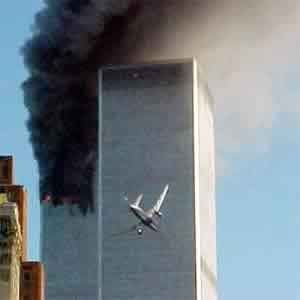
In particular, am I correct that your statement that "a 767 will of course have no difficulty penetrating a single layer of Aluminium at substantially greater speeds" is a reference to what is apparently seen below?


th_wtc_airplane_crash.jpg


If what is shown above is what you are referring to in your quoted statement, then I have reason to believe the reference it contains to "penetrating a single layer of Aluminum" appears to be highly misleading, to put it no more strongly than that.

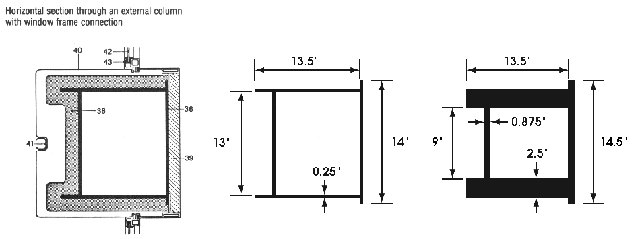
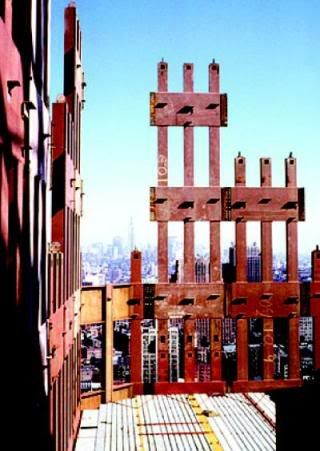
As the following diagram and photograph illustrate, the perimeter wall structures were assembled from pre-fabricated steel units consisting of 3 column sections and 3 spandrel plate sections welded together. Adjacent units were bolted together: steel column sections were bolted to adjacent columns above and below, and spandrel plate sections were mated with adjacent sections on either side with numerous bolts.

There were 59 perimeter steel columns on each face of the towers, and one column on each corner bevel, making a total of 240 perimeter columns in each tower.

Like the core columns, the thickness of the perimeter columns tapered from the bottom to the top of the towers. The illustrated cross-sections represent columns near the top, and near the mid-section of the towers.

col_dimensions.gif


This diagram shows horizontal sections of the Twin Towers' perimeter columns. The leftmost figure shows a section of a column, its enveloping insulation, and the aluminum cladding with window frame conections.

Clearly, the perimeter columns were steel, not aluminum:

fig_2_7-1.jpg


To be sure, the thickness of the steel beam perimeter columns tapered with height, but at its thinnist, the beams were <1/4inch steel.

What is the gauge of the aluminum shell of a Boeing 767?
 
Greetings gumboot,

I should like to double-check for accuracy of understanding of the above quote from an earlier post of yours.

In particular, am I correct that your statement that "a 767 will of course have no difficulty penetrating a single layer of Aluminium at substantially greater speeds" is a reference to what is apparently seen below?


Hi jammonius, you're quite right in correcting me for my mistake - the columns of the WTC are of course steel, not aluminium.

My point still stands, however.

The aircraft that hit the Enterprise was an A6M5 Reisen which has a maximum take-off weight of 2,733kg and a maximum speed of 570km/h.

A Boeing 767-200 has a maximum take-off weight of 142,880kg and a maximum cruising speed of 913km/h.

To emphasise the signfiicance of these differences, at the maximum cited speeds and weight, we can calculate the KE of each aircraft as KE = mv2
For the A6M5

KE = 2,733kg x 158m/s2KE = 2,733 x 24,964
KE = 68,226,612J
KE = 68MJ

For the B767

KE = 142,880kg x 253m/s2KE = 142,880 x 64,009
KE = 9,145,605,920J
KE = 9,145MJ

In other words a B767 has 134 times as much kinetic energy as an A6M5.

Now what does it need to penetrate?

The USS Enterprise had a 4 inch hardened steel armour hangar deck. Above this was a thinner steel deck with a six inch wooden flight deck bolted to it. Beneath the hangar deck, a further five steel decks were penetrated. These were unarmoured so we can assume a thickness of 1/4" or so, like the under-deck of the flightdeck.

That means, all up, the A6M5 managed to penetrate about 6" of wood and about 5 1/2" inches of steel, 4" of which was specially hardened armour plate.

To enter the WTC, a 767 only had to penetrate two layers of perimeter column web plates and one spandrel plate. Even at the very base of the towers this thickness did not exceed 6"; at the higher levels, where the aircraft impacts occurred, this was more like 3/4". The steel was all regular high-grade construction steel, not armour plate, the perimeter columns made of slightly higher grade than the spandrel plates.

The 767 had over two orders of magnitude more kinetic energy, but was required to penetrate about one order of magnitude less steel. Clearly penetrating the WTC was not going to be an issue.

 
Thread split to move the large "no plane" derail to a separate thread, so as not to further detract from the subject matter of the opening post in this thread. Carry on.
Posted By: LashL
 
Last edited:
in fact gumboot, the KE of the fuel load alone of the 767 is greater than the entire Japanese aircraft, or one might note that ONE engine of a 767 is twice the mass of the A6m5 and the 767 was moving 1.6 times as fast giving it (just the one engine) a KE more than 5 times greater than that of the A6M5
 
Last edited:
Didn't Ryan Mackey and Ron from Hardfire try this stupid Kamikaze attempt of debunking already?
 
Yes, they showed if an object had a large enough mass (like LastChild) it will break through steel.
 
Didn't Ryan Mackey and Ron from Hardfire try this stupid Kamikaze attempt of debunking already?

Well there was this stupid poster in that thread you're on about:

You claim that a plane with a bomb on it first impaled the USS Franklin and then the bomb that was on said plane exploded after the penetration?

Fine.

Where were these explosives? Was it just a bomb the plane was carrying? Didn't kamikazes also pack the nose of their planes with explosives? How would you know? How could you know how many and when they went off? After all isn't the model of the plane used still debated to this day never mind what it was packing?

Fairly evident that this poster hasn't any idea what s/he's talking about. The questions asked are fairly common knowledge and the answers are very easily found. One has to really want to know the answers though, I suppose.
 
Last edited:
Yes, they showed if an object had a large enough mass (like LastChild) it will break through steel.

like LastChild? LastChild was great. I just got done reading the no-sounders thread. Go to google and type in (forums.randi.org Lastchild). It's hilarious. I've read all his/her stuff I think. What's your favorite?
 
Greetings gumboot,


What is the gauge of the aluminum shell of a Boeing 767?

See. That's where you will never get it
120 tons of mass moving at or around 500 knots whether it be feathers or aeroplane is going to move a LOT of structure.

Isn't it time that you went to school ?
 
A World War II Kamikaze attack isn't what is claimed to have happened on 9/11. Don't you debunkers have any real comparisons?
 
A World War II Kamikaze attack isn't what is claimed to have happened on 9/11. Don't you debunkers have any real comparisons?
yes, we have all the other times large passenger aircraft were intentionally slammed into skyscrapers at high speeds
 

Back
Top Bottom