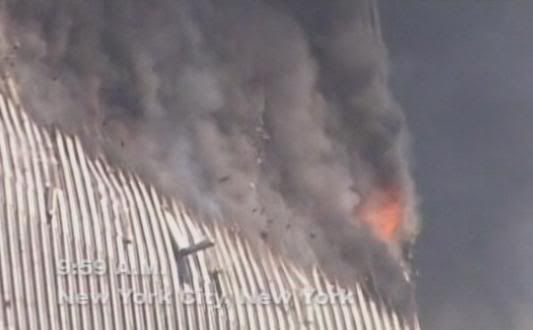
David Chandler Proves that Nothing Can Ever Collapse

Your long winded posts sound like a desperate defense lawyer's brief.

If you cannot answer each question competently, what I stated was a point-by-point engineer's disproof of your nonsense.

Nothing "lawyerly" about it.

The problem with what they are usually saying, and with what you are saying, is that it is unprovable, because it is not what happened ...

Are you ******** me??

"It's unprovable because it's not what happened..."??

You are using your craptastic CONCLUSIONS to determine what arguments are & are not "provable"??

I used nothing more controversial than F=ma, and the definition of stress.

and is only intended to maintain some level of doubt in people's minds.

You say... as you refuse to answer any of my engineering comments.

Transparent & incompetent, Tony.

One has to be brain dead not to realize that, due to it's total lack of deceleration and velocity loss ...

There WAS a deceleration. It fell at 0.7Gs, Tony. That means that it had an average deceleration of 0.3Gs.

The velocity losses were tiny and far too short term for your coarse, crude technique to detect. Precisely because the upper mass was so huge, and the connections so weak in comparison.

Your "force amplification", "mass amplification", etc. are simply figments of your confused imagination. Everything that happened can be explained with simple, sophomore engineering mechanics.

For some unfathomable reason, this seem to be beyond you.

Prove me wrong. Answer my technical comments. One by one.

... the upper section of WTC 1 could not have been the cause of the destruction of the lower section of the building.

Gee, now that you've made it clear that this is your STARTING PREMISE, I can see where you get all twisted up in your own nonsense. Perhaps you do better if you left the conclusions until the END of the analysis.


Tom
 
Last edited:
There are plenty of problems with the NIST story and Bazant's theory.

GREAT!!!! Woooo Hoooo!!!

Now what peer reviewed engineering journal anywhere in the world, in ANY LANGUAGE will be running your indepth analysis?

Come on tony. Man up.

Either produce a paper which shows they are wrong and get it published in a REAL peer reviewed journal or STFU.

Personally I think you should do the first one. I know that I am eagerly awaiting it.
 
I'll tell you what I'll do, Tony - when I'm at work tomorrow I'll draw up a couple of free body diagrams (since you seem to be unable to do that yourself) and write up an explanation. I do the same thing for the junior engineers and interns at our company when they have questions about physics and engineering. It seems this is the only way to get you to see your error.

Thank goodness! I'll be anxious for Tony to resolve this matter, since the general physics I class I am TA for right now is doing a lot of free body diagrams and the like, and I want to be sure to set them right on the use of Newton's second law. 'Cause I done been tellin 'em all that you sum the forces on the left hand side of the equation and put "ma" on the right hand side, and if the object ain't acceleratin' you say that the sum of forces = 0. Leastin' that's what the book says... ;)
 
First, any impulse in a collision between floors in the towers of just 1 millisecond would be indicative of a deceleration of about 500g's. So your math is not right here.

Point out where I said this post was directly related to the numbers I mentioned before. It wasn't meant to be.

An impulse capable of breaking up the lower structure would probably be in the 6g and 90 to 100 millisecond range.

Show me the calculation, please :)

We are actually measuring every sixth frame or 167 milliseconds not .05 seconds or 50 milliseconds as you state.

Which is actually a lot worse for you.

However, nobody is trying to measure the impulse. During the impulse kinetic energy is transferred and velocity is lost. It is the velocity loss that is looked for, which would indicate an impulse had taken place, and it takes time for the lost velocity to be recovered to what it was pre-impact.

No. The total acceleration of the upper block between the two frames you look at would have to be greater than the velocity loss.

In the case of the towers this recovery to pre-impact velocity would have taken about 800 milliseconds, during which several measurements could be made. These measurements show no velocity loss occurred indicating there was no impulsive load.

Show me the calculations, please.

McHrozni
 
Hey Walkyrie,
Are you calling Richard Gage a liar. Please don't. The twin towers fell at 2/3rd's freefall speed. And that is as close to freefall speed as it is to 1/3rd freefall speed, which is why the ae911truth like to say its "nearly freefalll speed". Tony Szamboti clarifies it nicely below.

Actually, Box Boy usually gets it better than that these days; he mostly says near freefall acceleration (not speed). He's stupid, but he does learn eventually when we correct him on these basic points.
 
...... it shows there are very serious problems with the current official explanation for the collapse of WTC 1.

If you don't want to face reality don't read it.


There are not just serious and grave problems with the NIST report , the NIST report ACTUALLY is just a bunch of LIES to help with the cover up of the controlled demolition disintegration Explosions that blow-up the World Trade Center on 911
 
Therefore the downward force exerted by the falling
block
must also have been less than its weight.

Remind me again what the scientific definition of "weight" is?
 
Today I was watching some news reports about the earthquake in Chile. Yes. There was an earthquake in Chile. Were some of you not off this forum long enough to hear about it?

Anyway they showed some footage of a church tower. The top of which broke off and tumbled into the street. Now maybe I should use this as a comparison to 9/11. I should say that because the top once compromised it should have crushed the rest of the tower below it and destroyed the rest of church as well. But that would be ridiculous.

But then again I am not a debunker. I also won't be bringing up any models of Popsicle sticks or cardboard towers for that matter.

What was the height to width ratio of the church tower? What was it's construction?

If you were not a truther you might understand that these questions are important and that church towers and pizza boxes are not very good models for the WTC towers.
 
Last edited:
Now that I actually bother to read this, it is amazing how amateurish this paper is, even to someone who knows very little about physics. Take this figure from page 5:


OK, first off he takes what little precision he has in measuring the vertical and skips every 5 frames, thereby smoothing over any possiblity of observing his "deceleration",
So, either he is massaging the data to make sure he gets the conclusion he wants, or he is a complete idiot. Actually, it appears that both are true.
but where are they getting these measurements? They are only making 5 measurements per second, but they have 2 decimal points of precision. Then for the vertical, they are measuring pixels on a compressed YouTube video taken from hundreds of meters away from the twin towers, using an unknown camera, yet they claim to have a precision to a thousandth of a meter? They can really measure the collapse to the millimeter?

Then their velocity is also carried out to the thousandth, despite the fact that neither of the measurements that went into it are even precise to one decimal point.

Didn't they teach this kind of thing in 5th grade math?

ETA: Then on page 8 they use this completely false precision and come up with even more false precision:

We are talking about (I assume) US public schools, so it's entirely possible he didn't get anything about precision or dimensional analysis until college.

To the best of my recollection (which may be hazy after 3-4 decades), I got very little if any instruction in significant digits, precision or dimensional analysis in math class. These topics, however, were covered very well in some of my science classes, high school chemistry and physics in particular.

That somebody who is supposed to be an engineer gets stuff this basic wrong, however, is truly amazing.

ETA: My US public school education happened in the '60's and '70's when some US public schools were still functional. There were signs of rot even then.

These days, there are pockets of decent education in the US Public schools, mostly in the more affluent districts, but, for the most part, you are lucky if graduate from high school knowing how to read and write (probably not with good grammar) and maybe do some arithmetic.
 
Last edited:
I don't even mind so much that he doesn't understand simple concepts - it's that he's such an arrogant ass while misunderstanding those concepts that makes me laugh.
Were he not so arrogant, watching an engineer confirm his ignorance of high school physics would just be kinda sad.

Feckless arrogance rocks.
 
We do know that in impulsive collisions of building sections both the upper and lower sections are simultaneously destroyed so the dynamic loading would not be available long enough for it to continue the destruction to the ground.

Can anybody make some sense of this sentence? Tony seems to be suggesting that just destroying the lower section isn't enough to stop it supporting the upper section, and that the dynamic loading needs to be prolonged after the lower section has been destroyed. Do unsupported objects simply screech to a halt, LoonyToons style, then hang in the air, in Szamboti world?

Dave
 
Please tell me what engineering concepts I am not grasping.
If you're supporting Chandler you don't even understand the difference between mass and weight. And it's already been shown you have no idea about gravity either.

Do you still think the floor assemblies could carry 725 lbs per square foot? :rolleyes:
 
Your history of engineering howlers is so well-established that you're not going to get anywhere by arguing from your personal authority. You'll have to offer a technical argument that holds up under examination by competent people, aka peer reviewWP.
Peer review? You may as well ask Tony to get in a cage with an enraged starving grizzly bear. Both requests are equallly terrifying to him.
 
Sag1.jpg


what is that sticking out of the building in the middle there? it is a column cover?
 
Can anybody make some sense of this sentence? Tony seems to be suggesting that just destroying the lower section isn't enough to stop it supporting the upper section, and that the dynamic loading needs to be prolonged after the lower section has been destroyed. Do unsupported objects simply screech to a halt, LoonyToons style, then hang in the air, in Szamboti world?

Dave

I think he's saying that the crushing mechanisms absorb the energy of the collapse and the structure reaches equilibrium before total collapse occurs. I suppose that's possible in some structures, but it's clearly not what happened in the WTC towers.
 
I think he's saying that the crushing mechanisms absorb the energy of the collapse and the structure reaches equilibrium before total collapse occurs.

That may be what he thinks he's saying, but there's no way to read that meaning into the words he uses. It worries me, sometimes, that Tony's cognitive dissonance repeatedly causes him to come up with statements that are so obviously absurd that they're laughable, yet he can't see anything wrong with them. There's a classic example on page 1 of this thread, where he asserts that the collapse of the towers was not a dynamic situation. It can't be healthy in the long run.

Dave
 
Tony Szamboti said:
The deceleration of the upper section is indicative of the load it is applying.
This sounds stupid.

Shouldn't the deceleration depend on the resistance provided by the lower part?

Seymour,

It ain't you.

The cornerstone to Tony's (and Heiwa's. and Chandler's) rap is to be intentionally confusing with his terminology. That ain't an accident. (And it is precisely what pisses me off about Tony. This amounts to willful "techno-bullying" by these bozos of the non-tech crowd. And I hate bullies.)

Just as soon as anyone is simple, clear & consistent with their terminology, all of the mystery evaporates. This is exactly why Tony will never be clear. Will not be consistent. And will not define his terms.

Tony constantly intermingles the concepts of average accelerations with instantaneous ones, average forces with instantaneous ones, time-average stresses with instantaneous stresses, and spatially average stresses with local stresses.

In each of these cases, the dynamic, short term, instantaneous values can be much, much greater than the time-averaged or spatially-averaged values. And in fracture mechanics, average values don't mean squat. Only the instantaneous & local values of stress determine whether or not something breaks.

In this particular case, the use of the word "deceleration" is deceptive. The correct use of the word "deceleration" means that a velocity is getting smaller.

In this particular case, he is talking about the downward velocity of the upper block.

Is Tony talking about "average velocity" or "instantaneous velocity"? He is never clear. But the answer is clear.

His data is so coarse (taking one position data every 150 msec), he can only speak about really gross "average" velocity.

And that velocity is not decreasing. From the moment the collapse begins, it only increases from zero, then levels out to a steady state (i.e., "terminal velocity"). At no time does this average velocity decrease. Ergo, there is NO deceleration of the upper block. There is only acceleration. (Acceleration in the downward direction. But this is NOT, by any definition of the term, "deceleration".)

For the short period of time (about 5 - 10 seconds, perhaps 30 - 50 stories or so) that the block is accelerating downwards, the average resisting force is less than the weight of the upper block. And BECAUSE the average resisting force is less than the weight, the block keeps accelerating. And it accelerates UNTIL the average resisting force equals the weight of the upper block.

Once this "force balance" situation has been reached (i.e., average resisting force = weight of the upper block), then the block accelerates no more, but maintains a constant downward velocity, i.e., "terminal velocity".

Notice that the block starts out with a low velocity and high downward acceleration. As the velocity increases, the average resisting forces increase, and the resultant downward acceleration of the block continuously decreases.

Once the block gets moving, if you want to slow the block down, then you must exert a force on it greater than its weight.

If you want to bring it to a halt in a short period of time (i.e., a short distance), then you've got to exert a force on it much greater than its weight. The shorter the distance in which you want to stop it, the higher the force that you've got to exert on it.

Once it gets moving, if you want to stop it in a distance that allows the stopping columns to survive (i.e., perhaps a couple of inches or so) and the descent to arrest, then the forces you've got to exert on the upper block are enormous. The columns of the lower block cannot generate those forces. And the columns of the upper block cannot withstand them either.

This is precisely what Bazant proved.

The reality is that there is no practical way to get those forces into the columns. And applying these levels of force to any other part of the structure (i.e., the wafer thin concrete floors or the delicate trusses) simply fractures them effortlessly.

And the collapse continues. Just like we saw.

Is this explanation (of the acceleration & forces) clear?

Tom

 

Back
Top Bottom