• Quick note - the problem with Youtube videos not embedding on the forum appears to have been fixed, thanks to ZiprHead. If you do still see problems let me know.

Magnetic reconnection and physical processes

This has all to do with your weird idea of "curled," where ever did you come up with that?

I asked you earlier in the thread what made the magnetic lines spiral into a tube.

You are hopelessly mixing various statements into an incomprehensible whole that you try to sell as "my" notions. That kite does not fly. And neither is this a "retreat."

Well, it's certainly "confusing" to say the least. Evidently you don't believe the "flux tube" will form in a "vacuum", so where exactly does that leave us now?

A "Birkeland current" does not form "only" in the Earth's upper atmosphere as you suggested earlier, it occurs "everywhere in nature", at least everywhere that "currents" flow through plasma. Even by your definition, there is "current" flowing in and trough the "magnetic line". It is therefore much more logical to assume that the "currents" are "reconnecting", not the "magnetic lines".

When you refer to a "topology change", between "flux ropes", you're also describing a "topology change" between macroscopic circuits. This is like claiming a magnetic field topology change during a lightning discharge event is evidence of "magnetic reconnection". It's the "current flow'' that drives the parade, and you simply have the cart before the horse. That "surprise" you folks had when the loops "collapsed" is directly related to the fact you're ignoring the circuit energy, and the "circuits" that sustain them. The moment the current stops flowing, the loops have nothing to do but cool off, and the heavier materials in the loops (like the iron we see emitting light from the loops) collapses back to the photosphere.

Actually T, I'm not trying to twist your words nor ignore anything. It seems to me however that you're simply "ignoring' the electrical activity inside the loop, and the "twisting/curling/spiraling effect" of your flux tubes is a classic example of an ordinary Birkeland current. There's nothing "reconnecting" except the "circuits" that sustain the magnetic ropes. That circuit topology changes over time as the electrons flowing through the rope take a path of lesser resistance to the photosphere. The only thing "reconnecting" are the two circuits, and the "magnetic fields" (not lines) spiral around the tube like any ordinary Birkeland current. The currents reconnect, not the magnetic fields. You're still ignoring the current flow inside the flux tube that sustains the tube. It should not be a surprise that the coronal loops can "collapse", because it's not JUST the magnetic field that sustains the loop, it's the "current flowing" through the plasma of the loops that sustains the loop.
 
Last edited:
If you look at Cosmic Electrodynamics by Alfven and Falthammar you will see what a flux tube is in 3.13.1 figure 3.18 (a). That is just a collection of field lines, they write: Consider a cylindrical flux tube (Fig . 3 .18 (a)) with length l and radius R << l.

That's technically where the quote ends by the way. The rest is stuff you're "interpreting" (incorrectly I might add) into the conversation.

Now this field B = Bz, the z-component of this field is curl free and thus there is no current in along the field.

What?

Let's look at the part of Alfven's comments that you quoted and put them into some context, shall we?

3 .13 .1 . Stability of twisted magnetic flelds

An originally homogeneous magnetic field in a conducting fluid may
become twisted by motions of the fluid . From the analogy between
magnetic field lines and elastic strings one can qualitatively expect
that sufficient twisting should make the configuration unstable for loop
formation . As such loop formation may be of importance for maintenance
of cosmic magnetic fields (§ 3 .14.3) the stability of twisted
magnetic fields is of some interest.
An order-of-magnitude estimate of the condition for instability for
loop formation can be obtained by the following simple argument
(Alfven, 1950) . Consider a cylindrical flux tube.....

Emphasis mine. At no time did Alfven suggest that there was no current flowing through the flux tube. You somehow "interpreted" that part in there all on your own in spite of what he actually claimed and actually said. How did you get the idea that there was no current flow involved?

Now this field B = Bz, the z-component of this field is curl free and thus there is no current in along the field. Also it can easily be that the tube is empty and there is only magnetic field.

That's clearly NOT the case in Alfven's actual example from the book. There is in fact a current flow in the loop and around the loop, and the loop is created by the movement of charged particles. The whole thing takes place inside of an actively "conducting" (not conductive) fluid. He's simply trying to calculate kink stability at that point and finds it easier to describe it from a B orientation. The notion however that there is no "current flow" in his example is simply a misconception on your part.
 
You're so full of it. I "understand' that an electrical discharge is not a "magnetic reconnection" event. Evidently Alfven didn't understand even a little bit of physics either because he called "magnetic reconnection" of form of "pseudoscience" and he invented MHD theory. But you're some much smarter than Alfven aren't you?


All that whining because someone's busted you on your inability to understand physics? Well fortunately for you there's been plenty of time for you to work up a reasonable, scientifically sound, quantitative reply to this...

The "circuit/resistor" approach explain that heating process quite nicely, but you seem to have no way to explains that heating process via "magnetic reconnection', unless you've claiming the loop is "magnetically reconnecting" within itself!

Okay. Go for it. Do something you've never done in all your years. Explain it quite nicely using the "circuit/resistor" approach, quantitative, like real science. No pretty pictures allowed. You have an opportunity here to show people that you're not in grade school anymore. Show your work.


Remember how we waited? Well show us what you've got, Michael. And use real physics, real numbers, make it an explanation that fits with the known laws of the Universe and one that some professionals in the field of physics actually understand and agree with.

So are you going to just let this claim become another one of your lies? Or another demonstration of your ignorance? Or will you explain quite nicely, using the "circuit/resistor" approach, how a single coronal loop reaches millions, sometimes tens of millions of degrees?


Or will we keep on waiting because you can't explain it even though you said you could?

As I said before, your ignorance is one Hell of a useful argument when you can't really do what you claim you can do. What's that word that means you've said something you know is not true?
 
Originally Posted by brantc View Post
If you think about it a process or problem should be describable in plain English(physical principles). And then you could derive a formula to quantify it.
As nice as that would be, it is an unreasonable expectation, and possibly one of the reasons you find this stuff so difficult to understand. It's like Michael Mozina's appeal to pretty pictures method of doing science. It is doomed to failure from the start, as can be seen from the fact that using that method, he has never once succeeded in understanding physics. Not even a little bit.

This stuff is not difficult to understand applying regular physics and understanding this in terms of physical effects. The hard part is working through Maxwells for the quantification.

I know how magnetic fields behave through experimentation. I then describe what I see and then come up with an equation, like Faraday(well maybe not that bright!). You can use math to make a prediction, but that is not always correct, in fact alot times that fails and you have to iterate..

Where as if you make observations and then connect them together using math you stand a better chance of describing reality.

Pictures are a big part of science.
What you are talking about is the interpretation of pictures. i.e. what kind of camera, the area, the measurements of the phenomena taken from knowledge of the area viewed.

There can be generalization based on the idea that most parties have some basic physics foundation and can interpret the pictures in some consistent fashion.
Or there can be specific details discussed to quantify a theory.

Both are valid upon previous agreement!!!!
 
Where as if you make observations and then connect them together using math you stand a better chance of describing reality.
You do realize that that is the reason why astronomers describe solar flares and some events in magnetospheres using magnetic reconnection models?
They observe that
  1. there is strong magnetic activity along with electrical currents,
  2. the configuration of the magnetic fields is consistent with magnetic reconnection, e.g. a null X point,
  3. the time scale for energy release is not consistent with other hypothesis such as induction from currents,
  4. the energy released is of the order of magnitude of the energy in the magnetic fields, not the energy in the currents.
They connect these observations together using math and so stand a better chance of describing reality.
 
I have never claimed you can get a flux ROPE (not tube) without current.


So if I say flux rope then that implies a current but if I say flux tube there is no current involved??

So a flux rope is a flux tube with plasma inside it???
 
So if I say flux rope then that implies a current but if I say flux tube there is no current involved??

So a flux rope is a flux tube with plasma inside it???
No. As tusenfem stated in previous replies to you:
A magnetic flux tube, in principle, is just a bundle of field lines, for which the magnetic flux through the start and end surface is the same, period, end, no further, that's it, final, nothing more to write down.
...

Now as soon as plasma is present, then there can be extra currents, e.g. driven by the EMF of the shearing footpoint motions of the flux tube, and these currents create a flux rope structure.

And the electric field comes from ...

Flux tubes may contain plasma flows. A flux tube is just a bundle of magnetic field lines B, nothing more nothing less, defined in such a way that a surface perpendicular to the field, which moves along the field lines, shrinks or stretches with the field lines, in such a way that the product BS remains constant. That is a flux tube, which may or may not contain plasma.

If the footpoints get sheared or twisted, then an EMF is generated (see Alfven for example). I have no idea what you mean with "at the solar equator" flux tubes come out all over the sun and mainly in the band with sun spots.

I do not understand what you mean with "a twisted pair" which you say is "living on the day line of the magnetopause". Why a "pair"? I can just have one flux tube, which can get twisted into a rope by current flow through the tube.
 
If it's continuous, how does it 'disconnect" and then "reconnect" to some other field line? [qimg]http://www.internationalskeptics.com/forums/images/smilies/confused.gif[/qimg]

I brought up this example to try to get you guys to see how nonsensical your arguments against MR are. This is a perfect example: "how can contour lines reconnect if the slope is continuous?"

But they can reconnect, as is obvious if you think about it just for a second. And that reconnection means something physically (although of course something different than for B field lines).
 
No. As tusenfem stated in previous replies to you:

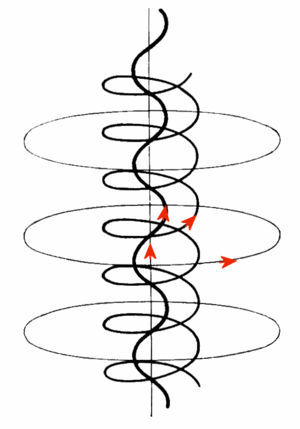
His answer is bogus RC because there is no "flux tube" of magnetic lines without the current flow of the plasma, and no way to achieve a 'flux tube" without plasma and without current flow. Let's see you create a couple of "magnetic flux tubes" in a vacuum and make them "reconnect" in the vacuum, and then tell me that there is any merit to tusenfem's definition. The physical "cause" of the "flux tube" is the "current flow" of the "Birkeland current".

http://en.wikipedia.org/wiki/Birkeland_current

300px-Magnetic_rope.png
 
Last edited:
All that whining because someone's busted you on your inability to understand physics?

You evidently "busted" Alfven's view of physics too eh?

Well fortunately for you there's been plenty of time for you to work up a reasonable, scientifically sound, quantitative reply to this...

Why? Since when did the scientific legitimacy of any scientific theory rise and fall on the math skills of yours truly? Get a grip. Your attitude is pure "ignorance on a stick" because you seem to think I personally need to be your math mommy or it doesn't count. Did you read *ANY* of those papers on macroscopic "circuits" in the solar atmosphere?
 
So if I say flux rope then that implies a current but if I say flux tube there is no current involved??

So a flux rope is a flux tube with plasma inside it???

They're playing games with words again because they are completely busted. The helix shape is a *CLASSIC* (and I mean *CLASSIC*) formation in plasma that you can see in any functioning plasma ball on Earth. It's not mysterious, and it's "cause" is the "circuit energy" that ultimately sustains it. The moment the current stops flowing the "magnetic lines" go away and the process stops.

The reason they were so "surprised" that the coronal loops could "collapse" in those Hinode images is proof of the fact that they just don't "get it". They keep trying to treat the "flux tube" as though it is some kind of rigid magnetic tube rather than a common ordinary plasma filament. That's their basic problem in a nutshell and all their "surprises" relate back to that same issue.

The shape of the "flux tube" is directly related to the current flow within the tube. It could not and would not form into that shape without the current flow. The "flux tube" is a classic MHD feature, and it's directly related to a current carrying filament.
 
You do realize that that is the reason why astronomers describe solar flares and some events in magnetospheres using magnetic reconnection models?
They observe that

[*]there is strong magnetic activity along with electrical currents,

Duh. There are strong magnetic activity in any electrical discharge in the Earth's atmosphere too. Is that "magnetic reconnection"?

[*]the configuration of the magnetic fields is consistent with magnetic reconnection, e.g. a null X point,

BS. There is no "null point" in the first place. It's a "current carrying filament" that can "short circuit" anywhere, not just at a null point. In fact you folks threw out the whole "null point" concept weeks ago! The null point is irrelevant in those magnetic examples you've been harping on. What "null point" is required in any of those magnet examples you've been tossing into this discussion?

[*]the time scale for energy release is not consistent with other hypothesis such as induction from currents,

More BS. You folks have never seen a coil in action evidently. You've also never seen an electrical discharge in the Earth's atmosphere before I guess.

[*]the energy released is of the order of magnitude of the energy in the magnetic fields, not the energy in the currents.

Willfully ignorant BS. Again you simply didn't read or didn't respond to the paper on Macroscopic circuits I posted earlier. The energy release of the flare is directly related to the 'circuit energy".

They connect these observations together using math and so stand a better chance of describing reality.

You ignored the math I provided, and your definition of "reality" isn't even close to "reality". In "reality", a "discharge" is not a "magnetic reconnection" event, and in "reality", magnetic lines cannot and do not "disconnect" or "reconnect' to other lines. Only "circuits" can reconnect. Your whole argument is simply absurd, particularly that pathetic comment about the energy not being related to the current after I just provided you with a paper that directly linked the two! You're in complete and total denial on that point, as well as that claim about the energy release rate somehow favoring your ideas. Nothing could be further from the truth. In fact that propagation speed is ultimately going to sink your ship because Bruce has already linked that speed of the event with discharges in an atmosphere. There's nothing unique or unusual about a discharge releasing energy quickly. It happens here on Earth every single day.
 
Last edited:
That's technically where the quote ends by the way. The rest is stuff you're "interpreting" (incorrectly I might add) into the conversation.

What?

Let's look at the part of Alfven's comments that you quoted and put them into some context, shall we?

Emphasis mine. At no time did Alfven suggest that there was no current flowing through the flux tube. You somehow "interpreted" that part in there all on your own in spite of what he actually claimed and actually said. How did you get the idea that there was no current flow involved?

That's clearly NOT the case in Alfven's actual example from the book. There is in fact a current flow in the loop and around the loop, and the loop is created by the movement of charged particles. The whole thing takes place inside of an actively "conducting" (not conductive) fluid. He's simply trying to calculate kink stability at that point and finds it easier to describe it from a B orientation. The notion however that there is no "current flow" in his example is simply a misconception on your part.

Just for completeness, I here copy the whole section 3.13.1

A&F said:
3 .13 .1 . Stability of twisted magnetic fields

An originally homogeneous magnetic field in a conducting fluid may become twisted by motions of the fluid . From the analogy between


here should be figure 3.18, where in the left panel there is a bundle of straight field lines and the right hand panel the field lines twisted and a "curl" in the field lines is created

FIG . 3 .18 . Illustration of look formation in a twisted magnetic field.
(a) Flux tube before twisting . (b) Flux tube after formation of a loop.


magnetic field lines and elastic strings one can qualitatively expect that sufficient twisting should make the configuration unstable for loop formation . As such loop formation may be of importance for maintenance of cosmic magnetic fields (§ 3 .14.3) the stability of twisted magnetic fields is of some interest.

An order-of-magnitude estimate of the condition for instability for loop formation can be obtained by the following simple argument (Alfven, 1950) . Consider a cylindrical flux tube (Fig . 3 .18 (a)) with length l and radius R << l . If it is twisted at one end through an angle φ, there is created an azimuthal magnetic field of strength

Bφ= (rφ/l) Bz, ( 3 )

where Bz, is the axial field strength . The total magnetic energy of the tube of force is thus increased to the value

WM = (l/8πμ) Int0R[(B2φ + B2z)2πr] dr = (B2z R2/8μ) (l + R2 φ2/ 2l). (4)

If the flux tube is deformed by loop formation as shown in Fig . 3 .18 (b), the length is increased by at least Δl = 2πR. At the same time the twist changes by the amount φ = - 2π . As, in the incompressible case, which we consider, the volume πR2l remains unchanged, the radius changes by ΔR = —RΔL/2l = -πR2l . As the flux πR2Bz remains
constant, the magnetic field changes by ΔBz = 2πBzR/l . If now the changes in l, R, and Bz are introduced into (4), one finds that the forming of the loop implies a decrease of magnetic energy if

φ > (sqrt(5)-1)1/R. (5)

This is the approximate criterion for instability.

Quantitative analyses of the problem have been performed by Lundquist (1951) and by Dungey and Loughhead (1954).

In a cylindrical coordinate system with coordinates r, φ, and z (and
unit vectors r, φ, and z) we can write the twisted magnetic field

B = Bφ(r)φ+Bz(r)z . (6)

The lines of force lie on cylindrical surfaces and form the angle

Ψ ~ arctan(Bφ/Bz) (7)

with the axis, and the pitch is

p =2πrBz/Bφ. (8)

The magnetic force is radial and in equilibrium it is balanced by a radial pressure gradient.

For a perturbation characterized by a deformation which, in Cartesian coordinates, x, y, z, has the form

ξ = A cos(bx) sin(az) x+ C sin(bx) cos(az) z (9)

with C/A = —b/a (incompressibility), Lundquist calculated the total change in magnetic energy and found the following condition for negative energy change (and thus for instability) :

Int0R [B2φ r] dr > 2 Int0R [B2z r] dr . (10)

(The energy method has later been developed to a high degree of refinement
: see Bernstein, Frieman, Kruskal, and hulsrud, 1958.)

As a particular kind of perturbation, namely (9), was used, (10) is a sufficient condition for instability, but need not be a necessary condition.

Equation (10) implies that when both axial and azimuthal fields are present, the configuration becomes unstable when the average energy density of the azimuthal field is twice the average energy density of the axial field. As mentioned above, the pinch with its purely azimuthal magnetic field is unstable .

By means of the normal-mode method Dungey and Loughhead (1954) have found that a cylinder with radius R and a uniformly twisted magnetic field (constant pitch p) is unstable if

p < 1/2 R. (11)

Now, this is the WHOLE section copied, and note that the only mention of "conducting fluid" is in the beginning. Naturally they need this, as then the field line foot points are anchored and the flux tube on the left in Fig. 3.18 (reminder just a bundle of straight field lines) can then be twisted to get to the situation on the right in Fig. 3.18.

However, in this whole part there is NO MENTION of currents WHATSOEVER. It is just a very elegant calculation of stability limits.

Now, as usual MM does not really read what is written by other posters, just projects his own ideas into it. This whole discussion was about the definition of a flux tube, like Alfven does with the left part of Fig. 3.18. There we have a bundle of straight field lines, B = B z, and the only thing I claimed was that along the tube there is no current flowing because the z-component of curl(B) (which is given by dBy/dx - dBx/dy, with both Bx and By zero) is zero.

If there is a plasma present, what else is happening? Well, there is a jump in Bz on the boundary of the flux tube as drawn in the left part of Fig. 3.18. This gives rise to a surface current around the tube.

When the Swedes start twisting the field, however, just like in a flux tube at the sun, currents have to be set up, because Bx and By deviate from zero.
 
Duh. There are strong magnetic activity in any electrical discharge in the Earth's atmosphere too. Is that "magnetic reconnection"?
Read the post, MM: only an idiot would think that "solar flares and some events in magnetospheres" are in the Earth's atmosphere.

BS. There is no "null point" in the first place.
BS. I am talking about the measured null point in measured magnetic reconnection events.

More BS. You folks have never seen a coil in action evidently. You've also never seen an electrical discharge in the Earth's atmosphere before I guess.
More BS steming from your ignorance I guess.
I have seen a coil in action. I have seen an electrical discharge in the Earth's atmosphere.
This is so dumb it deserves a separate post.

Willfully ignorant BS. Again you simply didn't read or didn't respond to the paper on Macroscopic circuits I posted earlier. The energy release of the flare is directly related to the 'circuit energy".
Willfully ignorant BS.
I did read and respond to that paper. It is nothing to do with "circuit energy".

You ignored the math I provided, and your definition of "reality" isn't even close to "reality".
Your amnesia is acting up MM.
You have never provided any math. You have cited some papers that have very little to do with this post.
As for ignoring reality - you are in a totally different universe :rolleyes: !
 
His answer is bogus RC because there is no "flux tube" of magnetic lines without the current flow of the plasma, and no way to achieve a 'flux tube" without plasma and without current flow. Let's see you create a couple of "magnetic flux tubes" in a vacuum and make them "reconnect" in the vacuum, and then tell me that there is any merit to tusenfem's definition. The physical "cause" of the "flux tube" is the "current flow" of the "Birkeland current".

http://en.wikipedia.org/wiki/Birkeland_current

[qimg]http://upload.wikimedia.org/wikipedia/commons/thumb/7/79/Magnetic_rope.png/300px-Magnetic_rope.png[/qimg]

This is not a flux tube, as the name of the figure clearly states:
(taken from the img link: Magnetic_rope.png/300px-Magnetic_rope.png)

A frakking Birkeland current CANNOT create the field it flows along, basic electrodynamics.
 
Why not induction + coils are not plasma

First asked 17 February 2010
Michael Mozina,
Did you understand the simple physics in the post Magnetic Reconnection Redux VII by Tim Thompson on 18th January 2010?

Or the later post below evokes this question:
First asked 27 January 2010 by Tim Thompson
Michael Mozina,
Have you figured out the difference between coils and plasma yet?

So let me return to a previous comment:
Originally Posted by Tim Thompson
What is magnetic reconnection?
My authoritative source for the physics of magnetic reconnection is the book Magnetic Reconnection: MHD Theory and Applications by Eric Priest & Terry Forbes, Cambridge University Press, 2000. Let me quote from the introduction (page 1): "As we shall discuss in more detail later on, reconnection is essentially a topological restructuring of a magnetic field caused by a change in the connectivity of its field lines." And in the following paragraph we find this: "The evidence of reconnection in laboratory fusion machines such as the tokamak and the reversed field pinch is so strong that there is no longer any controversy about whether reconnection occurs, but only controversy about the way in which it occurs."
Now, the mathematical formalism which describes the behavior of the magnetic field is the reconnection of mathematical field lines, hence the title "magnetic reconnection". It does not matter at all that the lines may or may not be themselves physically real. What does matter is that the mathematical formalism and the observed behavior of the field are mutually consistent, and they are in fact so. It also matters that magnetic reconnection and induction are easily distinguished, one from the other, as I have already pointed out for the relevant case of solar plasma physics:
Originally Posted by Tim Thompson
Why not induction?
Now, Mozina insists that what we are really seeing is induction. Is this a reasonable assertion? At the level of real physics it appears to be unrealistic. We know that induction is invariably constrained (or unconstrained) by the characteristic diffusion time for the magnetic field in a given environment. Remember that in the process of induction, the magnetic field move with respect to the charged particles, and it is that relative motion between field & particle that determines the transfer of energy from the magnetic field to the particles. Let me quote once again from Priest & Forbes, this time from section 1.1 ("The Origins of Reconnection Theory"), pages 6-7: "For example, solar flares release stored magnetic energy in the corona within a period of 100 s. By comparison, the time-scale for magnetic dissipation based on a global scale length of 105 km is of the order of 106 yrs. Typically, phenomena like the solar flare and the substorm require a significant fraction of the stored magnetic energy to be converted within a few Alfven time-scales. Such rapid time-scales are easily achieved in ideal MHD processes, but not in non-ideal ones. Although ideal MHD processes can release energy quickly, they rarely release a significant amount because of the topological constraints which exist in the absence of dissipation. In contrast, magnetic reconnection is not topologically constrained, and therefore it can release much greater amounts of energy (Kivelson and Russell, 1995)."

The best Mozina could come up with in answer to this was simply ...
Originally Posted by Michael Mozina
Let's look at your silly quote, one that is *EASILY* debunked. ... None of you have ever seen a "coil" in action eh?

That's the extent of Mozina's depth when it comes to thinking about physics. Of course, he had to completely ignore this:
Originally Posted by Tim Thompson
"This is the basic equation of magnetic behavior in MHD, and it determines B once v is known. In the electromagnetic theory of fixed conductors, the electric field and electric current are primary variables with the current driven by electric fields. in such a fixed system the magnetic field is a secondary variable derived from the currents. However, in MHD the basic physics is quite different, since the plasma velocity (v) and magnetic field (B) are the primary variables, determined by the induction equation and the equation of motion, while the resulting current density (j) and electric field (E) are secondary and may be deduced from equations (1.8) and (1.10a) if required (Parker, 1996)."
Priest & Forbes, page 14.

Evidently Mozina has yet to figure out that coils & plasmas are not exactly the same thing.
 
Birkeland currents are not flux tubes

His answer is bogus RC because
...snip Birkeland current stuff...
Once again your ignorance is shown Michael Mozina.
That is a Birkeland current (read the caption) - not a flux tube.

Have you ever looked that the picture itself?
The self-constricting magnetic field lines and current paths in a Birkeland current (or magnetic rope). The current is strongest at the axis and becomes weaker further away. Current flows parallel to the magnetic field, and derives partly from an external axial field and partly from the toroidal field produced by the current itself.
(emphasis added)

Have you ever noticed that the diagram has a citation?
That is to a section in chapter 15 in the NASA document SP-345 Evolution of the Solar System written in 1976 (and so a bit out of date) by some guy called Hannes Alfvén.
This figure has a caption:
FIGURE 15.3.2. Simple model of a filamentary current structure in a low-density plasma. Currents flow parallel to the magnetic field. The lines in the figure represent both current paths and magnetic field lines. The magnetic field derives partly from an external axial field and partly from the toroidal field produced by the current itself (see Alfvén and Fälthammar, 1963). The current is strongest at the axis and becomes weaker further away from the axis as depicted by the decreasing thickness of the lines.
(emphasis added)
 
Last edited:
Why? Since when did the scientific legitimacy of any scientific theory rise and fall on the math skills of yours truly? Get a grip. Your attitude is pure "ignorance on a stick" because you seem to think I personally need to be your math mommy or it doesn't count. Did you read *ANY* of those papers on macroscopic "circuits" in the solar atmosphere?


You claimed, with confidence, to be able to explain something that you appear unable to explain. Either you can explain it or you're a liar. It's up to you, Michael, how you want to leave the issue.

I'd really like to hear your explain how a single coronal loops reaches millions, sometimes tens of millions of degrees Kelvin over a 6000 K photosphere. The "circuit/resistor" approach explain that heating process quite nicely, [...]


See the bolded part? Can you explain it? Or are you lying again? Nobody in this thread believes you can explain it as you claim. But the situation here favors you, Michael. You can keep up your argument by tantrum, or you can show everyone how wrong they are.

(I predict continued ignorance.)
 
This is not a flux tube, as the name of the figure clearly states:
(taken from the img link: Magnetic_rope.png/300px-Magnetic_rope.png)

A frakking Birkeland current CANNOT create the field it flows along, basic electrodynamics.

Before I get into the "long" response, please explain to us how you think an ordinary filament in a plasma ball forms, and how you believe your "flux tube" is physically different from such a "structure" in plasma.
 

Back
Top Bottom