Akhenaten
Heretic Pharaoh

I thought I'd finished with this, but apparently not.



wollery said:I'm afraid that real life has rather impinged on my ability to post over the last week and a half, so I apologise for dragging up something that many of you might have thought was long buried. But not to Rramjet. No, Rramjet, I'm not apologising to you, because I have yet to get a coherent, reasoned response from you about my criticisms of Freidman's "arguments" against SETI.
Your last attempt to deflect the question of the energy required for interstellar flight was an appeal to the theoretical constructs commonly known as wormholes, which I pointed out require far more energy than conventional rockets use to accelerate for 1 year at 1g.
But that question has been answered, so I'll repost the other questions that you have completely failed to answer;
Do you know how narrow the TV and radio signals we use are? Do you know why we use them like that?
Can a radio station tell who has received their Radio broadcast?
Are you suggesting that we shouldn't look because we haven't seen any evidence so far?
Do you know how searches for extra-solar planets might identify signs of life? More importantly, how would they identify signs of intelligent life?
Before our leaders can deal with aliens our leaders need to know that the aliens are there. Who's going to find these aliens and open the channels of communication?
Do you think that a belief that UFOs are alien craft is incompatible with support for SETI?
It's a reasonable question to ask. If they should already be here then where are they? Have they made direct contact yet?
You claim to be a scientist, and to understand the scientific process. So, in your own words, please explain what's wrong with the SETI project from a scientific perspective.
Original posts here, here, and here.
And as a simple reminder, you introduced Freidman's website and asked us to discuss it. I did, and you avoided the discussion.
After all your recent criticisms of other posters' behaviour it would be extremely hypocritical of you to continue doing so, don't you think?
On the northern leg, in this case the target was on radar continually for minutes and they could track it relative to the airplane. True, they couldn't tell by eye how far away it was, but the directions correlated over a long period of time (minutes), which is quite strong evidence.Sorry Rramjet, you haven't conclusively shown how anyone can accurately measure by eye a light source against a black sky and black sea to be able to tell how far away it was to be able to confirm it was the same blip that was on the radar.
Until you can do this, you can not say that there was any radar visual tie up.
First:Of course what Maccabee fails to point out is that although a 100watt bulb is adequate for the minimum requirements, the regulations do not list a requirement of a 100watt bulb... they list a minimum requirement that the light be seen from a minimum distance depending upon the size of the boat. Also fishing boats are required to display a green light over a white light to warn other traffic that they are actively trawling. So once again Maccabee is only giving you the bits that fit his required result.
http://www.boatus.org/onlinecourse/r...ect/info2c.htm
Do some research of your own Rramjet instead of taking the word of someone who either does not know or does not want to you to know.
IF it WAS “blurring” then the green protrusion shown in the photo would be even LESS distinguishable than it is – especially given the above!I would also point out that squid boats are not round like the blurred blob in the photo above... that is a consequence of the picture being out of focus and most likely the reflection is blurring into the light source.
In Ireland's large report (referred to by Astrophotographer), Ireland mentions the satellite photo (that doesn't show a boat fishing in the Pegasus Bay at around midnight). Ireland then he suggests that a hypothetical squid boat could have "turned on" after the satellite went over! This would seem to be an extremely unlikely scenario. What was the boat DOING there all the time…just waiting for the satellite to go out of range? I don’t think so.Cool, then you'll be able to show us the satellite picture with validating documents?... no?... didn't think so.
Before the plane turned 92 deg. to its right, the azimuth was estimated to be 0 deg. (during flying distance of 80+ km)! Only AFTER the turn (when the pilot attempted to fly toward the UFO and found he could not) was the azimuth between 20-40 deg.Then it should have been visible on the Christchurch radar but it wasn't. Klass states Maccabee says that the depression angle for the light was 5 degrees below the plane's fore-aft axis (p. 244). If I read Dr. Maccabee's Applied optics plot right, he describes depression angles of 20-40 degrees at point D. That would be well below the aircraft.
Given that the fleet was 200km to the South East of Pegasus Bay, then any boat going to it would NOT cross the bay… it would travel along the coast. Look on the map! Such a boat would be travelling AWAY from the sighting area.Christchurch is on Pegasus bay. What did the boat do? Leap over the bay?
It was not going to “fish”. It was in transit. Such boats do NOT have their “fishing” lights on.If the boat went to Pegasus bay to fish, how long do you think they would be out? It would take at least a day from Wellington to get there and I am sure two weeks would not be that long if the fishing was good. There is no evidence that this squid boat did not leave Pegasus bay.
The fleet was 110nm South East of Christchurch. There was also a fleet to the North West of the South Island. Sorry for the confusion.I think you need to get your directions straight. Earlier you said the fleet was East (which is where it is shown on Dr. M's map) now you say West.
“…Lee also arranged for me to speak by phone with the pilot, the cameraman and the air traffic controller. Thus began the initial investigation of the sighting which was followed by analyses that lasted many years. I investigated the sightings by traveling to New Zealand and Australia for a month in February, 1979, to interview all the witnesses, by analyzing the film, and by discussing the sightings with numerous other scientists.” (http://www.brumac.8k.com/NEW_ZEALAND/NZFlashingLight/NZFlashingLight.html)Exactly how often did the pilot change his testimony? Do you have the interviews? Do we have the actual flight path of the plane? I find it interesting that the plot used by Maccabee to refute Ireland/Andrew's plot has the line of sights all pointing to the same general location (just like Ireland's plot) as if the target were stationary until the pilot turns away from the target (sighting line E).
But you have “misrepresented” the sightlines! Note for example your line from “point D” and the line from the second to next point above that. They are drawn completely in the wrong direction!These lines tend to point towards one location as if the target were nearly stationary. If we discount the "E" sighting lines, it paints an interesting picture.
View attachment 16705
Considering the problems with figuring out azimuth values on a moving/banking plane and that we are basing most of this on the memories recalled weeks/months after the event, I think Maccabee's plot is very similar to what Ireland and Andrew provided (this assumes the E lines are erroneous or another light source seen after the bank to port).
What about the efforts of the PEL scientists associated with the P-3 orions just a short while after these events? They demonstrated that AP was quite common. The scientists also noted this when monitoring the radar at Wellington.
And still Rramjet completely refuses to even acknowledge that my questions about Freidman's arguments exist.
Why is that Rramjet?
In reference to: UFOs: Challenge to SETI Specialists
Nuclear Physicist / Lecturer Stanton T. Friedman 5/02
(http://www.v-j-enterprises.com/sfufovsseti.html)
(...)
The questions I posted were rebuttals to you points.I answered you points here:
I made those points in direct reply to your questions and discussion, you are free to rebut them if you like.

I answered you points here:

Given that the fleet was 200km to the South East of Pegasus Bay, then any boat going to it would NOT cross the bay… it would travel along the coast. Look on the map! Such a boat would be travelling AWAY from the sighting area.
So given the sighting occurred at the end of December, Dr Maccabee had already spoken to the pilot etc just a couple of weeks after. Then again in February, just over a month after the event
The pilot was consistent in his recollections of the event.
But you have “misrepresented” the sightlines! Note for example your line from “point D” and the line from the second to next point above that. They are drawn completely in the wrong direction!
And you take all the sighting directions as “accurate” (yet still manage to misrepresent them!) to suit your own purpose – then simply IGNORE the two latter sighting directions! (or start hypothesising “other lights”!
Finally, by extending the radar directions you are essentially using the radar direction information as if you believed the radar was picking up the object (otherwise, why would the radar point in the direction of the object?). But it is clear from the diagram that the radar showed much shorter distances to the object that where your “lines” converge. The radar can't provide the direction to an object (within its range) without also providing a distance.
Hence there is a contradiction in Astrophotographers diagram. He can't have the radar indicating the direction to the HSB without it also providing the range! Simply the radar targets were not as far away as his “convergence area”.

“Both the upper atmosphere balloon data (temperature, humidity) and the tests carried out by the radar technician show that atmospheric refraction could not account for the interesting radar targets even though skeptics claimed that all the anomalous radar targets were the results of atmospheric effects.”
The problem with this argument is that the "normally anomalous" radar targets, presumably the normal ground clutter resulting from normal atmospheric refraction, were appearing and disappearing close to the coast, whereas the targets reported near the airplane were more than 20 miles from the coast where there was no ground clutter.
You just come out of the inlet… and turn right. The direction of your fleet is 110 nm Southeast – for the start of your voyage you travel parallel to the coast to get there. Less than a mile offshore is water deeper than any major vessel could ever wish for. Even very close to the shore is water as deep or deeper than the inlet and harbour. No need to go out into the bay – especially 60+km or more (!) as you contend by the positioning of your SB! I really think you SHOULD have a LOOK at a map of the area before you contend such obvious nonsense as above. (Google maps will give you a good view) Oh, and the harbour is Lyttelton if you were wondering and it is positioned about 8km inside the inlet.Please do. I can not even see what you are saying. Travel along the coast? Why would they travel along the shoreline and risk potential grounding? Why not go out to the open water (the bay) where navigation is easier and free of the shoreline hazards. I am not familiar with the Pegasus bay area but there are usually routes that commercial craft have to follow in and out of a port. Most of them send the ships out into the center of the harbor/bay before giving them free reign to execute their course. It has to do with managing the shipping traffic. Obviously, you are not a seaman.
I guess you didn’t read the statement above that Dr Macceabee had spoken to the aircrew less than two weeks after…and that a mere FOUR DAYS after the event the copilot recorded his recollections of the event on tape!Over a month later. Don't you think the potential for error creeps in with the passage of time?
What the…? Is that the best you can do? Nowhere in ANY of the literature has the pilot’s statements been contradicted or demonstrated to have changed in any way. YOU make the allegation, YOU must provide the evidence. Mere unfounded assertion will remain just that…unfounded! But of course this is an old debunker trick, just sling the mud and hope some of it sticks – who cares that there is no truth to it, just sling it anyway! Someone might believe you!Feel free to present evidence of this.
Ha! “Basic direction” is your code for “drawing inaccuracies to support a preconceived hypothesis”. YOU are the one wanting to “position” the SB. If you cannot do so from the radar data…then you are in a bit of trouble don’t you think. Besides, the radar provides direction AND distance. And those distances STILL do NOT match your “lines”!I just drew the lines with a basic direction. I did not realize you wanted a precise direction in them. It really does not matter, they all point towards the same general location and not away from it.
Huh! It has already been shown that Ireland and Andrews distorted THEIR diagram to suit their hypothesis (ignoring the pilot’s evidence in the process).Sigh....My point of this entire exercise is to
1) Point out that Maccabee's diagram is not much different than Ireland/Andrews with the exception of points shown at E. However, Ireland and Andrew were working from Macabee's original article. Because of what Ireland and Andrew pointed out, it seems Macabee made a few "corrections" to his later image.
Yeah, and that is an object tracking the plane! …and moving closer to it all the while(!), then taking evading action as the plane tried to turn toward it. Besides, your “lines” criss-cross all over the place!2) These sightlines point to one general area as if the light was not moving at all (or moving very slowly), which is contrary to the storyline of the object jetting about.
You keep missing the radar distances! You can extend lines all the way around the world if you like, I am sure they are bound to meet up somewhere! LOL. But they are just lines…you need to account for the distances!If you want to argue about the accuracy of these lines, feel free to redraw them but you will get a similar result (see below). If you want to state these sightlines are not accurate, then you basically are stating that it is impossible to determine where the light was located and just about any information is to be questioned.
According to Startup's book,( Startup, W. and Illingworth, N. (1980). The Kaikoura UFOs. Auckland: Hodder and Staughton), as the plane passed 3000 ft altitude and everyone could now see the bright light…To me, the E sightlines are out of place and are suspect when compared to the others. Exactly what were the conditions of the craft and crew, when these sightlines were made? Was the plane in a bank? Was the crew occupied with something else? Exactly how precise are the estimates? What if the co-pilot (who apparently gave these sightlines) was looking more towards the rear of the craft and earlier in the turn?
Dr Maccabee states that his corrections were made because:The radar data is from memory. We don't have any actual data to work with. The same can be said for the sightlines (Macabee mentions they are estimates). We have no idea exactly when these points actually happened (I think only one is actually recorded in the dialog between Wellington and the plane - pt C). If you look at Maccabee's original plot, he points out the first radar contact was at 28km out. Suddenly, when he wants to refute Ireland/Andrew, he changes this radar contact to having occurred much earlier (less than 20km out and only two minutes after takeoff). Apparently, Dr. Maccabee was not sure when the first radar contact was and only after some reflection (and possibly some persistent questioning of the witness to see if he would alter his time estimates) pushed it back because of the close convergence identified by Ireland/Andrew.
Since you have problems with the way I drew the sketch I posted before, here is a revised one with the lines drawn a bit more carefully. I also added a blue line showing where Maccabee's original plot was for his radar reading. One might be able to see why he decided to alter it after conferring with the witnesses. The projected convergence area changed a bit but it is not significant. The sightlines with the radar data estimates still indicate a target could have been stationary and was not "jetting about".
On the Southbound leg:Well, the only balloon data he presents is for Christchurch. This is a bogus data point since all the contacts came from Wellington radar which was about 180 miles to the northeast. The plane was between Wellington and Christchurch meaning that any sample at christchurch would not be a sample of the atmosphere between the plane and the Wellington radar. It was that atmosphere that affected the radio waves from the radar and not the atmosphere at Christchurch. I thought I pointed this out some time ago.
My question to you is did ANY of those “studies” track a single target for an extended period of time, maintaining both radar and visual identification? No, they did not.Using Maccabee as a catch-all response does you no favors. My question is about the studies done AFTER the incident by the PEL scientists. They observed anomolous contacts out in the ocean and not close to shore (See the photograph by Ireland published in Klass - it shows an AP contact well off the coast where there was no ground clutter). The same thing can be said for the P-3 orion chases. Is there a reason you choose to ignore those who were actually observing and studying the effects of AP on the actual radar? It is completely unscientific.

On the northern leg, in this case the target was on radar continually for minutes and they could track it relative to the airplane. True, they couldn't tell by eye how far away it was, but the directions correlated over a long period of time (minutes), which is quite strong evidence.
First:“A SB does have a green running light. Regulations specify that the running light have a rating of only a hundred watts or so. A photograph a 100 watt bulb at 12 nm under the conditions of this sighting the light would make no more than a faint image on the film, if there were no other lights around. However, the glare of the white lights, totalling several hundred thousand watts of power, would completely cover up the feeble light from the green bulb. Therefore the green "dot" could not be an image of the green running light on the HSB.”(http://brumac.8k.com/NEW_ZEALAND/RADARUFOS.doc)
Second, The 100 watt (or so) bulb can be seen a couple of miles when not competing with a hundred kW or more. But the bright white lights are so dazzling that only a "monster" optical system could resolve a 100 watt bulb (red or green) that would be within a few feet of a group of 10 -20 10 kW bulbs from a distance of a few miles, to say nothing of a distance of 10 miles. Crockett's camera had a 100 mm lens and was not a such a "monster" optical system.
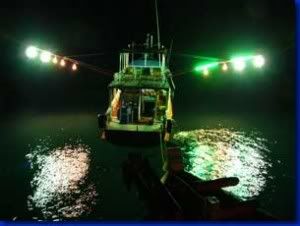
And given your above is incorrect, perhaps you will now reconsider your conclusion in light (no pun intended) of the new accurate information.IF it WAS “blurring” then the green protrusion shown in the photo would be even LESS distinguishable than it is – especially given the above!
If the satellite photo was not taken at the same time as the airplane was seeing a light from that general direction it is entirely possible that a SB could have been between it's active fishing grounds and not lit up to it's full extent. Certainly a lot more possible than an alien flying saucer had come across the universe to mess temporarily with a TV crew. But from what I gather from what Astrophotographer has pointed out, a single squid boat would probably not have shown on the satellite photo anyway.In Ireland's large report (referred to by Astrophotographer), Ireland mentions the satellite photo (that doesn't show a boat fishing in the Pegasus Bay at around midnight). Ireland then he suggests that a hypothetical squid boat could have "turned on" after the satellite went over! This would seem to be an extremely unlikely scenario. What was the boat DOING there all the time…just waiting for the satellite to go out of range? I don’t think so.
Have they the power to reach across interstellar space? I don’t think so… so what is SETI looking for…? It is looking for a directed signal from an ETI. What makes you think an ET would send such a signal, let alone direct it at earth?Do you know how narrow the TV and radio signals we use are? Do you know why we use them like that?
According to the ratings agencies they can! LOL. But what is the context of this question?Can a radio station tell who has received their Radio broadcast?
I am suggesting that given its chances of success, SETI is a massive waste of resources. That’s all. We would be better to follow up the evidence that we are already being visited.Are you suggesting that we shouldn't look because we haven't seen any evidence so far?
Signs of life is easy. Atmospheric chemistry is the clue there. Intelligent life? Well, if we discover a planet with signs of life then we point a radio telescope at it. Simple really. Why waste all the resources SETI does when there are alternatives that hold much more promise?Do you know how searches for extra-solar planets might identify signs of life? More importantly, how would they identify signs of intelligent life?
SETI? Open the “channels of communication”? I like optimism – but this is another WILD assumption! Does ET want to communicate with us? For what reason? They have already demonstrated a singular lack of interest in direct communication.Before our leaders can deal with aliens our leaders need to know that the aliens are there. Who's going to find these aliens and open the channels of communication?
I don’t “believe” any such thing – but the UFO debunkers sure seem to! Again, SETI is a waste of resources. Alternatives are available.Do you think that a belief that UFOs are alien craft is incompatible with support for SETI?
Perhaps they are merely self-interested and they don’t want to risk advanced technology falling into our hands. Perhaps they are ethical beings and realise that (as with our own experience) contact of advanced cultures with primitive ones invariably leads to no good outcome for the less advanced. Perhaps they are doing research and don’t want to “contaminate” the sample. There are many reasons…It's a reasonable question to ask. If they should already be here then where are they? Have they made direct contact yet?
From a “scientific” perspective…? It’s a demonstrated massive waste of resources It’s literally a million(s) to one shot based on a number of unfounded assumptions). There are more promising lines of research available.You claim to be a scientist, and to understand the scientific process. So, in your own words, please explain what's wrong with the SETI project from a scientific perspective.


So aliens have the power to fly a vessel across space, but not to send a detectable signal? Explain.Have they the power to reach across interstellar space? I don’t think so… so what is SETI looking for…? It is looking for a directed signal from an ETI. What makes you think an ET would send such a signal, let alone direct it at earth?
So the radar says it is X size in Y direction at Z distance. I look in Y direction and see a light. There are no other lights to be seen. Over a period of many minutes the radar continuously tracks this object as it changes direction and distance, all the while I note that the light can be seen ALL the time, without variation, right where the radar suggests I should look – no matter what direction and distance the radar is reporting. That’s about as conclusive as it gets short of crashing into the damn thing! But of course you cannot even do that – because it takes evasive action, all the while being tracked on radar and seen visually!Sorry Rramjet, you haven't conclusively shown how anyone can accurately measure by eye a light source against a black sky and black sea to be able to tell how far away it was to be able to confirm it was the same blip that was on the radar.
Until you can do this, you can not say that there was any radar visual tie up.
Dr Maccabee merely implies that a 100W (or so) navigation light could easily be seen up to the regulated 1-3 miles. I don’t see how that is misrepresenting anything. The whole point is that navigation lights would pale into insignificance under the glare of kWs of squid boat light. Especially when photographed at the distance supposed of (around)12nm. I hardly think that squid boats “beef up” their navigation lights to compete with their fishing lights, that would be a TOTAL (and unnecessary) nonsense!So yes, your Maccabee quote clearly demonstrates that I was correct and he is misrepresenting the regulations in regard to navigation lights. The regulations don't state what power the bulb has to be at all. They state the Minimum Distance it has to be visible from. So let's get this clear: We are talking about the minimum distance that the navigation light has to be visible from, not the boat. So it follows that if a boat has got some big bright white lights on it that would drown out the usual navigation lights, that boat would have to have proportionally bright navigation lights that still show clearly and distinctly from the big bright white lights. This is shown to an extent here with the boat in the photo having two quite distinct green strip lights along it's starboard 'lighting arm'
So you contend a squid boat floats idle for the better part of the night and THEN decides to start fishing? Just after the satellite passes over and just before the plane arrives? Besides, it has already been shown that the ministry had NO boats at the time and place. That would mean it was fishing illegally – and why would it do that when it could have joined its companions at sea AND WHY would it do that when it WOULD have been seen doing so from shore (not to mention the nightly plane flight)! I don’t think the Japanese would risk NZ not allowing them port facilities or applying some sanction or fine or removing their fishing rights (in other words creating a totally unnecessary international incident) just so ONE boat could fish? When all the others were happy out at sea? Your proposal is simply preposterous Stray Cat.If the satellite photo was not taken at the same time as the airplane was seeing a light from that general direction it is entirely possible that a SB could have been between it's active fishing grounds and not lit up to it's full extent. Certainly a lot more possible than an alien flying saucer had come across the universe to mess temporarily with a TV crew. But from what I gather from what Astrophotographer has pointed out, a single squid boat would probably not have shown on the satellite photo anyway.
SETI? Open the “channels of communication”? I like optimism – but this is another WILD assumption! Does ET want to communicate with us? For what reason? They have already demonstrated a singular lack of interest in direct communication.

Simple- they have to save energy to cross the gap between Earth and the places outside the borders of what we call nature (wahtever that means).

Evidence? [TM]...UFOs have demonstrated their capacity to operate "...outside the limits of what we take to be the boundaries of the natural world"....
Have they the power to reach across interstellar space? I don’t think so… so what is SETI looking for…? It is looking for a directed signal from an ETI. What makes you think an ET would send such a signal, let alone direct it at earth?
That’s two VERY large assumption right off the bat. THEN SETI has to search…how many star systems?... There’s a needle in the haystack for you!
According to the ratings agencies they can! LOL. But what is the context of this question?
I am suggesting that given its chances of success, SETI is a massive waste of resources. That’s all. We would be better to follow up the evidence that we are already being visited.
my boldingSigns of life is easy. Atmospheric chemistry is the clue there. Intelligent life? Well, if we discover a planet with signs of life then we point a radio telescope at it. Simple really. Why waste all the resources SETI does when there are alternatives that hold much more promise?
SETI? Open the “channels of communication”? I like optimism – but this is another WILD assumption! Does ET want to communicate with us? For what reason? They have already demonstrated a singular lack of interest in direct communication.
I don’t “believe” any such thing – but the UFO debunkers sure seem to! Again, SETI is a waste of resources. Alternatives are available.
Perhaps they are merely self-interested and they don’t want to risk advanced technology falling into our hands. Perhaps they are ethical beings and realise that (as with our own experience) contact of advanced cultures with primitive ones invariably leads to no good outcome for the less advanced. Perhaps they are doing research and don’t want to “contaminate” the sample. There are many reasons…
From a “scientific” perspective…? It’s a demonstrated massive waste of resources It’s literally a million(s) to one shot based on a number of unfounded assumptions). There are more promising lines of research available.