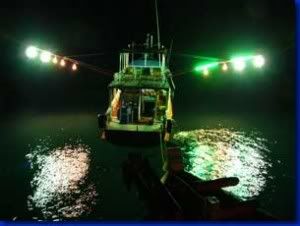
I have read his report and I don't see anyplace where such a track of a radar contact exists. Perhaps you can show me where he describes a radar contact entering the scope display from the edge, approach the plane, and then exit the scope display the way a real radar target would appear. Until you do, then we can safely state that the contacts were random in nature that would disappear and reappear at various places. This is EXACTLY what Startup described in the interview he did on NOVA. He stated they did two orbits to locate a radar contact and not once did they see anything in those orbits.This is EXACTLY the kind of behavior one would expect from contacts produced by AP conditions.
And…
Absolutely prove that these radar contacts and lights were one in the same. You have not done that.
On the northern leg:
“The captain turned on the weather radar in the mapping mode (M. E. L. Co., EL90; vertical fan beam 40 to 150 down; 3 sec sweep cycle; ranges: 20, 50, 150 nm) and immediately picked up a strong target in the direction of the light at a distance of about 18 nm. The pilot and copilot agreed that the size of the radar target (glowing spot) on the screen was about 3 to 5 times larger than one would get for a large boat. Startup’s initial impression was that he was looking at the moon, a slightly squashed moon. Then he realized it couldn’t be the moon, which was far in the west. He described it as a white sphere with a tinge of orange that was slightly flattened at the top and bottom. Guard compared it to a squashed orange. The color was similar to that of a sodium vapor lamp.
About this time Fogarty and Grant came up to the flight deck and they, too, saw the bright lights. Grant said his initial impression was of a white-yellow sphere like a ping pong ball in a dark room and illuminated by a ray of light. Grant, who was standing behind Startup, also had a good look at the radar screen. He said that in his mind there was no doubt that the direction to the radar target, as indicated by well defined angle lines on the radar screen, was the same as the direction to the lights.
(…)
For the next 10 minutes the plane flew in a straight line, continually climbing. According to Startup, who had the best view of the radar screen (which was at his left), the radar target initially moved radially inward (i.e. at a constant angle of about 30o to the right) to a distance on the order of 8 to 10 nm. Startup’s observation indicates that the object was traveling a bit faster than the aircraft. Then it slowly dropped back to the right, finally leaving the radar screen at the limit of its sweep (about 60o to the right).
(…)
During this time Crockett filmed this light using his 100 mm zoom lens.”
(Maccabee, B. (2005) A HISTORY OF THE NEW ZEALAND SIGHTINGS OF DECEMBER 31, 1978)
On the southern leg:
0016 WATCC reports "Target briefly appeared 12:00 to you at 10 miles." Visual confirmed.
0027 WATCC reports "Target is at 12:00 at 3 miles." The captain responded immediately, "Thank you. We pick it up. It's got a flashing light." The captain reported seeing "a couple of very bright blue-white lights, flashing regularly at a rapid rate…”
0031:30 WATCC “reported a target at 3:00 at 4 miles.”
Then:
“Two sweeps of the radar beam later he saw something really surprising. He reported, "There's a strong target right in formation with you. Could be right or left. Your target has doubled in size… The extraordinary condition of a "double size target" (DST) persisted for at least 36 seconds. "
“The cameraman told the reporter about the target flying in formation and the reporter started looking through the right side window for the target. The copilot was also looking and after some seconds he spotted a light which he described as follows: "It was like the fixed navigation lights on a small airplane when one passes you at night. It was much smaller than the really big ones we had seen over Kaikoura. At irregular intervals it appeared to flash, but it didn't flash on and off; it brightened or perhaps twinkled around the edges. When it did this I could see color, a slight tinge of green or perhaps red. It's very difficult describing a small light you see at night.
(…)
During this time the reporter also saw the light and recorded his impression: "I'm looking over towards the right of the aircraft and we have an object confirmed by Wellington radar. It's been following us for quite a while. It's about 4 miles away and it looks like a very faint star, but then it emits a bright white and green light." Unfortunately the light was too far to the right for the cameraman to be able to film it (he would have had to sit in the copilot's seat to do that). The captain was able to briefly see this light which the copilot had spotted. This event was a radar-visual sighting with several witnesses to the light.”
0035 WATCC reports "The target you mentioned, the last one we mentioned, make it 5:00 at 4 miles previously, did you see anything?" The captain responded, "We saw that one. It came up at 4:00, I think, around 4 miles away, " to which WATCC responded, "Roger, that target is still stationary. It's now 6:00 to you at about 15 miles and it's been joined by two other targets." (
http://brumac.8k.com/NEW_ZEALAND/RADARUFOS.doc)
Iniitally, you acted as if these radar-visual contacts were rock solid. Now it is not so solid. So basically we are discussing some random radar contacts and possible links to visual light observations. The case gets weaker by the moment.
“At about 0005 (12:05 A.M., local time), the captain and copilot first noticed oddly behaving lights ahead of them near the Kaikoura Coast (…)These lights would appear, project a beam downward toward the sea, and then disappear, only to reappear at some other location. Sometimes there was only one, sometimes none and sometimes several. After several minutes of watching and failing to identify the lights the pilot and copilot began to discuss what they were seeing.
(…)
At about 0012 they decided to contact Wellington Air traffic Control Center radar to find out if there were any aircraft near Kaikoura. (…)Since the copilot was in control of the aircraft on this particular journey, the captain did the communicating with WATCC. "Do you have any targets showing on the Kaikoura Peninsula range?" he asked. The controller at WATCC had been busy with another aircraft landing, but had noticed targets appearing and disappearing in that direction for half an hour or more.”
Also…
“At about 0020:30 the captain asked for permission to make a left hand orbit. (…) …the plane turned left to go around in a circle, which would take about 2 minutes…
(…)
During the turn the air crew and passengers could, of course, see the lights of Wellington and the lights all the way along the coast from the vicinity of Kaikoura to Christhurch and they could see the anomalous lights near Kaikoura…
(…)
During this period of time the WATCC controller noticed targets continuing to appear, remain for one or two sweeps of the radar, and then disappear close to the Kaikoura Coast. However, he did not report these to the airplane. He reported only the targets which were appearing near the airplane, now about 25 miles off the coast. The TV reporter, who was able to watch the skies continually, has stated (8) that he continually saw anomalous lights "over Kaikoura," that is, they appeared to be higher than the lights along the coastline at the town of Kaikoura.”
(
http://brumac.8k.com/NEW_ZEALAND/RADARUFOS.doc)
And which one of the hundreds of such contacts are we discussing. Now you seem confused. Is it one, two, five, hundreds? Focus please so we can actually get to the meat and potatoes/cut to the chase. Which contact was the best one?
On the northern leg…well, considering for at least selected portions of the flight there was an object that had concurrent radar/visual/film confirmation, what do you think?
On the southern leg there are two actually. The first:
“By 0027 (point 10) the plane was headed back southward along its original track. WATCC reported "Target is at 12:00 at 3 miles." The captain responded immediately, "Thank you. We pick it up. It's got a flashing light." The captain reported seeing "a couple of very bright blue-white lights, flashing regularly at a rapid rate. They looked like the strobe lights of a Boeing 737..."(Startup and Illingworth, 1980)). At this time he was again looking toward the open ocean. ”
(
http://brumac.8k.com/NEW_ZEALAND/RADARUFOS.doc)
“The next images on the film, taken at an unrecorded time after the takeoff from Wellington, are the images of a blue-white light against a black background. In order to document the fact that he was seated in the aircraft at the time of filming the blue-white light, he turned the camera quickly to the left and filmed some of the dim red lights of the meters on the instrument panel. Unfortunately Crockett did not recall, during the interview about a month later, exactly when that blue-white light was filmed, nor did he recall exactly where the camera was pointed at the time, although it was clearly somewhat to the right of straight ahead. The initial appearance of the blue-white light is followed by two other appearances…
(…)
Although it is impossible to prove, it is likely that Crockett filmed the flashing light at 0027. He was aware of the appearance of the blue-white light because he could hear the communications between WATCC and the captain. Therefore it is reasonable to assume that he pointed the camera toward that light and filmed even though he thought he would get nothing because the light was dim.
(…)
However, regardless of whether these blue-white images were made by the flashing light at 0027 or by some other appearance of a blue-white light, the fact is, considering where the plane was at the time, that this film was impossible to obtain from the conventional science point of view because there was nothing near the airplane that could have produced these bright pulses of light. The only lights on the flight deck at this time were dim red meter lights because the captain had turned off all the lights except those that were absolutely necessary for monitoring the performance of the aircraft. There were no internal blue-white lights to be reflected from the windshield glass, nor were there any blue-white lights on the exterior of the aircraft. The only other possible light sources, stars, planets and coastal lights were too dim and too far away to have made images as bright as these three flashes on the film. These images remain unexplained. Thus the probability is high, although one cannot absolutely certain, that the air crew and cameraman saw and recorded on film the appearance of the light that Causer reported to be at 3 miles in front of the aircraft. If true, then this was a radar/visual/photographic sighting. (A radar/visual/photographic sighting did occur about an hour later as the airplane flew northward from Christchurch.)"
(
http://brumac.8k.com/ - A HISTORY OF THE NEW ZEALAND SIGHTINGS OF DECEMBER 31, 1978)
The second (the Double Sized Target – beginning at around 0032):
“During the DST event the radar screen arc representing the aircraft return approximately doubled in length. This occurred moments after a target had been at 3:00 at 4 miles. According to the controller and the technician, this expanded arc moved, without distortion or bending, along the screen. It was seen on 4 rotations which means it moved like this for at least 36 seconds.
(…)
Hence, it appears from the above discussion that no satisfactory explanation based on conventional understanding of the radar and atmosphere has yet been proposed for the DST. It must remain an unexplained radar anomaly. Of course, the close temporal and spatial association between the DST and the preceding nearby target and between the DST and the subsequent light at the right side (with a subsequent radar detection at the right) suggests that there was one (or more) real, i.e., radar reflective, object (or objects) capable of high speed travel that was moving along with the airplane, perhaps above, below or behind (or, if two objects, at the left and right) during the DST event.”
(
http://brumac.8k.com/NEW_ZEALAND/RADARUFOS.doc)
Actually there were. In Dr. Ireland's article he mentions that several squid boats were in the area:
While the main fleet of thirty boats was fishing 250 km from the incident, records show that at least twenty boats were in transit between fishing grounds that night, and a few others were known to be fishing singly.
(Ireland and Andrews Applied optics 1 December 1979 p. 3890)
Klass also mentions that a squid boat had departed Wellington on December 16th with its destination as Pegasus Bay near Christchurch! (Klass p.242)
I want you to carefully note something here. Ireland and Klass never doubted the radar target was real because in their minds it was a squid boat, which clearly is a real object. So you cannot have it both ways Astrophotographer…a squid boat or an AP… according to you, which IS it?
It is also noted that Klass states a squid boat departed on December 16?! But the sighting occurred on December 30! And as Maccabee notes :
“According to Ireland … these locations are reported to the Ministry of Agriculture and Fisheries. However, ministry records failed to show any boats in the vicinity of the sighting area.” That puts paid to Klass and Ireland in no uncertain terms!
This is a false statement probably based on being force fed Dr. M's one-sided opinon:
While the main fleet of thirty boats was fishing 250 km from the incident, records show that at least twenty boats were in transit between fishing grounds that night, and a few others were known to be fishing singly.
(Ireland and Andrews Applied optics 1 December 1979 p. 3890)
Ireland and Andrews footnote this comment with the following:
New Zealand Ministry of Agriculture & Fisheries; personal communication (p. 3890)
Are you stating that Ireland and Andrews lied to a scientific journal?
Not necessarily “lied” (your word) but maybe just not provided the whole truth. Given the above noted categorical fact that
“…ministry records failed to show any boats in the vicinity of the sighting area” we might ask: WHERE WERE these boats “in transit” of Ireland and Andrew’s? I fact were they
anywhere near the vicinity of the sighting… or were they somewhere
else altogether!