Appreciated, but not needed. I was ranting more at Rramjet, who can't even prove something that he claimed happened in this thread. Kinda makes you wonder how he thinks he can prove aliens, doesn't it?
“ranting” is your word… and thus you give yourself away… may I suggest that in future you confine yourself to an analysis of the issues at hand rather than indulging in “rants”?
Do you realise how silly this is? You claimed evidence, you're now reduced to discussing how high a camera was. Even if your photograph turns out to be 100% genuine, it's a 100% genuine photo of something in the sky that no one can identify. How does this prove aliens?
It was not I that introduced the height of the camera issue – perhaps you should more appropriately address your “rant” toward the person who did (Astrophotographer).
Precisely, we cannot identify it in any mundane way, so what does that suggest to you?
My bolding.
I didn't read the wall o' text, but saw this rubbish quoted.
How can you expect to be taken seriously when you try to give a lesson in photographic procedure and get it so wrong? When there is overexposure, you don't get a "clear negative", you get a black (as far as the emulsion will allow) negative. It is the print that is "clear" (white)>
Yeah, okay, in my enthusiasm I got it the wrong way round. Nevertheless my substantive point remains. Astrophotographer claimed that the information was
still available for retrieval and I merely pointed out that was an erroneous assessment. Clear negative (underexposure) or opaque negative (overexposure)… BOTH situations lead to information loss about the subject when compared to the “correct” exposure – and this loss of information is NOT retrievable. Astrophotographers error is inexplicable for someone who claims to have spent many hours in a darkroom...
Have you looked at the waist finder on this camera? It is not some big lens but a very small viewer that is smaller than the size of a postage stamp! Carpenter pointed this out.
View attachment 16600
View attachment 16599
We have a choice that the cameraman used the very small waist finder, which gives a very small field of view and is difficult to frame or he chose to use the other finder, which is much easier to aim. Remember, the witness claim that had to run out real quick and photograph the UFO. Going to the waist finder would be time consuming and there was the danger the UFO would disappear or change location while he was busy trying to frame the shot by looking down. It would be far easier to just point and shoot the way the camera was meant to be used.
For anyone who has ever owned a camera with such a viewfinder on top, once you get used to it, it is as easy, if not easier and quicker to frame a photo from that position than at eye level.
Besides… as you are SO fond of pointing out, it is entirely
possible for this method to have been utilised and if
possibility is good enough for you, it is good enough for me. According to your own logic (that you and others have repeated so often in this thread) YOU now must prove that this method of framing and taking the photos did NOT occur…

Well, sure, but do you know how journalists work. Let me tell you, they pose you in precisely the way THEY want to compose THEIR picture – it hardly matters to them what the external reality of the situation might be (or have been), it is all down to how THEY want to represent things (to make a good photo for the magazine). They say things like “Now stand just there, face that way, now hold the camera up to your eye as if taking a photo… no, up to your
eye… okay, thanks, now another facing
that way… up to your eye again… yes, your eye… okay, good…now…” And so on… the final choice of how you pose is NOT up to you… and of course you don’t want to cause an argument so you take the path of least resistance and go with it. It happens all the time… so your Life magazine photos “prove”
nothing except that Trent was posed by a Life photographer in that way.
Also when using a waist height viewfinder, the image you see is reversed.
Meaning that a moving object flying from right to left will show up moving left to right in the viewfinder, making it almost impossible to track a moving object, especially in such a small viewfinder.
Of course, if the object wasn't moving at all and the appearance of movement was as a direct result of the camera position moving between the two shots... that would explain a lot.
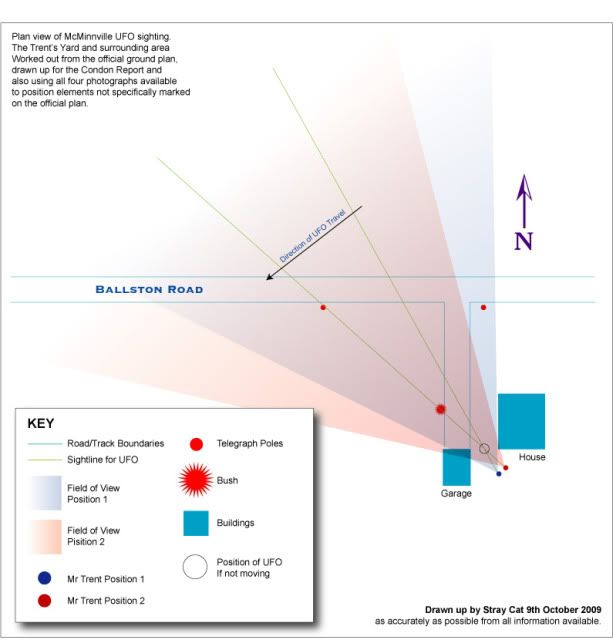
I know I've posted this pic in another thread last year, but if this subject is going to rear it's head again, I should present it for the present readers to examine:
[qimg]http://i246.photobucket.com/albums/gg117/ThePsychoClown/Trents-Yard-Plan.jpg[/qimg]
”Immediately after they both saw the object, apparently as it was still in a NE direction, moving slowly toward the W (6), they thought of their camera (1,2,3,6). Witness II ran to the car, thinking it was there, but Witness I remembered it was in the house and brought it (1,6). Witness II took the camera, which was already loaded. The roll of film had been purchased during the winter and already had two or three shots on it (4).
At this time "the object was coming in toward us and seemed to be tipped up a little bit. It was very bright -- almost silvery -- and there was no noise or smoke" (1).
Witness II explained that he took the first picture, re-wound his film as fast as possible and then as the object gathered speed and turned toward the northwest, he had to move rapidly to his right to get the second picture. Both were snapped within thirty seconds, he estimated (1). According to another early reference: "[Witness II] elaborated, 'There wasn't any flame and it was moving fairly slow. Then I snapped the first picture. It moved a little to the left and I moved to the right to take another picture.'" (3). Plates 23 and 24 show the two photographs in the sequence taken. During this interval the object was moving quite slowly, apparently almost hovering, and it apparently shifted both its position and orientation in a complex way, changing direction and tipping just before it moved away, as indicated in Plate 25 (2,6). However, Witness I described it as "not undulating or rotating, just 'sort of gliding'" (2). The UFO accelerated slowly during or just after the second photograph and moved away rapidly toward the west (2) . Witness I ran into the house to call her mother-in-law, got no answer, and returned outside just in time to see the UFO 'dimly vanishing toward the west' (2).
(
http://ncas.org/condon/text/case46.htm) (My emphasis Rr)
So you see, the UFO was moving
slowly making it entirely possible to “track” (or frame it in shot) with the “waist level” view finder.
Not only that, in your diagrammatic representation, you have the UFO moving NW when it was actually described as moving West. A small point I know but given your statement that the diagram was drawn “as accurately as possible from the information available”, it shows that this statement at least is false.
And just what is your diagram purporting to show anyway? As I remember it when you originally posted it was to show that the “sightlines” crossed at a point underneath the overhead wires and thus it was possible to “hang” a fake UFO from the wires in that position and still represent the apparent movement of the UFO between P1 and P2.
However independent photo analysis by Hartmann (in Condon -
http://ncas.org/condon/text/case46.htm) and by Dr Bruce Maccabee (
http://www.brumac.8k.com/trent1.html) seems to rule that out. If you disagree with those eminent person’s analyses on the matter, perhaps you can show how both might have been mistaken?