Is GM finished?

CEO's making $100 Million? $28000 an hour for college drop out throwing a ball through a hoop? Teachers making $15/hr dealing with one of our most important assets?

When remuneration is based on actual value added to society your point becomes valid. If you present a petition to do so I'll sign it. I'm all for a massive restructuring of the means for redistributing wealth in NA.

No one has explained to me what all these bankers did to earn their pay checks? Where did all this Wall Street money come from? Where did it go? How were they allowed to do this?

Don't worry, that was rhetorical. You can quote to me all day what the Union wage is and what kinda benefits they receive, but nobody knows what the sharks on Wall Street were doing to facilitate this collapse. Why? Because they don't disclose their pay, nobody is keeping track of them and they don't produce a tangible product.

This whole economic crisis was a result of the financial institutions playing fast and heavy with the working middle class wealth. When that ran out they outright lied to create more "Hey my autoworker did you know your house is worth $300 000 now, your rich!, borrow some more money against it so I can keep shuffling it around".

And what happened when that ran out? "Hey Mr. Foreign investor, hard working Americans are borrowing money and buying houses like crazy! Why don't you give me some money and get a piece of this action too?"

There's still no accounting for where all the money went. We've been led to believe it just disappeared. I'm inclined to believe that. I don't think it ever existed. It was all based on the promise that the middle class Americans would keep working their manufacturing jobs and continue to make the US a model for the rest of the World. Without a healthy North American auto sector we lose that. I honestly don't believe losing that is an option we can afford to explore.
The auto industry is not necessary for the survival of the middle class.

Many countries have high standards of living without any auto industry at all.
 
No, the point of repeating is to get it to sink in. Denial don't make it false.

No. Being false is what makes it false.

The economic data I've already shown (such as employment numbers for Wal*Mart vs. GM) are what shows it to be false.

We're talking about billions of dollars being taken out of the economy.

No, we're not. You're imaging billions of dollars being taken out of the economy, and I'm pointing out correctly that those billions of dollars only exist in your imagination. They were taken out decades ago, when the industrial economy of the USA switched over to a service one.
 
No. Being false is what makes it false.

The economic data I've already shown (such as employment numbers for Wal*Mart vs. GM) are what shows it to be false.

You didn't show any economic data, you did a back of the envelope calculation. In doing so, you failed to cover much of the value of GM , such aas engineering, steel purchase, auto supplier chain, etc. For anyone to make a claim, whether for GM or Wal-Mart adding more value, I would think a more detailed analysis would be rquired.
 
You didn't show any economic data,

Evidently employment figures aren't 'data'?


For anyone to make a claim, whether for GM or Wal-Mart adding more value, I would think a more detailed analysis would be rquired.

You'd think wrongly, then.

Sixty years ago, the automotive industry was the largest employer and GM was indeed the largest company in the world. When the US had an industrial economy.

But it is no longer 1950, and the automotive industry is no longer a major factor underlying the US economy. The "service sector" is about 80% of the GDP (check the CIA factbook if you like) while manufacturing in total is less than 20%.

Similarly, the percentage of the labor force employed in "manufacturing, extraction, transportation, and crafts" is only 22.6%, while the percentage employed in "managerial, professional, and technical" (i.e. mostly in professional/technical service) is nearly double at 35.5%, and "sales and office" adds another 24.8%. Finally, we have "other services" at 16.5%.

In other words, manufacturing as a whole employs less than one person in four, probably less than one person in six when you strip "transport" (which is generally considered a service) out of the CIA's category. By contrast, three people out of four are employed in service.

The USA could shut down all auto plants and never produce another car again -- and still lose less than 5% of its GDP.

That's not an industry that is critical to the national economy. It produces a tiny, TINY fraction of the GDP, employs a tiny, TINY fraction of the labor force, and pays out a tiny, TINY fraction of payroll.

... which is why Wikipedia lists the USA as one of the primary examples of a postindustrial society.
 
The auto industry is not necessary for the survival of the middle class.

Many countries have high standards of living without any auto industry at all.
True, but I think that talking about purely the auto-industry is simplistic. I would be better to talk about the general heavy industry.
 
True, but I think that talking about purely the auto-industry is simplistic. I would be better to talk about the general heavy industry.

Not really -- in fact, that's the point I've been making.

The auto industry isn't that important to the US economy. "General heavy industry" is still little more than background noise in the modern US economy.

As WildCat would point out, "many countries have high standards of living without any auto general heavy industry at all."

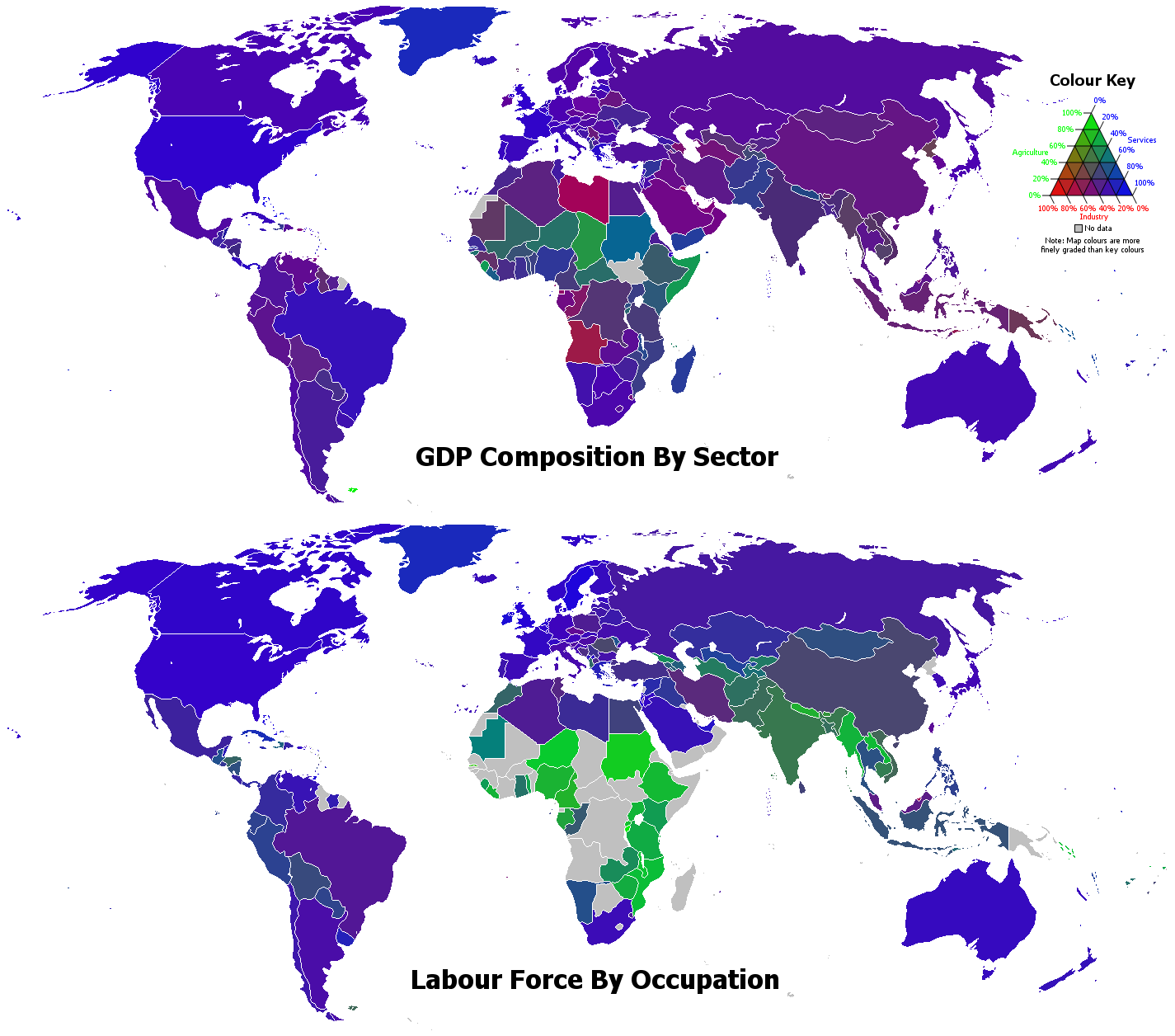
There's a lovely picture available here:
Gdp-and-labour-force-by-sector.png


Notice where the red and purple patches are, areas with substantial industry.

Then notice where the areas that you would like to live are.
 
Not really -- in fact, that's the point I've been making.

The auto industry isn't that important to the US economy. "General heavy industry" is still little more than background noise in the modern US economy.

As WildCat would point out, "many countries have high standards of living without any auto general heavy industry at all."

There's a lovely picture available here

Notice where the red and purple patches are, areas with substantial industry.

Then notice where the areas that you would like to live are.
And you completely miss the point. GDP has little to do with this, which is easy to see as there is an entire rainbow of colors in the poor zones.

Its about import and export. 'Products' make good export goods. Services don't, as they are locally based. So while the GDP of a country can be high, it will still slowly lose money/credit.
Even a small country that can fill most of its product needs and export their own products will make sure that money will keep on coming into their country.
 
Its about import and export. 'Products' make good export goods. Services don't, as they are locally based.

Um,.... this is simply wrong.

The entire information industry is a "service" and is largely export-based; every copy of Microsoft Office shipped overseas is an export. In fact, the single reference copy of Microsoft Office that was shipped to China (to make billions of copies from) is an export, and every dime that comes back to Redmond is booked as money from exports.

Similarly, every time someone in Canada downloads an instant-view movie, that's export revenue coming to both NetFlix and to the production/distribution company that made the movie.

Every time someone buys a burger from McDonald's anywhere in the world, money comes back to the States in the form of the franchise payment.

Here are the top export sectors for the United States to Spain (which are the numbers I could find most quickly):

# Medical Equipment - Leading Sector #1
# Pollution Control and Water Resources - Leading Sector #2
# Outbound Tourism to the United States - Leading Sector #3
# Safety and Security – Leading Sector #4
# Aircraft Parts –Leading Sector #5
# Franchising – Leading Sector #6
# Computer Software – Leading Sector #7
# Telecommunications Services – Leading Sector #8
# E-Commerce – Leading Sector #9
# Electric Power Systems – Leading Sector #10
# Telecom Equipment – Leading Sector #11

Notice how many of those are "general heavy industry." (None? Maybe power systems?) And notice how many of them are relatively pure services -- tourism, franchising, computer software, e-commerce, and telecommunications services.

To suggest that services make lousy exports flies in the face of economic reality.
 
Its about import and export. 'Products' make good export goods. Services don't, as they are locally based.

I should add..... the fact that services don't need to be locally based is, in fact, one of the defining technological advances that makes it possible for an economy to move from a manufacturing to a service-based economy.

Inventing the telephone is what makes telemarketing -- and also customer service reps -- possible. Inventing the radio and television is what makes wide-scale advertising possible. The spreadsheet and the internet make it possible for me to set up a boiler room somewhere and do taxes for people all over the world from a rented basement in the middle of Kentucky.

But that's only possible in a technologically advanced society. I can't do that from Bangladesh, because I can't rely on the internet being there to connect me to my clients. Nor can I rely on being able to hire people with the necessary technical skills in a country with a literacy rate of 20%.
 
Um,.... this is simply wrong.

The entire information industry is a "service" and is largely export-based; every copy of Microsoft Office shipped overseas is an export.
A CD is a product.


Every time someone buys a burger from McDonald's anywhere in the world, money comes back to the States in the form of the franchise payment.
And it ain't much. Most of the profit stays in the local economy.


Here are the top export sectors for the United States to Spain (which are the numbers I could find most quickly):

# Medical Equipment - Leading Sector #1
# Pollution Control and Water Resources - Leading Sector #2
# Outbound Tourism to the United States - Leading Sector #3
# Safety and Security – Leading Sector #4
# Aircraft Parts –Leading Sector #5
# Franchising – Leading Sector #6
# Computer Software – Leading Sector #7
# Telecommunications Services – Leading Sector #8
# E-Commerce – Leading Sector #9
# Electric Power Systems – Leading Sector #10
# Telecom Equipment – Leading Sector #11

Notice how many of those are "general heavy industry." (None? Maybe power systems?) And notice how many of them are relatively pure services -- tourism, franchising, computer software, e-commerce, and telecommunications services.
Industries:
Electric Power Systems
Telecom Equipment
Aircraft Parts
Medical Equipment
Pollution Control and Water Resources (this is likely equipment)

And considering that Outbound Tourism is on this is a good indication that the export to Spain is very low, especially considering that Spain is a massive importer with a trade deficit.

The balance of trade of the USA is very bad, it has a massive trade deficit, this is a fact. The only reason why its still has its standard of living it because its is borrowing/consuming the savings of other countries. And what is borrowed must be payed back eventually.
 
No. Being false is what makes it false.
The economic data I've already shown (such as employment numbers for Wal*Mart vs. GM) are what shows it to be false.
No, we're not. You're imaging billions of dollars being taken out of the economy, and I'm pointing out correctly that those billions of dollars only exist in your imagination. They were taken out decades ago, when the industrial economy of the USA switched over to a service one.

The graphs you provided are a clear indicator of why we need the automotive sector to be strong. In the countries where industry accounts for a higher percentage of the GDP the wages are very, very low as well as the standard of living.
In NA the wages are much higher and they contribute to a strong service sector.

I just don't think you understand the math. 7% of the cost of a vehicle is the wages (it takes about 20 hours to build a vehicle). The other 93% is in transportation, design, marketing etc. Most of which contributes to the American economy. Sure some of the electronics and fascia plastics may be imported, but even then they contribute to the economy.

Even last year there were 13.6 Million vehicles sold in the US. A rough calculation is $20.4 Billion in wages and another $264 Billion into the economy. It's hard to find a breakdown but approximately half of that goes to the cost of producing parts. The remaining $100 Billion goes to what you are referring to as service jobs. (granted a lot of these were imports, but we're considering an import only US market, like dr.k was referring to)

So for every 1 autoworker working in the US about 4 times their wages go into the service industry and another 4 times their wages go into off shoot manufacturing (Tier 1, Tier 2 and the rest)

The 1 autoworker and the numerous others in the feeder plants again contribute to the economy by spending their money on goods and services.

Do you see how quickly this loan to GM pays off? If everyone in the US looking for a car said "I'm going to take my time, do some research and buy a North American made vehicle" We could be out of this mess in no time. Even cash for clunkers had a significant impact on the economy.

Or we can go through a prolonged economic restructuring trying to find a new way to create wealth.
 
The graphs you provided are a clear indicator of why we need the automotive sector to be strong. In the countries where industry accounts for a higher percentage of the GDP the wages are very, very low as well as the standard of living.

So, we need more industry here because we need lower wages and a worse standard of living?

Well, that's an economic theory.

I just don't think you understand the math.

I understand it beautifully.

The math says that a service economy doesn't need heavy industry.

And when you look at the areas of the world with high wages and a good standard of living, they're the ones with no industry because they're all service economies. But I guess if you think that Uganda is a better model than the United Kingdom, or the Ivory Coast better than Iceland,.... then yes, by all means, bring back the smokestack industries.

And it's bring back. Because the industrial economy you are so desperately and counterfactually wishing for hasn't existed for thirty or more years.
 
Or we can go through a prolonged economic restructuring trying to find a new way to create wealth.

You're right. We can do that. We started to do that in about 1960 and ended in the mid-90s.

In other news, did you hear that Kennedy wants to put a man on the moon? And I hear there's this great new group coming out of Liverpool, called the Beatles, that are supposed to be quite good, if you ignore their haircuts....
 
The economic data I've already shown (such as employment numbers for Wal*Mart vs. GM) are what shows it to be false.

This is funny because the only problem I personally have with Wal Mart is that instead of eventually bankrupting themselves by paying a decent wage, giving health care and providing retirement, like GM and the Big 3, they will bankrupt society when the current work force retires and has nothing to fall back on.

I can already see the future where Wal Mart is staffed by migrant workers from the 3rd World. They simply add on living quarters in the back and ship them from store to store in buses where they stock the shelves at night using scanners and PDA's with pictures to correctly stock the shelves in stores that are laid out in identical fashion. All product inquires will go through a central processing terminal via internet. Cameras will allow someone in Singapore speaking fluent English to give information on products etc. for $1/hr. Check outs will be replaced by scanners that automatically deduct purchases from your Wal Mart account as you leave the building.
Eventually Americans won't even have to go to work. The service industry allows you to do it from home. The only vehicles on the road will be Wal Mart owned delivery vehicles, now delivering your purchases directly from a central processing Mega Plex. Space tethers will allow products to be shot into space from industrial nations and landed on Wal Mart owned docking stations in the midwest. Americans will become so fat their only logical recourse is the low gravity environment of space. "USA Proud", a Billion man space station is launched into low Earth orbit. The shadow of "USA Proud" creates a 10 degree cooling on the surface of the planet in its path. This allows people evacuated due to global warming 50 years prior to return. The ice caps also return and the waters of the oceans recede. America's new service is weather control as they change the orbit of "USA Proud" and place it over the paying countries of the World, changing weather patterns in their wake.

God help us all. :D
 
I just don't think you understand the math. 7% of the cost of a vehicle is the wages (it takes about 20 hours to build a vehicle). The other 93% is in transportation, design, marketing etc.
This cannot possibly be true.

You include wages, but not benefits. Wasn't it GM complaining that for every car sold they have $2,000 just in employee and retiree medical costs?

So clearly, your percentages are based on fudged numbers.
 
This is funny because the only problem I personally have with Wal Mart is that instead of eventually bankrupting themselves by paying a decent wage, giving health care and providing retirement, like GM and the Big 3, they will bankrupt society when the current work force retires and has nothing to fall back on.
The only person I've known who worked at Walmart made 6 figures, he was in human resources. Their pharmacists all make 6 figures also.

Not everyone is working the cash register or stocking shelves.
 
I can already see the future where Wal Mart is staffed by migrant workers from the 3rd World.
Maybe the unions should stop championing illegal immigration then. But they're so desperate for new members they can't help themselves.
 

Back
Top Bottom