
How is something like that a 3D image?
It's two 2D frames. It's a nice (and old) trick but that's all it is.
It becomes a 3D image when seen through a stereoscopic viewer. So unless you have one the image ain't worth squat.

How is something like that a 3D image?
It's two 2D frames. It's a nice (and old) trick but that's all it is.

Maybe that it's a guy in a bigfoot costume. There's more information in a 3D image than a single frame.

I guess you weren't paying attention. You don't need a stereoscopic viewer to see 3D, just stereo images. And besides, if you don't have a PC monitor to view the images, they ain't worth squat either.It becomes a 3D image when seen through a stereoscopic viewer. So unless you have one the image ain't worth squat.

Two 2D frames (stereo pairs) = 3D. You would be surprised how extensively this "trick" is used for photo interpretation. This method restores the elevation on aerial/satellite photos used to survey the land, forest, etc. Even the Mars missions used anaglyphs to add relief to the 2D photos.Blackdog said:How is something like that a 3D image?
It's two 2D frames. It's a nice (and old) trick but that's all it is.
Not true. Film alone amounts to more than the sum of the individual frames. This is akin to image averaging.Correa Neto said:But its information ammount will not be larger than the sum of the information ammounts contained by the individual images used to build it.
It likely won't prove anything. Especially the highly edited 3D image I created from Sweaty's GIF. But this method does provide a relative 3rd dimension, which is "new" information. It's not just cool to look at.In other words, nothing new will come from it. We don't have some crucial precise and reliable data on the camera optics or paralax or subject-camera distance to allow good measurements. You are also not supposed to trace drainage networks over Patty.
So, again, besides being cooler to look at, WTF is it suppose to prove?

I'm not surprised; believe it or not I actually can read and comprehend things above a 5th grade level. I'm pretty sure that when the satellite surveys a geographic area it records more than a few pictures to achieve the relief detail. It is also photographing static geographic features, the Patterson subject is not static. If it were we might get something more from this method.You would be surprised how extensively this "trick" is used for photo interpretation. This method restores the elevation on aerial/satellite photos used to survey the land, forest, etc. Even the Mars missions used anaglyphs to add relief to the 2D photos.
The information was already in the frames, right?Not true. Film alone amounts to more than the sum of the individual frames. This is akin to image averaging.
It likely won't prove anything. Especially the highly edited 3D image I created from Sweaty's GIF. But this method does provide a relative 3rd dimension, which is "new" information. It's not just cool to look at.
I'm just correcting you. It's got nothing to do with your comprehension, or lack thereof. Aerial surveys use stereo cameras to create stereo photo pairs. That's all you need. The relief info is contained in the parallax between the 2 slightly different perspectives.
I'm not surprised; believe it or not I actually can read and comprehend things above a 5th grade level. I'm pretty sure that when the satellite surveys a geographic area it records more than a few pictures to achieve the relief detail. It is also photographing static geographic features, the Patterson subject is not static. If it were we might get something more from this method.
Edge detection and relative distances from the camera, etc. Surely restoring the 3rd dimension counts for additional info. Geez.Regardless of the shift in perspective the main subject of the film is still two dimensional. I don't see any three dimensional aspect of the body of the subject. (muscles, costume folds, bullet holes, etc...).
Any motion blur and film anomalies that are on the subject are also on the stereoscopic images.
What can be determined (and we already knew this) is that the subject and photographer were moving.
What new information am I missing?
Wrong. If I measure Patty's dimensions in every frame, then I can determine her relative distances from the camera. Then I can reconstruct the trackway and track RP's position. I can also refine my estimates by feature tracking and image averaging. This is not information that can be gleaned from individual frames.Correa Neto said:The information was already in the frames, right?
No new information.
Thousands of photo interpreters might call you a scoftic, but not me.And regarding the 3d perception, call me a scoffic if you want, but I'm afraid I can't see cant any new usefull information being taken from it. That the guy who shot the film panned the camera is not exactly new information.
If we were looking at an image built from high-resolution scans taken from a first generation copy with all the image processing steps propperly recorded, then maybe -just maybe- something new would appear.
The edge detection alone can help determine Patty's body dimensions better than any other method used so far. Whether that ultimately helps resolve anything is unknown and perhaps unlikely, but it CAN give us new information. And when it comes to this film, at this point what more can you ask for? Otherwise, we're at a dead end and we might as well stop talking about it. But go ahead and scoff if you like. I'd like to see at least 1 comprehensive photogrammetric analysis of this film that everyone can agree on. Is that so wrong? 
I guess you weren't paying attention. You don't need a stereoscopic viewer to see 3D, just stereo images. And besides, if you don't have a PC monitor to view the images, they ain't worth squat either.
<snip>
Because the anomalies would have to persist over several frames, which means they weren't anomalies. Image averaging tends to counteract motion blur. This is how speckle interferometry gives us clear celestial images thru our turbulent atmosphere.If the edges of the subject contain motion blur and film anomalies how can you be certain the edges are properly defined?
Don't hold your breath (providing you're not pegging the sarcasometer). Bill is the only one who has the images that I would consider suitable for an analysis. Plus it's a crapload of work which I can't afford to do for free.BTW I look forward to your analysis and presentation on this new 3D study of the film. It sounds like you think you may have the answer to Bill's main problem.
A stereoscopic viewer cannot do anything different than you can do by crossing your eyes. And this "trick" does not approximate 3D, it represents the parallax between 2 images, precisely! This is a well established branch of geomatics called stereoscopy. And in geomatics the aim is precision.GT/CS said:Uh, no. You cannot see an true 3D without a stereoscopic viewer. What you're calling 3D is just a trick used to approximate 3D.
Wrong. If I measure Patty's dimensions in every frame, then I can determine her relative distances from the camera. Then I can reconstruct the trackway and track RP's position. I can also refine my estimates by feature tracking and image averaging. This is not information that can be gleaned from individual frames.
Thousands of photo interpreters might call you a scoftic, but not me.

<snip>
Bill is the only one who has the images that I would consider suitable for an analysis.
<snip>

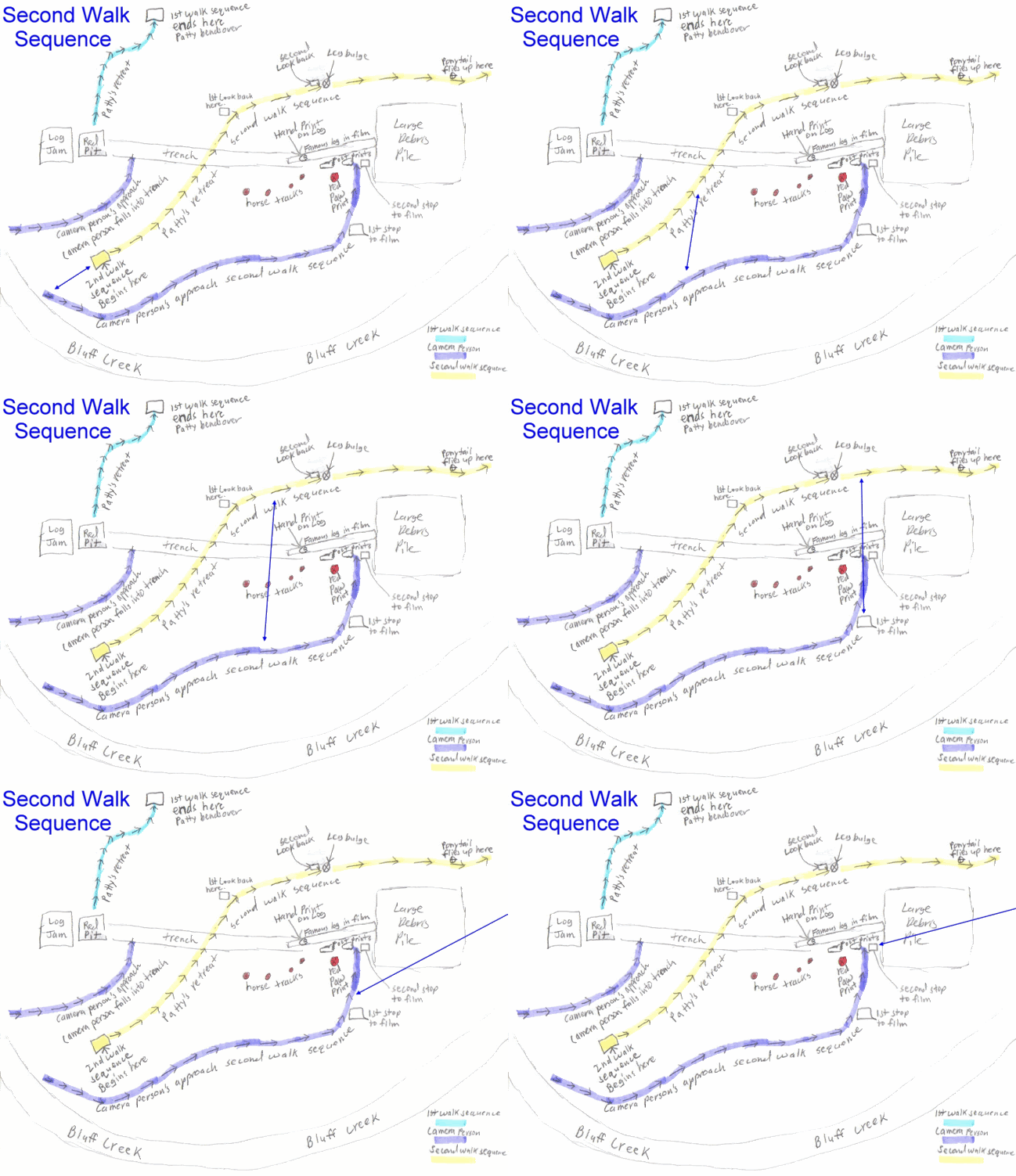

Dave Davis
Mr. Davis, while reviewing the film frame-by-frame in mid-2009, found "Bigfoot" wearing a Western hat and without a mask appearing in two sequences of the film that are not usually shown. There is also a person resembling Bob Gimlin appearing to hold the costume in the film's background, along with other images incorporated into the film that have noticeable inconsistancies with raw footage. For easy verification of the lack of authenticity, large black patches are seen throughout the film which do not appear in nature on a sunny day along the top of a photograph. A video of some of the findings was made available on YouTube at the following URL - http://www.youtube.com/watch?v=xXtcD4tXRVk

I don't know what to say about this analysis as I'm at a loss for words.

This is a New Years present for SweatyYeti complete with thigh hernia.
I can use that "re--HA HA HA HA HA--creation" ( ) in my analysis.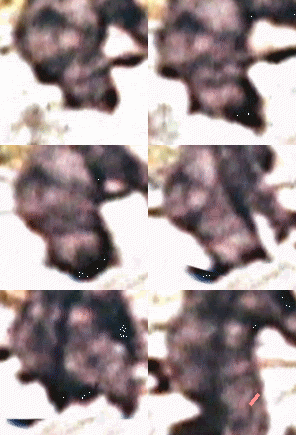
This is even more proof that Bob H. wasn't Patty...(the 'elbow reach' analysis being the HARD, numerical proof.)
The point that bulges is too low on the leg for it to be keys in his pocket.
But, as far as this particular claim is concerned....the spot that bulged is simply not located where a pocket would have been located, in any normal pair of pants.

Mr. Davis , image analysis expert that he his, seems to be ignoring just how huge those cowboys and their horse would be, if foreshortening were accounted for ..I don't know what to say about this analysis as I'm at a loss for words.
It is referenced on the Wiki page for the PGF.

