• Security incident: ISF was recently accessed by intruders. Please change your password, and change it anywhere else you used it. Read more

Re-using plastic water bottles causes CANCER!!!1!!

Yep! Seems Aluminium would have been the proper... err... "solution", instead! Y'all got it wrong, and are therefore going to die!

My brother, a materials engineer, just pointed out to me that soda cans aren't very pure aluminum (since the acid in Coke would cause lots of problems).

So again, it's the issue of an unknown "danger" vs. another unproven "danger".

My brother told me of a colleague who used to work for a plant that put stuff in aluminum cans, and saw how the cans were handled after they were sealed. He said the guy ALWAYS washed the outside of the can before opening it, and ALWAYS poured the contents into a glass. The point being that what's on the outside of the can--that many people actually put up to their mouths!--is probably way more dangerous than anything leaching out of the container.

I suspect the same is true of water bottles of any kind.
 
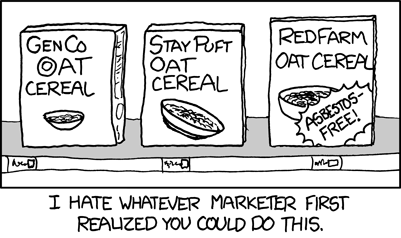
Just to lighten the mood...

... don't tip off the marketing droids to the possibilities of "cancer-free" bottles
:biggrin:

free.png


The above cartoon is under a Creative Commons Attr+NonCommercial license, see http://www.xkcd.com/641/
 
Last edited:
But given the option of the unquantified minor risk of a rash due to nickel sensitivity, or the unquantified risk of hermaphrodite flipper babies, I know which I'm going to choose.
Using SS containers, you can have the best of both worlds, i.e. be killed by heavy metals and grow tits - because of the estrogen straight from the tap. That's not at all depressing, though - since you get your complimentary dose of Prozac with that, too.
 
Last edited:
My brother told me of a colleague who used to work for a plant that put stuff in aluminum cans, and saw how the cans were handled after they were sealed. He said the guy ALWAYS washed the outside of the can before opening it, and ALWAYS poured the contents into a glass. The point being that what's on the outside of the can--that many people actually put up to their mouths!--is probably way more dangerous than anything leaching out of the container.

Good point. We always take it for granted that that can of fizzy pop we just bought wasn't stored in an outhouse before hitting the shelves.
I've been in bars ( in third world countries) where, if they're a "nice' bar they actually wipe the top of your beer bottle for you after popping the top. I took the liberty of examining a few unopened beers, and I really, really hope that brown stuff on the cap is rust.

I never did figure out just how I managed to pick up amoebic dysentery, giardia, and a tapeworm all at the same time. One of those beers was used to wash down the nine pills I was given by the doctor to clear this up.
 
One thing I haven't seen mentioned in this thread: most of the scare-woo i've read about this talks about the supposed danger of leaving the bottle, with water in it, inside a car on a hot day - the heat helps the breakdown of the plastic, is the problem, they claim.
 
One thing I haven't seen mentioned in this thread: most of the scare-woo i've read about this talks about the supposed danger of leaving the bottle, with water in it, inside a car on a hot day - the heat helps the breakdown of the plastic, is the problem, they claim.

This was part of the original alarm over baby bottles--they are frequently heated. (And heating has been shown to increase the leaching.) But again, this was only about the BPA hardened bottles, and again the evidence is less than compelling. However, Canada has banned the manufacture and import of these type of bottles. The U.S. has not.

See the FDA statement I cited earlier. On balance, there isn't enough evidence to consider these a danger. (I reserve the right to change my tune if more compelling evidence comes to light, and the FDA says they are paying attention to it.) As Wushcel has been pointing out, based on the evidence so far, it's not smart to switch to another type of less-studied material or a material known to be more reactive. As several of us have pointed out, we're more apt to be exposed to more dangerous stuff in a myriad other ways.
 

ISF - Join now!

Every member here is approved by hand. No bots, no spam, just people who care about evidence and honest debate.

Membership is free!

Create your free account

Back
Top Bottom