Evidence for why we know the New Testament writers told the truth.

Status
Not open for further replies.
Such as? I don't see a single one.
That's really nice. So where is this contemporary historian accounts of Jesus? All I see are people who are writing of Christians and their beliefs decades after the fact.
There are no contemporary historian accounts of Alexander the Great (who conquered much of the world), but I don't see anyone doubting him.
 
Last edited:
There are no contemporary historian accounts of Alexander the Great, but I don't see anyone doubting him.
So? We are not talking about Alexander the Great. Now back to your magic man. Where was this evidence again?
 
There are no contemporary historian accounts of Alexander the Great (who conquered much of the world), but I don't see anyone doubting him.
People who actually knew Alexander the Great and wrote about him:
His historian: http://en.wikipedia.org/wiki/Callisthenes
His General: http://en.wikipedia.org/wiki/Ptolemy_I_Soter
The liar: http://en.wikipedia.org/wiki/Onesicritus

http://en.wikipedia.org/wiki/Historical_Alexander_the_Great
You may want to read about him from the Indians, Babylonians as well.
 
Yes but the other half just about cover all our anti social behaviours.

5. You shall not dishonor your parents.

6. You shall not murder.

7. You shall not commit adultery

8. You shall not steal.

9. You shall not commit perjury.

10. You shall not covet.

Actually, I propose that we can cut these further. #10 is thought crime and I refuse point-blank to be held accountable for my thoughts. #5 and #7 are a little problematic. Adulterers are clearly scum in the majority of cases but is it illegal? Dishonoring parents - definition please? I do not do everything my parents tell me to, I am very critical of their occasional foolishness when it happens and if I felt they were being unreasonable, then they can go jump - they don't get a special pass because they're related to me.

That leaves don't lie, steal or kill. Well Duh! Any healthy/surviving society worked out these out ages ago and didn't need their neighbourhood invisible magic-man in the sky to spell it out for them. The ten commandments are like the sermon on the mount. Sounds pretty and useful and everyone points at them when asked about why their religion is good, but when examined half of it turns out to be utterly useless.


Btw, no-one is demanding that I believe in Alexander the Great or burn forever, or am immoral because I don't believe in him, or passing laws based on him. If they did, then they'd d*mn well better pony up the evidence, and it'd better be good. Until then I don't care if Alexander the Great was real. Also you did it wrong, this is the Julius Caesar/Socrates b*llcr*p argument, not the Alexander b*llcr*p argument.
 
Last edited:
People who actually knew Alexander the Great and wrote about him:
His historian: http://en.wikipedia.org/wiki/Callisthenes
His General: http://en.wikipedia.org/wiki/Ptolemy_I_Soter
The liar: http://en.wikipedia.org/wiki/Onesicritus

http://en.wikipedia.org/wiki/Historical_Alexander_the_Great
You may want to read about him from the Indians, Babylonians as well.

None of these people wrote during the lifetime of Alexander the Great. Sounds like gospel writers Matthew and John.
 
None of these people wrote during the lifetime of Alexander the Great. Sounds like gospel writers Matthew and John.
Hahahahahahahaha....you didn't read the links did you?

Who wrote those gospels again?
 
You made the positive claim, would you care to back it up instead of retreating to an ad hom attack?

Bob the manner may be direct but the expectation of positive reciprocation of a valid point is crucial to knowledge and clear communication. I have agreed as much as disagreed with those on this forum. If the information I submit is discounted purely on the basis of it being another position and validity stripped from it for that reason, the author looses credibility. Ad homs are a personal attack, I attack credibility.

In regard to your comment of running from the debate, just for Pax.

Tacitus “probably the most important reference to Jesus outside the New Testament.”
The quote, supposed to have been written around 117 AD, reads:
“Nero fastened the guilt . . . on a class hated for their abominations, called Christians by the populace. Christus, from whom the name had its origin, suffered the extreme penalty during the reign of Tiberius at the hands of . . . Pontius Pilatus, and a most mischievous superstition, thus checked for the moment, again broke out not only in Judaea, the first source of the evil, but even in Rome .”

How do we know f this quote is genuine, we do not, how do we know the credibility of all ancient texts, we don't. We surmise that so little was transcribed back then that there was a premium of credibility associated with ancient texts. If hardly anything is written about why write ********, because it was written in a time when writing was a premium there it is logical that most of the things written about were observations and not falacy. Excepting works written to astound such as the Lliad.
 
In regard to your comment of running from the debate, just for Pax.

Tacitus “probably the most important reference to Jesus outside the New Testament.”
The quote, supposed to have been written around 117 AD, reads:
“Nero fastened the guilt . . . on a class hated for their abominations, called Christians by the populace. Christus, from whom the name had its origin, suffered the extreme penalty during the reign of Tiberius at the hands of . . . Pontius Pilatus, and a most mischievous superstition, thus checked for the moment, again broke out not only in Judaea, the first source of the evil, but even in Rome .”
That's a nice description of Christians and their beliefs. So?
 
Joobz, I replied to another in the same vein that Wiki and the information contained within is today used as a reference, but would it be as credible in 2000 years? Who knows the facts, the participants and a few observers of the time. All I can add is that Jesus was mentioned by other historians of the time.
Outside the Bible, Jesus is also mentioned by his near-contemporaries. Extra-Biblical and secular writers (many hostile) point to Jesus' existence, including the Roman writings of Tacitus, Seutonius, Thallus and Pliny, and the Jewish writings of Josephus and the Talmud. Consider the chronicle of Cornelius Tacitus (55 to 117 A.D.). Tacitus was a Roman statesman and historian. He held several positions in the Roman government, including that of proconsul, or governor of the Roman provinces in Asia. Tacitus is also regarded as the "greatest historian" of ancient Rome.
Believing that Jesus existed and believing he's the son of god are completely different points. The would be like saying that evidence of Elvis' gold records proves he was alive in the 80s and those sightings were real.


One of the crowning achievements of Tacitus’ work is Annals, a 16 volume history of the Julian emperors from Tiberius to Nero, written between 115 and 117 A.D. In this work, Tacitus wrote about persistent reports of Jesus’ resurrection.
The veracity of anything you do not experience first hand is up for grabs.
Elvis lives!


I agree, that is why I pick and choose the salient rather than the doctrinal or rhetorical subject content of the bible to debate.
So it seems you agree with Waterman's post. You have a funny way of showinig it.

All I can say is that we are nothing, if there is more than nothing, that I have not found out as yet.
I'll assume you're joking.


Taint Waterman, it is Watermans narrow perception, if your going to be a protagonist be subjective don't just follow the leader. You were correct in your description of the post in question being a "simple post".
Simple isn't synonymous with wrong. Without a substantive critique of his post, all you really said in reply is "Well it's a bit more complicated than that..." Which is, in itself, an unimaginative response. EVERYTHING is always a bit more complicated. The increased complexity only matters if you can show where that greater detail will invalidate the argument in some settings. If there isn't such conditions, than the greater complexity is immaterial and referencing it is meaningless.

So, let me repeat, do you have any actual disagreement with Waterman's post? Is there an area of "increased complexity" that would invalidate the observation? If not, then doesn't that explain WHY people complemented his post? Especially given he is a new member here?
 
... Wiki and the information contained within is today used as a reference, but would it be as credible in 2000 years?
On subjective topics - e.g. those involving opinions, fashions, etc - no... 2,000 years hence, credibility will concern the authors

However, on (allegedly) objective topics - like the metamophosis of sand to glass and water to wine - yes... 2,000 years hence, credibility will be determined by evaluating/applying the methods described

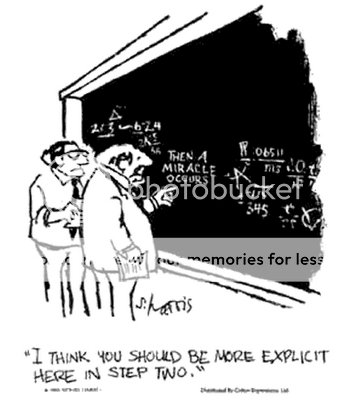
then-a-miracle-occurs-cartoon.png


Saying "then a miracle occurs/occurred" is NOT credible
 
Last edited:
Yes but the other half just about cover all our anti social behaviours.

5. You shall not dishonor your parents.

6. You shall not murder.

7. You shall not commit adultery

8. You shall not steal.

9. You shall not commit perjury.

10. You shall not covet.
Dishonor is not a law, covet is not a law, and the other three don't need a so-called god to know that living in a society you need those to be laws.

So again, what do the first five have to do with laws.

Paul

:) :) :)
 
Yes but the other half just about cover all our anti social behaviours.

5. You shall not dishonor your parents.

6. You shall not murder.

7. You shall not commit adultery

8. You shall not steal.

9. You shall not commit perjury.

10. You shall not covet.
How do you define adultery?
 
So, because the culture in the US shares similar moral guidelines to other cultures, the Ten Commandments are responsible for it?

Could it possibly be that the Constitution is based, in no small part, on English laws? (at a minimum, the Bill of Rights is most definitely linked to the Magna Carta, among other European legal documents).

Why is it hard to believe that societies around the world have accepted that certain things are required for a community to function, just as lions, wolves, etc do not prey on other members of their pack.

Give me a break Bob, all laws that evolved from a Judeo/Christian Abrahamic foundation (and thoe societies are the ones you mentioned) started with the ten commandments at their base as their guide to anti social behaviour.
 
Hahahahahahahaha....you didn't read the links did you?

Well I see Callisthenes is reported to have written about Alexander the Great but all his works have perished. You demand contemporary evidence for Jesus, but then rely on perished works for Alexander the Great.
 
Give me a break Bob, all laws that evolved from a Judeo/Christian Abrahamic foundation (and thoe societies are the ones you mentioned) started with the ten commandments at their base as their guide to anti social behaviour.
Give me a break sonofgloin, all the Ten Commandments evolved from a Egyptian/Canaanite/Babylonian/Greek Foundation started with the "golden rule" at their base as their guide to anti-social behavior. :rolleyes:
http://en.wikipedia.org/wiki/Ethic_of_reciprocity
 
Well I see Callisthenes is reported to have written about Alexander the Great but all his works have perished. You demand contemporary evidence for Jesus, but then rely on perished works for Alexander the Great.
Yup. What about it? I don't worship or much care if Alex existed or not.

Are you saying you don't care about Jebus? What about the evidence for you magic man again?
 
There are no contemporary historian accounts of Alexander the Great (who conquered much of the world), but I don't see anyone doubting him.
If someone was to tell me that Alexander the Great rose from the dead, walked on water and was going to come back to earth sometime again, I'd call BS on that as well.

Being real doesn't mean that all stories about that person are real.

Did George washington Chop down a cherry tree?
\
 
Status
Not open for further replies.

Back
Top Bottom