
You are using an out of date browser. It may not display this or other websites correctly.
You should upgrade or use an alternative browser.
You should upgrade or use an alternative browser.
The PG Film - Bob Heironimus and Patty
- Thread starter SweatyYeti
- Start date
- Status
- Not open for further replies.


Here are some crude overdrawings, indicating in white the location of each major fold.
ETA: Compare with the "original" (Davis-enhanced) pics, in an above post on this page.
I am not seeing any fabric, unless you consider skin to be a "fabric".

Here is an email i received from Henner Fahrenbach, asking about Vort's claim of seeing Fabric:
W.H.F.
I don't know what you are driving at with these probably fifth generation pictures. I happen to have photographic copies (Cibachrome) in large format of some of these images and there is nothing at all with this type of contrast visible in them. What I see are shades of brown depending on how the hair is illuminated. If you are a conspiracy theorist and suspect "fabric wrinkles" or some such over the top interpretation, you are just flogging a dead horse and doing that with bad input. Garbage in - garbage out - you can't do any sort of interpretation, not to mention contribution, by using anything other than original material. Cease bothering me once and for all with your stuff, dredged up by the hair - if you'll pardon the pun. There are better uses for your time!
W.H.F.
LTC8K6
Penultimate Amazing

We have, of course, seen the cibachromes and discussed them. They really look like fake fur. Much more so, imo.
EHocking
Penultimate Amazing

So he's saying that there is just not enough detail in the Cibachromes to say what the material might be (GIGO), therefore it must be hair.Here is an email i received from Henner Fahrenbach, asking about Vort's claim of seeing Fabric:
W.H.F.
How illogical.
Astrophotographer
Graduate Poster

- Joined
- Jun 3, 2004
- Messages
- 1,843
If these high quality cibachromes exist, why not have them scanned in high quality and present them on the internet. That way, all interested parties can have access to the same valuable information.
LTC8K6
Penultimate Amazing
IIRC, they have been shown here many times. I think I have some stored online somewhere.
Vortigern99
Sorcerer Supreme
I don't know what you are driving at with these probably fifth generation pictures. I happen to have photographic copies (Cibachrome) in large format of some of these images and there is nothing at all with this type of contrast visible in them. What I see are shades of brown depending on how the hair is illuminated. If you are a conspiracy theorist and suspect "fabric wrinkles" or some such over the top interpretation, you are just flogging a dead horse and doing that with bad input. Garbage in - garbage out - you can't do any sort of interpretation, not to mention contribution, by using anything other than original material. Cease bothering me once and for all with your stuff, dredged up by the hair - if you'll pardon the pun. There are better uses for your time!
First, I would think it's pretty clear what I'm "driving at", as I've made abundantly clear that there are streaks and slashes visible in the frames under review (among others) that are consistent with the known and studied action of folds in fabric material, and inconsistent with the action of primate skin. Where I was not clear before, I certainly hope this clarifies.
Second, I am indeed working with "probably fifth generation pictures", to my utter chagrin. I would be thrilled to examine the Cibachrome prints for myself, in order to render an unbiased opinion as to whether the streaks and slashes (whatever they are) are visible there as well. In the multi-generation pics under review, the contrast has been cranked up to artificially high levels, so that some details are enhanced and others blown out entirely. Via the Internet, however, I have examined copies closer to the original than the MK Davis sequence I'm currently using, and the streaks were visible there as well, only less pronounced and in the same "shades of brown" that Dr. Fahrenbach describes.
Third, the term "conspiracy theorist" is disingenuous, since hoaxing is a known and documented human behavior, particularly with regard to the phenomenon known as bigfoot. As such it is a far more probable that the film was hoaxed rather than that an undiscovered, non-human, bipedal primate is (or was) roaming the woodlands of North America, obtaining 8000+ calories a day while remaining hidden from all efforts to discover it, and leaving no bones or other verifiable signs of its existence apart from the imminently hoaxable footprint. The so-called "conspiracy theory" claim includes three persons, Gimlin, Patterson and a third, costumed party -- a conspiracy of three -- whereas a contention that bigfoot(s) are ingeniously elusive involves thousands of such animals escaping capture and cataloguing by scientific methods for many decades. Thus the term "conspiracy theorist", meant to be belittling and dismissive, is actually the more logical and fact-based conclusion here.
Fourth, as EHocking noted above, if there is not enough detail in the Cibachromes to say what the material might be, concluding that it must be "hair", as Dr. Fahrenbach has done, is at least as illogical as calling it "fabric". The distinction is that we have discovered evidence that the material is fabric, whereas there is no evidence that it is hair.
Fifth, as Astrophotgrapher noted above, "If these high quality Cibachromes exist, why not have them scanned in high quality and present them on the Internet? That way, all interested parties can have access to the same valuable information." And that way, too, we'll have found "better uses for [our] time", exactly as Dr. Fahrenbach has suggested.
First, I would think it's pretty clear what I'm "driving at", as I've made abundantly clear that there are streaks and slashes visible in the frames under review (among others) that are consistent with the known and studied action of folds in fabric material, and inconsistent with the action of primate skin. Where I was not clear before, I certainly hope this clarifies.
Second, I am indeed working with "probably fifth generation pictures", to my utter chagrin. I would be thrilled to examine the Cibachrome prints for myself, in order to render an unbiased opinion as to whether the streaks and slashes (whatever they are) are visible there as well. In the multi-generation pics under review, the contrast has been cranked up to artificially high levels, so that some details are enhanced and others blown out entirely. Via the Internet, however, I have examined copies closer to the original than the MK Davis sequence I'm currently using, and the streaks were visible there as well, only less pronounced and in the same "shades of brown" that Dr. Fahrenbach describes.
Third, the term "conspiracy theorist" is disingenuous, since hoaxing is a known and documented human behavior, particularly with regard to the phenomenon known as bigfoot. As such it is a far more probable that the film was hoaxed rather than that an undiscovered, non-human, bipedal primate is (or was) roaming the woodlands of North America, obtaining 8000+ calories a day while remaining hidden from all efforts to discover it, and leaving no bones or other verifiable signs of its existence apart from the imminently hoaxable footprint. The so-called "conspiracy theory" claim includes three persons, Gimlin, Patterson and a third, costumed party -- a conspiracy of three -- whereas a contention that bigfoot(s) are ingeniously elusive involves thousands of such animals escaping capture and cataloguing by scientific methods for many decades. Thus the term "conspiracy theorist", meant to be belittling and dismissive, is actually the more logical and fact-based conclusion here.
Fourth, as EHocking noted above, if there is not enough detail in the Cibachromes to say what the material might be, concluding that it must be "hair", as Dr. Fahrenbach has done, is at least as illogical as calling it "fabric". The distinction is that we have discovered evidence that the material is fabric, whereas there is no evidence that it is hair.
Fifth, as Astrophotgrapher noted above, "If these high quality Cibachromes exist, why not have them scanned in high quality and present them on the Internet? That way, all interested parties can have access to the same valuable information." And that way, too, we'll have found "better uses for [our] time", exactly as Dr. Fahrenbach has suggested.
Vortigern99
Sorcerer Supreme
BTW, if anyone has a link to, or copies of, scans of the Cibachrome prints from the "pre-log" sequence (the rear-angle shots of Patty walking toward the fallen tree), I'd love to inspect them. Thanks.
William Parcher
Show me the monkey!

- Joined
- Jul 26, 2005
- Messages
- 27,472
Vortigern99 said:The so-called "conspiracy theory" claim includes three persons, Gimlin, Patterson and a third, costumed party -- a conspiracy of three -- whereas a contention that bigfoot(s) are ingeniously elusive involves thousands of such animals escaping capture and cataloguing by scientific methods for many decades.
I don't really like the "for many decades" thing. Some people even start their counting from 1967 (PGF), or 1958 (birthyear of "Bigfoot" in mass media). I think it should be centuries, or even thousands of years. I tend to go with "over 400 years" which is when Europeans came to North America and began poking around. But Bigfoot bodies or parts could have been aquired long before that by Indians. A Bigfoot skull that was kept by a tribe for 1400 years would certainly serve as a legitimate piece of evidence at any time thereafter.
I agree that it has only been decades since there has been popular media coverage and therefore general awareness of Bigfoot. But the ability and desire to aquire and retain biological evidence of Bigfoot is not limited to decades.
I think it's more realistic to say that we haven't gotten a piece of Bigfoot in over 400 years than it is to say decades.
Vortigern99
Sorcerer Supreme
It is certainly debatable. I've given the more generous figure, decades, based on the fact that scientific inquiry into the American bifgoot has been at work since the 1950s at the earliest, but probably closer to the 1970s when Krantz began conducting his research. It's a point I'm willing to concede either way, since it's ancillary to the main thrust of my contentions.
LTC8K6
Penultimate Amazing
Man would have been in competition with sasquatch all along. There should be souvenirs and stories of battles. When you killed a bear, you wore your souvenirs proudly. Man attacked and killed animals much larger and more powerful than a sasquatch. Sasquatch would have been in the stewpot and bones with disassembly marks would be found.
davefoc
Philosopher

Those are spectacular bigfoot/human skeleton images kitakaze. Did you make them? Do you control the copyright to them?
Have you considered adding them to the Bigfoot category of Wikimedia?
The contract image would also be of general interest and a valuable addition to the Wikimedia Bigfoot category.
Anyway congratulations on really excellent work if you created the images and congratulations on good copying if you didn't.
I also think it would be nice to incorporate some of the imagery that is in your post into the Wikipedia Bigfoot article.
--Dave
Have you considered adding them to the Bigfoot category of Wikimedia?
The contract image would also be of general interest and a valuable addition to the Wikimedia Bigfoot category.
Anyway congratulations on really excellent work if you created the images and congratulations on good copying if you didn't.
I also think it would be nice to incorporate some of the imagery that is in your post into the Wikipedia Bigfoot article.
--Dave
SweatyYeti
Master Poster

- Joined
- Dec 1, 2006
- Messages
- 2,919
Those are spectacular bigfoot/human skeleton images kitakaze. Did you make them? Do you control the copyright to them?
Have you considered adding them to the Bigfoot category of Wikimedia?
The contract image would also be of general interest and a valuable addition to the Wikimedia Bigfoot category.
Anyway congratulations on really excellent work if you created the images and congratulations on good copying if you didn't.
I also think it would be nice to incorporate some of the imagery that is in your post into the Wikipedia Bigfoot article.
--Dave
Those skeletons have a major flaw in them, Dave. They don't account for the fact that Bob H's shoulder joint (if he was Patty) would have been located 2-3 inches inboard of where Patty's shoulder is...(due to the big difference in their upper-body widths)...
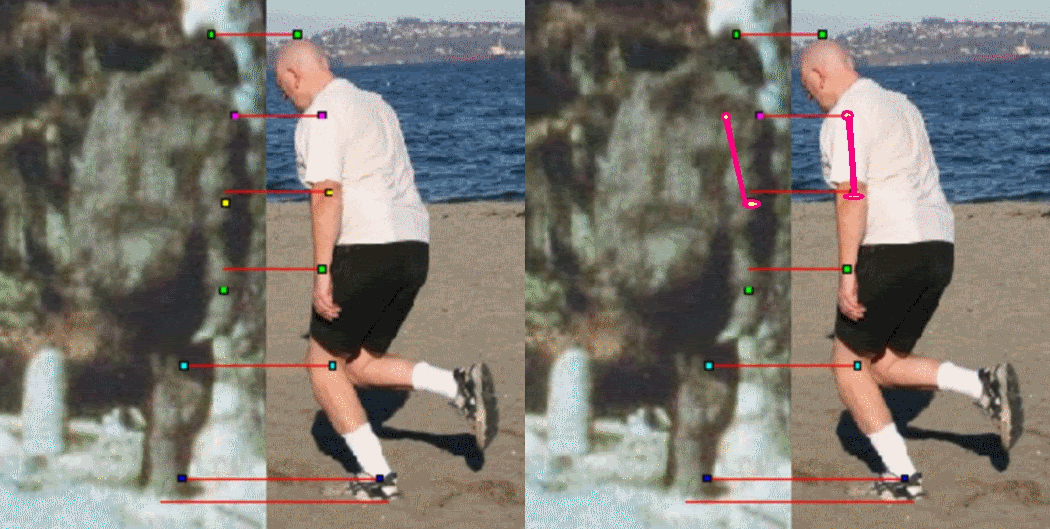
This means that Bob's upper arm actually needs to be longer than Patty's upper arm.
But Bob's upper arm.....(like Tube's upper arm, in the comparison above)....is actually shorter than Patty's.
The skelly's have a mighty deep hole to climb out of, before they can truly be considered legit.
One of kitakaze's little 'distortions', btw, is to post very small skeletal overlay images....so the differences in the limb lengths, between Fric and Frac, is shrunken down so much that it's barely noticeable.
Last edited:
davefoc
Philosopher
Thank you SeatyYeti for your thoughtful response.
Before I respond let me start with a bit of a disclaimer. I think the chances that creature in the PG film is an unknown primate that lives or lived in North America approaches zero. You reasonably might believe that my response is driven by my confirmation biases as a result.
As to your image:
I took it, reversed the image of the person on the right and mirrored it so that it was facing the same direction as the alleged bigfoot (AB). I then explanded the image on the right by 8% and did comparisons. There is a very good correlation between the images for the upper body when this is done. The width of the back seems much closer between the two images, the shoulders are very close in position, the arms are almost exactly the same length and the butt areas line up reasonably well, (although the undefined butt area in the AB photo makes it difficult to make much out of this comparison).
However when this is done, the length of the legs of the human appear to descend substantially below the AB legs. However this might not be as significant as it seems at first. It is difficult to determine from the AB image how deeply buried the foot of the AB is. It is also difficult to determine how deeply bent the AB legs are.
Overall, I would agree that kitakaze's skeleton/bigfoot images are not proof that the AB in the photo could actually be a human. But they provide significant evidence of the plausibility for such an idea. Your comparison image, suffers a bit because the human is in a distinctly different position than the AB and it suffers because the quality of the AB image does not allow the precise comparisons that you are trying to make to be done reliably. Nonetheless if I was just looking at the comparison you did in isolation from all the other evidence surrounding the case I would at least agree that you produced a legitimate basis for questioning the man in the monkey suit hypothesis.
However, given the obvious non-resemblance of the AB images to an actual animal and the non-resemblance of the movement of the AB to anything other than a human I would say it is highly unlikely that the PG film is anything other than a film of a man in a monkey suit. Put into the context of the rest of the evidence relevant to the AB, the possibility that a non-human creature is portrayed in the PG film is close enough to zero that for all practical purposes it is certain that it is a man in a monkey suit.
Before I respond let me start with a bit of a disclaimer. I think the chances that creature in the PG film is an unknown primate that lives or lived in North America approaches zero. You reasonably might believe that my response is driven by my confirmation biases as a result.
As to your image:
I took it, reversed the image of the person on the right and mirrored it so that it was facing the same direction as the alleged bigfoot (AB). I then explanded the image on the right by 8% and did comparisons. There is a very good correlation between the images for the upper body when this is done. The width of the back seems much closer between the two images, the shoulders are very close in position, the arms are almost exactly the same length and the butt areas line up reasonably well, (although the undefined butt area in the AB photo makes it difficult to make much out of this comparison).
However when this is done, the length of the legs of the human appear to descend substantially below the AB legs. However this might not be as significant as it seems at first. It is difficult to determine from the AB image how deeply buried the foot of the AB is. It is also difficult to determine how deeply bent the AB legs are.
Overall, I would agree that kitakaze's skeleton/bigfoot images are not proof that the AB in the photo could actually be a human. But they provide significant evidence of the plausibility for such an idea. Your comparison image, suffers a bit because the human is in a distinctly different position than the AB and it suffers because the quality of the AB image does not allow the precise comparisons that you are trying to make to be done reliably. Nonetheless if I was just looking at the comparison you did in isolation from all the other evidence surrounding the case I would at least agree that you produced a legitimate basis for questioning the man in the monkey suit hypothesis.
However, given the obvious non-resemblance of the AB images to an actual animal and the non-resemblance of the movement of the AB to anything other than a human I would say it is highly unlikely that the PG film is anything other than a film of a man in a monkey suit. Put into the context of the rest of the evidence relevant to the AB, the possibility that a non-human creature is portrayed in the PG film is close enough to zero that for all practical purposes it is certain that it is a man in a monkey suit.
Last edited:
Óðinn
Muse

- Joined
- Sep 5, 2007
- Messages
- 661
Except for a sasquatch. Funny they're the only apes with eyeshine too.I'm talking about pointing to a feature and saying "that can't be a primate, look at the scapula/teres group, it's all wrong." Form follows function. Chimps (and other apes) have nearly identical musculature to human beings, and in this case a bipedal primate would have identical or nearly identical musculature as a human being. There is no muscle on any primate that cuts across the spine.
Actually, I agree. But the point is that these aren't known facts, they're speculation. Even really good speculation can't prove anything. It might tip the scales for some people's opinions, I suppose.
If you watch the frames before and after (many of which are severely distorted) this area is just a highlighted part of the back and side of the leg which is being defined by Patty's arm shadow.The ilio-tibial band is what you're referring to. It's not a muscle proper, but a band of tissue connecting the joints of the leg, and it runs along the side/profile of the leg, not the posterior/rear of the leg. Also, you're neglecting my point that the semimem. and semitend. muscles run parallel to the leg; they don't cut across it at an oblique angle. Material folds do that; muscle groups do not.
You haven't shown that "foreground object" is any such thing, so please don't get ahead of yourself. The same shapes run continuously on the same area of a moving figure; they don't remain in place while the figure moves behind them.
I take it back. Both those lit areas you identify as folds aren't foliage. After having looked at a looping GIF focused on this sequence, I conclude that the artifact by the foot IS foliage, but the artifact on the leg is caused by the shadow of Patty's arm as she swings it backward. Watch this GIF and note how the shadow on the back of Patty's leg mirrors the right arm. What else could be casting that shadow if the sun was over Patty's right shoulder? Has to be the arm & hand.
Regardless of your motives, you wish your analysis to be correct.I have no agenda apart from the truth. As to "wishful thinking", I can assert that I want there to be a bigfoot out there somewhere. I wish there were a BF; I really, really do. I would love it if Patty were proven to be a real non-human North American primate. So by your logic, if "wishful thinking" were at play, I should be attempting to discredit the idea that these streaks are fabric folds, not supporting it.
Give me a break. What were your key points that I didn't address? The quality of these film images is not good enough to discern any folds in the fabric. Loose hair could potentially mimic any apparent fabric fold. Especially a shaky object at these distances from the camera. Many frames are so distorted they are only good for a "camera shake" analysis.It's important to note here that you're ignoring key points, forcing me to repeat myself, which indicates a degree of intellectual dishonesty on your part. Are we having a legitimate debate in which we address each other's observations, or are you intentionally dodging points for which you have no response?
Bottom line is I don't think anyone can point out any definite fabric folds in the current images available. Doesn't mean they weren't there, doesn't mean they were either. JMHO
Last edited:
Vortigern99
Sorcerer Supreme
If you watch the frames before and after (many of which are severely distorted) this area is just a highlighted part of the back and side of the leg which is being defined by Patty's arm shadow.
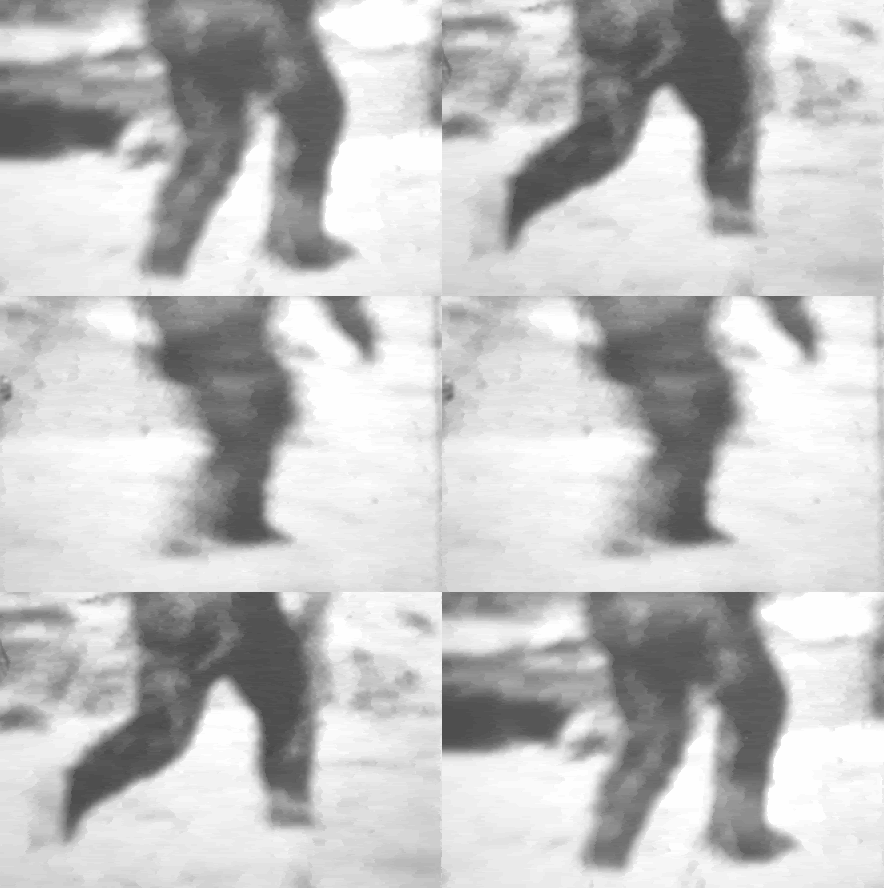
Excellent work, Odinn. I will concede that the mid-ankle streak evident in the frame I've called #21 is a product of the black shadow of the right arm being cast onto the highlighted bulge of the calf/shin region. In your animated GIF we can clearly see this shadow swinging over the calf area. Its angle, shape and evident movement visibly conform to that of the right arm. Well done.
However (and you had to see this coming!), that explanation does not serve for the other streaks and slashes of light evident elsewhere on the figure. There is no large mass, equivalent to the right arm, creating shadows, for example, on the final frame of the GIF you've posted above (at the point the reverse animation begins), which corresponds to my frame #27 (attached below).
The arm is fully forward in that frame, yet we can see the diagonal streak of the upper thigh (which you earlier mistook for the thigh muscles), stretching from the inner upper thigh to the outer lower thigh. This streak is visible on frames #6 (qv), 7, 8, 9, 13, 26, 27, 30, 31, 36 of the same "pre-log" sequence. (Some of these are attached below.)
Since the shadow of the arm can be excluded as a possible cause, owing to the arm's forward placement, the next reasonable observation we might make is that it is a feature inextricable from the surface of the figure itself, and not an effect of light and shade. Tentatively, we might conclude that this is a fabric fold, because there is no other explanation that comes to mind. If you have one, please offer it.
The quality of these film images is not good enough to discern any folds in the fabric. Loose hair could potentially mimic any apparent fabric fold.
I disagree. I discern numerous folds in various regions of the figure which to my eye are not effects of light and shade. And contrary to your assertion, loose hair does not mimic the action of fabric folds, for the simple reason that hair does not share the same anchor points (the joints of the limbs and body) as does a whole swatch of fabric, draped over the body and pulled taut or loose depending on the bend of the limbs. If you disagree, whereas you are making the original assertion, please provide evidence of it in any primate or other animal species you can find.
Give me a break. What were your key points that I didn't address?
I don't want to get into a sidebar about this, because it's largely irrelevant to the discussion. In short you neglected to answer several of my points, which I then repeated a second time before you finally addressed them.
Otherwise, this is a fine debate and I hope we can continue in this vein.
ETA: The frames attached below are numbered 7, 8, 13, 27, and 31, respectively. On the previous page I've also shown #6 in this sequence, which also shows the diagonal slash of the right rear thigh, which cannot be the parallel muscles of the thigh and cannot be the product of the shadow of the right arm.
Excellent work, Odinn. I will concede that the mid-ankle streak evident in the frame I've called #21 is a product of the black shadow of the right arm being cast onto the highlighted bulge of the calf/shin region. In your animated GIF we can clearly see this shadow swinging over the calf area. Its angle, shape and evident movement visibly conform to that of the right arm. Well done.
However (and you had to see this coming!), that explanation does not serve for the other streaks and slashes of light evident elsewhere on the figure. There is no large mass, equivalent to the right arm, creating shadows, for example, on the final frame of the GIF you've posted above (at the point the reverse animation begins), which corresponds to my frame #27 (attached below).
The arm is fully forward in that frame, yet we can see the diagonal streak of the upper thigh (which you earlier mistook for the thigh muscles), stretching from the inner upper thigh to the outer lower thigh. This streak is visible on frames #6 (qv), 7, 8, 9, 13, 26, 27, 30, 31, 36 of the same "pre-log" sequence. (Some of these are attached below.)
Since the shadow of the arm can be excluded as a possible cause, owing to the arm's forward placement, the next reasonable observation we might make is that it is a feature inextricable from the surface of the figure itself, and not an effect of light and shade. Tentatively, we might conclude that this is a fabric fold, because there is no other explanation that comes to mind. If you have one, please offer it.
The quality of these film images is not good enough to discern any folds in the fabric. Loose hair could potentially mimic any apparent fabric fold.
I disagree. I discern numerous folds in various regions of the figure which to my eye are not effects of light and shade. And contrary to your assertion, loose hair does not mimic the action of fabric folds, for the simple reason that hair does not share the same anchor points (the joints of the limbs and body) as does a whole swatch of fabric, draped over the body and pulled taut or loose depending on the bend of the limbs. If you disagree, whereas you are making the original assertion, please provide evidence of it in any primate or other animal species you can find.
Give me a break. What were your key points that I didn't address?
I don't want to get into a sidebar about this, because it's largely irrelevant to the discussion. In short you neglected to answer several of my points, which I then repeated a second time before you finally addressed them.
Otherwise, this is a fine debate and I hope we can continue in this vein.
ETA: The frames attached below are numbered 7, 8, 13, 27, and 31, respectively. On the previous page I've also shown #6 in this sequence, which also shows the diagonal slash of the right rear thigh, which cannot be the parallel muscles of the thigh and cannot be the product of the shadow of the right arm.
Attachments


Last edited:
SweatyYeti
Master Poster
- Joined
- Dec 1, 2006
- Messages
- 2,919
Thank you SeatyYeti for your thoughtful response.
Before I respond let me start with a bit of a disclaimer. I think the chances that creature in the PG film is an unknown primate that lives or lived in North America approaches zero. You reasonably might believe that my response is driven by my confirmation biases as a result.
As to your image:
I took it, reversed the image of the person on the right and mirrored it so that it was facing the same direction as the alleged bigfoot (AB). I then explanded the image on the right by 8% and did comparisons. There is a very good correlation between the images for the upper body when this is done. The width of the back seems much closer between the two images, the shoulders are very close in position, the arms are almost exactly the same length and the butt areas line up reasonably well, (although the undefined butt area in the AB photo makes it difficult to make much out of this comparison).
However when this is done, the length of the legs of the human appear to descend substantially below the AB legs. However this might not be as significant as it seems at first. It is difficult to determine from the AB image how deeply buried the foot of the AB is. It is also difficult to determine how deeply bent the AB legs are.
Overall, I would agree that kitakaze's skeleton/bigfoot images are not proof that the AB in the photo could actually be a human. But they provide significant evidence of the plausibility for such an idea. Your comparison image, suffers a bit because the human is in a distinctly different position than the AB and it suffers because the quality of the AB image does not allow the precise comparisons that you are trying to make to be done reliably. Nonetheless if I was just looking at the comparison you did in isolation from all the other evidence surrounding the case I would at least agree that you produced a legitimate basis for questioning the man in the monkey suit hypothesis.
However, given the obvious non-resemblance of the AB images to an actual animal and the non-resemblance of the movement of the AB to anything other than a human I would say it is highly unlikely that the PG film is anything other than a film of a man in a monkey suit. Put into the context of the rest of the evidence relevant to the AB, the possibility that a non-human creature is portrayed in the PG film is close enough to zero that for all practical purposes it is certain that it is a man in a monkey suit.
Thank you, for your thoughtful response, Dave.

I'll respond to it sometime tomorrow...but it'll probably be on the late side.
tube
Muse

- Joined
- Aug 1, 2005
- Messages
- 917
Oh Internet, thou great repository of past gustatory indiscretions...
While my skeleton remains dimensionally intact, I no longer eat like the O-mah.
No Atkins, no lipo, no stapled stomach, simply a Triumph of the Will.
Yet I am forever condemned to live with the Scarlet Lines that inexorably connect me to "Patty". At least my own body modification is a more aesthetic outcome than Johnny Depp changing his tattoo from "Winona" to "Wino"...
While my skeleton remains dimensionally intact, I no longer eat like the O-mah.
No Atkins, no lipo, no stapled stomach, simply a Triumph of the Will.
Yet I am forever condemned to live with the Scarlet Lines that inexorably connect me to "Patty". At least my own body modification is a more aesthetic outcome than Johnny Depp changing his tattoo from "Winona" to "Wino"...
Attachments

Third, the term "conspiracy theorist" is disingenuous, since hoaxing is a known and documented human behavior, particularly with regard to the phenomenon known as bigfoot. As such it is a far more probable that the film was hoaxed rather than that an undiscovered, non-human, bipedal primate is (or was) roaming the woodlands of North America, obtaining 8000+ calories a day while remaining hidden from all efforts to discover it, and leaving no bones or other verifiable signs of its existence apart from the imminently hoaxable footprint. The so-called "conspiracy theory" claim includes three persons, Gimlin, Patterson and a third, costumed party -- a conspiracy of three -- whereas a contention that bigfoot(s) are ingeniously elusive involves thousands of such animals escaping capture and cataloguing by scientific methods for many decades. Thus the term "conspiracy theorist", meant to be belittling and dismissive, is actually the more logical and fact-based conclusion here.
Hoaxing does exist, but it would be quite unusual for it to continue to modern day, being done all around North America, in every state, going unseen, undetected, and undocumented
Last edited:
- Status
- Not open for further replies.