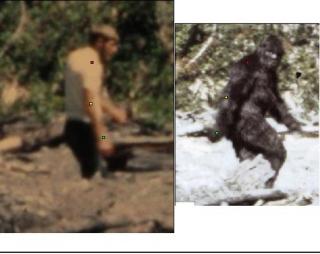
Not sure what you're pointing at in 6. Left arm? Bottom of the scapula?
12 looks like the highlighted bicep femoris (somewhat distorted).
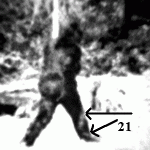
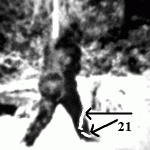
19 & 21 are the same foreground foliage. They are not even part of the leg.
Mostly, I see a pretty snug fit, suit or skin. Except maybe the butt could use some work.
First, let me apologize for the limitations in the images and software I'm using. I'm a professional freelance illustrator and art instructor; however, I do not use computer graphics in my work -- it's a personal, professional choice -- and as a consequence my "graphics software" is extremely limited.
That said, everything I'm indicating can clearly be seen on the frames under review with a minimum of attention and scrutiny of the images.
In
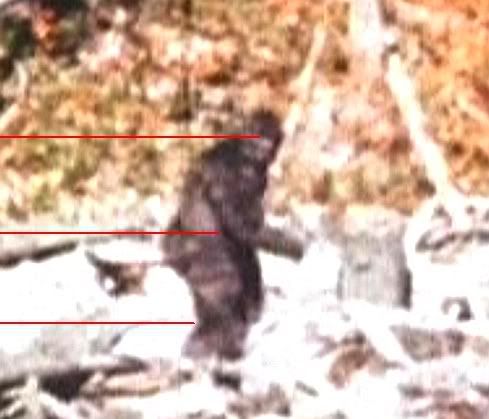
6, my arrow indicates a horizontal line that bisects the left half of the back, cutting across the dark, central line of the spine on a line perpendicular to the spine. This line is in the approximate location of the teres major muscle, or slightly below it; however the actual teres does not cross over the spine and is not a straight muscle as seen in the image. This highlighted, perpendicular, non-teres, spine-bisecting line can be seen in several successive frames of the film, remaining in the same location on the figure as it moves, so we know it is not a film artifact or a piece of foliage.
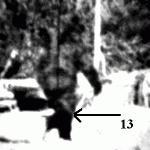
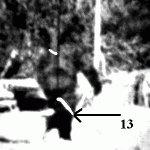
In
13 (not 12), I'm not indicating the biceps femoris, as that muscle runs along the anterior (front) of the thigh, and cannot be seen from this posterior angle. What I'm indicating here is the high-lit, diagonal slash that runs from the inner upper right thigh, down to the exterior lower right knee area. The arrow head indicates the endpoint of this high-lit slash. This same slash can be seen in 6, though in that pic the slash tapers off mid-way across the thigh, exactly as we would expect a material fold to do in this position.
19 & 20 cannot be foreground foliage because, again, these high-lit slashes can be seen on successive frames of the film, and they move with the figure, remaining in the same place on the figure as it locomotes. Foreground foliage would remain fixed as the figure moves behind it.
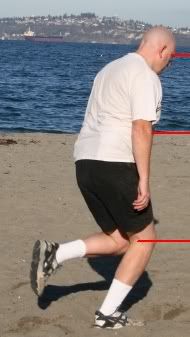
In my opinion as a professional illustrator, these are fabric folds. They behave according to the principles of drapery (which rules can easily be seen/verified by parading oneself in front of a mirror in loose-fitting clothes).
There are many smaller lines that also appear to conform to these principles of drapery, but I have only indicated the most prominent. For one example, in
6, at the base of the right foot, one can make out a series of three high-lit lines, arranged in a kind of pyramid form, radiating from the base of the calf muscle, exactly as we would expect fabric to radiate from a single attachment point, according to the aforementioned principles of drapery.
Primate skin (at least, the skin of every known and studied primate) is tight-fitting and does not behave in this way.



 ...
...