• Security incident: ISF was recently accessed by intruders. Please change your password, and change it anywhere else you used it. Read more

Forum birdwatching 2009

29/07/2009, Taiaroa Head, Dunedin, New Zealand:

Northern Royal Albatross Diomedea sanfordi....
Welcome to the 2009 thread, Floyt. Nice first record for the year.:D

List to date (i've not had time to update Order etc.

Total individual sightings: 1421
Number of forum contributors: 35
Species Count (incl ssp) : 569
Subspecies Count : 12

ETA: Webpage not updated for July yet.
 
Last edited:
San Diego Wild Animal park is the wrong habitat for Steller's Jay.

An immature Western Scrub-Jay perhaps?

Well that was certainly an idea I wouldn't have thought of.

I did find a few images of Western Scrub-Jay that made the idea seem at least plausible to me. But I didn't find any images that were close enough to make me think it was more likely than not a western scrub jay.

I wondered about the possibility of it being a brown-headed cowbird.

Here's a picture of a brown-headed female cowbird that made the idea seem plausible, but there isn't any hint of blue in the wings the way there was in the bird I photographed:

http://en.wikipedia.org/wiki/File:Molothrus_ater1.jpg

Anyway, my guess right now is that it isn't a cowbird, or a jay or a brewer's blackbird.
 
I have about 15 photos of birds that I took while in Spain and Portugal last month. I don't want to post all of them in the thread if that will slow down the site. I started a flickr account, but I'm not entirely sure what the best way for members to view them. Any ideas would be helpful.

My trip to Spain was not very successful birdwise, but I did get to see some cool species, very few of which I was able to ID.
 
About a month ago we spent about a week in the High Sierra including some time on the eastern Sierra, Mono Lake and Yosemite. It was the first time that I have been to the High Sierras since I have been involved in birdwatching.

It significantly changed my experience. I was much more alert to birds and fauna in general. I was particularly interested to see how the birds that I saw would vary from the ones near me.

The first surprise for me was the violet-green swallows. We have three kinds of swallows commonly near us, barn, tree and cliff. It was a real surprise to see the shiny green on the backs of swallows that I looked down on from the mountains near Sonora Pass.

The most surprising bird was the Northern Flicker that we saw in Bode. This is listed as a local species for Orange County where I live but I had never seen one. It is a striking bird. It seemed to something of an awkward flyer but it is quite strikingly marked. I was surprised to find out it was related to woodpeckers, but with hindsight I can see the similarities.

There are, of course, many birds on or near mono lake, but the one that stood out for me was the common tern. We went on a guided kayak tour and we saw them perched on the tufa formations. There were quite a few swallows out and about. I think they may have been the violet-green ones. Our guide, who was a bird and fish oriented biologist said that they were nesting in the tufa. I didn't see the nests. The dominant bird was the California gull for which Mono Lake is a primary breeding area. Our guide was going to be involved in a project to count them.

We saw a western tanager in the Eastern Sierra. This is another species that is listed for Orange county that I hadn't seen before.

Throughout the Sierras we constantly heard a very loud, very tiny bird. I never figured out what it was and I didn't get any pictures that were good enough of it to give me much of a chance of figuring it out. House wren seems like the best possibility.

We heard, but didn't see a sooty grouse in Yosemite. I have heard this bird many times but I've never managed to see it. They make a very distinctive, deep drum sound that is unlike any other sound in the forest.

And lastly we saw a nice old raven on top of half dome. We saw many ravens circling in a way similar to turkey vultures. It has always surprised me that turkey vultures are common in Orange County where we don't have many of the large fauna I would think a turkey vulture would need to survive on. But in Yosemite where there is lots of deer and other large fauna I didn't see any that I could identify for sure.
 
Hello! I'm sure I have nothing significant to contribute, since I'm not a 'real' birder. I did, however, bring Kotatsu down to western Washington State and we did do some strolling and looking, as well as him getting to see almost everything that congregates at my bird feeders. I am especially pleased that the hummingbird feeder on my window attracted an Anna's Hummingbird while Kotatsu was in the chair right next to the window!

I live in Renton, which is a bit south and east of Seattle (just south of Lake Washington, if you look at a map) and I'm up on the hill to the east of the area below the lake. The following birds have been at my feeders or seen on my evening strolls so far this summer:

Oregon juncos;
goldfinches (lots, including the Giant Sphere Bird, who is about 150% normal size)*
purple finches;
chickadees;
rufous towhees;
flickers;
red breasted robins;
barn swallows;
house sparrows;
crowned sparrows;
nuthatches;
downy woodpeckers (cute!);
hairy woodpeckers;
stellar's jays;
flickers;
killdeer;
pigeons;
alas, starlings.

Local birds of prey include: redtailed hawk; sharpshinned hawk; osprey; and bald eagle (the last two nest on the local cellphone towers).

We don't have mallards at the moment, but our storm-water control pond (across the driveway) annually has mallards, buffleheads, and occasionally mergansers. We also get the odd Canada goose, and sometimes a great blue heron.

I have undoubtedly left out a few, but since most of this thread seems populated by REAL birders, I'm sure that's not a great loss. Mostly I just wanted to indicate that, should you need someone in western WA, I'm here and am willing to provide data...feel free to PM me if there's a need.


Regards, MK


*Kotatsu will back me up on this, he's the most prosperous goldfinch I've ever seen!
 
Kotatsu: Miss_Kitt mentioned to me in passing that you might like this picture and that I could probably get it to you here.

This was on my deck tonight, not two hours ago :).

rf8nxqQGhH8dYPzyp2eaHg
 
Home from Vancouver now, and dead tired... I developed some kind of mild but irritating cold over the last few days, and spent 8.5 hours at Heathrow yesterday... I do have a lot of birds to report -- many of which overlap with Kitt's list -- but that'll have to wait until I've had much more sleep... I've also got teaching this evening (bleh...) and my back hurts from trying to sleep sitting on two planes and Heathrow (1); when will I be able to sleep?!

---
(1) Incidentally, if you're ever at Heathrow terminal 3 and find the normal large sitting areas to be too noisy or too filled with people, head to the far end of the terminal and look for a sign that says "Additional Seating" behind a shop that sells perfumes and alcohol. This will take you to a place with comfortable padded benches to sleep on, padded chairs, fans, and so on. This area was never more than a third full during the time I was there, and it is not widely advertised, but VERY nice.
 
Home from Vancouver now, and dead tired... I developed some kind of mild but irritating cold over the last few days, and spent 8.5 hours at Heathrow yesterday... I do have a lot of birds to report -- many of which overlap with Kitt's list -- but that'll have to wait until I've had much more sleep... I've also got teaching this evening (bleh...) and my back hurts from trying to sleep sitting on two planes and Heathrow (1); when will I be able to sleep?!

---
(1) Incidentally, if you're ever at Heathrow terminal 3 and find the normal large sitting areas to be too noisy or too filled with people, head to the far end of the terminal and look for a sign that says "Additional Seating" behind a shop that sells perfumes and alcohol. This will take you to a place with comfortable padded benches to sleep on, padded chairs, fans, and so on. This area was never more than a third full during the time I was there, and it is not widely advertised, but VERY nice.

Any ideas for the situation I describe in post 503?
 
I did find a few images of Western Scrub-Jay that made the idea seem at least plausible to me. But I didn't find any images that were close enough to make me think it was more likely than not a western scrub jay.
Anyway, my guess right now is that it isn't a cowbird, or a jay or a brewer's blackbird.

I think it is a juvenile Scrub-jay. The bill looks very Corvidae to me, as do the feet. I looked in my Helm guide for Crows and Jays, and the juvenile Florida Scrub-Jay (1), and the pattern of which feathers have grown blue seems to fit. I saw some Brewer's in Bellington (see below) and they all seemed to have yellow or white eyes, so that wouldn't fit.

I have about 15 photos of birds that I took while in Spain and Portugal last month. I don't want to post all of them in the thread if that will slow down the site. I started a flickr account, but I'm not entirely sure what the best way for members to view them. Any ideas would be helpful.

Send them to EHocking or me, and we'll work it out somehow.

My trip to Spain was not very successful birdwise, but I did get to see some cool species, very few of which I was able to ID.

Feel free to ask any questions if you remember details. Several of us here have experience with Mediterranean birds (I don't, though), and we have the proper literature to find out what experience hasn't taught us^^.

The most surprising bird was the Northern Flicker that we saw in Bode. This is listed as a local species for Orange County where I live but I had never seen one. It is a striking bird. It seemed to something of an awkward flyer but it is quite strikingly marked. I was surprised to find out it was related to woodpeckers, but with hindsight I can see the similarities.

I was looking for this bird EVERYWHERE in Vancouver, as my hosts said that it is really common, and can be see in any park or even in gardens where there are ants. Never saw a single one, until one day we were out catching birds on a mudflat, and there came a Flicker flying across the pastures, making a large circle when it saw the sea, and flew back again and disappeared from sight behind a house. Didn't get to see it well, but Miss_Kitt's house made up for that, when one came sitting on a tree just behind her garden and allowed itself to be observed for some time. Beautiful birds. I can't understand why the Americas got all the really spectacular woodpeckers...

Throughout the Sierras we constantly heard a very loud, very tiny bird. I never figured out what it was and I didn't get any pictures that were good enough of it to give me much of a chance of figuring it out. House wren seems like the best possibility.

I can't link directly to the page, but www.mangoverde.com -> World Bird Guide -> Passerines -> Wrens have a large collection of House Wren sounds from across the world. Indeed, it has quite a lot of sounds from other wrens as well, in case that's not the species you heard.

Oregon juncos;
goldfinches (lots, including the Giant Sphere Bird, who is about 150% normal size)*
purple finches;
chickadees;
rufous towhees;
flickers;
red breasted robins;
barn swallows;
house sparrows;
crowned sparrows;
nuthatches;
downy woodpeckers (cute!);
hairy woodpeckers;
stellar's jays;
flickers;
killdeer;
pigeons;
alas, starlings.

You forgot the zorse^^.

Also, now that you've found the thread, please come back (2).

Kotatsu: Miss_Kitt mentioned to me in passing that you might like this picture and that I could probably get it to you here.

This was on my deck tonight, not two hours ago :).

I envy you... All I saw was a group of six running away at a distance...

Finally, here are the bird species I saw in Washington State, US, during my brief visit. They are really divided between Bellingham, Bay View and Renton, but as there's quite a lot that was seen from the highway and so on, and I was a bit careless with my notes, I have lumped them all together under "Washington":

5/8 Washington
American Goldfinch Carduelis tristis
Barn Swallow Hirundo rustica
Savannah Sparrow Passerculus sandwichensis
Starling Sturnus vulgaris
Steller's JayCyanocitta stelleri
Wren Troglodytes troglodytes
Red-tailed Hawk Buteo jamaicensis
Black-capped Chickadee Poecile atricapilla
Killdeer Charadrius vociferus
Great Blue Heron Ardea herodias
House Sparrow Passer domesticus
Bald Eagle Haliaeetus leucocephalus
Mourning Dove Zenaida macroura
Brewer's Blackbird Euphagus cyanocephalus

6/8
Golden Flicker Colaptes auratus
North-Western Crow Corvus caurinus
Black-headed Grosbeak Pheucticus melanocephalus
Purple Finch Carpodacus purpureus
Dark-eyed Junco Junco hyemalis
Red-winged Blackbird Agelaius phoenicues
Spotted Towhee Pipilo maculatus
Anna's Hummingbird Calypte anna (3)
Canada Goose Branta canadensis
Domestic Pigeon Columba livia domestica
Song Sparrow Melospiza melodia

The last few days in Vancouver gave no new birds. Still, I think I reached about 100 species, which isn't all that bad. As soon as I have the photos worked out, I'll start posting them here, as well as the remainder of the Australia/Japan/Thailand ones.

---
(1) No picture of juvenile Western Scrub-Jay, and the book does not split the species anyway.
(2) And, again, thank you for having me over!
(3) This, according to my field guide, is way North of its usual range, but the birds we saw -- and these are supposedly regulars at Miss_Kitt's bird feeder -- doesn't fit in with anything else, really. Perhaps a very local population?

 
...
Anna's Hummingbird Calypte anna (3)
...
(3) This, according to my field guide, is way North of its usual range, but the birds we saw -- and these are supposedly regulars at Miss_Kitt's bird feeder -- doesn't fit in with anything else, really. Perhaps a very local population?

http://talkaboutwildlife.ca/profile/?s=178

The first paragraph here suggests they might be scarce enough to be worth a note to the local recorder, particularly if there's evidence of breeding, depending on where Miss_Kitt's is.
 
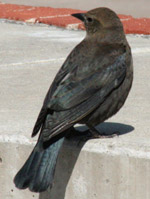
Could somebody identify this bird?

Looking in my Sibley Guide, I'd say it's probably a brewer's blackbird. The eye color is a tad deceptive because of the lighting, and some female brewers have dark eyes. Brown-headed cowbirds have stouter beaks so I think I'd rule that out.
 
Based on some other pictures of eastern bluebirds on the web it looks like it might be a female to me. Maybe somebody else could comment on whether I'm right or not.

Thanks, I read that they were once nearly eliminated from the Carolinas due to lack of nest cavities. -Birds of the Carolinas Field Guide

I shot it looking for something fun to do last winter.
 
Last edited:
Here in NorCal the western bluebirds unfortunately have to compete with loads of European starlings and house sparrows for nest cavities.
 
Looking in my Sibley Guide, I'd say it's probably a brewer's blackbird. The eye color is a tad deceptive because of the lighting, and some female brewers have dark eyes. Brown-headed cowbirds have stouter beaks so I think I'd rule that out.

One of the most characteristic features of the icterids, the group including the New World blackbirds and orioles, grackles and troupials, is the bill shape.

The bill is very straight-edged, resembling needle-nosed pliersWP, obviously the size and "robustness" varies with the species but the shape is quite distinctive. The only non-icterid I can think of which come close this is the European starling. These, however, have the upper and lower parts of the bill meeting in a straight line, whereas icterids generally have an angled commissure, the kink at the "corner of the mouth" which can give a slightly supercilious expression.

For (much) more information on icterid bill anatomy and evolution http://elibrary.unm.edu/sora/Auk/v068n04/p0411-p0440.pdf (note : it becomes a bit more user-friendly after p416)

Anyway, davefoc's bird doesn't have an icterid bill, so Brewer's blackbird and brown-headed cowbird can be eliminated.
 
Anyway, davefoc's bird doesn't have an icterid bill, so Brewer's blackbird and brown-headed cowbird can be eliminated.

Hmm so what do you think it is? I'm still leaning toward brewer's.

Here's another brewer's that looks similar:

blackbird-FC1.jpg


davefoc, can you describe its behavior?
 
Last edited:
...


davefoc, can you describe its behavior?

I can't. I was walking around the San Diego Wild Animal Park and I saw this bird and I took a picture of it. I didn't observe other similar birds and I haven't seen similar birds that live near me (about 100 miles north of San Diego Wild Animal Park in Fullerton, Orange County, California).

The picture Mako posted made me think Brewer's blackbird again. I took a bit of time looking at the beak issue again. I can see where spenisc is coming from on that (once my mind had recovered from the coma induced by the paper he linked to).

The Brewer's blackbird beaks in the images that I examined (I screen captured the beak section from some of the Brewer's blackbird bird images on the web) all had beaks that were more pointy than the beak on this bird. The beak on this bird was indistinguishable (by this amateur observer) from the beak of a western scrub jay.

The feather pattern around the head was interesting in the image of the bird I photographed. Although it's less apparent in the lower resolution image I posted than in the higher resolution original, individual feathers can be discerned under the eye. This might be indicative that the bird in question is a juvenile or maybe it doesn't mean anything.

I am sorry that the image was from an area that isn't nearer to where I live. Even if I didn't see the exact bird again I might see others that would provide some more clues to the identity.
 
davefoc


IMO the plumage is still way too different from that of a juvenile western scrub jay. The iridescence on your specimen is characteristic of a brewer's. Also, I have been to that wild animal park (mainly to see the california condors :)) and have observed brewers hanging around the food areas--this behavior is common at other zoos I've visited.
 
Last edited:

ISF - Join now!

Every member here is approved by hand. No bots, no spam, just people who care about evidence and honest debate.

Membership is free!

Create your free account

Back
Top Bottom