Moderated Continuation - Why a one-way Crush down is not possible

ever get the feeling your being ignored


Of course I'm being ignored, but that's the point. The only way to win with dishonest people who can't ever admit to being wrong is to make them squirm. They can never engage you openly and fairly because they understand that they're peddling snake oil. The trick is not to waste time reading their brain-dead posts, but to note carefully the challenges they run away from. Every time Heiwa and his parrot repeat their mindless mantra about parts C and A, remind them of the elephant in the room: the collapsing floors hit one floor at a time. They can't confront this assertion because it blows them out of the water. It reduces all of their silly posturing to rubbish.
 
Your hypothetical model and "one way crushdown" is off-topic to the design of the WTC towers and how they collapsed on 9/11.

Sorry, the 'one-way crush down' is the allegedly peer reviewed theory of Bazant & Co in several papers in the ASCE Journal of Engineering Mechanics that has been adopted by NIST to represent the destruction of WTC 1. That's the reason why we discuss it here.
My simple opinion is that that theory is not valid - as explained in my papers, e.g. that the basic assumption of Bazant, upper part is rigid, is wrong.
 
Sorry, the 'one-way crush down' is the allegedly peer reviewed theory of Bazant & Co in several papers in the ASCE Journal of Engineering Mechanics that has been adopted by NIST to represent the destruction of WTC 1. That's the reason why we discuss it here.
My simple opinion is that that theory is not valid - as explained in my papers, e.g. that the basic assumption of Bazant, upper part is rigid, is wrong.

But your model is a lemon.
 
Sorry, the 'one-way crush down' is the allegedly peer reviewed theory of Bazant & Co in several papers in the ASCE Journal of Engineering Mechanics that has been adopted by NIST to represent the destruction of WTC 1. That's the reason why we discuss it here.
My simple opinion is that that theory is not valid - as explained in my papers, e.g. that the basic assumption of Bazant, upper part is rigid, is wrong.


You lack the competence to understand Bazant's paper. Your assumption about his assumption has been shown to be nonsense.
 
Heiwa, I don't think it is possible for a person to be more incompetant than you are.
 
It is your opinion. Topic is something else. Try to focus on it. Show that you are competent.

The collapse begins at the impact floors. The floors above join the falling mass. The collapsing floors hit the floor immediately below, crushing it and adding its mass. The process is repeated until the building is gone.

You see, I can repeat a mantra as often as you. The difference is, I'm right and you're peddling nonsense.
 
The beam to column connections in the central core were not pinned connections. They were large connections with multiple bolts and welds which provided significant resistance to rotation of the column at the connection.

You keep saying they were pinned because that is a conservative method for design. That doesn't make it a reality.

The columns in the core were considered compact shapes because they had an effective length factor of about 0.65 to 0.70 and were only unsupported for one story giving them a relatively low slenderness ratio. Those columns were not buckling until they got near yield, which would require 3 times the load they were carrying.


No they certainly were not tony
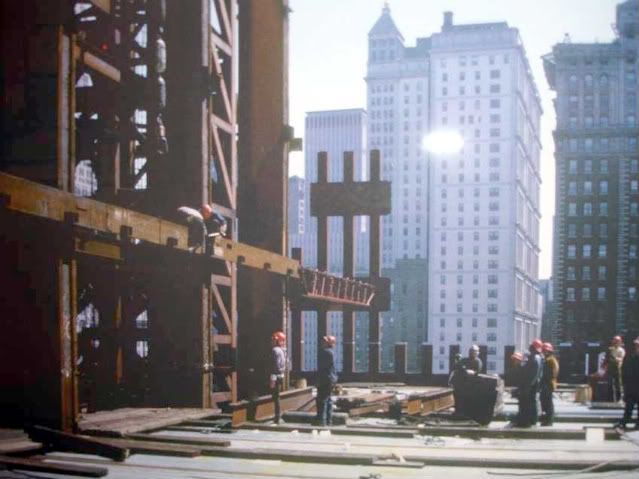
http://wtc7lies.googlepages.com/wtccoreconstruction

notice how the reversed "C" channel beams almost bypass the outside perimeter of core columns and are only attached to the face.

WTC-Jones19mar0615-1.jpg


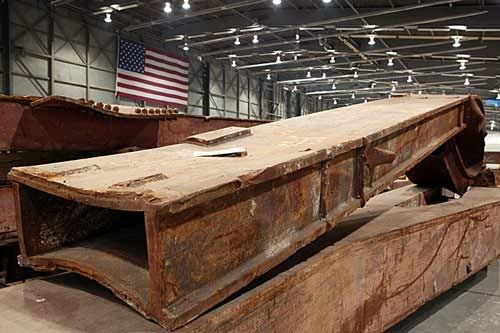
Tony please point out the "robust" beam connections of this particular core column

core3.jpg


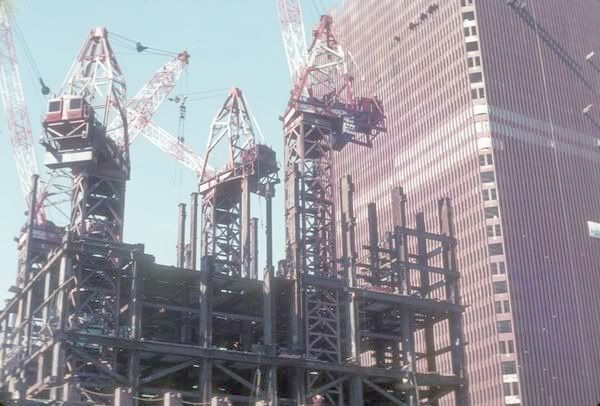
Another photo taken during construction of the core showing what are essentially pinned connections

wtc-core-construction-11.jpg
 
I'm having problems visualizing that. Got an illustration handy ?

(Thanks for all the great explanations.)

BigAl,

No prob.

Here's a diagram of the internal truss seat on the core column (on the right of the diagram). The peripheral column is off the screen to the left.

picture.php


What happens at this joint if you remove the external support at the peripheral column for the truss?

The metal of the truss will yield,

Possibly right at the left end of the horizontal "stiffener plate".
Possibly at the seam between the horizontal & vertical stiffener plates.

Whichever place fails, the whole truss swings downward at this point, just as if there was a pin joint here.

It's a high friction pin joint, because it takes a bit of force to bend the metal. But with a 30 - 60 foot lever arm, not very much force at all.

Other possibilities are that the screws fail or the channel to column weld fails. In this case, it acts just like an "overloaded, ruptured pin joint".

Here's an example of the same effect happening at an external seat. This "pin joint" was in the angle bracket right at the bend.

picture.php


Again, in it's installation, it's an angle bracket.
When it fails, it behaves like a pin joint.


Tom
 
Last edited:
BigAl,

No prob.

Here's a diagram of the internal truss seat on the core column (on the right of the diagram). The peripheral column is off the screen to the left.

[qimg]http://www.internationalskeptics.com/forums/picture.php?albumid=176&pictureid=1434[/qimg]

What happens at this joint if you remove the external support at the peripheral column for the truss?

The metal of the truss will yield,

Possibly right at the left end of the horizontal "stiffener plate".
Possibly at the seam between the horizontal & vertical stiffener plates.

Whichever place fails, the whole truss swings downward at this point, just as if there was a pin joint here.

It's a high friction pin joint, because it takes a bit of force to bend the metal. But with a 30 - 60 foot lever arm, not very much force at all.

Other possibilities are that the screws fail or the channel to column weld fails. In this case, it acts just like an "overloaded, ruptured pin joint".

Here's an example of the same effect happening at an external seat. This "pin joint" was in the angle bracket right at the bend.

[qimg]http://www.internationalskeptics.com/forums/picture.php?albumid=176&pictureid=1435[/qimg]

Again, in it's installation, it's an angle bracket.
When it fails, it behaves like a pin joint.


Tom

Good picture....I also had trouble picturing what you were talking about but Big Al beat me to the punch in asking...

I'm an EE man.....if isn't something really abstract like electromagnetic fields or an electron sea I can't picture it....

Im not even sure if I believe that mechanical engineering structures exist until I see a picture ;)
 
BigAl,

No prob.

Here's a diagram of the internal truss seat on the core column (on the right of the diagram). The peripheral column is off the screen to the left.

[qimg]http://www.internationalskeptics.com/forums/picture.php?albumid=176&pictureid=1434[/qimg]

Thanks. It should have been obvious to me that the lateral channel had to be to fasten trusses to because the trusses didn't line with the core beams otherwise.

Is "two 5/8" bolts" really all that is taking the lateral load for each truss?
 
Last edited:
Thanks. It should have been obvious to me that the lateral channel had to be to fasten trusses to because the trusses didn't line with the core beams otherwise.

Is "two 5/8" bolts" really all that is taking the lateral load for each truss?


I haven't had time to look back but If i recall one end was even slotted. perhaps to allow for slight discrepancy in the field and to allow columns to be set plumb. I also see some discrepancies in some of the descriptions ive seen on the web. There might be 3/4 bolts for the truss seat and 5/8 bolts for the viscoelastic dampers on the seat below the upper chord seats.
 
Sorry for being a bit slow here, but how do do the trusses provide lateral support to the core from the peripheral columns with a joint like that?

Or is it the actual floor frame we were talking of earlier that provide that? Or am I way off base on what's being dicussed?
 
BigAl,

No prob.

Here's a diagram of the internal truss seat on the core column (on the right of the diagram). The peripheral column is off the screen to the left.

[qimg]http://www.internationalskeptics.com/forums/picture.php?albumid=176&pictureid=1434[/qimg]

What happens at this joint if you remove the external support at the peripheral column for the truss?


Tom

Please note the two bolts that attach the floor assembly to the column/angle bar!

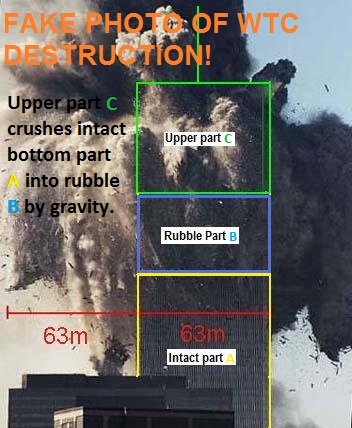
So what happens, when you remove the 'support', incl. the two bolts? This?

WTC.jpg


Well, this is what was recorded and then explained by NIST and others as follows:

1. Supports were removed between the undamaged upper part C and the likewise intact, lower part A, e.g. the truss seat above.

2. C displaced down and there were further local failures at contact C/A.

3. The local failures produced a compacted , structural rubble volume, part B, that produced more failures.

4. Part A blow up in 1 000 000 000's of bits as it lacked 'strain energy' to absorb the pressure of part B (according NIST).

5. Upper part C was intact all the time! It blow up later! According Bazant!

Moral lesson: If you believe that a tower is destroyed by removing two bolts in a floor truss high up, please check if all bolts are fastened inside your own head! Loose screws screw up!
 
Last edited:
Please note the two bolts that attach the floor assembly to the column/angle bar!

So what happens, when you remove the 'support', incl. the two bolts? This?

[qimg]http://heiwaco.tripod.com/WTC.jpg[/qimg]

Well, this is what was recorded and then explained by NIST and others as follows:

1. Supports were removed between the undamaged upper part C and the likewise intact, lower part A, e.g. the truss seat above.

2. C displaced down and there were further local failures at contact C/A.

3. The local failures produced a compacted , structural rubble volume, part B, that produced more failures.

4. Part A blow up in 1 000 000 000's of bits as it lacked 'strain energy' to absorb the pressure of part B (according NIST).

5. Upper part C was intact all the time! It blow up later! According Bazant!

Moral lesson: If you believe that a tower is destroyed by removing two bolts in a floor truss high up, please check if all bolts are fastened inside your own head! Loose screws screw up!
You forgot the bit that says "and then fly a large passenger jet into it" make sure all screws are.....
 
You forgot the bit that says "and then fly a large passenger jet into it" make sure all screws are.....

No, it happened one hour earlier and just produced a hole, some local failures, fire and no further destruction. The screws managed to prevent further destruction. No big deal, really. The NYFD could easily have handled that.
 

Back
Top Bottom