Merged Alien Big Cats in the UK?

18. A lion. Recaptured in Humberside in 1991, with the report being dated 9th March 1991. A zoo or a circus? Look for the news report, I'd suggest.

Rolfe.
This was indeed a circus escape, and it was 4 lions that ecaped into Grimsby town centre late in the evening. One man (biped) was attacked and the police used their car to ram the offending lion to get it off him. Think they were on the loose for a couple of hours if I remember. On the bright side, while the lions were rounded up, the local pubs were ordered to have a lock-in by the police!
 
Last edited:
I wasn't going to give details about last year's incident(s), but why not? It's not a state secret, no matter what Danny thinks. I can't get the exact dates and so on without searching the records, which I can't be bothered doing, but hey, it's lunchtime, so here's what happened as well as I can remember.

The shepherd from our own farm, right on the doorstep, showed up with the carcase of a ewe. He brings in almost every fatality he has, because of Home Office regs - a lot of his groups are on official feeding trials and things (OMG! vivisection! ban it!) and they're pretty strict about having fatalities properly investigated. This one was gruesome though, it was a classic throat-torn-out suffocation job. The excision was so neat he thought it might have been done by a human with a knife. He didn't find the missing flesh, but he did find the plastic ear tag from the missing ear, lying by itself a few feet from the body. The way it had been chewed suggested the missing tissue might have been eaten.

We got as far as determining that was no knife involved, and that it was a predator. I don't recall if we skinned her to check for claw marks or not. If it happens again I certainly will - this forum is a great resource! However, there was certainly no meat missing and the fleece was intact and unmarked. Whatever had killed her had not tried to eat her - only her right ear and her larynx.

I'd literally just got out of the PM room when I was called to the door to deal with a policeman. He had a bunch of photographs in his hand. The PM room attendant said, hey, how did you get photos of our sheep?? I pointed out that our ewe had been a Suffolk, and this was a Greyface. The policeman said the photos had been taken in Fife, the previous day, and he'd been sent to ask if it could be a big cat killing.

(At this point I tried to contact a retired local pathologist who has special expertise in these cases, the guy who looked at Charlotte the Sheep in fact, but he was away. When I got hold of him later, he confirmed from the photos that death was due to asphyxiation from the death grip, and the lack of bleeding was because the ewes were dead before the larynx was actually ripped out.)

So, we had a discussion about it - the shepherd, the policeman and the vets. Fife and Midlothian are separated by a big body of water, and we all agreed that it was physically impossible for an animal without access to a motor vehicle to have carried out both attacks. Thus, it was either two separate free-living animals, or one animal with access to a motor vehicle.

We considered the former possibility first. The policeman said that there had been big cat "sightings" in Fife, but we'd had none in Midlothian. We thought about the possibility of there being a loose cat in either location, and realised it wouldn't fly (unless the cat could fly!). Fife is low-lying and intensively farmed. One mouthful of larynx wouldn't keep anything going for very long, and they'd had no other reports of dead sheep. The same was really true for our own area. Although we have a big area of wild country right on our doorstep, and indeed the field the ewe had been in was on the edge of the wild country, it's still farmed. We have hill sheep and beef cattle up there, and the stockmen keep an eye on them and record any losses. There are also gamekeepers looking after the grouse shooting. Nobody had reported any unusual losses, or any devoured carcasses lying around. The hills are also very open, with little cover, and in spite of shepherds, gamekeepers and quite a lot of hillwalkers, there were no Danny-style "sightings" on record.

So we decided that if either case was the work of a big cat, it was a big cat which had only just arrived. Paradoxically, it was the double occurrence that was reassuring. If it had only been one, we'd have been seriously considering the possibility of a newly-released big cat (even though there isn't a zoo near here), and waiting for the next body to show up. However, the likelihood of two big cats appearing simultaneously in two separate counties was stretching credulity. We concluded that as we had two, it was either something common enough to happen in two places independently, or the same animal taken from one location to another in a vehicle. Both of these possibilities led to the same conclusion - dog. (The shepherd kept talking about badgers, but I didn't really buy that myself.)

I thought it was either the case that one dog had learned this particular killing grip, and the owner had taken it to Fife the previous day, or that the technique was quite a common canine attack method. However, I haven't seen another one since, so it seems to have been a coincidence whichever way you look at it.

More cases did appear, but they were different. Later in the summer the same shepherd came in with a big Suffolk lamb, newly dead. He said he'd seen it looking ill and breathing badly, and had taken it inside and given it antibiotics. However, he found it dead next time he checked. He was worried about pneumonia.

This lamb had suffered one single powerful bite to the flank, with the teeth apparently having taken hold round the end of the rib cage. There was a tear in the skin, the body wall was intact, but the rumen and the diaphragm were both ruptured. There were rumen contents in the chest, which is why the lamb had been breathing badly. There was one other skin-deep bite on the hindquarters.

About the same time a farmer from East Lothian came in with a lamb in his trailer. He said he'd gone out in the morning to find at least half a dozen lambs lying dead, and many of the remainder looking ill. He'd loaded up this one, apparently the sickest of the survivors, for us to find out what was going on, but it had died in transit. This lamb had also suffered bite wounds to the abdomen which had penetrated the intestines. This time there were numerous smaller bites, and when we skinned the lamb we found a lot of skin-deep teeth marks on the rump and hind limbs.

Oddly, when I made my report, the farmer didn't believe me, but by the time he received the report the knacker had already collected the other carcasses. A phone call to the knacker's yard elicited the information that there were no bite wounds visible, but there hadn't been on the one we'd seen either - they were only visible once the lamb was skinned. I asked if we could have another one, but as the others were all recovering the farmer was understandably reluctant. I told him to inform the police.

Some time passed, and then the third local case occurred. I got in one morning to be told that our shepherd was already on the doorstep with a casualty, and it was horrific. He had gone to do his usual morning inspection and found a full-grown gimmer trying to stand, but obviously injured. She had no muscle or connective tissue between the stifle and the hock of her left hind leg. The intact tibia was the only thing holding on the rest of the leg and the foot. The shepherd had immediately got his needle and killed the sheep on humane grounds. There wasn't another mark on her, but there wasn't a hunk of meat lying on the grass either. I've still got that leg in the freezer. We told the cops, because we were concerned that a dog that could do that to a sheep could do the same to a child, but they didn't seem all that interested.

These were all the ones I dealt with myself, but I think there was at least one more, possibly two, that colleagues saw. There have been none for some time though. I'm fairly sure that the East Lothian one was a separate incident, with a completely different modus operandi. However all the Midlothian ones I saw, all from our own farm, looked like a dog with very powerful jaws that was into giving one huge bite, then running off with whatever it had in its mouth. The first case, the throat-torn-out, had looked very expert, but it didn't manage to that again.

The real oddity was the Fife one, with the identical injury just two days before our one. Quite a coincidence whichever way you look at it. Either two dogs happened to do exactly the same (very unusual) thing almost simultaneously and never again, or our dog was taken to Fife by its owner and pulled off the only two perfectly-executed throat-rips of its life (that we know of) in the two locations. There have been no other casualties reported from Fife since then.

So there's why I'm as sure as I reasonably can be that there isn't a big cat stalking the Pentland Hills, or even Fife. Not because we haven't had suspicious injuries, because we have, but because the amount of unaccounted-for meat around here wouldn't keep a toy poodle alive. Even the ones that are found dead of disease or accident only have evidence of carrion bird scavenging.

I think there's a sheep-worrying Rottweiler somewhere round here, and I hope the next thing it bites isn't human.

Unless, of course, we have an invisible ghost panther that only slips through the interdimensional void to have one quick chomp, then disappears again....

Rolfe.

 
This was indeed a circus escape, and it was 4 lions that ecaped into Grimsby town centre late in the evening. One man (biped) was attacked and the police used their car to ram the offending lion to get it off him. Think they were on the loose for a couple of hours if I remember. On the bright side, while the lions were rounded up, the local pubs were ordered to have a lock-in by the police!


Thanks, that's great info! I suspect all the other cases on the DEFRA list (which isn't hosted on www.defra.gov.uk by the way, it's a link to the Wayback Machine) can be found the same way by anyone who's interested. I think they've just collated whatever news reports they could find to get rid of an annoying FoI request, then washed their hands of it.

Rolfe.
 
It should also be mentioned that the big cats deal with their prey after killing in a different way than the canids.

Big cats (maybe putting aside lions) don't like to eat their prey in an exposed situation. They instinctively drag or carry the prey to a more secluded place before beginning to feed. Leopards commonly take prey up into a tree. Pumas try to hide the carcass and will even cover it with debris, returning to feed over a period of days. It is unusual for a big cat to feed on its prey in the exact location that it was killed (unless that spot is already in deep cover). A sheep may be killed in a pasture or meadow, but they will want to drag it to the woods before starting to eat. Conversely, canids are quite happy to eat the prey where it fell. Small prey that can be carried (think rodents and rabbits) may be taken to another location to eat.

There are also differing feeding preferences concerning which parts are eaten first and how.
 
Is there anywhere online that describes these differences? As you can see, we don't get many predator killings round here and it would be interesting to read up a bit more on it.

None of the cases I described showed any signs of anything trying to consume the carcass in any way at all, although the bitten-out chunk was always missing (except the ear tag had been rejected!). Two of the sheep weren't even dead, although one was certainly incapacitated and should have been easy prey.

I find this behaviour entirely typical of a sheep-worrying dog, which is acting out its predatory instinct in only a partial way, without taking the act through to consumption. It was really just the two examples of the apparently skilful throat-ripped-out bite I found remarkable.

Rolfe.
 
Is there anywhere online that describes these differences? As you can see, we don't get many predator killings round here and it would be interesting to read up a bit more on it.


There must be. It is also likely to be American. We have large predators here and they do take livestock. The science of specifying the predator is sometimes applied by necessity. We also have a similar situation here where people claim cougar predation in places where they are not documented or expected. This is because of Cougar Mania. Professional necropsies usually conclude canid or bear. Injuries from barbed wire and such will be blamed on cougar. Dogs or coyotes will get into wired pens and send a herd into a frenzy. You get ripped hides and other self-injuries from the barbs in addition to the typical kill/feed injuries. The hide rips can be declared as a cougar using its claws like a scalpel. Much of this can be attributed to local "common folk" insisting that they have cougars or "panthers". We told you so. :rolleyes:

This is routine work for vets and other experts, but the subculture populace can be at odds with them. Yes, we have our conspiracy theorists here in full force. Those government guys don't want to admit that big cats are on the prowl. Those guys will tell you that coyotes killed that pony but they know it was a panther!
 
As far as things that will go for sheep or larger are concerned, we've really only got domestic dogs. The last wolf was killed in 17-something. Foxes will take poultry and may scavenge, but they don't usually go for mammals bigger than about rabbit size. Our shepherd was banging on about badgers, but I'm still sceptical about that one. We do of course have people, too, but they usually use knives, which cut the hair, and that can be seen.

So if anything other than that is suspected, we'd have to go for American (or maybe European) information. We'd need the accounts of the pathologists who work in the areas where such animals are indiginous. I have a feeling that some of my colleagues are a little too ready to say "possible big cat" without any supporting evidence.

Charlotte the Sheep
The Sundrum horse

Certainly, if the injuries are suspicious, then one must always consider the possibility of a recent escape from captivity. And in that case, where might it have come from? Privately-owned big cats are extremely rare and normally illegal, and the location of most zoological collections is known. One also has to ask, if this animal has been at large for any length of time, what else is it eating? Is there any possibility that the local ecosystem is supporting a large carnivore?

I just don't think enough people are asking these latter questions. There is no evidence of any such animal in Hertfordshire or Ayrshire or any other damn place for that matter. So, dear colleagues, kindly stop exciting local reporters by talking about big cat attacks until such time as some evidence emerges. Dogs (or as you say, barbed wire injuries) and occasionally human malice are the default explanations, and these causes can produce a very wide range of presentations.

Rolfe.
 
Last edited:
On this side of the big pond, there is considerably more 'sophistication', organization and effort put into promoting the mania. At least for that Michigan Wildlife Conservancy which seems to be running the front lines for this.

Their website hosts a video of two housecats in a Michigan field which they say are cougars. You will see expert testimony and analysis of the video. Conclusion: 100% cougars. It's ridiculous, but look at the slick product and promotion that they pulled off.


"Cougar Video"
 
I had a fantastic week in Michigan last autumn. I loved it! However, I didn't get very far from Lansing, apart from a day trip to Saugatuck. I had an imaginative hour wandering in a patch of woodland telling myself it was a bit Paul Bunyan had missed, but I kept coming to the edge and finding myself in a ploughed field. I was shown round the university veterinary facilities, which were very impressive.

I'd have been mildly surprised to learn there were undetected big cats in the southern peninsula, given the geography. But who knows? It's all wild and woolly over there!

Rolfe.
 
Are you saying that Cougars actually prey on feral housecats?!! :covereyes
.
The community manager saw the cougar in her front yard, and her feral cats disappeared.
.
..
Was the coyote population affected too?
.
I don't know. There's many more coyotes than cougars around. And they move fast!
It's difficult to wait for the prey to come by out here in the desert. One has to go look for it.
The jacks I see are usually already moving away from me when I see them. They get antsy when I a hundred yards away, but some can be startled, and don't always move rapidly, sometimes freezing. Which can lead to disaster.
 

Attachments

  • jrJackRabbit-notrunning.jpg
    jrJackRabbit-notrunning.jpg
    154 KB · Views: 1
  • fcCoyoteLunch.jpg
    fcCoyoteLunch.jpg
    125.5 KB · Views: 3
Some basic information here (w/photos).

Related: INTERPRETING PHYSICAL EVIDENCE OF COYOTE PREDATION


Oh, thanks! :)

You seem to have some very ambitious foxes over there - ours don't tackle sheep or cattle of any age.

I note the comment about dog attacks.

Domestic dogs do not normally kill for food and their attacks usually lead to indiscriminate mutilation. True feral dogs are more apt to kill for food.

Sheep-killing dogs usually work in pairs or larger groups and can inflict considerable damage. Sheep are likely to be bitten in the head, neck, flank, ribs, and front shoulders, and the ears of mature sheep are often badly torn. Often sheep attacked by dogs are not killed but are mutilated to the point where they must be destroyed. The external appearance of some dog bites may not look serious but a necropsy reveals serious tissue damage (Bowns 1976).


Fits the cases I described very well. I didn't suspect a pair though. However, I noticed something else, with regard to the coyote.

In attacks on adult sheep, goats and older lambs, coyotes typically bite the throat just behind the jaws and below the ear (Wade and Bowns 1982). [....]

Connolly et al. (1976) considered the sheep killing technique of coyotes to be remarkably consistent. Each coyote ran alongside the fleeing sheep, clamped its jaws on the neck laterally (sometimes dorsally) just behind the ear, and braced its feet to stop the sheep. The coyote's grip then shifted to the larynx region, and it simply held on and waited for the sheep to succumb (primarily by suffocation).


That is an exact description of the first two ewe carcasses I saw. Which confirms my evaluation that a canid could be responsible. Whether it was one dog, simply taken to Fife on that day (I'm surmising it's local to here because of our subsequent losses), or two individual dogs which both got it right within two days, I suppose we'll never know. It didn't manage to repeat the performance in subsequent attacks though.

Rolfe.
 
Here is an amazing video of a cougar taking down a deer on a forest road. NSFW because of profanities, and know that you will see a deer being killed.

Note the determined kill bite to the throat. This is all about crushing the trachea - it's virtually a bloodless kill.
 
That -is- one of the better ones!
At least they used the zoom properly.
The deer was bigger than the cat.
I'm bigger than the cat.
Hmmmmmmmm!
 
Stuffed Felicity

there were big cats loose in the UK,

felicity.jpg


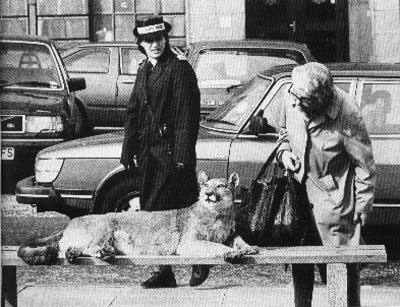
Here's a little conundrum for the Bigfooters. The above photo isn't "real", of course. It portrays Felicity after her death and appointment with the taxidermist. I'm just curious about the provenance. I'm inclined to believe it might be as real as the Cottingley Fairies - that is, not manipulated. I think it's perfectly possible they took the stuffed cat into a street, put her on a bench, and photographed her with a couple of interested onlookers, as a publicity stunt for the museum or something.

However, it could be photoshopped. And I'm not sure where the background is, but it looks more likely to be Inverness than Cannich. The apparent age of the picture seems deceptive. Felicity didn't die till the mid-1980s as far as I know, so the whole picture can't be older than that. I think the use of black and white film (or is it a colour pic rendered in black and white?) makes it appear older than it really is. Or has someone photoshopped a picture of the late Felicity on to an older photograph? A car nut might be able to date the models on display in the car park.

I'm just curious, as I can't find the provenance of the image beyond its presence on the British Big Cats web site, where Marduk took it from.

Anybody know anything about it?

Rolfe.
http://www.britishbigcats.org/images/cms/felicity.jpg
 
Speaking about government cover ups. It got me looking for something I remembered from awhile back... Virgil Smith.
http://www.lib.niu.edu/2001/io010221.html

Mr. Smith contends there is a population of 250 to 300 cougars living in the wild in Illinois and that state and federal officials have participated in a secret release of the animals. As early as 1998, the DNR urged Mr. Smith to share his alleged evidence with state biologists.

On another note: I have come across a few deer kills from coyotes. In one case I followed the tracks, both deer and coyote, to the location where I had discovered the deer kill. Quite a bit of tooth punctures to the upper throat area, also, it was cleanly gutted. Drag marks on the ground around the area, and the puncture wounds to the neck, made me confident this was a kill as opposed to scavenging. The rear legs also had some small superficial cuts on the surface. I didn't see any large posterior leg wounds or any large perforations to the hind. My friend with me at the time thought "It must have been dogs, Only dogs would hamstring a deer." He said. I'm not convinced of this? I tend to think more "indiscriminate mutilation" would have been present. I had seen more damage to the upper neck area (puncture wounds) Thinking the coyotes had brought this deer down in this fashion... Then fed.
The last one I had seen was too scavenged to tell, it may have succumbed to disease or predation. Though I think the coyote diet here, consists more of the local rabbit.
Coyotes are the only large predator we have in my area. There isn't a big problem with attacks on livestock here. About the most exciting thing that happens here is the palpation of cattle.
 
Sorry, I'm having way too much fun here! I just noticed this delicious contradiction.

totally agree, the police as always do not require evidence of an animal to take reports from a government source seriously. I think they would rather err on the side of safety than have to say "we did nothing" when someones toddler goes missing.


Defra were recently caught covering up and playing down the evidence, [....] The forestry commission were also forced to release information [....]
it would cause public panic to know that there was a possibility of coming across a big cat in the wild, we have enough trouble getting parents to understand that every stranger is not a paedophile intent on raping and murdering their children without starting a nationwide panic over every domestic feline thats spotted without anything in view for scale.


Sorry, don't mind me. I hadn't realised quite what a rich seam of woo we have right here on this little island, and I was reviewing the thread to follow some of the lynx. [Boom, boom - I'll be here all week....]

I think a lot of what's going on is because nobody is really debunking it. So it's quite easy for the BBCS to feed up-beat stuff to receptive local press looking for a story.

Despite no concrete photographic evidence of big cats in the county, Gloucestershire police believe there are pairs living in the Forest of Dean and around the Cirencester area.


Well, if nobody actually goes to the Gloucestershire police and asks them if this is true, then it's just going to sit there unchallenged. And so the legend grows. I'm quite astonished at the number of web pages I found all either stating point blank that pumas are breeding in the countryside, or taking a mysterious, well-you-never-know line. Pointing out that the whole thing is vanishingly improbable simply on empirical grounds just doesn't sell papers I'm afraid.

I'm not volunteering, but it's kind of fun to realise that we've got our own local Bigfooters right here.

Rolfe.
 
Last edited:

Back
Top Bottom