The grey cloud on my memory has lifted and the pretty winter birds were "Satin Birds". We get one or two taipens a year here along with others. A few years back I pinned a good sized tiapan down with out hurting him(her) tied a builders string line around his,her neck. By this time the snake was what we call "bested" so for fun dragged him over to some nursery workers to show them my new pet, they all bolted. Teathered snake in the shade undecided what to do with it as it was dinner time. came back later to find snake dead, alas the line must have been too tight around the neck or it had a heart attack. The tiapan is a travelling snake it moves from place to place following food,think the king browns do the same. While the rest are happy to stay near food and water. Some how crows and snakes have learnt not to eat cane toads as they kill, but the crow turns the cane toad over and eats the tongue as it is the only non poison bit. They all know this so are there memorys inherited or the connected mind bit? The old bushies say a crow can read your thoughts. As soon as you think "I'm gunna shoot you ,you black ====" they bolt.

-
Security incident: ISF was recently accessed by intruders. Please change your password, and change it anywhere else you used it. Read more
You are using an out of date browser. It may not display this or other websites correctly.
You should upgrade or use an alternative browser.
You should upgrade or use an alternative browser.
Australia
- Thread starter Akhenaten
- Start date
Hi, another Aussie checking in. I've been lurking here for ages (made this ID about a year ago and forgot all about it) so why not delurk in the Greatest JREF Thread ever?
Australia is a strange place. For a people who have largely elected small conservative governments and prime ministers we're also remarkably progressive when we want to be. Back in the 1900s Australia was looked upon as a freakish social experiment, a reputation bolstered by a series of Australian 'firsts'.
These include:
Electing the first parliamentary socialist government ever, that of Anderson Dawson, in 1899 (ok, it was a minority govt in Queensland and it lasted exactly one week, but still, big stuff in what was still the Age of Empires), repeating the feat at national level in 1904 (this time for three months). The Australian Labor party was an early success (UK Labour didn't get into power until 1931) and but for its tendency to towards split and mass defections at times of high political drama it would have been the dominant force for most of 20th century Aussie politics. Until the formation of the Liberal Party in 1944, right-wing defectors from Labor formed most of the non-Labor governments and parties. These include the Nationalist Party (in power 1917-29), formed by the defection of then Labor PM Billy Hughes over WW1 conscription (for), the United Australia Party (in power 1931-1941), created out of a merger between the Nationalists and Labor members defecting over the pursuit of Keynesian economics by the Labor Scullin government.
The Harvester Judgement of 1907, which was one of the first attempts at setting a minimum wage anywhere in the world. It established in Australian law the notion that an employee was owed a 'living' wage that could "meet the normal needs of the average employee, regarded as a human being in a civilised society." It was reached at the Commonwealth Court of Conciliation and Arbitration, established in 1904 (the Kiwis set theirs up a decade earlier, but they don't have their own thread in HLA so there ).
).
Women's sufferage - first extended in South Australia in 1894, Western Australia in 1899 and the Commonwealth as a whole in 1902. During the 1916 conscription referendums both sides made extensive use of slogans and advertising targeting women for the first time in political history (though again, the bloody Kiwis extended sufferage first in 1893).
oh and on the definitive Aussie songs - you're missing "Cattle and Cane" The Go-Betweens, "Wide Open Road" the Triffids and "Berlin Chair" from You Am I.
Cheers!
Australia is a strange place. For a people who have largely elected small conservative governments and prime ministers we're also remarkably progressive when we want to be. Back in the 1900s Australia was looked upon as a freakish social experiment, a reputation bolstered by a series of Australian 'firsts'.
These include:
Electing the first parliamentary socialist government ever, that of Anderson Dawson, in 1899 (ok, it was a minority govt in Queensland and it lasted exactly one week, but still, big stuff in what was still the Age of Empires), repeating the feat at national level in 1904 (this time for three months). The Australian Labor party was an early success (UK Labour didn't get into power until 1931) and but for its tendency to towards split and mass defections at times of high political drama it would have been the dominant force for most of 20th century Aussie politics. Until the formation of the Liberal Party in 1944, right-wing defectors from Labor formed most of the non-Labor governments and parties. These include the Nationalist Party (in power 1917-29), formed by the defection of then Labor PM Billy Hughes over WW1 conscription (for), the United Australia Party (in power 1931-1941), created out of a merger between the Nationalists and Labor members defecting over the pursuit of Keynesian economics by the Labor Scullin government.
The Harvester Judgement of 1907, which was one of the first attempts at setting a minimum wage anywhere in the world. It established in Australian law the notion that an employee was owed a 'living' wage that could "meet the normal needs of the average employee, regarded as a human being in a civilised society." It was reached at the Commonwealth Court of Conciliation and Arbitration, established in 1904 (the Kiwis set theirs up a decade earlier, but they don't have their own thread in HLA so there
).Women's sufferage - first extended in South Australia in 1894, Western Australia in 1899 and the Commonwealth as a whole in 1902. During the 1916 conscription referendums both sides made extensive use of slogans and advertising targeting women for the first time in political history (though again, the bloody Kiwis extended sufferage first in 1893).
oh and on the definitive Aussie songs - you're missing "Cattle and Cane" The Go-Betweens, "Wide Open Road" the Triffids and "Berlin Chair" from You Am I.
Cheers!
Last edited:

Akhenaten
Heretic Pharaoh

What he said 
Cooee Cobber.
Cooee Cobber.
Akhenaten
Heretic Pharaoh
Happy Birthday Bob!

Cheers and best wishes for today and for the year ahead,
Dave
PS Bruce Woodley, of the Seekers, is another famous Aussie having a birthday today.
Cheers and best wishes for today and for the year ahead,
Dave
PS Bruce Woodley, of the Seekers, is another famous Aussie having a birthday today.
Akhenaten
Heretic Pharaoh
Our situation is rather different.
http://www.theaustralian.news.com.au/story/0,25197,25383013-22242,00.html
Sorry I did not see this posted back when you did - Seriously what a beautiful story - one to keep for the next time an anti france thread erupts on here
My apologies if I've appeared to be ignoring you blokes. I simply don't have anything to add.
I've appreciated all your posts and hope others have as well.
Cheers,
Dave
HawaiiBigSis
List Management

Hi, another Aussie checking in.
Welcome, Horza! May you find plenty to add.
Akhenaten
Heretic Pharaoh
Quolls
First thing we need to do is stop using the term "rare", since it tends to be a bit subjective. Like "common". Depends on where you are really.
The fact is that between the six species currently available, their status ranges from "not-threatened", through "vulnerable", to "endangered". Despite their conservation status, however, there are enough of them about that most people will have seen them or their spoor if they've spent any time in the bush. More importantly, there are enough of them that if we're careful, they'll do alright.
Humans are ultimately the biggest threat to them, through the agency of the usual suspects; indiscriminate poisoning, loss of habitat and competition from introduced species. The method of dispatch mentioned by Sideroxylon does a lot of them in too, and unfortunately this is probably how most folks get their first look at a quoll.
I might have thought that cats and foxes would be less of a threat to quolls, since they're well-equipped to take care of themselves, and in some areas they are considered to be apex predators. The experience of the Eastern Quoll in fox-free (we hope) Tasmania, however, seems to indicate that other carnivores do indeed have an effect. I suspect that pressure would come from competition for prey rather than from direct attacks. They're nasty little buggers if they're cornered, Just like Tasmanian Devils, to which they are related, and I wouldn't take one on without Arthwollipot and something sharp standing by.
As with many native animals, the biggest threat at the moment in some areas is the Cane Toad, Bufo marinus.
Quolls look like this:

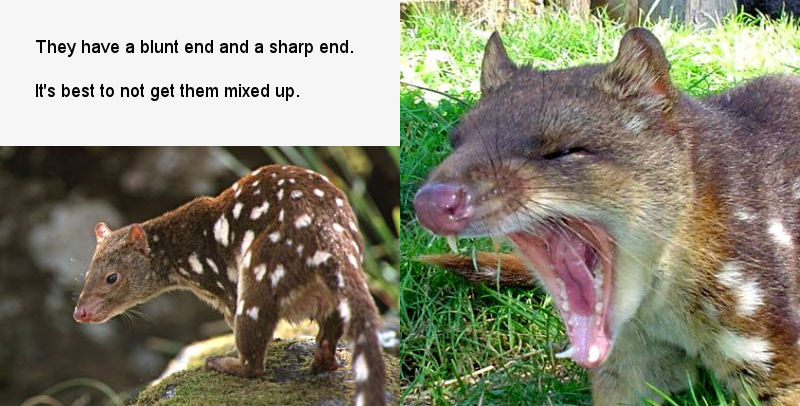
©Geocities
©Quoll Seekers Network ©Flamungo
Edumacational Stuff
Australian Government - Department of Leftover Bits and Pieces
And Bob's dad's chookhouse!
Kingdom Animalia
Phylum Chordata
Class Mammalia
Infraclass Marsupialia
Order Dasyuromorphia
Family Dasyuridae
Genus Dasyurus
The Dasyuridae family also includes the previously mentioned Tassie Devil and the extinct (prolly) Thylacine. All of these have nasty, big, bitey teeth,like rabbits
There are currently six known species of quoll. These are they:
Tiger Quoll or Spotted Quoll, Dasyurus maculatus
These are the dudes in the pictures above, and are the largest and most numerous. They're Australia's largest carnivorous marsupial except for "Matilda", the giant kangaroo from the Commonwealth Games in Brissie, which ate children.
There are two subspecies Dasyurus maculatus maculatus, found from southern Queensland south to Tasmania and Dasyurus maculatus gracilis, found in an isolated population in northeastern Queensland.
Size ranges from 35-75 cm (14-30 in) in length with a tail of about 34-50 cm (14-20 in). When fully grown, males can reach 7 kilograms (15 lb) while females reach about 4 kilograms (9 lb). The northern mob are noticeably smaller than their southern cousins.
Wikipedia
The Tiger Quoll is listed by the IUCN on the Red List of Threatened Species with the status "vulnerable". The Australian Department of the Environment and Heritage considers the northern subspecies D. m. gracilis as "endangered". Chooks consider them to be "threatening".
Western Quoll or Chuditch, Dasyurus geoffroii
Found in the southwestern part of Western Australia, these little fellers are about ½ the size of the Tiger Quoll.
Wikipedia
Of all the other quolls, the Western Quoll is most closely related to the . . .
Bronze Quoll, Dasyurus spartacus (and so's his wife)
. . . which come from New Guinea. The Bronze Quoll was only discovered in the 1970s, and only properly described as a separate species in 1987. The Queensland Museum is studying them, but little is known about them so far.
New Guinean Quoll, Dasyurus albopunctatus
These also come from New Guinea. Who'd o' thunk it?
They're only little, at about ½-1½ kg (1-3 lb) and mainly live in the highlands above 3 000 feet. They spend a lot of their time up in the trees and have transverse pads on the soles of their feet, an adaptation which is not present in the mainland species.
Both of the New Guinea varieties of quoll are believed to be under threat from the same nasties as ours are, but it's pretty rugged and remote up there so I doubt if anyone knows for sure.
Northern Quoll, Dasyurus hallucatus
These appear in a number of separate populations across northern Australia from the Pilbara in the west to around where Bob lives in southeast Queensland.
They're the smallest of all the quolls at a maximum 1 kg (2lb) and are the ones most threatened by the dread cane toad.
The Northern Quoll has recently been listed as "endangered" under Australian Commonwealth legislation (the EPBC Act), although it is only listed as "near threatened" by the IUCN
Eastern Quoll, Dasyurus viverrinus
These are now found only in Tasmania, although formerly they also lived on the eastern mainland. They're about the size of teh kitteh.
Finally, the poor little fellers have found a safe haven. Without the introduced species like foxes, cats, foxes, cane toads and foxes, they are doing quite well, and could even be said to be (shudder) "common" on the Apple Isle. They are frequently observed scavenging in people's yards and stuff.
Did I mention foxes?
Fun Facts
Cheers,
Dave
One cold winter night about 1945 there was a big ruckus in the chook house. Dad shoots a quoll (think that's spelt right) as it was killing chooks. Have never seen one since they are very rare, perhaps someone we know will provide a picture as he is very good at that. It was spotty black and white like a big cat from memory.
1080 poisoning by the government in the 50s wiped many creatures out and caused cancer in humans as it's made from sodium fluoride. (Bastards)
Google is your friend Bob:
http://www.environment.gov.au/biodiversity/threatened/publications/quolls2004.html
Not that rare, and unlike many of your posts, I actually believe the first part of this post, but not the second.
I used to see a lot of them on sealed roads at night around the Top End - probably enjoying the warmth before inevitably becoming road kill.
First thing we need to do is stop using the term "rare", since it tends to be a bit subjective. Like "common". Depends on where you are really.
The fact is that between the six species currently available, their status ranges from "not-threatened", through "vulnerable", to "endangered". Despite their conservation status, however, there are enough of them about that most people will have seen them or their spoor if they've spent any time in the bush. More importantly, there are enough of them that if we're careful, they'll do alright.
Humans are ultimately the biggest threat to them, through the agency of the usual suspects; indiscriminate poisoning, loss of habitat and competition from introduced species. The method of dispatch mentioned by Sideroxylon does a lot of them in too, and unfortunately this is probably how most folks get their first look at a quoll.
I might have thought that cats and foxes would be less of a threat to quolls, since they're well-equipped to take care of themselves, and in some areas they are considered to be apex predators. The experience of the Eastern Quoll in fox-free (we hope) Tasmania, however, seems to indicate that other carnivores do indeed have an effect. I suspect that pressure would come from competition for prey rather than from direct attacks. They're nasty little buggers if they're cornered, Just like Tasmanian Devils, to which they are related, and I wouldn't take one on without Arthwollipot and something sharp standing by.
As with many native animals, the biggest threat at the moment in some areas is the Cane Toad, Bufo marinus.
Quolls look like this:
©Geocities
©Quoll Seekers Network ©Flamungo
Edumacational Stuff
Australian Government - Department of Leftover Bits and Pieces
Quolls are carnivorous marsupials with a pointed snout, a long tail and brown to black fur distinctively spotted with white. They are lively, attractive animals, with bright eyes, a moist pink nose and many sharp teeth.
The largest species, the spotted-tailed quoll, eats birds, reptiles and mammals such as bandicoots, possums, echidnas and rabbits. The smaller quolls eat mainly insects, birds, frogs, lizards, snakes, small mammals and fruit. Quolls also eat carrion (dead animals), and sometimes scavenge around campsites and rubbish bins.
And Bob's dad's chookhouse!
Like most Australian mammals, quolls are mainly active at night. Typically, they spend the day in one of their many dens, although Spotted-tailed Quolls and Northern Quolls sometimes forage and bask in the sunshine.
Kingdom Animalia
Phylum Chordata
Class Mammalia
Infraclass Marsupialia
Order Dasyuromorphia
Family Dasyuridae
Genus Dasyurus
The Dasyuridae family also includes the previously mentioned Tassie Devil and the extinct (prolly) Thylacine. All of these have nasty, big, bitey teeth,
There are currently six known species of quoll. These are they:
Tiger Quoll or Spotted Quoll, Dasyurus maculatus
These are the dudes in the pictures above, and are the largest and most numerous. They're Australia's largest carnivorous marsupial except for "Matilda", the giant kangaroo from the Commonwealth Games in Brissie, which ate children.
There are two subspecies Dasyurus maculatus maculatus, found from southern Queensland south to Tasmania and Dasyurus maculatus gracilis, found in an isolated population in northeastern Queensland.
Size ranges from 35-75 cm (14-30 in) in length with a tail of about 34-50 cm (14-20 in). When fully grown, males can reach 7 kilograms (15 lb) while females reach about 4 kilograms (9 lb). The northern mob are noticeably smaller than their southern cousins.
Wikipedia
Before European settlement the southern subspecies had a range extending from southern Queensland through coastal New South Wales and Victoria to Tasmania. It is now confined to a few areas, mostly in national parks, and listed as threatened in all mainland states. Land clearing, habitat destruction, and possible predation by the red fox and cats have led to the decline. It has a large home range, and can cover over 6 km overnight.
The northern subspecies of the Tiger Quoll lives in restricted areas around Cairns and Cooktown in northern Queensland, and also in Papua New Guinea. It is slightly smaller than the southern subspecies. It is predicted that only 50% of quolls remain compared to last century.
The Tiger Quoll is listed by the IUCN on the Red List of Threatened Species with the status "vulnerable". The Australian Department of the Environment and Heritage considers the northern subspecies D. m. gracilis as "endangered". Chooks consider them to be "threatening".
Western Quoll or Chuditch, Dasyurus geoffroii
Found in the southwestern part of Western Australia, these little fellers are about ½ the size of the Tiger Quoll.
Wikipedia
The Western Quoll was formerly found throughout most of inland Australia, reaching areas of Queensland, New South Wales and Victoria. It is now restricted to the south-western corner of Western Australia, where it inhabits wet and dry sclerophyll forests and mallee.
Of all the other quolls, the Western Quoll is most closely related to the . . .
Bronze Quoll, Dasyurus spartacus (and so's his wife)
. . . which come from New Guinea. The Bronze Quoll was only discovered in the 1970s, and only properly described as a separate species in 1987. The Queensland Museum is studying them, but little is known about them so far.
New Guinean Quoll, Dasyurus albopunctatus
These also come from New Guinea. Who'd o' thunk it?
They're only little, at about ½-1½ kg (1-3 lb) and mainly live in the highlands above 3 000 feet. They spend a lot of their time up in the trees and have transverse pads on the soles of their feet, an adaptation which is not present in the mainland species.
Both of the New Guinea varieties of quoll are believed to be under threat from the same nasties as ours are, but it's pretty rugged and remote up there so I doubt if anyone knows for sure.
Northern Quoll, Dasyurus hallucatus
These appear in a number of separate populations across northern Australia from the Pilbara in the west to around where Bob lives in southeast Queensland.
They're the smallest of all the quolls at a maximum 1 kg (2lb) and are the ones most threatened by the dread cane toad.
The Northern Quoll has recently been listed as "endangered" under Australian Commonwealth legislation (the EPBC Act), although it is only listed as "near threatened" by the IUCN
Eastern Quoll, Dasyurus viverrinus
These are now found only in Tasmania, although formerly they also lived on the eastern mainland. They're about the size of teh kitteh.
Finally, the poor little fellers have found a safe haven. Without the introduced species like foxes, cats, foxes, cane toads and foxes, they are doing quite well, and could even be said to be (shudder) "common" on the Apple Isle. They are frequently observed scavenging in people's yards and stuff.
Did I mention foxes?
Fun Facts
- Captain Cook collected quolls along the east coast in 1770, and recorded "quoll" as their local Aboriginal name. Quolls were often seen by early settlers, who called them "native cat", "native polecat" and "spotted marten", names based on familiar European animals.
- Male Northern Quolls all die after the mating season, leaving the females to raise the young alone. Deadbeat Dads. Literally.
- The female Eastern Quoll gives birth to up to 30 young. Of these, only the first to attach themselves to the six teats will survive.
- Matilda, the Commonwealth Games kangaroo, didn't really eat children, although that would have been much awesomer. That thing was just soooo gay.
Cheers,
Dave
arthwollipot
Limerick Purist Pronouns: He/Him

Happy Birthday, Bob! One year older, then, eh?
eeyore1954
Philosopher

- Joined
- Jun 9, 2006
- Messages
- 6,811
Can that be true? i would have thought it was much further. how long would it take to drive there with a new car out of Detroit.Detroit, Michigan is 6531 kilometres (3919 miles) from Sydney, New South Wales.
Akhenaten
Heretic Pharaoh
Detroit, Michigan is 6531 kilometres (3919 miles) from Sydney, New South Wales.
Can that be true? i would have thought it was much further. how long would it take to drive there with a new car out of Detroit.
No, that can't be true at all. The actual distance is 15 254 km (9 478 statute miles). I'd try and pretend that I accidentally measured the chord distance intstead of the arc, but I don't really know what happened. Insufficient/excess coffee is my only defence, or I may have been in Universe #6 that day. Things are somewhat smaller over across up through down there.
Well spotted and thanks.
Now . . . about the driving thing.
Heading over to Seattle is the first leg, and shouldn't be a problem. The drive up the west coast of Canada looks delightful, on well-made roads, and you'll be in Alaska before you know it.
At this point, Google Earth starts suggesting a number of kayak trips, but I think the car might present some difficulties. I'd suggest island hopping across the Aleutians on a resupply vessel out of Anchorage.
The next landfall could be tricky. The Kamchatka Peninsula. I'd suggest a moderate-sized Carrier Force for this leg, and maybe travel at night. Quietly.
Your route now takes you down the length of the Land of the Rising Sun. Ferry services between the islands are frequent and quite safe.
Until you cross over to the Philipines. I'd consider purchasing additional flotation devices in Japan, and test them thoroughly before boarding a Philipines Pherry.
Remember that Carrier Force? Might come in handy for the crossing to Irian Jaya. Don't forget some Marines, because you need to drive through a lot of Indonesia before you reach Papua, and there are some dangerous things in Indonesia.
On to Port Moresby, another island-hopping sojourn through the Torres Strait Islands and . . .
At last! Terra Australis!
Now the tough bit of the trip starts, but there's Aussies about to help you on your way from here on, so you're cruisin'.
25 293 km, and 55 days, 21 hours after starting out you'll arrive in Sydney, the Sin City, Jewel of the Pacific and Hub of the Universe.
Oh wait . . . an American car?
You're stuffed.
You'll need to do the trip in reverse. Fly to Sydney and purchase an Australian V8 Supercar.
These cars are capable of skimming across the water at > mach speeds in total comfort and safety and will have you in San Diego in about 3 hours. The home stretch to Detroit may involve shifting back a gear or two, so allow another 2 hours for that bit.
Cheers and Happy Trails, Pardner
Dave.
Last edited:
MG1962
Unregistered

- Joined
- Sep 27, 2006
- Messages
- 17,252
Grrrrrrrrrrr - ya making me home sick cobber

Happy Birthday, Bob! One year older, then, eh?
Thanks you arthwollipot, Dave and JREF forum for kind wishes, % wise a year is not much older(any body got young pill they don't want?) The Quoll in the chook house was dark grey, nearly black with white spots, not a bad colour for edge of snow line hunting. That was a couple of years before the mouse plague.
Akhenaten
Heretic Pharaoh
The grey cloud on my memory has lifted and the pretty winter birds were "Satin Birds".
Also known as the Satin Bowerbird, Ptilonorhynchus violaceus.
Boy
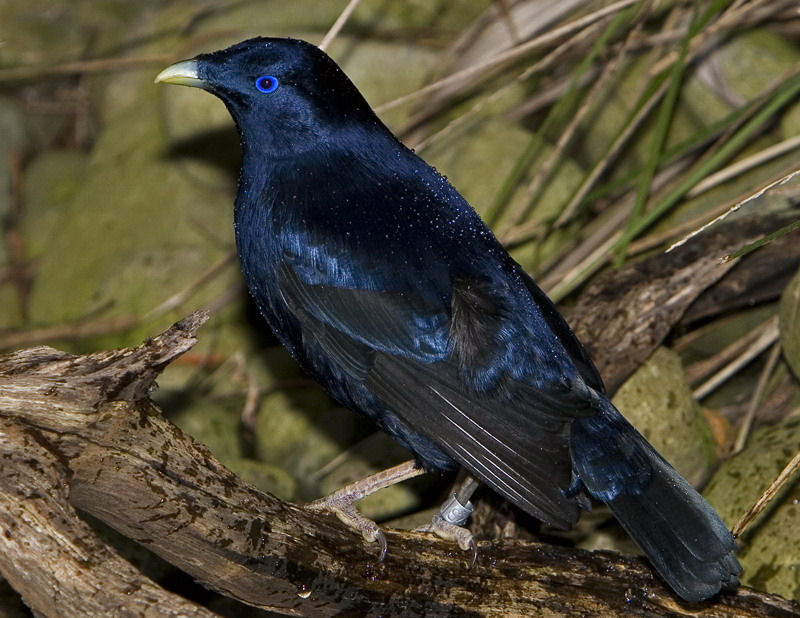
© Pam Russell
Girl

© Oz Trekhttp://www.oztrek.com.au/pages/blue-mountains-fauna/birds.php
Playing mummies and daddies

© chappo's doodlings
The "bower" part of being a bowerbird is explained by the Australian Reptile Park
Bowerbirds are so-named because of the intricate bower structures built by the males. These are not nests but display arenas to attract females. The male further enhances the attractiveness of his bower by decorating with blue objects and then carrying out an involved courtship dance. Once enticed into the bower, mating takes place and then the female leaves to build a nest and raise the offspring all by herself.
More deadbeat dads, just like the quolls. There's a pattern forming here.
Satin bowerbirds inhabit the heavily forested and heathland areas of coastal eastern Australia from Melbourne north to central Queensland. A separate race occurs in a small area of far northern Queensland separated by over a thousand kilometres from its southern cousins. We don't talk about them much. They're conservative christians and dull as dishwater at parties.
Distribution

© Great Ramesses Beard Bazaar
London - New York - Paris - Karnak
In drawing the above map and recalling my own sightings, I note that the range of these birds is smaller than, but similar to, the range of the Red Bellied Black Snake, and indeed they both like the damper, darker, more heavily-wooded areas. I'll bet there are some ugly incidents.
Bowerbirds are omnivorous, and their diet includes fruits, berries, new shoots and insects. They aren't above a bit of garden raiding and other scavenging on the urban fringes as well, and this seems to fit the behaviour described in an earlier post of Bob's.
Kingdom: Animalia
Phylum: Chordata
Class: Aves
Order: Passeriformes
Family: Ptilonorhynchidae
Genus: Ptilonorhynchus
Species: Ptilonorhynchus violaceus
Phylum: Chordata
Class: Aves
Order: Passeriformes
Family: Ptilonorhynchidae
Genus: Ptilonorhynchus
Species: Ptilonorhynchus violaceus
Fun Facts
- Satin bowerbirds always build their bowers on a north-south axis.*
- Man-made decorative objects include anything suitably coloured (blue) such as milk bottle caps, straws and clothes pegs.
- Seashells, berries and the feathers of other birds are popular natural items used for decorating bowers. Around Pi-Broadford the most common item in the bowers I've stumbled upon are the bright blue feathers of the Crimson Rosella, Platycercus elegans.
- It has been hypothesized that as males mature their colour discrimination develops and they are able to select more blue objects for the bower.**
- In Australian slang, a "bowerbird" is a person who likes to collect things. Lots of things. Not necessarily blue.
* Australian Reptile Park
** Wikipedia
Cheers,
Dave, Bowerbirdus amazinghoardica
Last edited:
Akhenaten
Heretic Pharaoh
40 Years Ago
.
A digger stands at the end of the street, his rifle upside-down.
He died when a woman could walk alone, anywhere in town.
If she's not safe in years of peace, why did he go to war?
What was the purpose? What was the Glory? What was he fighting for?
Sometimes this world worries me; sometimes it makes me cry.
Then one more day is one day closer to the day I die.
And I think I'll leave it all behind, I've had enough to say,
"Go back to nature; live in the forest, before they take it away."
Now I'm no pauper, I don't believe. I've known no poor man's days.
But I'm still hungry to know the reason that I came this way.
Was it to learn that I can't buy the peace I used to know.
When I was just a little boy, forty years ago.
And I will keep on searching until the day I know.
the peace I knew as a little boy, forty years ago.
- John Williamson
He died when a woman could walk alone, anywhere in town.
If she's not safe in years of peace, why did he go to war?
What was the purpose? What was the Glory? What was he fighting for?
Sometimes this world worries me; sometimes it makes me cry.
Then one more day is one day closer to the day I die.
And I think I'll leave it all behind, I've had enough to say,
"Go back to nature; live in the forest, before they take it away."
Now I'm no pauper, I don't believe. I've known no poor man's days.
But I'm still hungry to know the reason that I came this way.
Was it to learn that I can't buy the peace I used to know.
When I was just a little boy, forty years ago.
And I will keep on searching until the day I know.
the peace I knew as a little boy, forty years ago.
- John Williamson
.
Sideroxylon
Featherless biped

Excuse me for heading off the main track and onto the subject of religion but this poem just came to mind for some reason – perhaps it is because that sacred “one day in September” nears.
Life Cycle, by Bruce Dawe.
When children are born in Victoria
they are wrapped in club-colours, laid in beribboned cots,
having already begun a lifetime's barracking.
Carn, they cry, Carn … feebly at first
while parents playfully tussle with them
for possession of a rusk: Ah, he's a little Tiger! (And they are …)
Hoisted shoulder-high at their first League game
they are like innocent monsters who have been years swimming
towards the daylight's roaring empyrean
Until, now, hearts shrapnelled with rapture,
they break surface and are forever lost,
their minds rippling out like streamers
In the pure flood of sound, they are scarfed with light, a voice
like the voice of God booms from the stands
Ooohh you bludger and the covenant is sealed.
Hot pies and potato-crisps they will eat,
they will forswear the Demons, cling to the Saints
and behold their team going up the ladder into Heaven,
And the tides of life will be the tides of the home-team's fortunes
- the reckless proposal after the one-point win,
the wedding and honeymoon after the grand-final …
They will not grow old as those from the more northern States grow old,
for them it will always be three-quarter-time
with the scores level and the wind advantage in the final term,
That pattern persisting, like a race-memory, through the welter of seasons,
enabling old-timers by boundary fences to dream of resurgent lions
and centaur-figures from the past to replenish continually the present,
So that mythology may be perpetually renewed
and Chicken Smallhorn return like the maize-god
in a thousand shapes, the dancers changing
But the dance forever the same - the elderly still
loyally crying Carn … Carn … (if feebly) unto the very end,
having seen in the six-foot recruit from Eaglehawk their hope of salvation
Wondering what it's all about?
http://www.youtube.com/watch?v=X_hqosNvv5E
Warning video contains over the top proselytism.
Life Cycle, by Bruce Dawe.
When children are born in Victoria
they are wrapped in club-colours, laid in beribboned cots,
having already begun a lifetime's barracking.
Carn, they cry, Carn … feebly at first
while parents playfully tussle with them
for possession of a rusk: Ah, he's a little Tiger! (And they are …)
Hoisted shoulder-high at their first League game
they are like innocent monsters who have been years swimming
towards the daylight's roaring empyrean
Until, now, hearts shrapnelled with rapture,
they break surface and are forever lost,
their minds rippling out like streamers
In the pure flood of sound, they are scarfed with light, a voice
like the voice of God booms from the stands
Ooohh you bludger and the covenant is sealed.
Hot pies and potato-crisps they will eat,
they will forswear the Demons, cling to the Saints
and behold their team going up the ladder into Heaven,
And the tides of life will be the tides of the home-team's fortunes
- the reckless proposal after the one-point win,
the wedding and honeymoon after the grand-final …
They will not grow old as those from the more northern States grow old,
for them it will always be three-quarter-time
with the scores level and the wind advantage in the final term,
That pattern persisting, like a race-memory, through the welter of seasons,
enabling old-timers by boundary fences to dream of resurgent lions
and centaur-figures from the past to replenish continually the present,
So that mythology may be perpetually renewed
and Chicken Smallhorn return like the maize-god
in a thousand shapes, the dancers changing
But the dance forever the same - the elderly still
loyally crying Carn … Carn … (if feebly) unto the very end,
having seen in the six-foot recruit from Eaglehawk their hope of salvation
Wondering what it's all about?
http://www.youtube.com/watch?v=X_hqosNvv5E
Warning video contains over the top proselytism.
Akhenaten
Heretic Pharaoh
That's brilliant, Mate. Your religion is most welcome here, and I foresee input by other followers in due course 
Those verses gave me an insight that I'd missed up until now, and it's changed my opinion slightly about the Faithful (for the better, I think). I love this bit:
Shame it will be lost on the furriners.
ETA: Carn the Blues
Those verses gave me an insight that I'd missed up until now, and it's changed my opinion slightly about the Faithful (for the better, I think). I love this bit:
They will not grow old as those from the more northern States grow old,
for them it will always be three-quarter-time
with the scores level and the wind advantage in the final term.
Shame it will be lost on the furriners.
ETA: Carn the Blues
Last edited:
Sideroxylon
Featherless biped
Verily that and the following verses go far in explaining some of life’s eternal mysteries – like why Richmond supporters flock to matches and tithe memberships year after year. Recently I was at a loss to understand a young niece taking up with the Tiges but it’s easily understood in the light of this unflagging optimism that their time must some day come again. I must confess that as a worshiper of the mighty Magpies my making this statement surely smacks of irony, however the completion of the holy trinity of Eddie, Bucks and Malthouse is indeed an omen that our destiny is near.
Last edited:
MG1962
Unregistered
- Joined
- Sep 27, 2006
- Messages
- 17,252
Although a very corny song, two verses of Up There Cazaley have always touched
Well you work to earn a living
But on weekends comes the time
You can do what ever turns you on
Get out and clear your mind
Me, I like football
And there's a lot of things around
But when you line 'em up together
The footy wins hands down
Now there's a lot more things to football
That really meets the eye
There are days when you could give it up
There are days when you could fly
You either love or hate it
Depending on the score
But when your team run out or they kick a goal
How's the mighty roar (hooray, hooray)
Well you work to earn a living
But on weekends comes the time
You can do what ever turns you on
Get out and clear your mind
Me, I like football
And there's a lot of things around
But when you line 'em up together
The footy wins hands down
Now there's a lot more things to football
That really meets the eye
There are days when you could give it up
There are days when you could fly
You either love or hate it
Depending on the score
But when your team run out or they kick a goal
How's the mighty roar (hooray, hooray)
Last edited:
arthwollipot
Limerick Purist Pronouns: He/Him
I've posted it before, and I'm sure to post it again. No sport-related song can ever hold a bar to I Was Only Nineteen (A Walk In The Light Green) by John Schumann:
Mum and Dad and Denny saw the passing out parade at Puckapunyal,
(1t was long march from cadets).
The Sixth Battalion was the next to tour and it was me who drew the card…
We did Canungra and Shoalwater before we left.
And Townsville lined the footpath as we marched down to the quay;
This clipping from the paper shows us young and strong and clean;
And there's me in my slouch hat, with my SLR and greens…
God help me, I was only nineteen.
From Vung Tau riding Chinooks to the dust at Nui Dat,
I'd been in and out of choppers now for months.
But we made our tents a home, VB and pin-ups on the lockers,
and an Asian orange sunset through the scrub.
And can you tell me, doctor, why I still can't get to sleep?
And night time's just a jungle dark and a barking M16?
And what's this rash that comes and goes, can you tell me what it means?
God help me, I was only nineteen.
A four week operation, when each step could mean your last one on two legs:
it was a war within yourself.
But you wouldn't let your mates down 'til they had you dusted off,
so you closed your eyes and thought about something else.
Then someone yelled out "Contact"', and the bloke behind me swore.
We hooked in there for hours, then a God almighty roar;
Frankie kicked a mine the day that mankind kicked the moon: -
God help me, he was going home in June.
1 can still see Frankie, drinking tinnies in the Grand Hotel
on a thirty-six hour rec. leave in Vung Tau.
And I can still hear Frankie lying screaming in the jungle.
'Till the morphine came and killed the bloody row
And the Anzac legends didn't mention mud and blood and tears,
and stories that my father told me never seemed quite real
I caught some pieces in my back that I didn't even feel…
God help me, I was only nineteen.
And can you tell me, doctor, why I still can't get to sleep?
And why the Channel Seven chopper chills me to my feet?
And what's this rash that comes and goes, can you tell me what it means?
God help me,
I was only nineteen.