• Security incident: ISF was recently accessed by intruders. Please change your password, and change it anywhere else you used it. Read more

Forum birdwatching 2009

Missed this one; glad you liked them! I'll try to find a nice prize for this year's as well, but I'm hoping there'll be more interest^^.

Anyway, dead tired in Vancouver now, I add a few species to the Canadian list, which I believe is well nigh empty:

Barn swallow Hirundo rustica
American Crow Corvus macrorhynchus
House Sparrow Passer domesticus
Mew Gull Larus canus
Domestic Pigeon Columba livia domestica

So far nothing special. Or that's what I want you to believe, at least, for I have one more species on my list for today:
Bushtit Psaltriparus minimus
Or so I believe, at least. The way it looked fits perfectly, but there's no mention of the sound in the National Geographic Society's field guide. The ones I saw (about a dozen!) sounded almost like Blue Tits doing small talk, or like those annoying sounds Goldcrests and Treecreepers make soemtimes that make it impossible to tell them apart:
"tsi-tsi-tsi-tsi-tsi"
or variations thereof. Anyone with prior experience with this bird who can tell me if I'm right or wrong?

If it sounds like the recorded Bushtit sound here, I would call it a Bushtit.

Have fun in Vancouver.
 
Two species for the list seen today in the foothills near Denver, Colorado, USA.

Cooper's Hawk Accipiter cooperii
Lesser Goldfinch Carduelis psaltria


I have already reported Red-tailed Hawk this year. Yesterday I got a nice photo.

 
Going thru some photos from when I got my Canon SX10, I found this female house finch with something quite wrong with both feet!


We've just had a case conference on that photo. We think only the left leg is affected. The main lesion is midshaft metatarsal, and the distal phalangeal lesions are possibly secondary, due to the bird not being able to use the leg properly. It's either inflammatory or neoplastic, and we think the former. It's unlikely to be a healed fracture, because the leg is straight and a fracture of that bone would be unlikely to heal straight. Possibly a chronic abscess, with the small feathers that appear to be growing where feathers shouldn't being stuck there due to leaking exudate. The bird nevertheless seems to be managing adequately in spite of the lesion.

But we could be wrong. Send us the patient for a full clinical analysis.

Our bill will be in the post....

Rolfe.
 
Looking good.

It looks like birds seen in Hawaii are also being included in the USA figures. Was this intended, or did I screw things up by listing the place for my sightings as Hawaii, USA?
No. Your sightings were OK. It was others that I'd assigned to USA instead of Hawaii.

You may need to refresh that page to see the changes, depending on your browser settings.

Oh, btw, do you know how much of a pain in the rear it is to search for a username "Kestrel" in a list of bird sightings? :mad:
 
No. Your sightings were OK. It was others that I'd assigned to USA instead of Hawaii.

You may need to refresh that page to see the changes, depending on your browser settings.

Oh, btw, do you know how much of a pain in the rear it is to search for a username "Kestrel" in a list of bird sightings? :mad:

Should I change my user name to Sparrow? :)
 
A small update for this morning, when I went to Simon Fraser University (which is ugly):
Bald Eagle
Swainson's Thrush
American Robin
Cedar Waxwing
White-crowned Sparrow
Spotted Towhee

ETA:
Raven
Tree Swallow

We're off to our first shorebird catch tonight, so there'll be at least a few more birds today. Vancouver is amazingly depauperate when it comes to birds other than crows...
 
Last edited:
Seen above timberline on Mt Evans, in Colorado, USA:

Brown-capped Rosy Finch Leucosticte australis
American Pipit Anthus rubescens
 
Correction:
American crow should be North-western Crow Corvus caurinus. Apparently the American is extremely rare here, and there's crows everywhere.

We've been out catching on the mudflats of Boundary Bay two nights in a row now, and had time for some birdwatching as well. So far we've only caught three species, but that's more or less what we expected.

9/8 Vancouver:
Vaux's Swift Chaetura vauxii
Purple Finch Carpodacus purpureus

9/8 Boundary Bay/Tsawwassen
Great Blue Heron Ardea herodias
Red-tailed Hawk Buteo jamaicensis
Starling Sturnus vulgaris
House Finch Carpodacus mexicanus
Greater Yellowlegs Tringa melanoleuca
Mallard Anas platyrhynchos
Least Sandpiper Calidris minutilla
Glaucous-winged Gull Larus glaucescens
Killdeer Charadrius vociferus
Western Sandpiper Calidris mauri
Capsian Tern Hydroprogne caspia

10/8 Tsawwassen
Black-capped Chickadee Poecile atricapilla
Song Sparrow Melospiza melodia
Downy Woodpecker Picoides pubescens
Cliffswallow Petrochelidon pyrrhonota
Marsh Wren Cistothorus palustris
American Goldfinch Carduelis tristis
Mute Swan Cygnus olor

10/8 Boundary Bay
Western Gull Larus occidentalis
Common Loon Gavia immer
Semi-palmated Sandpiper Calidris pusilla
 
:(

Caramel offed a bird today. The first one he's got this year. He was quite tidy this time and my mother didn't notice, but he left the little head (with a bit of trachea attached), the feet, the gizzard, and half a dozen wing feathers in the hall. I don't know what species it was, but it was very small, probably this year's chick.

I hope this isn't the start of anything. I probably provide enough food to offset the occasional loss, but I may have to start locking the cat flap.

Rolfe.
 
Home from England now, and off to Canada tomorrow. We visited quite a few places in ten days (1), and I have made no effort keeping track of what I saw where and when. Thus, I will add the following species merely as "England", and on the 6th of July (2), in no particular order:

...
Fielfare
...

You should report this to the local recorder.
 
I am interrupting your regular diet because I don't know who better to ask than you lot. :)

I saw this yesterday

http://farm3.static.flickr.com/2561/3713918835_560b7da3fe.jpg?v=0
http://farm3.static.flickr.com/2459/3713920689_e06d77eb1e.jpg?v=0
http://farm4.static.flickr.com/3283/3714777272_a18e6d4417.jpg?v=0

and I think it is a hummingbird hawkmoth. Maybe

It was in a place called borgue in dumfriess and galloway and my book (which is a few years old) says they do not occur so far north. But I cannot find anything else which looks like it so can anyone identify this: and if so can you say if it is out of its range?
 
Last edited:
Thanks mummymonkey :)

I put it on that site you linked. I am quite chuffed :)
 
We've just had a case conference on that photo. We think only the left leg is affected. The main lesion is midshaft metatarsal, and the distal phalangeal lesions are possibly secondary, due to the bird not being able to use the leg properly. It's either inflammatory or neoplastic, and we think the former. It's unlikely to be a healed fracture, because the leg is straight and a fracture of that bone would be unlikely to heal straight. Possibly a chronic abscess, with the small feathers that appear to be growing where feathers shouldn't being stuck there due to leaking exudate. The bird nevertheless seems to be managing adequately in spite of the lesion.

What about the birds (often warblers) you sometimes get with these enormously bloated toes? We had a Blackcap a few years ago that had a back toe that was almost five centimetres long, and shaped more or less like a bean pod. Is it some kind of infection? Cancer?

I also recently read that there are mites that infest some American finches (notably the Red Crossbill) and bury between their scales, eventually causing the feet to fall off... Parasites can be so intriguing sometimes.

I am interrupting your regular diet because I don't know who better to ask than you lot. :)

A very nice insect. I used to collect them (insects), and had quite a large collection of moths and butterflies, but I threw it all away when I moved to Gothenburg and my mother had the audacity to demand that I clear out my old room before moving into a new one.

No catching today, but a lot of birdwatching. I went to Capilano Suspension Bridge in North Vancouver (overpriced at 24.85 for students) and after that to Burnaby Lake (which was free). Apart from some really nice slugs, a few minks (heard and seen!) and a beaver (! photos will follow), these are the new species of the day:

Vancouver:
Brandt's Cormorant Phalacrocorax penicillatus
Pigeon Guillemot Cepphus columba

Capilano:
Wren Troglodytes troglodytes
Western Flycatcher Empidonax difficilis
Brown Creeper Certhia americana

Burnaby Lake:
Gadwall Anas strepera
Tree Duck Aix sponsa
Canada Goose Branta canadensis
Pied-billed Grebe Podilymbus podiceps

I also got some nice photos of Swainson's Thrush, American Robin, Song Sparrow, Spotted Towhee, and the ducks, but these'll have to wait until I get back to Sweden, because the connection here is really bad...
 
Some photos from Japan last year (sadly most of hand-held birds) part 4: Buntings, sparrows and finches

If anything, Japan should be known for its buntings, for there are (at least) 25 species recorded, of which three are endemic or near-endemic. Most of these pictures will be of juveniles, as that’s what we caught most of, and it can thus be a bit tricky to tell them apart.

The most common one in our catches was undoubtedly the Black-faced Bunting Emberiza spodocephala:

D1253306.jpg

D1120027.jpg


which in Japan comes in two subspecies:

D1223222.jpg


With the continental spodocephala to the right, and the Japanese near-endemic personata to the left. The former can be recognised by its lack of yellow on the body, and the greyer head and back. Brazil (1991) claims that spodocephala is only a rare migrant, which is not really my experience. Perhaps every twentieth Black-face we caught was a spodocephala, and I think we caught something like 3000 Black-faces in total while I was there. So they are quite common, at least in Hokkaido.

Second most common in the catches in Northern Hokkaido was the Grey Bunting Emberiza variabilis, another Japanese near-endemic. While the female is rather nondescript:

D1223250.jpg


The male is the very poster child for.. slate or lead coloured or whatever that colour is:

D1280041.jpg


Some kind of blue, perhaps? The Japanese name – Kuroji – means “Black Sparrow”, which I guess is as fitting as “Grey Thrush” (called Kuro-tsugumi” = “Black Thrush” in Japanese).

The third most common bunting on Hokkaido was the Rustic Bunting Emberiza rustica:

D1200179.jpg


(though this picture is from Fukushimagata, north of Niigata on Honshu). This and the Arctic Warbler (see part 2) have some of the strangest migration routes of all Passerines. Both species breed in Northern Sweden, and fly across Asia and Japan to winter in the Philippines and East Asia. Only the curious Amur Falcon Falco amurensis has a more unexpected migration route of the birds I know about.

Hokkaido gave only one more bunting, the Reed Bunting, which is the same species as the one in Europe (Emberiza schoeniclus), but of subspecies pyrrhulina:

D1253310.jpg


The other “common” Reed Bunting over there is the near-endemic Japanese Reed Bunting Emberiza yessoensis:

D1230266.jpg


The name is from an old spelling of Ezo, the old name for Hokkaido, where it ironically doesn’t breed, though it apparently used to. It is quite widespread in the Amur area as well. It’s much smaller and more graceful than the Reed Bunting, and the males are easy to tell apart. The females and non-breeding males are a bit harder, especially as you run the risk of having Pallas’s Reed Bunting Emberiza pallasi in Japan as well (I didn’t see this one), but Japanese Reed Bunting is never striated on the flanks and upper rump.

We got a lot more species at Fukushimagata, including the rare Yellow-throated Bunting Emberiza elegans:

D1210226.jpg


Here a juvenile, which looks nothing like the adults. In fact, I was not able to tell what it was when I saw it, and still am not quite sure that this photo is actually elegans. I will look through my notes again and update if I find that it isn’t. Either way, elegans is one of the many continental species that appear every now and then in Japan: Yellow-browed Bunting Emberiza chrysophrys, Tristram’s Bunting Emberiza tristrami, Little Bunting Emberiza pusilla, Yellowhammer Emberiza citrinella, Ortolan Bunting Emberiza hortulanaBlack-headed Bunting Emberiza melanocephala and Chestnut Bunting Emberiza rutila, of which I saw none.

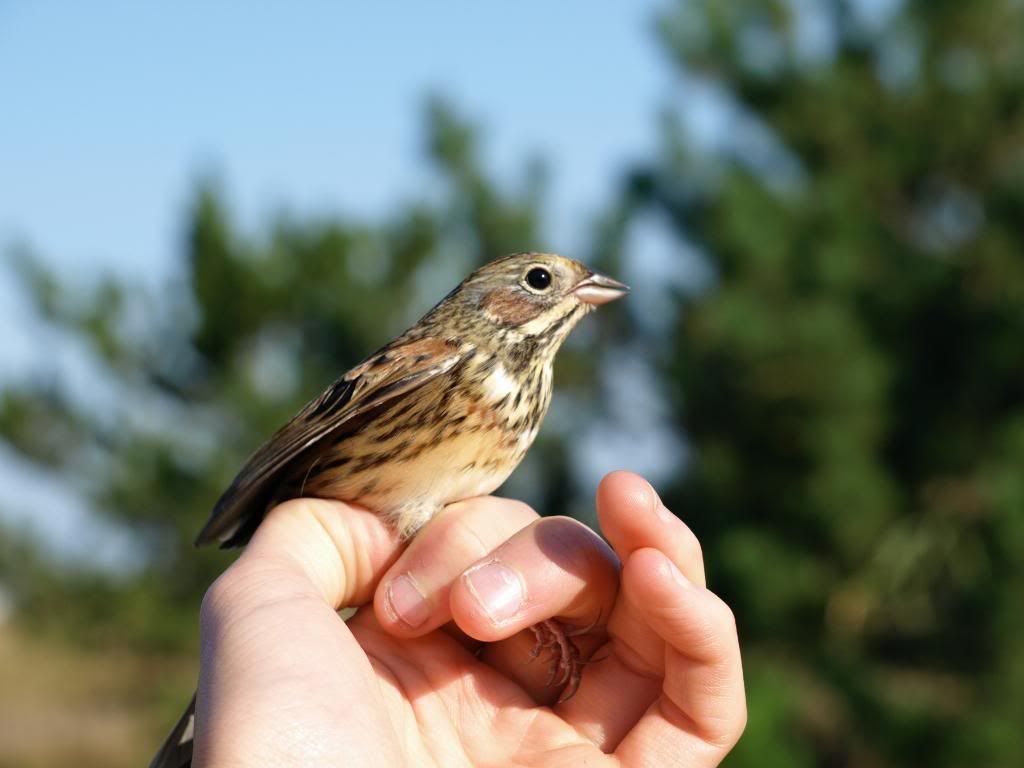
We did get quite a lot of these Siberian meadow Buntings Emberiza cioides, though:

D1210223.jpg


Which goes “thyyy” when you hold it in your hand, a bit similar to Meadow Pipit. Probably the cutest of the lot.

The only true endemic is this one:

D1180124.jpg

(male)

D1210204.jpg

(probably female or young)

Japanese Yellow Bunting Emberiza sulphurata, an unbelievably small bunting. The last one is the Chestnut-eared Bunting Emberiza fucata:

D1270323.jpg


which I can’t remember if we had on Hokkaido, but we did have it a lot on Honshu. The brown ear covers and the characteristic, but hard to describe, head patterns are indicative of this species, which like the Grey Bunting and the Meadow Bunting is also much larger than most of the others.

It should be mentioned, perhaps, that I saw very few of these species outside the nets. Only at Fukushimagata and at Hamatombetsu were there large flocks hopping around in the reeds or on the ground, and these flocks were mainly spodocephala and schoeniclus.

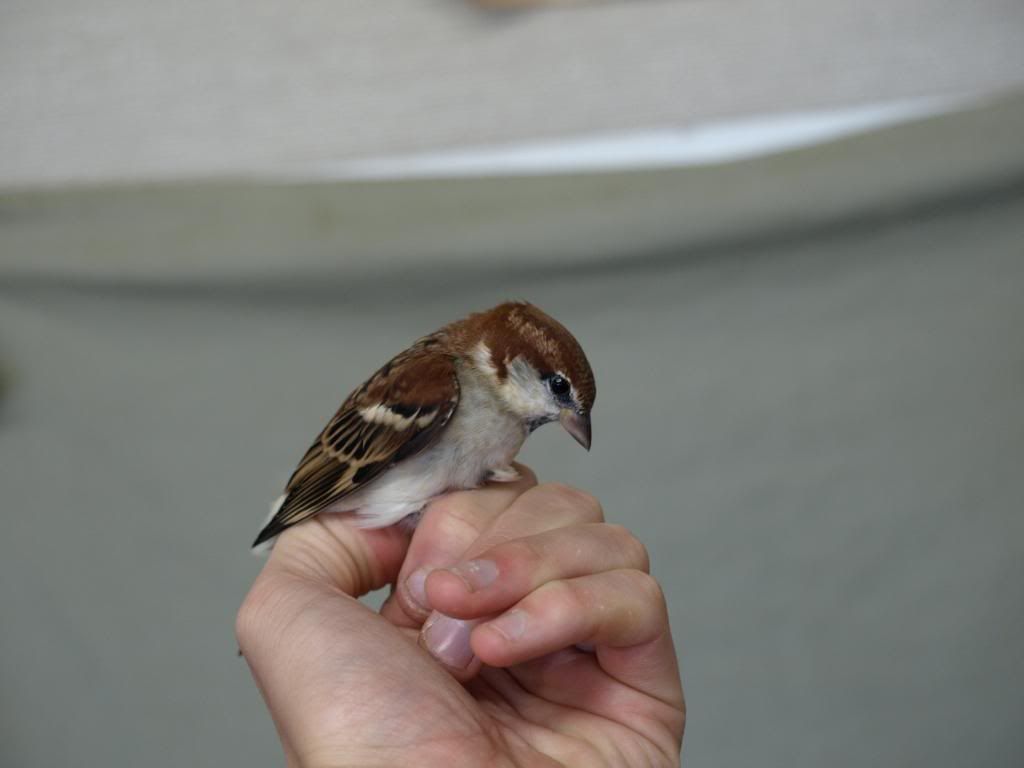
Japan has NO resident House Sparrows Passer domesticus. I recall having seen a report that they had had their first straggler in 2005 or so, so there’s at least one record, but otherwise they only have Tree sparrows Passer montanus in the cities. There is another species in more rural areas, the Russet Sparrow Passer rutilans:

D1170099.jpg


And at a distance, they can be hard to tell apart and often occur in mixed flocks in smaller villages. However, whereas the Tree Sparrow female is more or less identical to the male, the Russet Sparrow female looks like a House Sparrow female. The males can be told apart on head colour (brown in Tree, obviously russet in Russet) and the lack of the black cheek patch in Russet. Tree Sparrow is also marginally larger, but while that feels obvious in the hand, it’s nothing of the sort in the field.

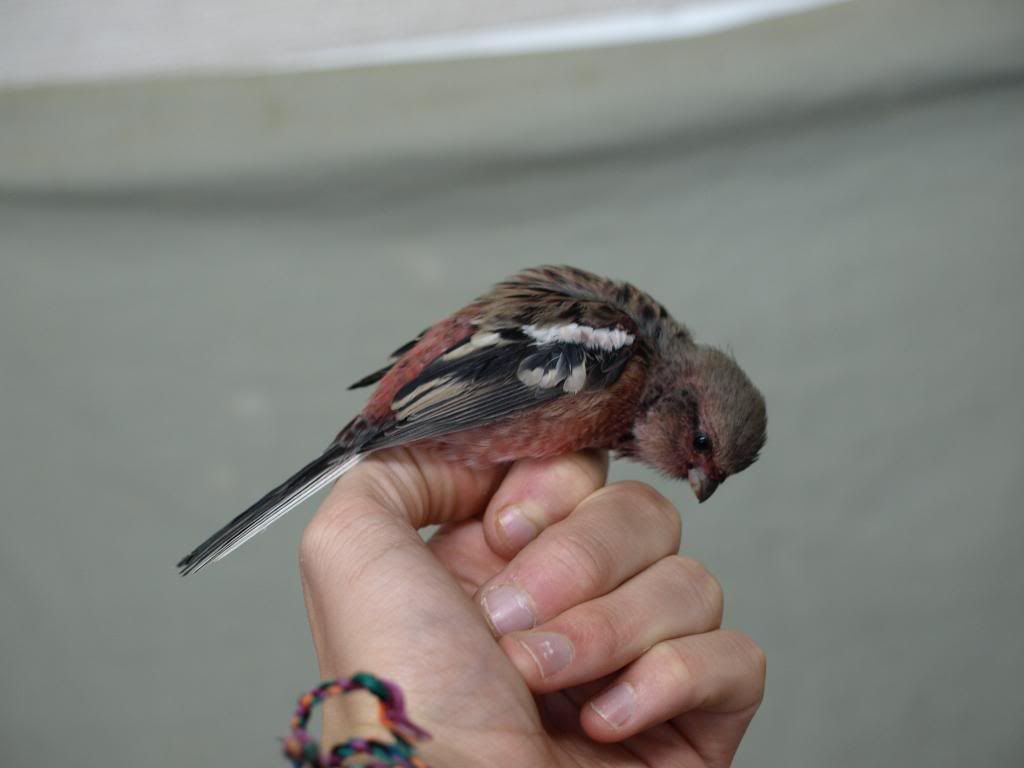
Moving, finally, to finches, there’s really only a few I had much to do with. While there are both Siskin Carduelis spinus and Redpoll Carduelis flammea in Japan, we never caught either, nor any Grosbeaks (Chinese Eophona migratoria, Pine Pinicola enucleator, or Japanese Eophona personata). We missed all Bramblings Fringilla montifringilla, Pallas’ Rosy Finches carpodacus roseus, and Rosy Finches Leucosticte arctoa by leaving Hokkaido too early, and the Rosefinch carpodacus erythrinus by being in the wrong part of the island. There’s Red Crossbill Loxia curvirostra and Two-barred Crossbill Loxia leucoptera, but we never once went to the right sort of place. We did catch some Hawfinches Coccothraustes coccothraustes and some Bullfinches Pyrrhula pyrrhula griseiventris (with grey chest and stomach), but they were all juveniles, and I have no good pictures of them. The only finches I got good pictures of are the adorable Benimashiko, or Long-tailed Rosefinch Uragus sibiricus:

D1210228.jpg


And the Kawarahiwa or Oriental Grenfinch Carduelis sinica:

D1200183.jpg


This species occurs with two subspecies, the resident kawarahiba and the migrant sinica, and we caught both. The one in the picture I would say is sinica, which generally is larger and has a darker head, but I found it hard to tell them apart unless you had both at once. I seem to recall that sinica had much more white on the primaries than kawarahiba, which also speaks for the one in the picture being sinica. If I find any good comparison pictures, I will post them as well.

We end with an unknown species of spider that was very common in the Tokyo area:

D1143050.jpg


--
Brazil, M. A. (1991). The Birds of Japan. Cristopher Helm, London.

 
I'd guess some sort of Orb Web spider. Perhaps a Golden Orb Web. Quite common in Oz too.

I seem to recall that we found two different ones in Japan, easily told apart by the colour patterns, but I can't remember exactly how. I think i did get photos of both, though.

Anyway, a day of birdwatching outside Vancouver gave twenty new species to the Canada list:

Pitt Lake:
Osprey Pandion haliaetus (1)
Brown-headed Cowbird Molothrus ater
Yellow Warbler Dendroica petechia
Eastern Kingbird Tyrannus tyrannus
Grey Catbird Dumetella carolinensis
Willow Flycatcher Empidonax traillii (2)
Sand Martin Riparia riparia
Turkey Vulture Cathartes aura
Yellowthroat Geothlypis trichas
Bullock's Oriole Icterus bullockii
Savannah Sparrow Passerculus sandwichensis
Violet-Green Swallow Tachycineta thalassina
Ring-billed Gull Larus delawarensis
Ring-necked Duck Aythya collaris
Bufflehead Bucephala albeola
Black-headed Grosbeak Pheucticus melanocephalus
Rufous Hummingbird Selasphorus rufus (3)
Green-winged Teal Anas carolinensis
Pintail Anas acuta
Trumpeter Swan Cygnus buccinator

---
(1) Ospreys here, to me, seem to have more white on the head, and be slightly redder on the wings than back in Europe. Dave, the UK boyfriend of my host here, didn't think so, though, but admitted that he had perhaps less experience with the European birds than I have.
(2) Correction: Western Flycatcher has apparently been split since my field guide was published, and the correct English name for the populations up here is Pacific Slope Flycatcher. The scientific name is the same, though.
(3) So, I've seen hummingbirds, and I was smitten instantly. Hummingbirds are wonderful. I love hummingbirds.

I have many loves when it comes to birds. Pink-eared Duck, Jackdaw, Russet Sparrow, Spot-billed Duck, Kingfisher, and all manner of fantails and white-eyes. Fortunately, nature, unlike society (4), does not frown on polyamory, and I can easily add hummingbirds to this list. We saw several today, and this might have been the best birding experience I’ve ever had and, as you know, I have done some pretty amazing birding the last two years…

Seeing that first hummingbird -- whizzing past us where we sat, but still having time to stop, just for an instant, and have a look at us and see what we were up to -- instantaneously gave birdwatching a whole other meaning.

Theoretically, I have been doing it since I was nine, but I doubt one can truly be a birdwatcher without having seen a hummingbird. I think a more proper way to describe my bird-related activities up until now -- apart from louse collection -- is that I have been looking at the birds in a manner similar to the people who have no clue and go, "Well, *I* saw a swan last weekend" or "That looks just like a House Sparrow to me".

Show me a man who has seen a hummingbird and not fallen in love, and I will show you one who might have seen one, but never really looked at it. Sort of the way I look at people playing football. They are undeniably there -- you can hear the inarticulate grunts that pass for communication, often from quite a distance -- but I have no idea for what purpose. It's all some kind of muddy mess to me.

Although the list of reasons why I hate Gothenburg is already quite long, I can add “It doesn’t have hummingbirds!” to it without any problems.

(4) Except France.
 
Last edited:

ISF - Join now!

Every member here is approved by hand. No bots, no spam, just people who care about evidence and honest debate.

Membership is free!

Create your free account

Back
Top Bottom