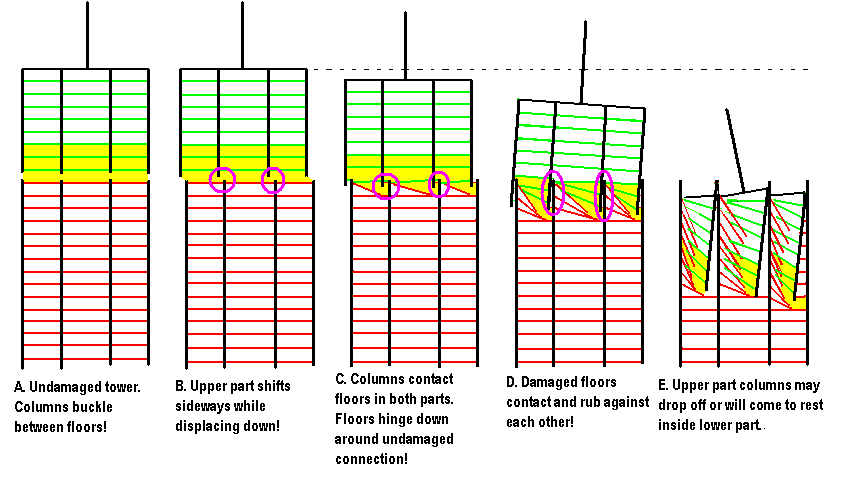
Why a one-way Crush down is not possible

Status
Not open for further replies.
Can someone explain this for me:-

If the weight of the buildings and the loss of structural integrity due to intense heat, was enough to almost pulverise the cores, why would there be any core left standing at the base at all, seeing as this would seem to be the most vulnerable part, considering the immense weight coming down against it? It's as though the core wasn't able to support so much weight all at once...but then it was again!

The floors collapsed around the core. Although the towers appeared from the outside to have uniform strength from top to bottom, the cores were built in much the same way old-fashioned skyscrapers were -- large at the bottom, small at the top. The part that was briefly left standing was the sturdiest, but it couldn't stand for long without the combination of floors and perimeter columns holding it up.
 
The floors collapsed around the core. Although the towers appeared from the outside to have uniform strength from top to bottom, the cores were built in much the same way old-fashioned skyscrapers were -- large at the bottom, small at the top. The part that was briefly left standing was the sturdiest, but it couldn't stand for long without the combination of floors and perimeter columns holding it up.

It was the sturdiest, but it was never built to withstand all that unfettered weight upon it; why did it manage to stay up at all?

Because it wasn't weakened by heat? Neither was the almost two thirds or so that would have been above it.
 
The NIST essentially has no physical evidence of the steel reaching high enough temperatures to weaken it in any significant way.

Science has never had any physical evidence of many things that are held to be true. That the earth's core is a solid ferro-nickel ball, for example. Nobody has ever been down there.

NIST, though, provides detailed analysis of calculated fire intensity, path and duration at WTC, based on real workstation fires in a laboratory, with different configurations of material, location and material integrity.

We'd all be mighty grateful if you could even begin to describe the size, composition and location of your WTC CD charges. You're a physicist, after all.

Looking forward to your analysis, however simple.
 
??? Evidently a vertical element displacing down outside the structure contacts nothing! A vertical or horizontal element displacing down inside the structure evidently contacts a horizontal or vertical element there.

That's why a one-way crush down is not possible.

So why do you show ALL the perimeter columns (represented by two black lines) spearing the floor slabs.

You are showing a diagram that represents ALL the perimeter columns. Your diagram suggests that ALL the perimeter columns speared through the concrete floors and snapped the concrete floor slabs into nice, long slabs.

This is not correct and you know it. Your diagram is completely wrong and you use it to mislead people into thinking that your claims are correct.

You need to fix the diagram as it is WRONG!

Thanks!
 
Your questions have already been answered.

The NIST essentially has no physical evidence of the steel reaching high enough temperatures to weaken it in any significant way.

You said they had none.

I say they have. Retract your false statement from earlier and stop moving goalposts. You are adding qualifiers to change your initial claims instead of admitting it was an incorrect claim. Very childish. They had steel which has evidence of reaching around 800 and 1000 deg C. You know it and so do I.

I guess you are not a thermite man then? Just bog standard CD with high explosives?

Tony Szamboti said:
Are you saying that Leslie Robertson is not shown in 911 Mysteries saying what I have mentioned here?

No, I am asking you if it was you who said they had seen a documentary previously in which you claimed something was admitted when in fact you made it up. If it was not you I will retract.
 
Can someone explain this for me:-

If the weight of the buildings and the loss of structural integrity due to intense heat, was enough to almost pulverise the cores, why would there be any core left standing at the base at all, seeing as this would seem to be the most vulnerable part, considering the immense weight coming down against it? It's as though the core wasn't able to support so much weight all at once...but then it was again!


Coming down around it. And it was not pulverised.
 
Even if that were true, it is the most plausible mechanism by which the steel would become weakened.

Do you have physical evidence that the steel failed by any other mechanism? Now would be the time to present that evidence.

(And please don't mention those ridiculous paint chips. We know all about those.)

What he keeps doing is parroting that stupid misrepesentation of NIST's data. I've been telling Tony he's been doing this and he ignores it. Mackey's talked about this as well more times than ever needed. The trade centers were ignited with 10 thousand gallons of ignitor fluid on 6 floors! And to exasperate the problem the plane impacts completely paralyzed any sprinkler system the upper floors had. Unless Tony has justification for a several hundred degree temperature gradient in the interface between the columns and the air temperature of the fires.
 
??? Evidently a vertical element displacing down outside the structure contacts nothing! A vertical or horizontal element displacing down inside the structure evidently contacts a horizontal or vertical element there.

That's why a one-way crush down is not possible.

Let's get granular so you can explain something to me. We'll use your "accurate" diagram as a visual aid that I have marked up.
WTC1slicea2.gif

I can agree with your representation of the extreme right and left of your diagram that the entire row of those perimeter columns, coming inside/outside as a whole would indeed shear the concrete floors from there respective connections.

What you fail to show correctly OR explain is the points I circle in purple in the diagram above. You are representing one or two perimeter columns that you suggest as sprearing through the concrete floor and cracking it lengthwise into nice long slabs. That's not possible since there where about 60 perimeter columns per side. How can a 208' wall of about 60 perimeter columns slam onto the very edge of a reinforced concrete floor and not bend or shear the floor truss connection down?

How can you show the middle two lines in your diagram as spearing through the concrete floor and there were 60 columns in the wall?

How can you expect a 208' long wall of about 60 perimeter columns (including the weight all the floors above) to come smashing down on the extreme edge of the concrete floor slab below and expect the 30 "L" shaped truss connections welded to the SIDE of the peimeter columns to arrest that downward collapse? I mean hontestly? The "L" shaped truss connection was about 6" deep?

Your red floors would not seperate like you show in the diagram above.

Your diagram is extremely incorrect.
 
Leslie Robertson is shown saying he didn't think they considered the fuel in the 1964 analysis and says no more about it, so I don't see how it could be labeled as quote mining or taken out of context.

Have you watched it? If so, do you have a different interpretation of what he said?


Yesterday I posted the following excerpt from the NIST FAQ page. You ignored it as inconvenient to the rubbish you peddle, so here it is again:

Speaking of the kind of thing that is getting extremely tiresome...


(from NIST's FAQ page)

"The capability to conduct rigorous simulations of the aircraft impact, the growth and spread of the ensuing fires, and the effects of fires on the structure is a recent development. Since the approach to structural modeling was developed for the NIST WTC investigation, the technical capability available to the PANYNJ and its consultants and contactors to perform such analyses in the 1960s would have been quite limited in comparison to the capabilities brought to bear in the NIST investigation."
 
His comment that as far as he knows they didn't consider the fuel from the aircraft in the analysis. Skilling says they did.

All I hear is crickets Tony...

Where is the direct quote from Skilling that says they did do fire analysis on the srtuctural steel?

WTF is so hard here? You obviously read it to make the statement.

Or did you just make this up?
 
And to exasperate the problem the plane impacts completely paralyzed any sprinkler system the upper floors had.

This highlights another problem with the truther fantasy that they continually ignore. After you crash an airliner into a building, what madness could possess you to make you think you could activate any kind of demolition system that was set up in the exact spot where the damage was greatest and fires were raging out of control?

...the mind boggles.
 
So...your beliefs define reality, and theirs don't?

Knowledge helps to understand reality. On 911 a new phenomenon was allegedly seen for the first two times ever - one-way crush downs of composite stuctures. A little bit part C of a composite structure A was alleged to drop (free fall) on A by gravity and then, one-way crush down A by gravity.
Nobody has really been able to explain the phenomenon.
Attempts to recreate the phenomenon have all failed.
I have simply suggested that the alleged phenomenon is not possible, i.e. does not exist in reality. No structures of any kind exists where a part C of A can one-way crush down A. A always arrests C! It is a fact!

A lot of people disagree. They suggest One-way crush downs are normal and natural phenomenons. But they cannot support the suggestion by any facts. It seems to be a simple belief.
 
Knowledge helps to understand reality. On 911 a new phenomenon was allegedly seen for the first two times ever - one-way crush downs of composite stuctures. A little bit part C of a composite structure A was alleged to drop (free fall) on A by gravity and then, one-way crush down A by gravity.
Nobody has really been able to explain the phenomenon.
Attempts to recreate the phenomenon have all failed.
I have simply suggested that the alleged phenomenon is not possible, i.e. does not exist in reality. No structures of any kind exists where a part C of A can one-way crush down A. A always arrests C! It is a fact!

A lot of people disagree. They suggest One-way crush downs are normal and natural phenomenons. But they cannot support the suggestion by any facts. It seems to be a simple belief.

I'm sure you realize this, but saying that something is a fact, or even an axiom, doesn't make it so.
 
Let's get granular so you can explain something to me. We'll use your "accurate" diagram as a visual aid that I have marked up.
[qimg]http://i238.photobucket.com/albums/ff290/gamolon/WTC1slicea2.gif[/qimg]
I can agree with your representation of the extreme right and left of your diagram that the entire row of those perimeter columns, coming inside/outside as a whole would indeed shear the concrete floors from there respective connections.

What you fail to show correctly OR explain is the points I circle in purple in the diagram above. You are representing one or two perimeter columns that you suggest as sprearing through the concrete floor and cracking it lengthwise into nice long slabs. That's not possible since there where about 60 perimeter columns per side. How can a 208' wall of about 60 perimeter columns slam onto the very edge of a reinforced concrete floor and not bend or shear the floor truss connection down?

How can you show the middle two lines in your diagram as spearing through the concrete floor and there were 60 columns in the wall?

How can you expect a 208' long wall of about 60 perimeter columns (including the weight all the floors above) to come smashing down on the extreme edge of the concrete floor slab below and expect the 30 "L" shaped truss connections welded to the SIDE of the peimeter columns to arrest that downward collapse? I mean hontestly? The "L" shaped truss connection was about 6" deep?

Your red floors would not seperate like you show in the diagram above.

Your diagram is extremely incorrect.

Thanks for comments. The figure is just one simple example what can happen when an upper part C of a structure contacts a similar structure part A below. I show others.

Your ringed details inside the structures evidently show internal vertical elements, e.g. failed, strong core columns, contacting horizontal, weak elements, e.g. floors; it is thus suggested that the strong elements damages/cuts/punches through the weak elements.

If you look carefully, you see how the strong elements of lower part A damages weak elements, the green floors in upper part C! Hopefully you agree that this is a realistic result! That is the main purpose of the figure!

However, Bazant, the world famous expert of the subject, suggests that the bottom horizontal element of part C (floor #97 in WTC 1) is not damaged (sic!) at impact and that this thin element destroys the strong A columns below, then compress the A columns into rubble (part B) that protects part C. Parts B and C then continue to destroy A. All nonsense of course.

NIST suggest that part C applies potential energy, PE, on A at impact and that A lacks strain energy, SE, to absorb this PE, so that global collapse ensues. PE>SE=global collapse according NIST.

NIST unfortunately forgets that A also applies energy/forces on C at impact and that C can absorb even less strain energy than A. This should show up as jolt of C! C being decelerated by A. A provides resistance!

Thus A will immediately start to destroy C at impact. As the PE applied by C is very small - see my paper you quote from - that PE will soon be transformed into local failures (heat) and friction between displaced elements in contact (more heat) of C and A and the local failures should be arrested within ONE second. C should stop up on top of A.

A one way crush down by C of A is not possible under any circumstances.

 
Last edited:
I'm sure you realize this, but saying that something is a fact, or even an axiom, doesn't make it so.

Sorry! No structure of any kind exists where a part C of A can one-way crush down A. A always arrests C! It is a fact!
 
Knowledge helps to understand reality. On 911 a new phenomenon was allegedly seen for the first two times ever -

You mean the new phenomenon of the WTC 1 and 2 being hit by a commercial airliner and then having out of control multi-floor fires?

one-way crush downs of composite stuctures. A little bit part C of a composite structure A was alleged to drop (free fall) on A by gravity and then, one-way crush down A by gravity.
Nobody has really been able to explain the phenomenon.

People have tried but you don't seem to be able to understand the explanations....you prefer playing with lemons and cardboard....

Attempts to recreate the phenomenon have all failed.

Are you referring to your "attempts" with fruit and cardboard?

I have simply suggested that the alleged phenomenon is not possible, i.e. does not exist in reality. No structures of any kind exists where a part C of A can one-way crush down A. A always arrests C! It is a fact!

You think it's a fact because you have "demonstrated" it with fruit and cardboard?

If you really can't figure out why such "demonstrations" are not valid then you really need to talk to this guy....
 

Attachments

  • Captain Obvious.jpg
    Captain Obvious.jpg
    124.4 KB · Views: 2
1. You mean the new phenomenon of the WTC 1 and 2 being hit by a commercial airliner and then having out of control multi-floor fires?


2. People have tried ....


3. Are you referring to your "attempts" with fruit and cardboard?


4. You think it's a fact because you have "demonstrated" it with fruit and cardboard?

5. If you really can't figure out why such "demonstrations" are not valid then you really need to talk to this guy....

1. No.

2. They all failed.

3. No.

4. No.

5. Why?
 
Leslie Robertson is shown saying he didn't think they considered the fuel in the 1964 analysis and says no more about it, so I don't see how it could be labeled as quote mining or taken out of context.

Have you watched it? If so, do you have a different interpretation of what he said?
Robertson thinks your realcddeal is nuts.

Robertson designed for an aircraft impact and the WTC towers were confirmed to repel impacts of aircraft below 200 mph, confirming Robertson's 180 mph impact study was accurate. On 911 two planes exceeded the design impact by 7 and 11 times and contributed in a big way to the collapse of the WTC and proving Heiwa ideas are delusions. You fail to do the work and come up with numbers and use your failed opinions to make up delusional conclusions. Robertson used engineering, you use opinions wave your hands and say CD.
 
Last edited:
Status
Not open for further replies.

Back
Top Bottom