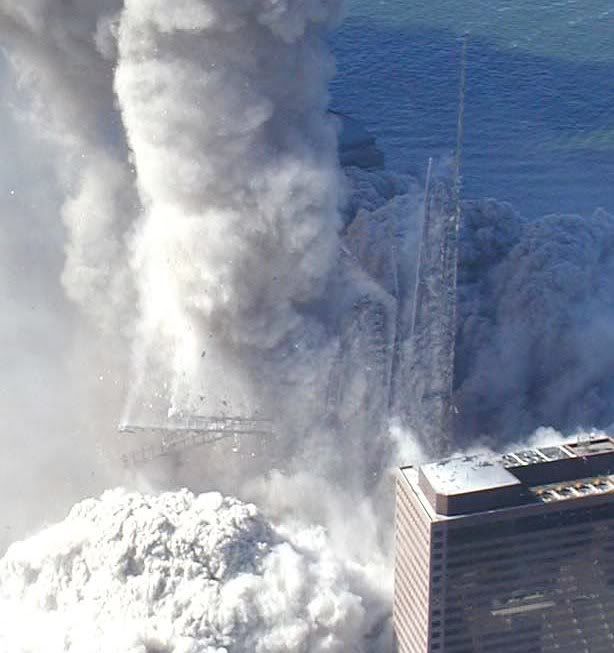
Why a one-way Crush down is not possible

Status
Not open for further replies.
Well it strikes me that the centre dowel would remain standing. The same would apply for other upstanding elements.

What about the "weight" floors? Do you think they would collapse all the way to the ground or would the "thumbtack" supports arrest the collapse at some point?
 
Heiwa, does this model qualify for your challenge?

How about this model.

Let's take a 25lb weight used for weight lifting. The round weights with a hole in the middle that can be slipped onto a weight lifting bar. Lets get 6, 1" diameter wooden dowels and pound them into the ground around the perimeter of the weight mentioned above. Let's take a single 1" diameter wooden dowel and pound it into the ground in the center of the ring we just created.

Now let's slip one of the 25lb weights mentioned onto the center wooden dowel down to about an inch from the ground. We'll put one thumbtack (the kind with the plastic head on them, not the flat heads) in each of the perimeter wooden dowels right below the weight and put two thumbtacks, opposite one another on the center wooden dowel.

We'll build our tower up 40 feet high with a "floor" weight every foot.

We'll then created a seperate section the same way, but only 1/10th the size, which would be 4 weights (or 100lbs). We will then position the 1/10th section above the 40 foot tower we created using a dowel to center it above.

We then drop the 1/10th section down the centering dowel from a height of 10 feet above.

What do you think would happen? Are the "thumbtack" connections going to arrest the upper part and stop it from bringing everything down the the ground?
 
OK - the highest stress will occur at contact point sledge hammer/L shaped connection assuming it is a small area. But as the contact point is pretty strong it will just be deformed. Other highly stressed area is the sledge hammer handle! Maybe it will break?
Deformation of the L shaped connection, or breaking it, may also produce the funny effect that the sledge hammer slips off and continues displacing somewhere else? Hitting the person holding the handle?

You know, releasing and applying energy on a structure to produce a force that should, e.g. damage the structure, is not so easy. If something breaks or deforms, the force may slip off and the energy is applied somewhere else. Happens in every scale.

Ok. What if I replaced the sledghammer with a wrecking ball and dropped the wrecking ball down from 50' along the side of the perimeter column onto the "L" shaped truss connection? What would happen then? Would the bracket bend downward at all or shear off? Or would the bracket resist and the wrecking ball would just bounce off?
 
Heiwa, can you please address the contradiction you have made with your following quotes:


Which is correct?

"Is it? I clearly say that the intact floors are just hanging on the columns; like pictures on a wall." This is the crux of Heiwa's lunacy. He thinks that the floors can hinge, and still support the entire weight of the floor (and maybe even their contents due to friction) and the columns, now unbraced and subject to extreme lateral forces, will not collapse.
 
No idea, though I know where he sits- any damn place he likes. lol


The point, Bill, is that the question tests your ability to think in terms of scale. It's not a question that requires any knowledge of physics. A bright child could solve it very quickly while daydreaming in class. You are stumped by it, yet you want to debate engineering with engineers.
 
Of dowels :

Of course a dowel is a small unit structure, whereas the WTC cores were massive, composite and dependent on lateral support for their ultimate stability. However, they did their best to act dowel-like and in both cases were the last part to fall:

wtc2corestanding.jpg


wtc1peelingcore.jpg
 
how about 5 5 foot dowels and 25 lb weights

4 of which are set up in a square pattern (looking top down) spaced so the weight is very close to the dowels
then have a 5th dowel in the center
use the thumb tacks to support the weight (one on each dowel) every 6 inches so that you get 9 high (maybe use 2 tacks on the center dowel)

then drop a 10th weight from 10 feet

(NOT TO SCALE LOL)
weights1.jpg


EDIT: better render
 
Last edited:
"Is it? I clearly say that the intact floors are just hanging on the columns; like pictures on a wall." This is the crux of Heiwa's lunacy. He thinks that the floors can hinge, and still support the entire weight of the floor (and maybe even their contents due to friction) and the columns, now unbraced and subject to extreme lateral forces, will not collapse.

:D

But will Hewia admit his mistake?

I think not.

;)
 
You stick with your gorillas and let Heiwa take care of the engineering.


What's truly sad is that you have no idea how ridiculous you are. You are helpless to deal with a reasoning problem that wouldn't tax a bright child. You slavishly parrot your incompetent guru, although his idiocy has been torn to shreds by real engineers. He ran away from my question about how he will react to his inevitable dressing-down by the engineers at the ASCE journal. How about you? Is EVERY real engineer a shill?

You see, Bill, the concept of scale is incomprehensible to you. Yet, you want to discuss engineering.

Pssst. As the giant gorilla has height, depth, and width, try multiplying by 4x4x4.
 
Last edited:
Status
Not open for further replies.

Back
Top Bottom