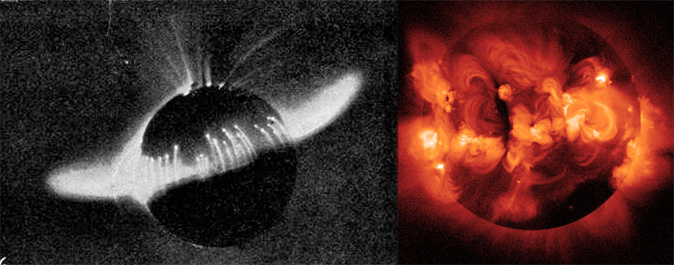
Electric universe theories here.

Status
Not open for further replies.
What is the % of Nickel and Iron?

That been answered and addressed in almost every published paper.

What is the % of heavily ionized iron in the coronal loops?

I'd guess it's mostly all ionized inside the current carrying part of the loop.

Are these close to 100% and if not why not?

I'd say the were the same percentages of ionization we find here on Earth inside of a lightening bolt.

Why do expeiments with brass spheres have anything to do with the Sun if it is not made of brass?

He used several different spheres and the specific material isn't particularly relevant. It's still made of metals and heavier elements, and it's powered by heavy elements.
 
Why do you think neon gives off white light? I've asked you about this before, and you avoided the question.

It's not actually "pure" neon, it has hydrogen and helium and many other elements passing through it. (See the SERTS data for more details). There are hydrogen atoms (protons) that are constantly flowing through every part of that layer for instance.
 
That been answered and addressed in almost every published paper.
So you agree with Wikipedia?
Sun
The Sun is composed primarily of the chemical elements hydrogen and helium; they account for 74.9% and 23.8% of the mass of the Sun in the photosphere, respectively.[50] All heavier elements, called metals in astronomy, account for less than 2 percent of the mass. The most abundant metals are oxygen (roughly 1% of the Sun's mass), carbon (0.3%), neon (0.2%), and iron (0.2%).[51]
(emphasis added)

Why do astronomers not get ~100% for neon? After all the photosphere is neon according to you.

I'd guess it's mostly all ionized inside the current carrying part of the loop.

I'd say the were the same percentages of ionization we find here on Earth inside of a lightening bolt.
The question was badly worded - it was about the % of iron in the coronal loops.
Do the figures from the Iron Sun model match the figure of 0.2% above?

He used several different spheres and the specific material isn't particularly relevant. It's still made of metals and heavier elements, and it's powered by heavy elements.
How do you know that the specific material is not relevant. Did you test a Brass Sun model against the observation?
 
Last edited:
It's not actually "pure" neon, it has hydrogen and helium and many other elements passing through it. (See the SERTS data for more details). There are hydrogen atoms (protons) that are constantly flowing through every part of that layer for instance.
Thta is an interesting expression: "hydrogen and helium and many other elements passing through it".

Do hydrogen and helium and many other elements also pass through the hypothetical, invisible, thermodynamically impossible solid iron surface that is below the photosphere?
 
Well you have to admit it would be difficult for Sol88 to figure out what the Mozina model is, since Michael hasn't actually specified his crazy notion in terms of a solar model.
You are either incapable of comprehending the English language, or you really are the single most unethical individual I know of. All of these theories relate directly back to Birkeland's original experiments. It's not *MY* solar model. Wake up already.


Kristian Birkeland did not suggest that the Sun had a solid iron surface, or brass, or silver plated copper, or any such thing. That inane solid surface idea is yours and yours alone, Michael. So speaking of unethical, how dare you pass off the blame for your idiocy onto a dead guy? Your fantasy isn't a solar model. It's a wildass guess based on a seriously wrong interpretation of an image about which you obviously know very little.

He doesn't know where the electricity comes from that powers his glowing orb,
I've explained to you several times now that I personally lean towards Birkeland's original power source, specifically fission. *YES* he did mention radioactive elements by name as the power source.


Birkeland's little terrella models ran off of fission? You don't say. Well, there's some good old hands on, lab tested empirical science for you. Just the way you like it, Michael! And all this time I thought you were claiming that electrical hookup he had in that glass box was how the terrella lit up. So Birkeland was right and you're wrong, or is it the other way around?. You nut. :)

For God sake, talking to you is like talking to brick wall. You do not listen. You do not comprehend what I tell you and you misrepresented everything I've said to you. You irrationally claim that because I don't bark math for you on command that I am incapable of doing any math. That is pure unethical BS. You have no ethics at all.


My comment is well supported. For one thing, you were banned from BAUT for spending months claiming you would eventually present some mathematical support for your nutty claim, yet you continued to make excuses, stall, avoid, and change the subject. You never did then, and in the years since then, you still haven't been able to shape your wacky notion into something quantitative. Math is crucial to communicating physics in a specific and detailed way. Math is even crucial to explaining how light from what angle at what intensity might make a mountain how tall cast a shadow how dark and how long. If you could handle a little math you could explain that very first image on your web site. You know, that image you've never been able to explain in detail, with specifics, because you don't understand numbers?

I take it the bolded parts below are the only parts of my comment you take issue with, and that you're in agreement with the rest. Good. We might be getting somewhere.

Well you have to admit it would be difficult for Sol88 to figure out what the Mozina model is, since Michael hasn't actually specified his crazy notion in terms of a solar model. He doesn't know how thick the shell is. He can't define the thermal or density characteristics. He won't actually commit to a particular material, other than to say some vague kind of iron that acts unlike any material ever known. He doesn't know anything about the science required to see 4000 kilometers into the photosphere, but he thinks it can be done. He even thinks he's the only human on Earth who has actually done it.

He doesn't know where the electricity comes from that powers his glowing orb, but fancies it operates like a $19.95 Wal-Mart plasma ball, or the white hot sparks blowing off an arc welder's electrode. But he doesn't seem to actually know how those things work. He doesn't know what sort of current or resistance values would be required to make the Sun as hot and bright as it is. He doesn't know that brighter isn't necessarily hotter, even though that has been explained to him many times.

He does believe Birkeland postulated a solid surfaced Sun, but can't actually show anyone where Birkeland did that. He sees what appear to be calculations in Birkeland's notes, and assumes that must be where the answer lies, but has no clue what those numbers really mean. He went on about his hero Birkeland's iron terrella model for several weeks once before someone actually had to tell him the terrella wasn't iron at all. It was brass.

Michael can't do math. It's doubtful he can even balance his own checkbook judging from the evidence he's placed before us here. And that running difference image he posts at the very top of his web site, the one he keeps lying about not being explained by anyone? He doesn't even know how to explain it himself. "It looks like a surface." Yep, that's it. He doesn't know how high the mountains, which things are surface features and which ones aren't, how big an area the picture includes, and over what kind of time span the sequential source images were gathered. He can't explain, in any detail, that first image he hangs out as evidence.

Not once has Michael been willing to specify a quantitative detail about the running difference image, or about anything related to his wacky conjecture. Numbers, quantitative data, something on which to start calculating the plausibility of his fruitcake fantasy, are meaningless to him. He's said so himself repeatedly. Solar models, at least from a legitimately scientific point of view, require quantitative descriptions. Michael has never offered any such thing. There is no model. So it's no surprise that Sol88 doesn't know what Michael is talking about. Nobody really does. Not even Michael! :)


Say, Michael, why do you suppose it is that no professional or academic in astrophysics or any related field, anywhere in the world, agrees with you about that solid surface of the Sun?
 
Micheal Mozina - In your web site you refer to the paper "Changes in the subsurface stratification of the Sun with the 11-year activity cycle" by Sandrine Lefebvre and Alexander Kosovichev in this assertion:
.

Can you tell us where in the paper it is stated that any of the subsurface layers are solid?

That paper certainly does not say that this stratification subsurface layer is necessarily solid but it demonstrates that sound travels faster and differently through this region, and this region shows significant and measurable changes over the course of solar cycle. Kosovichev's work with sunspots has also demonstrated that the down-drafting of plasma underneath of a sunspot is a relatively shallow affair and at about 4800KM the plasma flow starts to flatten out and go horizontal. Why is that? Sound would travel faster through a solid and a crust would certainly change over the solar cycle, particularly during the active phases, and particularly closest to the equator where all the action is happening. It would also explain why movement in the atmosphere is a relatively shallow process, why we observe "rigid features" under sunspots in Doppler images, why we observe "rigid features" in RD images, etc.

If not then how can you show your calculation that any of the layers is solid?

I can (actually Kosovichev's math) shows "calculations" of all the aforementioned items. All those calculations look good to me, and his images certainly show rigid outlines under the photosphere with lifetimes far in excess of the "structures" of the photosphere which come and go in roughly 8 minute intervals and change in a very fluid-like (MHD-like) way.

My guess is that you assume that your hypothetical, invisible, thermodynamically impossible solid iron surface exists.


It's not thermodynamically impossible. Heat is carried away from the surface in the electrons coming from the surface. The atmospheric (plasma) layers of the sun are arranged by atomic weigh with the thickest and coolest layers underneath and the lightest and hottest layers in the helium chromosphere and the hydrogen corona. By your way of thinking the photosphere could not possibly be cooler than the chromosphere, but it is.

You thus guess that the behavior of 0.99 Ro point shows a solid and maybe unvarying surface (it in fact varies by ~10 km between 1977 and 2004). You forget that you do not need to have solids in order to have stratification. You can also have stratification in liquids, gasses and plasma.

Ok, fine, I absolutely agree. We can have a "stratification" process occurring in anything. In fact I assume that is the case since I assume that the layers above and below the photosphere are arrange by atomic weight. We must ask ourselves:

What type of stratification would A) block plasma flow downdrafts at about 4800KM below the surface of the photosphere, show up in Doppler images as "rigid shapes" and create RD images?

The sentence in bold is of course your delusion that the TRACE instrument's 171 Angstrom pass band can see below the photosphere[/QUOTE]

How can you logically or rationally know that not a single photon at that wavelength penetrates the photosphere?

when this is physically impossible.

It is not "physically impossible". It was "physically demonstrated" in a lab by Birkeland and his team over 100 years ago. He had "loops" going right through his plasma layers. You can't tell me it's physically impossible because I've seen experiments where it was done. Get real.

And ...

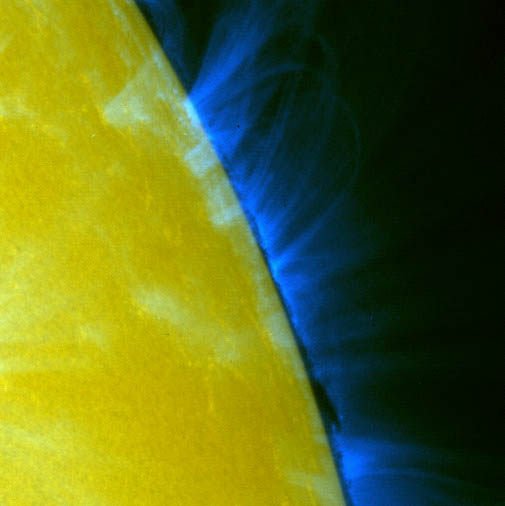
Notice how in the image below the coronal loops (blue) on the limb do not actually touch the visible surface (yellow) of the Sun.

So now we just need to know exactly how these two types of images were calibrated, now don't we? I've not had a lot of luck getting help with any images from LMSAL on their various images, but perhaps you could ask them for us and elaborate as to their response when you get it?

Whereas it's easy enough to see how they put together the Yohkoh and Trace images and lined up the coronal loops, it's far less obvious how the put together the two types of images or how they might be "aligned" either via software or camera hardware. Someone with more clout than me will have to get those answers, but I'd personally love to hear them. Hint: FYI, I've got similar questions about some Hinode limb images (movies actually) that have been released. :)

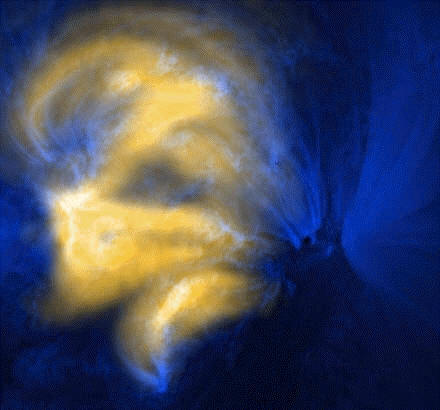
They stop at the layer of solar moss (the bright lines). Astronomers describe this as position as the "base" of the coronal loops as seen in the image. The TRACE 171A images never extend to the photosphere.

I do not know that from that single image, nor can I know that without knowing many more of the details of how they compiled that specific image. I see no obvious way to align them as I see with the Yohkoh, Trace composite. I also can't tell from such a low resolution image how many of those loops may indeed protrude into the photosphere even in that image.

Anyone who knows basic physics will see that the TRACE 171 Angstrom filter being used excludes radiation from material cooler then 160,000 K

In Birkeland's experiments, the "hot zones" were the physical (solid) bumps on the spheres where electrons peeled off parts of the sphere and ionized particles of the sphere. The whole "loop" was "lit up" due to the electron flowing in the plasma, like an ordinary plasma filament in a plasma ball. The light is related to the "current flow", not necessarily a specific location in the solar atmosphere. You are *ASSUMING* that the sun is a *SIMPLE* and *COOPERATIVE* and *NICE* environment that is thermally isolated and thermally layered with nothing unusual going on. Any x-ray image, or 171A image, or combined image of the sun can demonstrate that this is not a "simple" process, nor does a loop span a single part of the atmosphere.
mossyohkoh.jpg


While the loop is lit from top to bottom, it radiates more x-rays as the loops reach the corona. The heating takes place throughout the loop, not only at the base of the loops. That is why the light doesn't taper off with the height of the loop and that demonstrates it's not a "simplified" thermal layered system.

 
Last edited:
Kristian Birkeland did not suggest that the Sun had a solid iron surface, or brass, or silver plated copper, or any such thing. That inane solid surface idea is yours and yours alone, Michael. So speaking of unethical, how dare you pass off the blame for your idiocy onto a dead guy? Your fantasy isn't a solar model. It's a wildass guess based on a seriously wrong interpretation of an image about which you obviously know very little.
I was under the impression that the Iron Sun model with a solid iron surface (as descrbed by Micheal Mozina) was also the Iron Sun model of Professor Oliver Manuel. But I cannot find any mention of a solid iron suface on Oliver Manuels web page - just enhanced concentrations of iron within the Sun.
So this delusion may be unique to Micheal Mozina.
 
So you agree with Wikipedia?
Sun

(emphasis added)

Why do astronomers not get ~100% for neon? After all the photosphere is neon according to you.

Because astronomers oversimplify everything. They count photons from the sun and *ASSUME* that whatever ratio they observe must all be mixed together,iron and nickel mixed with hydrogen and helium and all radiating at the same temperature in the photosphere like a nice "black body" should. Unfortunately the sun isn't "simple" and "nice" and easy to mathematically quantify.

The question was badly worded - it was about the % of iron in the coronal loops.

How *EXACTLY* did you intend to figure out exactly how much of each element is present? I started with SERTS data, but all that really tells me by itself is that iron and nickel exist in that loop at very high temperatures, high enough to ionize iron 10 and 14 times over. That by itself won't tell us what percentage of the whole sun is iron or nickel or any of the other elements present in the SERTS data.

How do you know that the specific material is not relevant. Did you test a Brass Sun model against the observation?

Why would I start with brass after looking at the SERTS data, particularly the SERTS data during active phases? Hint: What's different between quiet and active sets of data?
 
Kristian Birkeland did not suggest that the Sun had a solid iron surface, or brass, or silver plated copper, or any such thing.

CHAPTER VI.
ON POSSIBLE ELECTRIC PHENOMENA IN SOLAR SYSTEMS AND NEBULAE.

128. The Sun. The series of experiments that I have made with a magnetic globe as cathode in
a,arge vacuum-box, for the purpose of studying analogies to the zodiacal light and Saturn's ring, have
k to discoveries that appear to be of great importance for the solar theory.
We have already several times had occasion to give various particulars regarding the manner in
\\ ch these experiments were carried out. It is by powerful magnetisation of the magnetisable globe
trt the phenomenon answering to Saturn's rings is produced. During this process, polar radiation and
di'uptive discharges at the equator such as that shown in fig. 2473 (which happens to be a unipolar
di'harge) may also occur, if the current intensity of discharge is great. If the magnetisation of the globe
a Fig. 247. b
be -educed (or the tension of the discharge increased) gradually, the luminous ring round the globe will
be reduced to a minimum size, after which another equatorial ring is developed and expands rapidly
Hi; 247 b). It has been possible for the ring to develope in such a manner that it could easily be deincstrated
by radiation on the most distant wall of my large vacuum-tube (see fig. 217). The correspondin;
ring would then have a diameter of 70 cm., while the diameter of the globe was 8 cm.
It is a corresponding primary ring of radiant matter about the sun that in my opinion can give
an efficient explanation of the various zodiacal light-phenomena. In the above-mentioned experiments,
it seen how the rays from the polar regions bend down in a simple curve about the equatorial plane
of ic globe, to continue their course outwards from the globe in the vicinity of this plane. An aureole
is ^reby produced about the magnetic globe, with ray-structure at the poles, the whole thing strongly
resnbling pictures of the sun's corona.

I'm not going to fix it and dress up up for you, but you're lying through your teeth and there is the proof.

That inane solid surface idea is yours and yours alone, Michael. So speaking of unethical, how dare you pass off the blame for your idiocy onto a dead guy?

You'd prefer I try to take credit for the dead guy's (his friends too) ideas? Dude, he took pictures and everything. Do you think he wouldn't have put the satellite images together with his own experiments?

birkelandyohkohmini.jpg


Just because you have no ethics of any sort does not mean that I get to take credit where credit is not due. He'd turn over in his grave if I tried to take credit for his work, or ignore his work. You've done the best job you possibly can to bury his work so please don't lecture me about Birkeland or what he believed. I doubt you've even read his book. Have you? Yes or no? Just answer the question like a man.
 
Dancing David, I think I may have another way for you to visualize the movement of positively charged ions in an outward direction. In an ordinary solid a lattice of conductive material is held in place and the atoms can't move around freely so the movement of electrons through the metal doesn't cause the metal to move with the electron. It's fixed in place by the whole conductive lattice and the electrons wind their way through the lattice. In the case of plasma, the atoms/ions are not fixed. The flow of electrons through the ion will cause the ion to move toward the flow direction of the elections, particularly if there are many electrons moving in that direction relative to the ion itself. In other words it's going to pick up momentum over time, as will the entire conductive lattice. This movement forms a twisted sort of helix shape through spacetime, a Birkeland current. Does that help you to visualize why the positively charged ions move as well as the electrons? Keep in mind that Birkeland's terella was the cathode and spewed electrons from every direction. Only when the internal magnetic fields were strong enough, and the current flow was strong enough did he create loops in the atmosphere. At all times he was spewing particles into the plasma around the sphere and heating the plasma around the sphere. When he pumped the chamber full of plasma he was able to create visible "layers" of plasma around the sphere that were "lit" by the electrons flowing from the sphere to the sides of the chamber.
 
My comment is well supported. For one thing, you were banned from BAUT for spending months claiming you would eventually present some mathematical support for your nutty claim, yet you continued to make excuses, stall, avoid, and change the subject.

That place is pathetic. They literally hold "witch trials" for any and all "ATM" idea. Evidently if you aren't "with them", you're put on trial for heresy. That's the worst cult in cyberspace.

Dear DRD asked me to compute the amount of 171A light that I might expect to penetrate several layers of plasma of (at the time) unknown thicknesses and there was no possible way for me to do that logically and rationally. I was then told not to post *ANYWHERE ELSE ON THE WEBSITE ON ANY TOPIC OF ANY SORT* before answering that question. When I took too long by whatever arbitrary standards they had at that time, they banned me. They got worse later on too. Now you can't even talk about a "banned topic" for more than 30 days. That is the single most pathetic excuse for a scientific website on the planet. Please!
 
I was under the impression that the Iron Sun model with a solid iron surface (as descrbed by Micheal Mozina) was also the Iron Sun model of Professor Oliver Manuel. But I cannot find any mention of a solid iron suface on Oliver Manuels web page - just enhanced concentrations of iron within the Sun.
So this delusion may be unique to Micheal Mozina.


No, Oliver Manuel proposes some kind of elemental layering of the Sun. Other than the vague concept of layering of some sort, he actually doesn't agree with Michael in any substantial way about that iron surface. Michael has claimed that Manuel's research supports his claim, and that Manuel is an ally in his quest to convince the world that the surface of the Sun is solid. It's another lie.

Oliver Manuel has his own crackpot notion with the iron located in the center and the composition working outwards towards the surface with lighter and lighter elements, but Manuel has never claimed there is a solid iron surface on the Sun. Michael likes to fantasize that he has, but when pressed for quotes or other specific supporting evidence for that part of his delusion, he has been wholly unable to offer any.
 
No, Oliver Manuel proposes some kind of elemental layering of the Sun. Other than the vague concept of layering of some sort, he actually doesn't agree with Michael in any substantial way about that iron surface. Michael has claimed that Manuel's research supports his claim, and that Manuel is an ally in his quest to convince the world that the surface of the Sun is solid. It's another lie.

The term we all (three of us) agreed upon is "rigid'. That seemed to leave enough wiggle room for a more dense plasma, something we all agreed it "might" be, rather than a solid. Since we wrote something like 5 papers together, it's a LIE to suggest we are not in basic agreement. I claimed that Manuel's work supports a mostly iron sun.

You have to be the single most unethical debater in the business. Are you proud of yourself for the constant stream of sleaze?
 
Kristian Birkeland did not suggest that the Sun had a solid iron surface, or brass, or silver plated copper, or any such thing.
CHAPTER VI.
ON POSSIBLE ELECTRIC PHENOMENA IN SOLAR SYSTEMS AND NEBULAE.

128. The Sun. The series of experiments that I have made with a magnetic globe as cathode in a,arge vacuum-box, for the purpose of studying analogies to the zodiacal light and Saturn's ring, have k to discoveries that appear to be of great importance for the solar theory. We have already several times had occasion to give various particulars regarding the manner in \\ ch these experiments were carried out. It is by powerful magnetisation of the magnetisable globe trt the phenomenon answering to Saturn's rings is produced. During this process, polar radiation and di'uptive discharges at the equator such as that shown in fig. 2473 (which happens to be a unipolar di'harge) may also occur, if the current intensity of discharge is great. If the magnetisation of the globe a Fig. 247. b be -educed (or the tension of the discharge increased) gradually, the luminous ring round the globe will be reduced to a minimum size, after which another equatorial ring is developed and expands rapidly Hi; 247 b). It has been possible for the ring to develope in such a manner that it could easily be deincstrated by radiation on the most distant wall of my large vacuum-tube (see fig. 217). The correspondin; ring would then have a diameter of 70 cm., while the diameter of the globe was 8 cm. It is a corresponding primary ring of radiant matter about the sun that in my opinion can give an efficient explanation of the various zodiacal light-phenomena. In the above-mentioned experiments, it seen how the rays from the polar regions bend down in a simple curve about the equatorial plane of ic globe, to continue their course outwards from the globe in the vicinity of this plane. An aureole is ^reby produced about the magnetic globe, with ray-structure at the poles, the whole thing strongly resnbling pictures of the sun's corona.

I'm not going to fix it and dress up up for you, but you're lying through your teeth and there is the proof.


Huh? I said, "Kristian Birkeland did not suggest that the Sun had a solid iron surface, or brass, or silver plated copper, or any such thing." And you post some random gibberish? Please, if you think something in there actually shows that Birkeland was under the impression the Sun actually had a solid metal surface, highlight it.
 
The term we all (three of us) agreed upon is "rigid'. That seemed to leave enough wiggle room for a more dense plasma, something we all agreed it "might" be, rather than a solid. Since we wrote something like 5 papers together, it's a LIE to suggest we are not in basic agreement. I claimed that Manuel's work supports a mostly iron sun.

You have to be the single most unethical debater in the business. Are you proud of yourself for the constant stream of sleaze?


Oliver Manuel does not agree with your nutty notion that the Sun has a solid iron surface. He's crazy, too, but he thinks the iron is in the center. There's no basic agreement on that part of the issue.
 
Huh? I said, "Kristian Birkeland did not suggest that the Sun had a solid iron surface, or brass, or silver plated copper, or any such thing." And you post some random gibberish? Please, if you think something in there actually shows that Birkeland was under the impression the Sun actually had a solid metal surface, highlight it.

You go right ahead and highlight every "metallic globe" and "discharge" in the quote for us GeeMack.
 
Oliver Manuel does not agree with your nutty notion that the Sun has a solid iron surface.

That is false. He agrees with me that we can see this "stratification subsurface" in heliosiesmology data and in the RD images. As I said, we all (three, not two) agreed upon the term "rigid". We all agree that we can observe a "rigid" surface in those images.

Until I met Dr. Manuel, yes, I think he believed the sun was "layered" like an onion. Once he saw the RD and Doppler images on my website however, he contacted me and insisted that we write a paper and we include the images in the next paper. Suffice to say, whatever mountain you are trying to make over the term "rigid' he's closer to my position than to yours.
 
You've done the best job you possibly can to bury his work so please don't lecture me about Birkeland or what he believed. I doubt you've even read his book. Have you? Yes or no? Just answer the question like a man.

When did you intend to answer this question?
 
That paper certainly does not say that this stratification subsurface layer is necessarily solid but it demonstrates that sound travels faster and differently through this region, and this region shows significant and measurable changes over the course of solar cycle. Kosovichev's work with sunspots has also demonstrated that the down-drafting of plasma underneath of a sunspot is a relatively shallow affair and at about 4800KM the plasma flow starts to flatten out and go horizontal. Why is that? Sound would travel faster through a solid and a crust would certainly change over the solar cycle, particularly during the active phases, and particularly closest to the equator where all the action is happening. It would also explain why movement in the atmosphere is a relatively shallow process, why we observe "rigid features" under sunspots in Doppler images, why we observe "rigid features" in RD images, etc.
The reason is simple - sunspots are magnetic structures and plasma is affected by magnetic fields.

"We" do not observe "rigid features" in RD images. Ignorant and deluded people see visions of "rigid features" in RD images to fit ther own preconceptions.

I can (actually Kosovichev's math) shows "calculations" of all the aforementioned items. All those calculations look good to me, and his images certainly show rigid outlines under the photosphere with lifetimes far in excess of the "structures" of the photosphere which come and go in roughly 8 minute intervals and change in a very fluid-like (MHD-like) way.
The problem is that " lifetimes far in excess" is not forever. That fits magnetic fields that last hours, days or longer (like sunspots and coronal loops) rather than a "solid iron surface" that is not actually solid.

It's not thermodynamically impossible. Heat is carried away from the surface in the electrons coming from the surface. The atmospheric (plasma) layers of the sun are arranged by atomic weigh with the thickest and coolest layers underneath and the lightest and hottest layers in the helium chromosphere and the hydrogen corona. By your way of thinking the photosphere could not possibly be cooler than the chromosphere, but it is.
Can you give a citation for electrons being a major carrier of heat in the Sun?
My understanding was that it was radiation. Unluess this is just abother of you baseless assertions.

The second law of thermodynamic applies to spontaneous flow of heat. The high temperature of the corona is explained by it being heated by mechanisms such as wave heating or magnetic connection.

If you want an analogy for your thermodynamically impossible, invisible solid iron surface then think about a sheet of iron above a fire and the layers of air above that. The iron sheet must be at least as hot as the fire and the air must be at least as hot as the iron sheet. The air will not be hotter than the iron sheet unless there is a separate mechanism to heat it.
Fire = Sun's core.
Iron sheet = your impossible solid iron sphere.
Air = photosphere.

Another point:
If this impossible solid iron sphere existed at a temperature of < 2000 K then the core of the Sun must have a temperature of < 2000 K. No fusion. No fission. No neutron decay. All of the Sun's energy must come from above the iron surface (and how hot is the photosphere again?).

But do not worry - you can always add a gigantic refrigerator to the Iron Sun idea :D !

Ok, fine, I absolutely agree. We can have a "stratification" process occurring in anything. In fact I assume that is the case since I assume that the layers above and below the photosphere are arrange by atomic weight. We must ask ourselves:

What type of stratification would A) block plasma flow downdrafts at about 4800KM below the surface of the photosphere, show up in Doppler images as "rigid shapes" and create RD images?
Stratification in a plasma would block plasma flow downdrafts at about 4800KM below the surface of the photosphere, not show up in Doppler images as "rigid shapes" on the photosphere and never show up in RD animations.

How can you logically or rationally know that not a single photon at that wavelength penetrates the photosphere?
That is not what the physics states. There are some 171A photons form the photosphere. They are a tiny proportion of the solar irradiance. Seeing them would be like seeing a candle flame through the flames of a forest fire.

For example:
Notice how in the image below the coronal loops (blue) on the limb do not actually touch the visible surface (yellow) of the Sun. They stop at the layer of solar moss (the bright lines). Astronomers describe this as position as the "base" of the coronal loops as seen in the image. The TRACE 171A images never extend to the photosphere.
The intensity of 171A photons from the photosphere is so low enough that the gap between the "base" of the loops is black.
Moss at the Limb:
moss3.jpg
 
Status
Not open for further replies.

Back
Top Bottom