Electric universe theories here.

Status
Not open for further replies.
An interesting little web page:
WHAT THE HELIOSEISMIC RESULTS MEAN FOR THE SOLAR INTERIOR
I discuss the meanings of the new helioseismic results for the solar interior and atmosphere. The eigenfrequencies of p-modes have provided us the sound speed profile as well as the density profile in the Sun. I discuss how to determine the profiles of other physical quantities. The solar oscillations may provide us with a diagnostic tool not only for the solar interior but also for the solar atmosphere. I discuss prospects of the helioseismic investigation of the chromosphere of the Sun.
The author does not give a density profile diagram.

However the squared sound speed is interesting in that there is no discontinuity from MM's hypothetical and impossible solid iron surface ("4800km beneath the visible photosphere" on his web site).
It should be just visible on the right side of the diagram. The speed of sound in iron varies according to temperature and is about 5 kilometers per second or 500,000 centimeters per second. Square this to get 250,000,000,000 cm2/s2 which is basically zero on the diagram's scale (1015 cm2/s2).
Thus we should see a dip to zero staring at whatever depth MM thinks the hypothetical and impossible solid iron surface stars at and ending at ~0.99. There is no such dip.

I am sure that there are other papers out there that detail the calculated density profile of the top of the convection zone.
 
RC....
The visible "bases" of the loops are *CERTAINLY NOT THE SAME* in the x-ray spectrum as they are in the iron ion wavelengths. Why would you find it the least bit objectionable or surprising if they observed the footprints of radio wavelengths at a slightly different depth? That is not surprising nor harmful to my argument in the least. It would be as if you superimposed a third color in the image that overlayed nicely over the other two colors with a slightly different location of the base it can observe at that wavelength. It's not a big deal. It's to be expected since different wavelengths will have a different absorption rate.
That is right - they are not and I am not surprised.

The "bases" happen to be above the photosphere in both cases because the photosphere (and anything below it) is not visible in the x-ray spectrum or the iron ion wavelengths.

I have no idea what you mean by a third color - a third color for what and of what?

Trace Spacecraft Discovers Moss on the Sun
"The TRACE observations of solar moss show how the transition region is much more complex and dynamic than previously observed," said Dr. Bart De Pontieu of LMSAL. "We are getting a glimpse of how the Sun's magnetic field changes from a chaotic jumble at its visible surface to the well-organized magnetic field present in coronal loops. This transition is complicated by the presence of the dynamic and relatively cold jets from the chromosphere. These jets sometimes interact with and push around the much hotter plasma at the base of the coronal loops."

How did scientists such as Dr. Bart De Pontieu determine where all this activity happened. They took pictures!
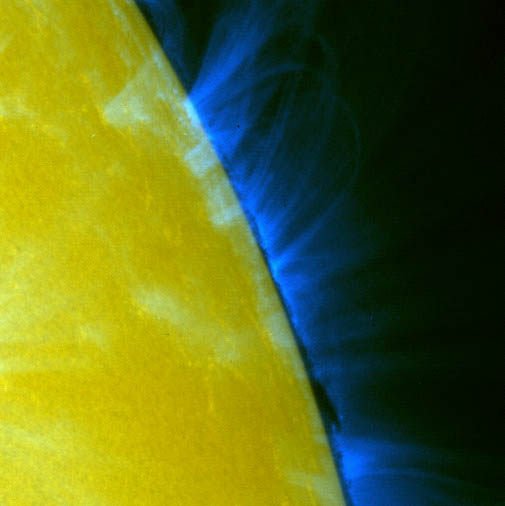
Notice how in the image below the coronal loops on the limb do not actually touch the visible surface of the Sun. This will really confuse MM who thinks that detectors see coronal loops along their entire length (including below the visible surface of the Sun).
Anyone who knows basic physics will see that the TRACE 171 Angstrom filter being used excludes radiation from material cooler then 160,000 K and so excludes the chromosphere (about 2000 km thick, highest temperature ~100,000 K) and some of the solar transition zone.

Moss at the Limb
moss3.jpg

This composite TRACE image shows a layer of moss seen at the Solar limb. The yellow image is a visible light image of the Sun and shows the "solar surface" or photosphere. The blue image is a TRACE 171 Angstrom image showing 1 to 2 million degree coronal loops and a bright "layer" of moss just above the surface. The moss layer is located between about 1500 to 4000 km (1000 - 2500 miles) above the solar surface, much lower than the typical coronal loop apex heights
 
Last edited:
That is impossible to answer from a running difference image since each pixel in the image represents hundreds of kilometers.


I tend to be more inclined to go with the heliosiesmology data personally.


Well, the quantitative methods of analyzing the location of the crust are spelled out in Kosovichev's paper. The qualitative (interpretative) process is spelled out (qualified) by Birkeland's series of controlled experiments and the other key satellite imagery like the RD images, the Doppler images and that composite TRACE/Yohkoh image.


Were it not for heliosiesmology findings of a "stratification subsurface" that changes over time, you might have a point. Since that is not the case, we're going to have to debate the merits of all "interpretations" of the data sets, all the images and the various findings.

I can only image how frightened you must be if you still feel the need to insert pointless and childish name calling into every post. You must be pretty desperate.

MM, I respectfully point out that you have not answered the questiosn as posed. Nor have you given any reasonable data to suggest the nature of an answer.

these and many other questions, including mine, remain unaanswered by you.

It would help your theory if you would actually answer some of the very specific questions when they are asked.

If we are discussing the Iron Sun, talking about Birkeland and the terrella is not an answer.

So how does the apparent ratio of equal numbers of electrons and positive ions fit into your suggestion that the solar wind is generated by the flow of electrons from the sun to the heliosphere?

There are not enough electrons to generate the momentum needed to move the positive ions by 'towing'.

So how do you account for this?

Saying 'there might be more electrons closer to the sun', is not viable.

If the heliosphere has the charge needed to attract the leectron then it would start to repulse the positive ions as soon as the electron number drops.

So how does your model fit in with the oberseved numbers of electrons and positive ions?

Saying 'it is more like current flow', is not viable as well, you could have negative charge and current low, and you could have positive current flow, but this is a situtation of both electrons and positive ions.

So how do these currents seperate and flow, what evidence is there that the solar wind is seperated like that?
 
Last edited:
An interesting little web page:
WHAT THE HELIOSEISMIC RESULTS MEAN FOR THE SOLAR INTERIOR

The author does not give a density profile diagram.

However the squared sound speed is interesting in that there is no discontinuity from MM's hypothetical and impossible solid iron surface ("4800km beneath the visible photosphere" on his web site).
It should be just visible on the right side of the diagram. The speed of sound in iron varies according to temperature and is about 5 kilometers per second or 500,000 centimeters per second. Square this to get 250,000,000,000 cm2/s2 which is basically zero on the diagram's scale (1015 cm2/s2).
Thus we should see a dip to zero staring at whatever depth MM thinks the hypothetical and impossible solid iron surface stars at and ending at ~0.99. There is no such dip.

I am sure that there are other papers out there that detail the calculated density profile of the top of the convection zone.

Hmmmmmm.
 

I had the same exact reaction. :) It will take me awhile to digest that info. Today and probably tomorrow I am going to be swamped at work so it will likely be later in the week. I will however read through it carefully, but at first glance, the data looks a to be a bit dated compared to Kosovichev's more recent papers:

http://arxiv.org/abs/astro-ph/0510111

The sound speed profiles between Kosovichev's observations and that graph do not seem to match from .9 to 1.0R. Kosovichev found some significant sound speed changes starting at around .995R. I'll have to read through them both again to be able to comment intelligently, but my first impression is that the online presentation cited is simply dated material at this point. I am not sure how to "interpret" the huge drop off in figure 2 at about .95R+, but that could be related to the technological limits of their technique rather than the data set itself. I need to read the material more carefully before I can comment on that part.
 
You think you could provides for me some sources that support your presentation of "Birkeland was right and Chapman was wrong". I'd certainly love to see something that support scientists considering Birkeland a crackpot (or an equivalent term of the day).

Somehow, I get the notion that you are way over exaggerating what really happened. I've read some history on it and I have a different understanding.

A simple request. I won't fall into your trap of answering a question with a question. We've discussed this before elsewhere.

Can you fulfill my request?
 
I had the same exact reaction. :) It will take me awhile to digest that info. Today and probably tomorrow I am going to be swamped at work so it will likely be later in the week. I will however read through it carefully, but at first glance, the data looks a to be a bit dated compared to Kosovichev's more recent papers:

http://arxiv.org/abs/astro-ph/0510111

The sound speed profiles between Kosovichev's observations and that graph do not seem to match from .9 to 1.0R. Kosovichev found some significant sound speed changes starting at around .995R. I'll have to read through them both again to be able to comment intelligently, but my first impression is that the online presentation cited is simply dated material at this point. I am not sure how to "interpret" the huge drop off in figure 2 at about .95R+, but that could be related to the technological limits of their technique rather than the data set itself. I need to read the material more carefully before I can comment on that part.
That "huge drop" in figure 2 is the difference between observations and a specific model (according to the caption):
"Relative difference δc2/c2$ between the square of the sound speed c in the Sun (inverted from various observational data sets) and that in a model computed by Christensen-Dalsgaard et al. (1996). After Takata and Shibahashi (1998a)."

Do the "significant sound speed changes starting at around .995R" in Kosovichev's data match with your calculations of the speed changes expected from a solid iron surface?
Have you actually done these claculation and if so could you give a link to them?

Otherwise this is just wishful thinking on your part. I doubt that Kosovichev would have missed the big difference beater the speed of sound in a plasma and the speed of sound in a solid iron surface.

P.S. Just how thick do you think your hypothetical, thermodynamically impossible, invisible solid iron surface is?

ETA: The paper you linked to is a recent paper of Kosovichev but has absoloutely no sound speed profiles in it. Which is the paper with his sound speed profiles in it?
 
Last edited:
Re: Validity of plasma properties & inversion techniques

A solid (say carbon) is far more apt to radiate as a "black body" than a light plasma. What (preferably a physical experiment) makes you believe that a very light, mostly hydrogen and helium plasma is going to radiate like a "black body"?
Easy. First, even you yourself do not claim to actually see the surface directly in any of your images, be it carbon or anything else. You claim only to see evidence for a surface under the plasma, which is what we do see. Hence, even by your own claims, the plasma is opaque (i.e., optically thick) in all of the wavelengths presented. So even if there were a surface and it did emit thermal radiation, we would never see it because the optically think plasma will absorb all of it, allowing us to see only the thermal emission from the plasma itself.

Second, remember how I described the inversion procedure. It is based on limb darkening measurements and a disk center to limb brightness ratio. Well, the line of sight from the observer through the limb does not anywhere intersect where the surface may or may not be, but passes entirely through the atmosphere. Since we are not looking at the surface, we will not see any thermal emission from it. After all, if as you say, the plasma is too "thin", then it will never be able to scatter enough thermal emission from the surface into our line of sight for us to see thermal emission from the surface. And if it is "dense" enough to do that, then the thermal emission from the plasma directly would overwhelm any scattered component from the surface. So any way you slice it, using lines of sight that avoid the surface region altogether guarantees that you will not see the surface, or its thermal emission, if there is a surface to see.

Meanwhile, the inversion technique requires only two pre-conditions: (1) local thermodynamic equilibrium, and (2) the validity of the basic physics of radiative transfer. The former is guaranteed to be true by virtue of the fact that we actually see a black body thermal SED, and the latter has already been well established. So it's a pretty hard barrier to argue your way around. The properties derived for the plasma from the inversion technique must be valid, within the limits of standard observational uncertainty.

Finally, one should be somewhat cautious about calling the photosphere a "plasma". Only where the photospheric temperature is at its maximum, about 9400 Kelvins, does the free electron density rise as high as 1% of the neutral hydrogen density. Furthermore, the principle source of continuum opacity in the photosphere at eyeball light wavelengths is the H- ion, and this despite the fact that its abundance is as low as 10-8 of the neutral hydrogen. This latter fact underlines the crucial point that your basic assumption, that a "thin" plasma cannot radiate thermal emission, is not physically valid. By concentrating on the density, which is in reality not necessarily a major physical constraint, you entirely overlook the optical depth, which is in fact the physical parameter which is the ultimate arbiter of whether or not any gas or plasma will emit thermal radiation. So long as you concentrate on the density instead of the optical depth then you are avoiding the real physics of the situation altogether.
 
Nitpicking Verbiage

You're nitpicking verbiage here a bit aren't you?
Maybe so in this case, since it's fair to say that "thin" could be properly understood in context. However, more seriously, your sloppy use of language gets in the way on a regular basis. If you can't say something correctly, how is anyone supposed to know that you actually understand? After all, your own words are all we have to go by when we try to interpret your words in the context of your thoughts.

For instance ...

Magnetic fields form as a whole continuum. They don't exist individually ...
So, maybe you really meant "magnetic field lines", but you actually said "magnetic fields", which makes no sense at all. Anyone who takes these words at face value will simply decide you're nuts and go away. You do this a lot and it does not help your own case. It's probably a result of posting too much. But whatever it is, you need to tighten up your language and be more careful about saying what you mean, and about using the right words to say it.
 
Kosovichev's discontinuity

I need to read the material more carefully before I can comment on that part.
I suggest you consult the following: Solar Interior Rotation and its Variation (Rachel Howe, Living Reviews in Solar Physics, 2009). See especially the section on near surface shear, and see figure 22. That figure shows in panel d a feature quite reminiscent of Kosovicehv's discontinuity. But it shows up only in panel d, which implies that it is dependent on latitude. If one interprets Kosovicehv's discontinuity as a solid surface, then it should be there at all latitudes, but if one interprets it as a sub surface shear layer, then its latitudnal dependence makes sense.

Consider also that the same heleoseismological techniques that show the presence of the discontinuity also show the differential rotation of the sun in its deep interior. It will seem self-contradictory to express, on the one hand, confidence that the techniques are valid and disclosed the presence of the surface you want to be there, but on the other hand confidence that the techniques are not valid when they disclose interior differential rotation that you do not want to be there.
 
More solar gamma rays

Rather, the reasonable thing to do is look at the gamma rays and let them tell you, by their physical characteristics (line width & line shape, band center & band width, spectral energy distribution, relative line strengths & etc.) how they were generated. Let nature lead the investigation, not prejudice.
Ok, but then we do know of two likely culprits, so there is no need to start making up options on the fly is there?
Nobody is "making up options". There are not "two likely culprits", but rather there are "several likely culprits", and we are simply choosing from a larger menu of "likely culprits" than you like. It is very wrong to look at the menu of "culprits" in Earth's atmosphere, and then arbitrarily assume that the menu must be identical for the sun. After all, one cursory glance at the sun is enough to convince anyone that the sun is very different from Earth. So why must the list of "culprits" be the same? Why would anyone even think that way?

When we do that we find that the sun generates gamma rays from all manner of sources. There is of course the ubiquitous e-/e+ annihilation line at 511 keV, the neutron capture line at 2.223 MeV, nuclear de-excitation line emission from C, O, Ne, Mg, Si, and Fe, as well as bremsstrahlung from accelerated electrons. The bremsstrahlung is the component that you would assign to "electric discharge", since the narrow line emission obviously is not.
Woah. Wouldn't a powerful discharge through these elements create these specific emissions lines particularly in a z-pinch scenario?
Absolutely not.
 
MM, I respectfully point out that you have not answered the questiosn as posed.

Actually David, I did try to explain that the rather limited resolution of the RD images will not provide us with adequate resolution to calculate the height of various features in the image. Each pixel represents of distance of hundreds of kilometers so isolating a feature that is at most perhaps 10 kilometers in size simply isn't feasible in such images.

The heliosiesmology data does however provide us with some very useful data related to plasma flows and layers under the photosphere. It suggests that the observed stratification subsurface changes by up to 10 KM over the course of a solar cycle (figure 3 of the paper I cited). It shows that flows of plasma under the photosphere tend to flatten out and go horizontal at around the 4800 KM point.

I would personally be inclined to believe that the volcanic ranges can reach sizes that rival volcanoes on Earth, perhaps even larger. They certainly appear to be far more active than volcanoes on Earth, particularly during the sun's active phases where the "active regions" can survive multiple solar rotation cycles.

Nor have you given any reasonable data to suggest the nature of an answer.

I think it is reasonable to look to and rely upon the heliosiesmology and Doppler data, but the resolution of even these images is going to be somewhat limited. That technology is however shows promising results in Kosovichev's tsunami video. That persistent feature could be measured in the x and y axis, but the z-axis is harder.

It would help your theory if you would actually answer some of the very specific questions when they are asked.

Assuming I can answer them, I have tried to answer many or most specific questions put to me, including yours. My time however is limited, my own understanding is limited, and there are many individuals for me to respond to in this forum. It's also a very hostile conversation (not you personally or Tim) and I therefore have to be extremely careful about how I phrase things. Even the least little innocent statement can be instantly twisted and my statements are often twisted like a pretzel.

If we are discussing the Iron Sun, talking about Birkeland and the terrella is not an answer.

Of course it's an answer. It's the only "legitimate" series of experiments that have ever been done on this kind of a solar model. Birkeland's model "predicts" those high energy discharges to loop through the atmospohere. It predicts a "bright" and "electrically active" plasma atmosphere. His model is lab tested and it works.

So how does the apparent ratio of equal numbers of electrons and positive ions fit into your suggestion that the solar wind is generated by the flow of electrons from the sun to the heliosphere?

I'm not sure if it fits, I've never personally duplicated Birkelands work and filled the chamber with Langmuir probes. We could at least physically check it out in lab, but I personally have a day job and a limited budget. This should be the kind of thing you guys get paid to do and that my tax dollars are spend on. :)

There are not enough electrons to generate the momentum needed to move the positive ions by 'towing'.

I don't profess to know that his is absolutely true, particularly in the area closest to the photosphere where we observe the most acceleration. By the time the solar wind reaches earth at 1AU, the "flow rate" between electrons and protons might be similar similar if you looked in *all* directions, but "charges" (both positive and negative) are moving through space and time at a very high rate. This is called "current flow". That behavior was a "prediction" of Birkeland's model, as were the loops, the jets, the high velocity particles, etc.

So how do you account for this?

Saying 'there might be more electrons closer to the sun', is not viable.

Of course it's a viable option. Something is heating up the corona to millions of degrees. Not every electron that leaves the surface will arrive safely at the heliosphere. Things happen to charged particles in a plasma along the way.

If the heliosphere has the charge needed to attract the leectron then it would start to repulse the positive ions as soon as the electron number drops.
Perhaps that does happen far out near heliosphere itself. I suppose we'll have to look the IBEX data to get a clearer picture of events.

So how does your model fit in with the oberseved numbers of electrons and positive ions?

Even Langmuir had a tough time measuring "current flow" inside plasma. You seem to insist that this charged particle ratio is the same everywhere from all the directions at every point in the solar atmosphere at all times. It's not clear to me from the data that this is *always* the case, particularly during CME type events.

Saying 'it is more like current flow', is not viable as well, you could have negative charge and current low, and you could have positive current flow, but this is a situtation of both electrons and positive ions.

So how do these currents seperate and flow, what evidence is there that the solar wind is seperated like that?

I personally think you should look to Birkeland's own work for your answers. You may find your own answers there yourself in exactly the format you're looking for (he even does the math :) ) and I may not accurately present his statements in each instance for that matter. IMO it's really worth the time to read his material for yourself so that you aren't getting the information third hand. I've had numerous people misrepresent some of his work, and I have inadvertently done so myself on message boards due to sloppy verbiage on my part or a failure to proofread my own sentences.

I personally think you're sort of making a mountain out of a molehill. Birkeland did not predict a single type of particle would come from the sun, or that a single charge would come from the sun. He personally had to clean the sides of his experiments from time to time due to the deposits that come from the sphere.
 
Nobody is "making up options". There are not "two likely culprits", but rather there are "several likely culprits",

How many of them are *naturally* occurring events here on Earth? Why wouldn't you attempt to explain these things via a *KNOWN* force of nature *BEFORE* dreaming up a very complicated solution that does not occur "naturally"? IMO, unless you can explain how you can isolate "magnetic reconnection" from "circuit reconnection" or "particle reconnection" and/or induction, I see no reason to create a new name for a very old process. A "discharge" in plasma is not a "magnetic reconnection" event, it's simply a discharge through plasma. What energy release process is actually unique to 'magnetic reconnection" at the level of particle physics?

and we are simply choosing from a larger menu of "likely culprits" than you like.

I don't mind you selecting 'likely" (as is natural) culprits. It's when you start going out of your way to not seriously consider the more likely culprits (naturally occurring processes) that I start to complain. There are "natural" mechanisms that occur on Earth that release these sorts of high energy emissions. Birkeland's experiments even *predicted* them based on actual physical testing of concept. Why do I need to look to 'exotic' (things that aren't naturally occurirng) answers when the tried and true answers work just fine?

It is very wrong to look at the menu of "culprits" in Earth's atmosphere, and then arbitrarily assume that the menu must be identical for the sun.

Why would I begin by assuming that they cannot be the due to the same process?

After all, one cursory glance at the sun is enough to convince anyone that the sun is very different from Earth.

Well, if by "cursory", you mean *WITHOUT* the satellite images, sure they "look different" on the outside. The sun has a shiny atmosphere. If however we peer a bit deeper into the solar atmosphere, we see that satellite observations tend to strongly resemble Birkeland's experiments. Those "loops" for instance were even photographed by Birkeland. My impression is that you're trying to judge a book by it's outer cover and that is rarely if ever a good barometer of what's under the cover.

If we were to look at a planet covered with water, we might be tempted to think the whole thing is water, but that isn't necessarily (or likely to be) the case. There may be a crust under that water. The same is true of the sun. The photosphere is nothing but a plasma double layer made of neon. What is under that layer remains to be seen, but it cannot be seen with the naked eye. Technology is helpful. :)


So why must the list of "culprits" be the same? Why would anyone even think that way?

What I do not understand is why you believe this particular culprit is any different than the same culprit Birkeland used when he created his own high energy loops in the atmosphere of his solar model. Why do I need to look elsewhere when I know for a scientific fact (empirical experimentation) that he obvious solution is found in electrical discharges?

Absolutely not.

Ok, I'll bite. How are you "absolutely" certain?
 
Actually David, I did try to explain that the rather limited resolution of the RD images will not provide us with adequate resolution to calculate the height of various features in the image. Each pixel represents of distance of hundreds of kilometers so isolating a feature that is at most perhaps 10 kilometers in size simply isn't feasible in such images.
Where did you get the "10 kilometers in size"?

Actually Micheal, you need to first learn
  • What running difference images are, i.e. they are computer animations generated by subtracting a previous original image from the current original image and creating an animation frame from the result. They only display changes.
  • That the TRACE 171A pass band cannot detect the photosphere or below. In fact the pass band was chosen to detect events in the chromosphere and above.
  • The second law of thermodynmics means that you cannot have a cool object in contact with two hotter objects and have it retain its temperature. For example your hypothetical, invisible solid iron surface at an unspecified temperature < 2000 K (I vote for 3.142 K) is between the hotter core and hotter photosphere.
You seem to be ignoring this for a previous post.

Notice how in the image the coronal loops on the limb do not actually touch the visible surface of the Sun. This will really confuse MM who thinks that detectors see coronal loops along their entire length (including below the visible surface of the Sun).
Anyone who knows basic physics will see that the TRACE 171 Angstrom filter being used excludes radiation from material cooler then 160,000 K and so excludes the chromosphere (about 2000 km thick, highest temperature ~100,000 K) and some of the solar transition zone.

Moss at the Limb:
http://www.solarviews.com/browse/sun/moss3.jpg

Do you have an explanation?
The options seem to be:
  1. The image is correct and thus all of the features in the TRACE 171A pass band images are in the corona. They are 1000's of kilometers higher than the photosphere. They are even higher than any hypothetical, invisible, thermodynamically impossible solid iron surface.
  2. The yellow (photosphere) image has been incorrectly placed in the composite image with respect to the blue TRACE 171A image.
    The problem with this is that implies incompetence by the astronomers - in which case why should you trust any of their images?
    In addition note that the bottom of the coronal loops in TRACE 171A pass band image are at various distances from the photosphere (possibly due to other factors) - you need to explain that.
  3. It is a worldwide conspiracy to debunk the Iran Sun theory because that theory is so obviously right :D !
 
The photosphere is nothing but a plasma double layer made of neon. What is under that layer remains to be seen, but it cannot be seen with the naked eye. Technology is helpful. :)
I would also be interested in your evidence that the photosphere is made of neon.
What is the percentage of neon in the photosphere? (alternately what is the percentage of other elements in the photosphere?)
Is the percentage that you have measured for neon in the photosphere reflected in the % of neon in the corona and solar wind?
If not why not?

Technology is helpful. :)
Helioseismology works very well using the standard solar model (ignoring your hypothetical, invisible, thermodynamically impossible solid iron surface). It can be used to detect sunspots on the far side of the Sun. It can be used to measure the core of the Sun. It can be used to detect convection currents in the Sun.
For some reason it does not detect a solid iron surface.
Somebody out there is obviously suppressing this important observation because they do not want a Nobel Prize :rolleyes: !
 
Actually David, I did try to explain that the rather limited resolution of the RD images will not provide us with adequate resolution to calculate the height of various features in the image. Each pixel represents of distance of hundreds of kilometers so isolating a feature that is at most perhaps 10 kilometers in size simply isn't feasible in such images.

The heliosiesmology data does however provide us with some very useful data related to plasma flows and layers under the photosphere. It suggests that the observed stratification subsurface changes by up to 10 KM over the course of a solar cycle (figure 3 of the paper I cited). It shows that flows of plasma under the photosphere tend to flatten out and go horizontal at around the 4800 KM point.

I would personally be inclined to believe that the volcanic ranges can reach sizes that rival volcanoes on Earth, perhaps even larger. They certainly appear to be far more active than volcanoes on Earth, particularly during the sun's active phases where the "active regions" can survive multiple solar rotation cycles.
Um, okay others have said why you solid iron ball or sphere seems to have some issues in not being viable.
I think it is reasonable to look to and rely upon the heliosiesmology and Doppler data, but the resolution of even these images is going to be somewhat limited. That technology is however shows promising results in Kosovichev's tsunami video. That persistent feature could be measured in the x and y axis, but the z-axis is harder.


Assuming I can answer them, I have tried to answer many or most specific questions put to me, including yours. My time however is limited, my own understanding is limited, and there are many individuals for me to respond to in this forum. It's also a very hostile conversation (not you personally or Tim) and I therefore have to be extremely careful about how I phrase things. Even the least little innocent statement can be instantly twisted and my statements are often twisted like a pretzel.
Nope, that is the JREF, we are here to examine ideas, some ideas are coherent with the body of data and knowledge, and some are not.

If you can't defend your ideas clearly and coherently, then the JREF is not for you.

People poke holes in my ideas all the time. that is what the JREF is for. I learn a lot here.
Of course it's an answer. It's the only "legitimate" series of experiments that have ever been done on this kind of a solar model. Birkeland's model "predicts" those high energy discharges to loop through the atmospohere. It predicts a "bright" and "electrically active" plasma atmosphere. His model is lab tested and it works.


I'm not sure if it fits, I've never personally duplicated Birkelands work and filled the chamber with Langmuir probes. We could at least physically check it out in lab, but I personally have a day job and a limited budget. This should be the kind of thing you guys get paid to do and that my tax dollars are spend on. :)
Excuse me, what the Fred are you talking about. I am a teachers' aide who works in the computer labs of two grade schools. I am not paid to study plasma physics.

I am working on my house this summer, rather than doing summer custodial.

Your bias is showing, maybe you should open your mind. part of the process of the JREF is to understand the other POV.

It would appear that much of the data suggest that the sun is a large collection of gas, plasma at various temperatures and densities.

There is not much data to suggest that there is a sphere or ball of solid iron in it.

But you are welcome to your thoughts.
I don't profess to know that his is absolutely true, particularly in the area closest to the photosphere where we observe the most acceleration. By the time the solar wind reaches earth at 1AU, the "flow rate" between electrons and protons might be similar similar if you looked in *all* directions, but "charges" (both positive and negative) are moving through space and time at a very high rate. This is called "current flow". That behavior was a "prediction" of Birkeland's model, as were the loops, the jets, the high velocity particles, etc.
Yup sure, and what percentage of positive ions flowed outwards from Birkeland's sphere, or towards it.

Hmmmm.

You are avoiding my question.

What keeps the repulsion of the positive ions while being towed from counter acting the pulling of the electrons? The same force will effect them both. It will not just effect the electrons and ignore the positive ions. So if the heliosphere is drawing the electrons towards it, it will also repel the positive ions.


That seems to be an inherent contradiction in your model of the solar wind.
[/quote]


Of course it's a viable option. Something is heating up the corona to millions of degrees. Not every electron that leaves the surface will arrive safely at the heliosphere. Things happen to charged particles in a plasma along the way.
[/quote]
then what keeps the positive ions from being repelled by the heliosphere and reversing direction at the point the electron density begins to drop off?
Perhaps that does happen far out near heliosphere itself. I suppose we'll have to look the IBEX data to get a clearer picture of events.


Even Langmuir had a tough time measuring "current flow" inside plasma. You seem to insist that this charged particle ratio is the same everywhere from all the directions at every point in the solar atmosphere at all times. It's not clear to me from the data that this is *always* the case, particularly during CME type events.
I am discussing your model of the solar wind, you say it is driven by a negative flow from the sun to the positive heliosphere. that creates a huge problem for having equal numbers of positive ions and electrons.

The repulsion of the positive ions from the positive heliosphere.
I personally think you should look to Birkeland's own work for your answers. You may find your own answers there yourself in exactly the format you're looking for (he even does the math :) ) and I may not accurately present his statements in each instance for that matter. IMO it's really worth the time to read his material for yourself so that you aren't getting the information third hand. I've had numerous people misrepresent some of his work, and I have inadvertently done so myself on message boards due to sloppy verbiage on my part or a failure to proofread my own sentences.

I personally think you're sort of making a mountain out of a molehill. Birkeland did not predict a single type of particle would come from the sun, or that a single charge would come from the sun. He personally had to clean the sides of his experiments from time to time due to the deposits that come from the sphere.

I am discussing your model, you said that it explains the solar wind. If you do not wish to explain the way out of the self contradiction, that is up to you.


For the negative flow of electrons to carry the positive ions to the direction of the heliosphere means that the momentum of those electrons must be greater than repulsion of the positive ions.

I haven't even asked yet for you to demonstrate the charge separation that you have suggested exists.

I am saying that the model of the solar wind as presented has a huge contradiction in it.

 
Last edited:
More solar gamma rays II

Nobody is "making up options". There are not "two likely culprits", but rather there are "several likely culprits", and we are simply choosing from a larger menu of "likely culprits" than you like.
How many of them are *naturally* occurring events here on Earth?
All of them. The spectral energy distribution (SED) of terrestrial gamma-ray flashes (TGFs) is invariably a very wide band power law distribution typical of bremsstrahlung. The energy range can be as large as about 10 keV to 15 MeV or higher, though the energy above about 10 MeV falls off rapidly (see, i.e. Smith, et al., 2005). One thing that TGFs never do is show narrow line emission. However, there is narrow line gamma ray emission from Earth's atmosphere, as a reaction to cosmic ray impacts (see, i.e., Murphy, Share & Kozlovsky, 2006, Share, et al., 2002).

There are "natural" mechanisms that occur on Earth that release these sorts of high energy emissions. Birkeland's experiments even *predicted* them based on actual physical testing of concept. Why do I need to look to 'exotic' (things that aren't naturally occurirng) answers when the tried and true answers work just fine?
(1) All of the processes I consider are naturally occurring.
(2) The narrow line mechanisms are not "exotic" compared to bremsstrahlung.
(3) Where in his writings did Birkeland predict gamma ray emission and what spectral energy distribution did he predict for them?

After all, one cursory glance at the sun is enough to convince anyone that the sun is very different from Earth.
Well, if by "cursory", you mean *WITHOUT* the satellite images, sure they "look different" on the outside.
With or without satellite images. The sun radiates with an effective black body temperature about 6000 Kelvins, while earth radiates with an effective black body temperature of about 255 Kelvins. Surely it is naivete at its finest to assume that all of the physical processes at work on those two worlds are the same. Does it not make sense that higher energy events can happen on the Sun than on Earth?

Woah. Wouldn't a powerful discharge through these elements create these specific emissions lines particularly in a z-pinch scenario?
Absolutely not.
Ok, I'll bite. How are you "absolutely" certain?
Because it has never happened before anywhere, either in a lab or in nature? Because it is physically impossible? Those feel like pretty good reasons to me.
 
Comments on Magnetic Reconnection II

IMO, unless you can explain how you can isolate "magnetic reconnection" from "circuit reconnection" or "particle reconnection" and/or induction, I see no reason to create a new name for a very old process.
I already did that a long time ago: Comments on Magnetic Reconnection. But we all know quite well that it is prejudice that counts over science with you, so naturally you summarily reject all of the controlled laboratory experiments that disagree with your personal preconceptions. You didn't even consider any of them, just dismissed them with a wave.

What energy release process is actually unique to "magnetic reconnection" at the level of particle physics?
It is the transition of the magnetic field to a lower energy configuration, so energy is transferred from the magnetic field to the kinetic energy of the particles.
 
Kosovichev's stratification

Micheal Mozina - In your web site you refer to the paper "Changes in the subsurface stratification of the Sun with the 11-year activity cycle" by Sandrine Lefebvre and Alexander Kosovichev in this assertion:
At this depth, contemporary gas model theory runs headlong into a stratification layer, a layer of solid material where sound waves begin to travel faster than they travel through plasma. This is a layer that holds the three dimensional shapes like we see in the gold image on the right.
.

Can you tell us where in the paper it is stated that any of the subsurface layers are solid?
If not then how can you show your calculation that any of the layers is solid?

My guess is that you assume that your hypothetical, invisible, thermodynamically impossible solid iron surface exists. You thus guess that the behavior of 0.99 Ro point shows a solid and maybe unvarying surface (it in fact varies by ~10 km between 1977 and 2004). You forget that you do not need to have solids in order to have stratification. You can also have stratification in liquids, gasses and plasma.

The sentence in bold is of course your delusion that the TRACE instrument's 171 Angstrom pass band can see below the photosphere when this is physically impossible. And ...

Notice how in the image below the coronal loops (blue) on the limb do not actually touch the visible surface (yellow) of the Sun. They stop at the layer of solar moss (the bright lines). Astronomers describe this as position as the "base" of the coronal loops as seen in the image. The TRACE 171A images never extend to the photosphere.

Anyone who knows basic physics will see that the TRACE 171 Angstrom filter being used excludes radiation from material cooler then 160,000 K and so excludes the chromosphere (about 2000 km thick, highest temperature ~100,000 K) and some of the solar transition zone.

Moss at the Limb:
moss3.jpg
 
Last edited:
Status
Not open for further replies.

Back
Top Bottom