Why a one-way Crush down is not possible

Status
Not open for further replies.
Keep babbling. The thirteen falling floors do not hit ninety-seven floors all at once. They hit a single floor, the one immediately below, and then the process is repeated until the building is gone.

Yes, the real engineers at the ASCE journal would certainly be surprised that an engineering school gave a degree to someone who dreams that increasing the height from which C is dropped onto A makes no difference. As a combination of cocksure arrogance and hopeless obtuseness, you can't be topped.

How many floors into the collision do you think the original 13 falling floors of the upper block of WTC 1 would remain intact? If they are turned into rubble at some point do you then think that the rest of the collapse to the ground is due to the large amount of looser material pummeling the lower structure in an avalanche fashion?
 
How many floors into the collision do you think the original 13 falling floors of the upper block of WTC 1 would remain intact? If they are turned into rubble at some point do you then think that the rest of the collapse to the ground is due to the large amount of looser material pummeling the lower structure in an avalanche fashion?
Now explain to us Tony how if they turned into rubble, mass is reduced?
Its like the old trick question. Whats heavier? A ton of steel or a ton of gravel? Tell me your not this stupid?
 
Yes! Surprised? The height is just a question of energy applied by the small part C. How to convince you?
Start with a small height/energy and see what happens! There is a bounce!
Double the height/energy application! Some local failures followed by arrest.
Increase height/energy 10 times! Part C is really damaged but A still stands after arrest of C
Increase height/energy again 10 times. Part C is completely destroyed but parts of A are still standing. No one-way crush down of A has taken place so far. Parts of A are still connected.
Increase height/energy another 10 times. Same thing happens - you see when part C is completely destroyed it cannot damage A further. A completely damaged structure C cannot apply any energy on what remains of A.
Conclusion. A one-way crush down of A by C is not possible by dropping C on A.

Yes, I agree that A will be damaged ... but topic is Why a one-way Crush down is not possible. Don't change the subject.

Surprised isn't the right word. In fact there are no words.

Perhaps you would enlighten us as to what happened here:

http://i47.photobucket.com/albums/f178/myphotos1960/wtc6.jpg

http://images.google.com/imgres?img...?q=wtc+6&hl=en&client=safari&rls=en&sa=N&um=1

Particularly this FEMA statement: "...most of the central part of WTC 6 suffered collapse on all floors." -FEMA

It seems like those parts which were "completely damaged structure C" applied a goodly bit of energy to what was until moments before, perfectly UNDAMAGED building K (in this case the customhouse). While you are idiotically suggesting that random damaged parts of falling buildings can't apply any energy, perhaps you can explain the damage to all the other buildings on the site and not on the site which were hit by the falling DEBRIS from WTC1 and WTC2.
 
Surprised isn't the right word. In fact there are no words.

Perhaps you would enlighten us as to what happened here:

http://i47.photobucket.com/albums/f178/myphotos1960/wtc6.jpg

http://images.google.com/imgres?img...?q=wtc+6&hl=en&client=safari&rls=en&sa=N&um=1

Particularly this FEMA statement: "...most of the central part of WTC 6 suffered collapse on all floors." -FEMA

It seems like those parts which were "completely damaged structure C" applied a goodly bit of energy to what was until moments before, perfectly UNDAMAGED building K (in this case the customhouse). While you are idiotically suggesting that random damaged parts of falling buildings can't apply any energy, perhaps you can explain the damage to all the other buildings on the site and not on the site which were hit by the falling DEBRIS from WTC1 and WTC2.

Well, to be perfectly frank with you! In my opinion WTC 1, 2 and 7 were all destroyed by controlled demolition. It is quite obvious based on available evidence and basic physics (topic). And you worry about the adjacent buildings. Sorry pal - keep on topic.
 
Surprised isn't the right word. In fact there are no words.

Perhaps you would enlighten us as to what happened here:

http://i47.photobucket.com/albums/f178/myphotos1960/wtc6.jpg

http://images.google.com/imgres?img...?q=wtc+6&hl=en&client=safari&rls=en&sa=N&um=1

Particularly this FEMA statement: "...most of the central part of WTC 6 suffered collapse on all floors." -FEMA

It seems like those parts which were "completely damaged structure C" applied a goodly bit of energy to what was until moments before, perfectly UNDAMAGED building K (in this case the customhouse). While you are idiotically suggesting that random damaged parts of falling buildings can't apply any energy, perhaps you can explain the damage to all the other buildings on the site and not on the site which were hit by the falling DEBRIS from WTC1 and WTC2.

It seems WTC 6 (your building K) must have been destroyed from below! Such a hole in the structure cannot have been done by anything falling on it from above.
My suggestion is that WTC 6 was destroyed by a bomb in the basement. It seems that it took place simultaneously with the controlled demolition of WTC 2. Suggest you start a new thread about the hole in WTC 6.
 
It seems WTC 6 (your building K) must have been destroyed from below! Such a hole in the structure cannot have been done by anything falling on it from above.
My suggestion is that WTC 6 was destroyed by a bomb in the basement. It seems that it took place simultaneously with the controlled demolition of WTC 2. Suggest you start a new thread about the hole in WTC 6.

Frankly, you have shown yourself totally unqualified to make such conjecture. Pardon me if I want a second opinion.
 
Actually, when you apply a force on a mass, the mass accelerates in the direction of the force. So when a mass (WTC 1 upper part) drops on and contacts anything static (WTC 1 lower part), anything static applies a force on the mass and accelerates it. And maybe crushes it.

So lower part crushes or bounces off upper part. Is that what you say? If yes, I agree. Happens in a game of basket ball all the time.

I'm replying just to comment on a certain principle here, and not to engage with you in any kind of dialogue. You being a troll makes that counterproductive.

You seem to be saying that there is a fundamental difference in how a mobile mass and a stationary one behave when one collides with the other.

When one mass is moving and one is stationary, each is in it's own inertial frame. Were it not the fact that one of them is anchored in the ground, there would be no way to tell from within the inertial frame of each which was moving and which was stationary...in fact, the terms are meaningless from a relativistic standpoint.

So, why would the stationary portion behave differently from the mobile one? The only difference, again, is that one is anchored and thus unable to rebound from the collision. That portion is therefore more likely to fail than the mobile portion, which can "bounce" to a certain extent.

If the two objects were interacting in a weightless environment, then you would expect the larger mass to "win" in an inelastic collision, although it would certainly be damaged. However, in the case of buildings there is a third object that is much, much bigger than the other two...it's called the ground. And gravity has a tendency to squash both masses as close to the ground as it can.

Of course, this is all very generalized stuff, but it demonstrates that your very generalized reasoning is faulty.
 
It seems WTC 6 (your building K) must have been destroyed from below! Such a hole in the structure cannot have been done by anything falling on it from above.
My suggestion is that WTC 6 was destroyed by a bomb in the basement.

Sweet fluffy baby Jesus, but you're an ongoing, one-man Stundie.

:dl:
 
D. You seem to be saying that there is a fundamental difference in how a mobile mass and a stationary one behave when one collides with the other.

E. When one mass is moving and one is stationary, each is in it's own inertial frame. Were it not the fact that one of them is anchored in the ground, there would be no way to tell from within the inertial frame of each which was moving and which was stationary...in fact, the terms are meaningless from a relativistic standpoint.

F. So, why would the stationary portion behave differently from the mobile one? The only difference, again, is that one is anchored and thus unable to rebound from the collision. That portion is therefore more likely to fail than the mobile portion, which can "bounce" to a certain extent.

G. If the two objects were interacting in a weightless environment, then you would expect the larger mass to "win" in an inelastic collision, although it would certainly be damaged. However, in the case of buildings there is a third object that is much, much bigger than the other two...it's called the ground. And gravity has a tendency to squash both masses as close to the ground as it can.

H. Of course, this is all very generalized stuff, but it demonstrates that your very generalized reasoning is faulty.

D. Not really. I look at the total result when two assemblies, A and C, of mass elements collide. A is connected to ground. C is free to move/drop.

E. Yes, the ground is a very important factor to consider. A third assembly of material points.

F. Yes, A will deform relative ground, as will C, at contact C/A. The question which of A and C will fail first is subject topic + whether C can one-way crush A to ground.

G. See F. Has gravity a tendency to squash both assemblies of material elements, C and A, in collision? Deform, yes! Squash, no! Anyway, when a failure occurs, in C or A, we are no longer talking about C and A any longer. It is Cfailed and Afailed that must be considered in what happens then. Quite interesting matter. Some people suggest a new assembly of elements pop up! B - an assembly of rubble, apparently of failed elements of C and/or A.

H. I like generalized reasoning. So far nobody as been able to produce an assembly of mass elements A+C, then taken off the top piece C of this assembly A+C (C = 1/10A) and dropping C on A to produce a one-way crush of A. It seems it is not possible. I have made an axiom about it. Please demonstrate that the axiom is faulty.
 
Sweet fluffy baby Jesus, but you're an ongoing, one-man Stundie.

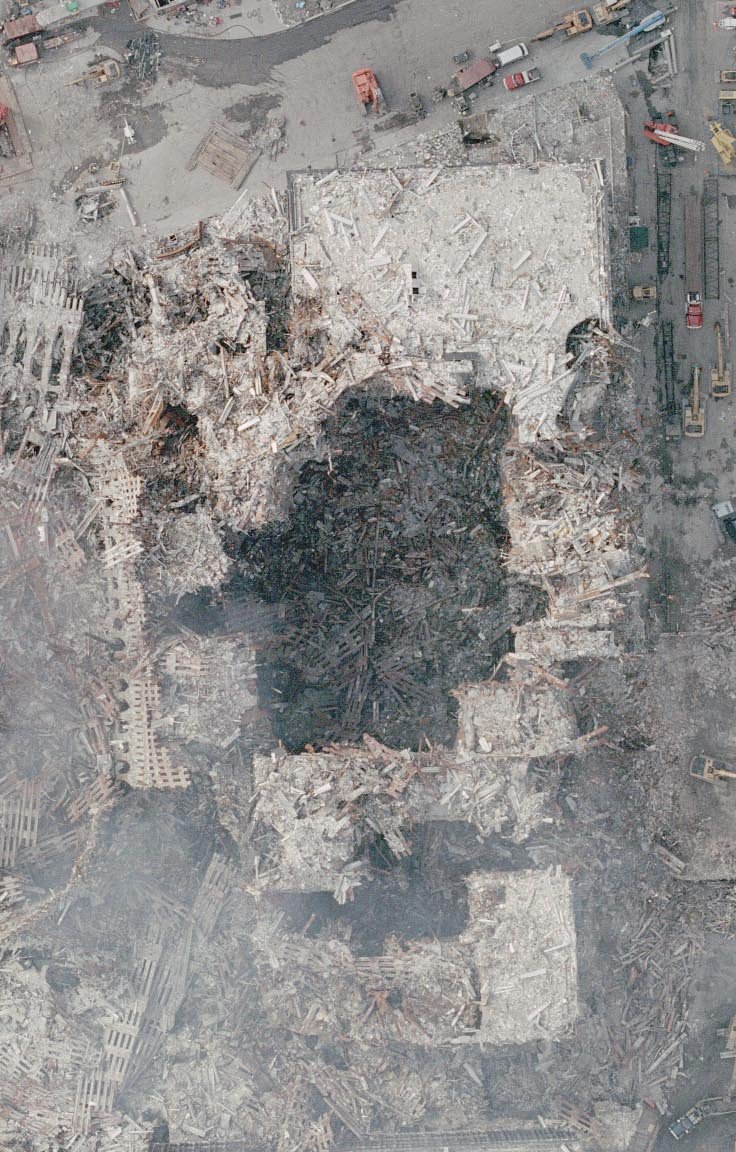
So what did you find at the bottom of the big hole in K, aka WTC 6? Big bits of structure from other buildings? Or bits of WTC 6? Or nothing? From photos it seems there was ... nothing! But start another thread about it.
 
Last edited:
So what did you find at the bottom of the big hole in K, aka WTC 6? Big bits of structure from other buildings? Or bits of WTC 6? Or nothing? From photos it seems there was ... nothing! But start another thread about it.

Nothing? Looks like hundreds of tons of perimeter columns from WTC1.

wtc6.jpg
 
Last edited:
Now explain to us Tony how if they turned into rubble, mass is reduced?
Its like the old trick question. Whats heavier? A ton of steel or a ton of gravel? Tell me your not this stupid?

In the videos I can see the material puffing out of the crushing zone. Do you want to say, that this material stay in the crushing zone?
 
In the videos I can see the material puffing out of the crushing zone. Do you want to say, that this material stay in the crushing zone?

Mostly smoke and dust, not a significant fraction of the mass.
 
Nothing? Looks like hundreds of tons of perimeter columns from WTC1.

[qimg]http://phunkadelic.org/wtc6.jpg[/qimg]

Hm, WTC 1 was destroyed much later than WTC 6 was destroyed. Should not all of the destroyed WTC 6 be below these "hundreds of tons of perimeter columns from WTC1"?

You really believe that 'some hundreds of tons of debris from WTC 1' can destroy an intact building?
 
Now explain to us Tony how if they turned into rubble, mass is reduced?
Its like the old trick question. Whats heavier? A ton of steel or a ton of gravel? Tell me your not this stupid?

A ton of steel has SG 7.85. And SG of gravel? Say 1.5. So steel is heavier than gravel for same volumes. Water has SG 1. Take a shower!
 
Hm, WTC 1 was destroyed much later than WTC 6 was destroyed. Should not all of the destroyed WTC 6 be below these "hundreds of tons of perimeter columns from WTC1"?

You really believe that 'some hundreds of tons of debris from WTC 1' can destroy an intact building?

How was WTC1 destroyed later than WTC6 when WTC6 was destroyed by WTC1 falling on it?

And yes, hundreds of tons of debris dropped from nearly 1000 feet can easily punch a big hole in a building.
 
Hm, WTC 1 was destroyed much later than WTC 6 was destroyed. Should not all of the destroyed WTC 6 be below these "hundreds of tons of perimeter columns from WTC1"?

You really believe that 'some hundreds of tons of debris from WTC 1' can destroy an intact building?

Heiwa - of the twin towers it was WTC1 that was closest to WTC6.
You seem to be under the impression that WTC2 was the closest. You are wrong in the most basic way possible.
 
Yes! Surprised? The height is just a question of energy applied by the small part C. How to convince you?
Start with a small height/energy and see what happens! There is a bounce!
Double the height/energy application! Some local failures followed by arrest.
Increase height/energy 10 times! Part C is really damaged but A still stands after arrest of C
Increase height/energy again 10 times. Part C is completely destroyed but parts of A are still standing. No one-way crush down of A has taken place so far. Parts of A are still connected.
Increase height/energy another 10 times. Same thing happens - you see when part C is completely destroyed it cannot damage A further. A completely damaged structure C cannot apply any energy on what remains of A.
Conclusion. A one-way crush down of A by C is not possible by dropping C on A.

Yes, I agree that A will be damaged ... but topic is Why a one-way Crush down is not possible. Don't change the subject.


Well, you've set my mind at ease about one thing at least. NASA can stop its search for asteroids that may impact the Earth. Any that do will either self-destruct or simply bounce off into space.

Looks like "Armaggedon" got it wrong after all. Thank goodness we dodged that bullet.
 
Status
Not open for further replies.

Back
Top Bottom