• Quick note - the problem with Youtube videos not embedding on the forum appears to have been fixed, thanks to ZiprHead. If you do still see problems let me know.

The Heiwa Challenge

Status
Not open for further replies.
bill,

All papers that are accepted for publication are discussion papers T.

You say the CUTEST things, ya little muchkin. ;)

They have been judged by Heiwa's engineering peers to be worthy of discussion.

You say the CUTEST things, ya little muchkin. ;)

You are free to go the same route and try for publication though i don't think we should hold our breaths.

Feel free to run the experiment. Till you turn blue. And then some...

NIST have no collapse conclusions for Bazant to support . They only took their analysis up to the point of glabal collapse and no further.

Would you care to place a small, or large, wager that "NIST has no collapse conclusions"?

For the rest yuur post is long and rambling as usual and has nohing remarkable to answer.

That's why, even tho I made a few side comments to you, that post was not addressed to you.

There are others, less challenged than you, ya little muchkin, who might get the points that I made.

:D

tom

Address the argument rather than personalizing the discussion.
Replying to this modbox in thread will be off topic  Posted By: prewitt81
 
Last edited by a moderator:
Anders, I agree that the two points work hand in hand. The overall force developed in a shock load is a function of mass participation and loose rubble elements do not participate with each other.

You have capably pointed that out here and shown the bankruptness of the notion that this loose amalgam could have continued to crush the lower structure.

Some people here just don't want to get it. They don't want to see that you can't drive a nail with a hammerhead composed of a bag with loose nails in it.
(emphasis added)


It still intrigues me how anyone can describe rubble that is being compressed between the floors of a standing structure and the floors of a falling structure as "loose."

Try it in a horizontal scenario. From left to right we have: a bulldozer facing right, a 10-foot high pile of "loose" gravel, and a brick wall. The bulldozer goes into gear. I'd ask "what happens next?" but I don't care for evasions or stupid answers, so I'll just answer instead. Some of the gravel will be pushed sideways out of the way, but enough of it will be compressed between the bulldozer and the wall to rupture or knock over the wall, well before the bulldozer blade itself gets to the wall.

The wall will be destroyed by "loose" gravel. Because, of course, the gravel is not actually loose once the bulldozer starts pushing it against the wall.

For a really fair comparison, we'd need a bulldozer with a blade 200 feet wide and 200 feet high.

Respectfully,
Myriad
 
(emphasis added)


It still intrigues me how anyone can describe rubble that is being compressed between the floors of a standing structure and the floors of a falling structure as "loose."

Try it in a horizontal scenario. From left to right we have: a bulldozer facing right, a 10-foot high pile of "loose" gravel, and a brick wall. The bulldozer goes into gear. I'd ask "what happens next?" but I don't care for evasions or stupid answers, so I'll just answer instead. Some of the gravel will be pushed sideways out of the way, but enough of it will be compressed between the bulldozer and the wall to rupture or knock over the wall, well before the bulldozer blade itself gets to the wall.

The wall will be destroyed by "loose" gravel. Because, of course, the gravel is not actually loose once the bulldozer starts pushing it against the wall.

For a really fair comparison, we'd need a bulldozer with a blade 200 feet wide and 200 feet high.

Respectfully,
Myriad
.
Myriad,

Nice analogy.

Mind if I steal it??

tom
 
1. The stronger elements of part A (e.g. vertical columns) rip apart the weaker elements of part C (e.g. horizontal floors) at contact. The connections are not really affected! This means that the weaker, damaged elements of part C (the floors) are still connected to, e.g. strong elements of part C. There are no loose elements, just damaged ones, and they are not added to part A.

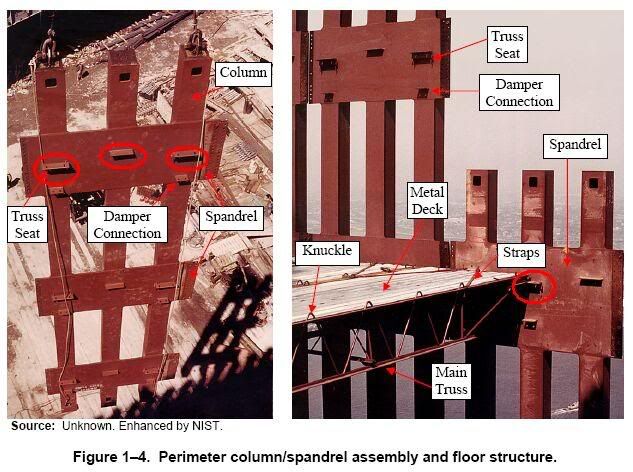
So you mean to tell me that that floor truss seats that I circled in red in this photo...:
1-4_perimeter-column-1.jpg


...would the resist the weight of Part C coming down on them? The floor truss supports wouldn't shear off or bend downward releasing the concrete floor they supported?
 
No cash prize as ever been offered in The Heiwa Challenge, which is just to produce any structure that self-destructs. Just look around! Can you find any? Enter it in The Heiwa Challenge. Shouldn't cost you a kopek.

No, the cash prize has been offered to selected indivudals that imply that they can prove the phenomenon C one-way crushing A theoretically. In spite of this encouragement they have all given up.

Heiwa, structures cost money to either buy or construct. What's my motivation for doing so? Proving you wrong? That ain't enough.
 
Can you please explain your natural mechanism for overloading a structure designed to handle several times the load above it, without a deceleration of the statically insufficient impacting mass? You do not explain the mechanics of how that could happen here and many are curious, not just me.

There should have been a detectable deceleration at every floor impact for the statically insufficient load above to have been able to destroy the structure below. The detection can be done due to the velocity taking time to recover, one does not actually need to observe the actual jolt. Of course, the problem for Bazant's theories and by extension the NIST, as they use Bazant to avoid analyzing the collapse dynamics themselves, is that there were no decelerations of the upper block in WTC 1.

Hey Tony,


I will assume that you don't mean "how did the failure initiate?" That has been completely explained. I assume that you are asking "why didn't the collapse arrest immediately"? And "why didn't we see the jolts during the collapse"?

Sure. Easy. It's been explained about 20 times in just this thread.

This is a completely false assumption: "... overloading a structure designed to handle several times the load above it ...".

The COLUMNS of the towers were designed to carry the weight above. The FLOORS of the towers were NEVER designed, intended or CLOSE to capable of carrying the loads of the floors above. They were overloaded by at least 3 orders of magnitude.

Accurate estimates of the force on EACH column of the 12 stories of the North Tower was approx 80 TONS per column. Each column was on the order of 1 square foot. The result pressure was approximately 160,000 psf DYNAMIC load. The floors were designed to support (IIRC) about 300 psf STATIC load.

Notice any difference there, Tony?

Is this really a mystery to you???


As you can see above, the stress overload on the concrete floors was a MULTIPLE of ~160,000/300 = 5000. Tell me how much of a deceleration jolt you expect to see from this...!!

Let's create an analogy. We will use a stress based model, so that scaling factors don't complicate things too badly.

A chicken egg (brittle, just like the concrete floors) is "designed" to support the weight of an approximately 1 pound hen, nicely distributed over approximately 3 square inches. If I carefully set a 1 pound hammer on top of the egg, it will support that weight just fine. If I drop a hammer, say from one foot height, onto the egg, there is a certainty that it'll crack. When it does, it'll provide a jolt to the hammer. If one were to take high speed video of the hammer, one might even be able to detect the jolt. IF you had sufficient resolution of time & space to detect the very slight, very high frequency jolt.

Now, without resorting to all those annoying calculations, what does your gut tell you about the magnitude of the jolt if the hammer happened to be "overweighted" by the same multiple (5300x), AND dropped from a, say, one foot height. How much deceleration do you expect to see from dropping a 2 1/2 TON weight onto an egg??

Go do some real NUMBERS, Tony.

Include the MAGNITUDE of the jolt that you expect to see. FYI, the concrete floors were 4" thick. They will certain fracture after having been deflected by 1/2". Then you'd have the ductile failure of the cross trusses & bolts that'd be 90% complete in about, say, 1 foot of deflection. So there's the travel distance of the upper block over which your impulse goes from zero to max to zero again. You have to be able to resolve FRACTIONS of this distance in your data.

Now wrap that number around the resolution of your camera, Tony, when the images are taken from 1/2 mile away. How many FEET is one pixel??

Include the frequency of the jolt that you expect to see, Tony. You've got NTSC video. 30 frames per second. Oooops. INTERLACED. 15 frames per second on successive raster lines. Nyquist sampling theory, tony. Max frequency component that you can resolve is going to be about 2 Hertz.

Now you know why I asked you if you took your data from every frame. You didn't answer me.

And then there's the dampening effects of the air exhaustion that I mentioned earlier. To which you also never replied.

Very "Heiwa-esque" of you, Tony.

Would you answer me now? Please. Pretty please. With a cherry on top.

Do you REALLY think that you'll be able to see this jolt with a video camera from 1/2 mile away??

tom

That's a good post, tom. A lot of people don't seem to realize that the structure was designed to be strong as a complete system, but individual elements could fail when things went awry and they experienced loads they weren't designed to handle. And, the structure becomes less able to handle these increasing loads as more of its components are removed from the system.

Mackey also addressed similar issues to Tony's questions here:

http://www.internationalskeptics.com/forums/showthread.php?postid=4350623#post4350623
 
So you mean to tell me that that floor truss seats that I circled in red in this photo...:
http://i238.photobucket.com/albums/ff290/gamolon/1-4_perimeter-column-1.jpg

...would the resist the weight of Part C coming down on them? The floor truss supports wouldn't shear off or bend downward releasing the concrete floor they supported?

that middle one you circled in the photo to the left? Not a truss seat. that is for the wye reinforcing bars embedded in the lightweight concrete floors above the floor pans which is why they are higher.. IIRC the trusses were 80 inches on center. So every other perimeter column gets a truss seat.
 
This is unexpected & great news.

Please answer these questions directly. Succinctly.

"Yes" or "no" for each question. Embellish as you wish.

1. Is the $1 million prize is available for providing this theoretical proof.

2. What does "selected individuals" mean? I would very much like to get into this club & offer my proof.

3. You must prove that the funds are available. Please arrange to put them into escrow for the duration of your challenge.

4. Who judges? Since you are both unqualified and biased, we MUST have INDEPENDENT, QUALIFIED individual or panel to make this judgment.

5. Are there any other stipulations about to arise?

tom

Tom

Add #6 The $1 meeellion prize to be paid in US Dollars only.

(Check out the Zimbabwe Dollars rate)
http://secedu.net/stylebid.com/images/DSC06314.JPG
 
Last edited:
that middle one you circled in the photo to the left? Not a truss seat. that is for the wye reinforcing bars embedded in the lightweight concrete floors above the floor pans which is why they are higher.. IIRC the trusses were 80 inches on center. So every other perimeter column gets a truss seat.

Thanks AW.

So what happens to the truss seats around the perimeter of that first floor that Part C comes in contact with? Will those not shear off or bend downward?
 
Thanks AW.

So what happens to the truss seats around the perimeter of that first floor that Part C comes in contact with? Will those not shear off or bend downward?


in just about every photo of the debris pile taken during the WTC cleanup. I cannot find a single perimeter column seat, Weather truss, damper, or wye bar, that is not bent downward to vertical. Check for yourself. this can only mean one thing. after collapse initiation the floor pancaked within the perimiter tube and then debris ejected the perimeter outward.
 
in just about every photo of the debris pile taken during the WTC cleanup. I cannot find a single perimeter column seat, Weather truss, damper, or wye bar, that is not bent downward to vertical. Check for yourself. this can only mean one thing. after collapse initiation the floor pancaked within the perimiter tube and then debris ejected the perimeter outward.

That must have been where the NWO put the termites to heat-weaken the steel.
 
(emphasis added)


It still intrigues me how anyone can describe rubble that is being compressed between the floors of a standing structure and the floors of a falling structure as "loose."

Try it in a horizontal scenario. From left to right we have: a bulldozer facing right, a 10-foot high pile of "loose" gravel, and a brick wall. The bulldozer goes into gear. I'd ask "what happens next?" but I don't care for evasions or stupid answers, so I'll just answer instead. Some of the gravel will be pushed sideways out of the way, but enough of it will be compressed between the bulldozer and the wall to rupture or knock over the wall, well before the bulldozer blade itself gets to the wall.

The wall will be destroyed by "loose" gravel. Because, of course, the gravel is not actually loose once the bulldozer starts pushing it against the wall.

For a really fair comparison, we'd need a bulldozer with a blade 200 feet wide and 200 feet high.

Respectfully,
Myriad

Myriad..see it in slow moton... The top block falls and impacts the top of part A. The concrete floors meet and explode and the columns in both parts are the first next thing to reach their respctive next floors. Of course they completely chew them up as teeth chew food. Not only that...the upper and lower teeth are meshing. Some pieces of floors are still janging off columns and getting caught up. Friction is increasing, the mass above is decreasing as it's former floors turn to loose rubble, much of which will all away to the sides.
 
Last edited:
Myriad..see it in slow moton... The top block falls and impacts the top of part A. The concrete floors meet and explode and the columns in both parts are the first next thing to reach their respctive next floors. Of course they completely chew them up as teeth chew food. Not only that...the upper and lower teeth are meshing. Some pieces of floors are still janging off columns and getting caught up. Friction is increasing, the mass above is decreasing as it's former floors turn to loose rubble, much of which will all away to the sides.


Ever see whats left of a car after a dump truck load of gravel rolls over on it? An entire family visiting from the UK was crushed to death in my town many tears ago. The 3/4 inch pieces of blue stone didn't care.
 
Myriad..see it in slow moton... The top block falls and impacts the top of part A. The concrete floors meet and explode and the columns in both parts are the first next thing to reach their respctive next floors. Of course they completely chew them up as teeth chew food. Not only that...the upper and lower teeth are meshing. Some pieces of floors are still janging off columns and getting caught up. Friction is increasing, the mass above is decreasing as it's former floors turn to loose rubble, much of which will all away to the sides.


I've taken the liberty of creating a diagram illustrating your new analysis of the collapse dynamics following collapse initiation:

130124a2824faa4dc9.jpg


I do not find it convincing.

Respectfully,
Myriad
 
in just about every photo of the debris pile taken during the WTC cleanup. I cannot find a single perimeter column seat, Weather truss, damper, or wye bar, that is not bent downward to vertical. Check for yourself. this can only mean one thing. after collapse initiation the floor pancaked within the perimiter tube and then debris ejected the perimeter outward.

Well, that's what my thinking has always been.

Even though the columns are the strong points, the floor trusses (the weakest links) will give first in my thoughts.

Part C hits the top floor of Part A and breaks the floor trusses. That floor becomes added weight along with Part C and hits the next floor.

Is Heiwa claiming that the floor trusses of the top floor of Part A will slow down the downward motion of Part C and that after hitting a certain number of floors, Part C is supposed to cease moving downward?
 
I've taken the liberty of creating a diagram illustrating your new analysis of the collapse dynamics following collapse initiation:

[qimg]http://www.internationalskeptics.com/forums/imagehosting/130124a2824faa4dc9.jpg[/qimg]


I do not find it convincing.

Respectfully,
Myriad


lol...Looks a bit like Cheney.
 
Myriad..see it in slow moton... The top block falls and impacts the top of part A. The concrete floors meet and explode and the columns in both parts are the first next thing to reach their respctive next floors. Of course they completely chew them up as teeth chew food. Not only that...the upper and lower teeth are meshing. Some pieces of floors are still janging off columns and getting caught up. Friction is increasing, the mass above is decreasing as it's former floors turn to loose rubble, much of which will all away to the sides.

Are you saying that the bottom floor of the descending top block meets the top floor of the stationary bottom block and the floor trusses of the top floor of the bottom block partially resist the descending motion of the top block?

The floor trusses of the first floor resist enough to slow down the descent of the top block enough that after the top top hits a few more floors below it will eventually stop?

So wait. As each floor of each respective block meets, the obliterate one another until all of the top blocks floors are gone, leaving whatever is left of the bottom block?

Am I getting this right?
 
Status
Not open for further replies.

Back
Top Bottom