• Security incident: ISF was recently accessed by intruders. Please change your password, and change it anywhere else you used it. Read more

Australia

Queanbeyan.

Moe. Any more noms, readers? :)


I find it interesting that Australia doesn't have distinct regional accents. I can't tell by your pronunciation whether you're from Perth or Brisbane. I might be able to tell you whether you're from Cremorne or Redfern, and I could probably tell you wether you were from Perth or Mintabe. But this has more to do with socioeconomic status and quality of education than purely location. I probably wouldn't be able to tell whether you're from Mintabe or Meekathara.

That's something that we seem to have on our own, isn't it?

The causes and effects of this are worth discussing for a while, I hope, because I find it fascinating as well. I've always wondered why it's so easy to tell the difference between a New Yorker and a Texan, or a between a Gordie and a Scouse, but as you say, never the difference between a Sandgroper and a Banana Bender.


What Australia does have is regional idiom. It's not that people pronounce words differently in different places, but that they use different words for common concepts. For example, a bogan in Canberra can be called a "Charnie", as in someone who lives in Charnwood (the highest-crime suburb in Canberra). But you wouldn't expect someone from Sydney to understand the idiom, even though that person would pronounce it identically.

Yup. I'll bet Wildy could baffle a few people if he started talking about spoggies sitting on Stobie poles.


Cheers,

Dave
 
What a brilliant dictionary. I could spend hours on it and learn words and meanings I never thought existed.

But as former Bondi lifesaver (club champion 1967, but I'm not putting tickets on myself at all) I can categorically confirm that Bondi cigars were a reality at that beach. Not now, thankfully.


The world shrinks yet again! In 1967 I was a daily fixture on Cronulla beach.

Since you won't put tickets on yourself, I will. ;)

The Surf Lifesavers are excellent representatives of what it is to be Australian, and are truly worthy of the title "hero". Well done, lionking.

Here's a bit of history for you:

Surf Life Saving Reel

The Surf Lifesaving reel had its first public demo on December 23rd 1906 at Bondi Beach, Sydney, New South Wales. The first person to be rescued was a little boy called Charles Smith, later to become the famous Sir Charles Kingsford Smith.


LifeSavers.jpg

ozbird.com


We southern beach goers had more trouble with bluebottles than "floaters".


Cheers,

Dave
 
He was from Sydney, as I was originally. Any links to NSW regiments would be appreciated.


The Lancers! A rich heritage indeed.

Below is a studio portrait of Cecil Stanley Samuel Hibbert wearing the uniform of the 1st Australian Light Horse (the New South Wales Lancers). Hibbert later enlisted with the 1st AIF at Sorrento, Vic, on 15 July 1915, and served as a private in the 7th Battalion. 2850A Private Hibbert died of wounds in Belgium on 5th October 1917.


NSWLancer.jpg

© Australian War Memorial


Other images of 1LH and NSW Lancer uniforms can be seen here.


Here is the lineage of the NSW Lancers.

LancersLineage.jpg

© New South Wales Lancers Memorial Museum Incorporated


The 12th (New South Wales) Light Horse Regiment formed part of the 4th Light Horse Brigade under Brigadier-General William Grant (born Stawell, Victoria). Earlier, Australian General Sir H. G. Chauvel had been ordered "to capture Beersheeba today, in order to secure water and take prisoners". Chauvel had other units available including British troops, but directed the 4th Brigade forward. "Put Grant straight at it", he directed.

The attack of the 4th Light Horse Brigade at Beersheba was history's last great mounted charge.


Trooper Eric Elliot said:
"It was the bravest, most awe inspiring sight I've ever witnessed, and they were. . . yelling, swearing and shouting. There were more than 500 Aussie horsemen . . . As they thundered past my hair stood on end. The boys were wild-eyed and yelling their heads off".


Beersheba - the last great mounted charge


Larrikins. ;)
 
Last edited:
It’s like that for me most of the time. It’s nice to talk to a fellow Aussie to trot out expressions that used to come so naturally. I don’t say "bugger" anymore – it’s a bit embarrassing to explain that one. Calling someone a bastard as a term of endearment doesn’t go down well around here either.


Meh. I've been watching too many Pommy shows to the extent that I'm more likely to use their insults rather then Australian ones.


I pick up and recycle words all the time, and this is a classic example. I picked up "bugger" (no sexual overtones, gentle foreign readers) from the TV ads for Toyota, featuring the talking Blue Heeler, and started using it as a replacement for "bummer" which I'd earlier picked up from American TV.

TV (and radio) are often responsible for propogating or reviving Aussie expressions.


Contributor's comments said:
"Brass monkey weather" was used in SA and its use increased during the 70s or 80s due to a beer/ale commercial on the radio and telly - Cooper's Stout I think.

Australian Word Map


Cheers,

Dave
 
I don't think anything anything got in the old distillery without coming out 70 proof, my liver sure diid. I know of a carleton brewery at yatala (yummmm). Dunno about historically in the area of beenleigh though. As to lion park do you mean grrrr lions or the lions association? I don't know but I can ask my dad, he's been a beenleigh boy a fair while and knows a lot of the history.


Grrr lions.

Also yes, Carlton yummy. :)
 
Brass monkey weather is very common in Sydney. Funny thing is it nothing sexual or vulgar
 
An intresting spot up the road from where Dave lives is between Wangaratta and Myrtleford where the road (I believe) goes through an ancient crater. As you start to climb from Everton to Gapstead you are in it.

Google maps show a circle depression washed out on the Wang end. Interestingly gold is all around but none in the depression area.

The ridge around seem to me to be rubble.


Like this?

Wangaratta.jpg


As you say, there's big mobs of gold in the hills, but none down on the flat. I don't know why.

Speaking of mountains in this area, I have a bro- and sister-in-law living at the foot of the Warby Range, in the extreme lower left of the above picture.

Their town is Glenrowan, Victoria, and it has quite a history.


Back towards Wang. (Everton), my parents had a property for awhile that was taken up by a Dr Grant who was William Hovell's brother in law. (see: Hume & Hovell) His name is (was) scatched into a window pane on the remains of the first homestead complete with ghost.

Called the station "The Grange". Plenty of tiger snakes - Dad got over 200 feet of snake one summer. The Wraith boys from Harrietville who Dad bought it from sold snake skins to New Zealand, and for easy skinning nailed the snakes through the head to the shed wall leaving dozens of dried heads - should have got a photo.


Rolf Harris said:
So they tanned 'is 'ide when 'e died, Clyde,
And that's it 'angin' on the shed.​


I'll quote the whole song later.


Darn, just run out of home made Vodka.


  1. Go home.

  2. Make more.

  3. Post stories.

  4. Profit?

;)


Cheers Mate.
 
Last edited:
Queanbeyan.

I find it interesting that Australia doesn't have distinct regional accents. I can't tell by your pronunciation whether you're from Perth or Brisbane. I might be able to tell you whether you're from Cremorne or Redfern, and I could probably tell you wether you were from Perth or Mintabe. But this has more to do with socioeconomic status and quality of education than purely location. I probably wouldn't be able to tell whether you're from Mintabe or Meekathara.

What Australia does have is regional idiom. It's not that people pronounce words differently in different places, but that they use different words for common concepts. For example, a bogan in Canberra can be called a "Charnie", as in someone who lives in Charnwood (the highest-crime suburb in Canberra). But you wouldn't expect someone from Sydney to understand the idiom, even though that person would pronounce it identically.

Having worked all around Australia for the mining industry, I would have to say that this is mostly true.
Tasmania and the NT use 'bloke' and 'cobber' more then mate
N.S.W and Victoria will use Westies for bogan
South Australians draw out the vowel sound - caaastle instead of castle
Queenslanders will end sentences with 'A' - 'It's a great day, a?

There does seem to be a slight diffenence in accents between those in the city and the country. When I worked for Moura mines I had a hard time understanding the locals. They seemed to mumble there words.
 
"[A] batch of some 50 or 60 Australian prisoners were marched off close behind us — immensely big and powerful men, who without question represented an elite formation of the British Empire, a fact that was also evident in battle."
Lt. Gen. Erwin Rommel

A history of Australian troops in WW2
http://www.awm.gov.au/atwar/ww2.asp

(I think) one of the greatest moments, when reserve troops saved the country from being invaded (well, saved PNG from being invaded which would have allowed the Japanese to setup a base to invade Australia)

Kokoda
http://en.wikipedia.org/wiki/Kokoda_Track_Campaign

For such a small country (in population) our contribution was enormous and we served in nearly every front, including having men posted in Iceland, helping protect the Russia coast line.


From your links:

Some members of D Company, 39th Battalion, returning to their base camp after a battle at Isurava.

Kokoda2.jpg


Right to left:

Warrant Officer 2 R. Marsh, Privates G. Palmer, J. Manol, J. Tonkins, A. Forrester and Gallipoli veteran Staff Sergeant J. Long. Their shoes sink deep in the mud on the hilly jungle track.


Kokoda1.jpg


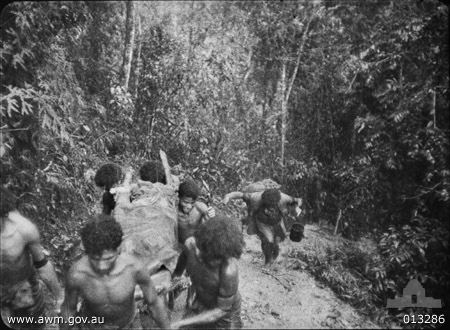
Native bearers (popularly known as "Fuzzy Wuzzy Angels") carry a wounded Australian soldier on a stretcher. They are moving up a steep hill track through a thick tropical jungle.


Cheers
 
Last edited:
No corrections, but you have just reminded me that my grandfather and his brothers were in the Light Horse Brigade, but served in Egypt and France (IIRC). I always thought that my father was BSing me (not for the first time) about the history of my grandfather - being shunned by the local Catholic Church when he turned up after the war wearing his slouch hat etc - until I was given photographs of him and his brothers in uniform, young and innocent, before getting on the boat and also seeing his letters from the front.

The courage of these men fighting a war with so little relevance to the security of Australia is awe-inspiring. Although I'm not sure he served there, I am determined to visit Villers-Bretonneux before I turn up my toes.

wikipedia said:
The 13th Light Horse Regiment and one squadron of the 4th Light Horse Regiment served on the Western Front, first as divisional cavalry squadrons for the 2nd, 4th and 5th Divisions, and then as the I Anzac Corps Mounted Regiment. A squadron of the 4th provided the divisional cavalry squadron for the 1st Division and one of the 14th Light Horse for the 3rd Division. In combination with New Zealand mounted troops, the squadron of the 4th became part of the II Anzac Corps Mounted Regiment. After the Australian Corps was formed in November 1917, the I Anzac Corps Mounted Regiment became known as the 13th Light Horse Regiment again.

Other than those 2 units the Light Horse never set foot in Western Europe.
 
"[A] batch of some 50 or 60 Australian prisoners were marched off close behind us — immensely big and powerful men, who without question represented an elite formation of the British Empire, a fact that was also evident in battle."
Lt. Gen. Erwin Rommel

A history of Australian troops in WW2
http://www.awm.gov.au/atwar/ww2.asp

(I think) one of the greatest moments, when reserve troops saved the country from being invaded (well, saved PNG from being invaded which would have allowed the Japanese to setup a base to invade Australia)

Kokoda
http://en.wikipedia.org/wiki/Kokoda_Track_Campaign

For such a small country (in population) our contribution was enormous and we served in nearly every front, including having men posted in Iceland, helping protect the Russia coast line.

That's putting a kind spin on it. Reserve troops indeed.

What they were was half trained militia battalions, until the 21st brigade was sent up. It's amazing and a credit to the men and officers of the 39th militia battalion managed to hold off the Japanese as long as they did, given they were up against elite Japanese troops and they hadn't ever completed basic training.

It was a cruel joke by the government to send them there in the first place. The 7th division had arrived back in Australia and was available to be sent up in full strength, but instead they sent up 3 undertrained militia battalions, one of which, the 53rd, was later described as "quite the worst battalion in Australia".
 
Having worked all around Australia for the mining industry, I would have to say that this is mostly true.
Tasmania and the NT use 'bloke' and 'cobber' more then mate
N.S.W and Victoria will use Westies for bogan
South Australians draw out the vowel sound - caaastle instead of castle
Queenslanders will end sentences with 'A' - 'It's a great day, a?

There does seem to be a slight diffenence in accents between those in the city and the country. When I worked for Moura mines I had a hard time understanding the locals. They seemed to mumble there words.

What? I've lived in Victoria my whole life and never once have I heard this "westie" word.
 
Other than those 2 units the Light Horse never set foot in Western Europe.

That would mean that my family probably shot at them.

It was a cruel joke by the government to send them there in the first place. The 7th division had arrived back in Australia and was available to be sent up in full strength, but instead they sent up 3 undertrained militia battalions, one of which, the 53rd, was later described as "quite the worst battalion in Australia".

I think it says a lot about the Australians if they can do that. And then you get idiots like Blamey with his "running rabbits" comment.
 
That would mean that my family probably shot at them.


I think it says a lot about the Australians if they can do that. And then you get idiots like Blamey with his "running rabbits" comment.

That has to be in the running for stupidest thing ever said by a commanding officer.
 
Great picture of the depression- crater Dave, did you know that fruit bats have made it to Wangratta. Our over sea people may be interested to know that the black night raiders range in the hundreds of thousands mainly from Cape York south to about Sydney. A good 2ft wing span and camp in big mobs in secluded trees. Terrible toilet habits as they hang upside down like black foot balls. Speaking of Aussie toilets,one bloke built a "Thunder Box" over a deep old mine shaft near Bright. Don't drop watch or wallet and be very carefull. This same bushie had a cow with 5 legs. (true) I was brought up near Bright on what is now the "Old Tobacco Shed"(tourist trap) on the beautiful Ovens river now a gutter from dry years and over water useage. Rainbow trout,brown trout sparkling water all gone, guess we didn't help fishing with Alfred Noble.
 
Last edited:
That's cool - I didn't know that they couldn't echolocate. I guess those fruit don't provide much of a chase.
 
Last edited:

ISF - Join now!

Every member here is approved by hand. No bots, no spam, just people who care about evidence and honest debate.

Membership is free!

Create your free account

Back
Top Bottom