Sol88
Philosopher

- Joined
- Mar 23, 2009
- Messages
- 8,437
1)nothing
2)What's the point?
Ahh I see the intellectual police have been called!
Last edited:

1)nothing
2)What's the point?
I will play along with the troll for a second.
Sol88, if you hypothesize that the planet Mercury was once charged up---like a great big capacitor---and that a runaway *discharge* created an arc, and the arc was responsible for the spider-like formation in the Caloris basin ... well, let's do some MATH.
Let's hypothesize that we can charge Mercury up. Just plug in a big jumper cable, or shoot a highly-charged wind at it, or ... something. One way or another, we'll hypothesize that we can build up an electrostatic voltage on the whole planet. How much excess charge can we pack on while doing this?
As an isolated sphere, Mercury's capacitance is about 0.2 millifarads. That's, um, not very much. A *gigavolt* static potential would carry only 200,000 Coulombs (about one car battery). I want to emphasize that a gigavolt is a very, very high potential. There is no way to charge something up to a gigavolt by bathing it in a kilovolt-energy solar wind.
Let's see, how much *energy* do you store when you pack 200,000 C into a gigavolt potential? 2 x 10^14 joules ... about 50 kT of TNT, or something in the ballpark of the Nagasaki atomic bomb.
Therefore, we have (unfortunately) lots of experience with the craters formed by 50 kT energy releases. They're a 100 meters in diameter and a few meters deep---underground explosions might excavate only a hundred meter or so cavity. Moving rock around takes lots of energy.
So what do we find on Mercury? A hole 40,000 meters in diameter.
Sol88, your "arc welder" hypothesis requires energy to be stored somewhere. The largest charge we can expect Mercury to pick up from the Solar Wind is a few kilovolts, giving it a few hundred Joules of energy---whereupon your Giant Arc Discharge Into Space could perhaps occur, but it would barely heat up a cup of tea, much less excavate a 40,000 meter crater.
How much energy do you think you need for the crater, Sol88? How will you charge up an isolated capacitor to the (apparently required) ten teravolts? You can't. Since Mercury could never have been this highly charged, it's never had anything like enough stored electrostatic energy to excavate a crater with an arc discharge. You casually invented an Giant Cosmic Welding Torch, Sol88, but you forgot to find somewhere to plug it in.
You're welcome to do the same calculation under the (equally stupid) assumption that Mercury had (like Earth) a dielectric atmosphere with an internal mechanical charge conveyor. You will have to learn electrostatics to do so.
Why on Earth would you want a transformer?
Well, in some way you can see it like that, only that the induced current (through the disturbance of the magnetic field) will flow in that disturbed magnetic field, sort of like the Birkeland currents in the Earth's magnetospere. In this case there is NO linking of two current circuits like in a transformer (where it is usually used to down the voltage of the one circuit to the other circuit).
The explosion produced not only a surge of visible light but also a mammoth cloud of charged particles and detached magnetic loops—a "CME"—and hurled that cloud directly toward Earth. The next morning when the CME arrived, it crashed into Earth's magnetic field, causing the global bubble of magnetism that surrounds our planet to shake and quiver. Researchers call this a "geomagnetic storm." Rapidly moving fields induced enormous electric currents that surged through telegraph lines and disrupted communications.
Structures
Three types of rille are found on the lunar surface:
* Sinuous rilles meander in a curved path like a mature river, and are commonly thought to be the remains of collapsed lava tubes or extinct lava flows. They usually begin at an extinct volcano, then meander and sometimes split as they are followed across the surface. Vallis Schröteri in Oceanus Procellarum is the largest sinuous rille.
* Arcuate rilles have a smooth curve and are found on the edges of the dark lunar maria. They are believed to form when the lava flows that created a mare cool, contract, and sink. This are found all over the moon, examples can be seen near the south-western border of Mare Tranquillitatis and on the south-eastern border of Mare Humorum.
* Straight rilles follow long, linear paths and are believed to be grabens, sections of the crust that have sunk between two parallel faults. These can be readily identified when they pass through craters or mountain ranges. Vallis Alpes is by far the largest graben rille, indeed it is regarded as too large to be called a rille and is itself bisected by a straight rille; Rupes Recta in Mare Nubium is a clearer example.
Rilles which show more than one structure are termed hybrid rilles. Rima Hyginus in Sinus Medii is an example, initially formed through a fault and subsequently subject to volcanic activity.
[edit] Formation
Precise formation mechanisms of rilles have yet to be determined. It is likely that different types formed by different processes. Common features shared by lunar rilles and similar structures on other bodies suggest that common causative mechanisms operate widely in the solar system. Leading theories include lava channels, collapsed lava tubes, near-surface dike intrusion, subsidence of lava-covered basin and crater floors, and tectonic extension.
You seem to forget that the sipder crater and ray system on Mercury is unique. Just read what you have lnked to. If it was common then how come all of the astronomers were surprised to see it? Why is there a news release about a common, garden variety feature?Even the similar features we see on the moon CAN NOT be explained in any convectional manner, if you were to take the time to think for your self, you would be surprised.
Talk about being obtuse: It is not cosmology.It has everything to do with cosmology and the crew here know it, that's why there being obtuse!
You seem to forget that the sipder crater and ray system on Mercury is unique. Just read what you have lnked to. If it was common then how come all of the astronomers were surprised to see it? Why is there a news release about a common, garden variety feature?
There are no similar features, i.e. crater + ray (trough) system on the Moon.
In addition: electric discharge has been ruled out as a cause of this unique feature since:
- There is no charge separation caused by the solar wind (as you assume) because Mercury has a shielding magnetic field.
- Mercury does not have an atmosphere to support terrestrial forms of lightning.
- A falsifiable, testable prediction of the idea would be that similar craters would appear elsewhere. For example there should be examples on the Moon since it is exposed to the solar wind. Since more examples are not seen, the idea is falsified.
And now Mercury can be added to that list.However, the term has also been used loosely to describe similar structures on a number of planets in the Solar System, including Mars, Venus, and on a number of moons. All bear remarkable structural resemblance to each other.
Talk about being obtuse: It is not cosmology.
Think about the logical consequences of this being plasma cosmology:
Scale this "plasma" event up to cosmological scales.
Are you happy with a planet (Mercury) that is millions of light years big?

But magnetic fields ARE!!millions of light years big
So what?1 Mercuries magnetic field induces currents in the core!
That is the point - you have not given any source for the electric discharge.2 We are not talking atmospheres here though a tenuous one does exist
What list? If you mean riles then you really need to have your eyes checked.3 And now Mercury can be added to that list.
A ray system comprises radial streaks of fine ejecta thrown out during the formation of an impact crater, looking a bit like many thin spokes coming from the hub of a wheel. The rays can extend for lengths up to several times the diameter of their originating crater, and are often accompanied by small secondary craters formed by larger chunks of ejecta. Ray systems have been identified on the Moon, Mercury, and some moons of the outer planets. Originally it was thought that they existed only on planets or moons lacking an atmosphere, but more recently they've been found on Mars in infrared images taken from orbit by Mars Odyssey's thermal imager.
Are you happy with this?Think about the logical consequences of this being plasma cosmology:
Scale this "plasma" event up to cosmological scales.
Are you happy with a planet (Mercury) that is millions of light years big?
 !
!Are you silly: You quote the formation of a crater as evidence for plasma cosmology and then remove the planet when you scale it up? How is the crater formed at cosmic scales if there is no planet?Forget the planet, scale the electric and magnetic effects, troll!
But magnetic fields ARE!!

Ahh I see the intellectual police have been called!

But those papers Tusenfem are saying currents are being induced in the core?
What happens then?
The solar wind is very dynamic and because of Mercuries position right next door to the Sun, what happen if a killer CME blew by?
Such as the Carrington Event? and that's only going back couple hundred years! How old is Mercury? I'll wager it's seen it's fair share of large events!
What happens when one of those babies runs into a planet with an induced magnetic field? Like Mercury!
All the criteria for my hypothesis are there! Everything by what was on the other end of the discharge!
charge separation and charge equalization. it's what electricity does!
but now the mods have been called in, I see everyone here is going to let this compelling piece of evidence that the universe (or at least our soar system) is electricaly active and gravitationally stagnate!
Even the similar features we see on the moon CAN NOT be explained in any convectional manner, if you were to take the time to think for your self, you would be surprised.

I will play along with the troll for a second.
Sol88, if you hypothesize that the planet Mercury was once charged up---like a great big capacitor---and that a runaway *discharge* created an arc, and the arc was responsible for the spider-like formation in the Caloris basin ... well, let's do some MATH.
Let's hypothesize that we can charge Mercury up. Just plug in a big jumper cable, or shoot a highly-charged wind at it, or ... something. One way or another, we'll hypothesize that we can build up an electrostatic voltage on the whole planet. How much excess charge can we pack on while doing this?
As an isolated sphere, Mercury's capacitance is about 0.2 millifarads. That's, um, not very much. A *gigavolt* static potential would carry only 200,000 Coulombs (about one car battery). I want to emphasize that a gigavolt is a very, very high potential. There is no way to charge something up to a gigavolt by bathing it in a kilovolt-energy solar wind.
Let's see, how much *energy* do you store when you pack 200,000 C into a gigavolt potential? 2 x 10^14 joules ... about 50 kT of TNT, or something in the ballpark of the Nagasaki atomic bomb.
Therefore, we have (unfortunately) lots of experience with the craters formed by 50 kT energy releases. They're a 100 meters in diameter and a few meters deep---underground explosions might excavate only a hundred meter or so cavity. Moving rock around takes lots of energy.
So what do we find on Mercury? A hole 40,000 meters in diameter.
Sol88, your "arc welder" hypothesis requires energy to be stored somewhere. The largest charge we can expect Mercury to pick up from the Solar Wind is a few kilovolts, giving it a few hundred Joules of energy---whereupon your Giant Arc Discharge Into Space could perhaps occur, but it would barely heat up a cup of tea, much less excavate a 40,000 meter crater.
How much energy do you think you need for the crater, Sol88? How will you charge up an isolated capacitor to the (apparently required) ten teravolts? You can't. Since Mercury could never have been this highly charged, it's never had anything like enough stored electrostatic energy to excavate a crater with an arc discharge. You casually invented an Giant Cosmic Welding Torch, Sol88, but you forgot to find somewhere to plug it in.
You're welcome to do the same calculation under the (equally stupid) assumption that Mercury had (like Earth) a dielectric atmosphere with an internal mechanical charge conveyor. You will have to learn electrostatics to do so.
 This could be really important to the PC/EU theory Sol88.
So what?
Show that this induced current disharges on the surface at large enough amperage to create craters then you may have a point. Otherwise you are just speculating.
Real scientists have actual numbers from their theories that show that craters and ray systems can be created from impact events.
That is the point - you have not given any source for the electric discharge.
What list? If you mean riles then you really need to have your eyes checked.
You have one example that looks like the picture that you are obsessed with. This is the spider crater + ray system (really a tough system) on Mercury.
Have you ever seen a ray system image? They look nothing like the picture that you are obsessed with, e.g. there is no branching.
Also learn to read (emphasis added):
Are you happy with this?
I am definitely not happy with it
Are you silly: You quote the formation of a crater as evidence for plasma cosmology and then remove the planet when you scale it up? How is the crater formed at cosmic scales if there is no planet?
There are magnetics fields on cosmological scales. You seem to think that they
I assume that these cosmological magnetic fields are part of plasma cosmology (or at least one of the many plasma cosmologies). Any plasma cosmology that claims that planetary phenomena are evidence of cosmological phenomena is definitely scientific woo.
- Are generated by planets like Mercury (wrong).
- Have similar strengths to planetary magnetic fields (wrong).
- Experience electric discharges for some reason (wrong).
Planetary phenomena (e.g. magnetospheres, etc.) are evidence of the validity of plasma physics at planetary scales and support for the ability to scale plasma properties from lab scales to planetary scales and further to interstellar scales.
Getting back to your original obsession - the spider crater on Mercury (for some reason you have derailed yourslef into riles).
The spider crater and the surrounding terrain differ in the density of craters. This leads to a difference in age depending on the rate of formation of craters. This will be some 1000's of years. Note that the Spider crater itself has no clear craters within it. There are some features that I think may be craters or debris from the crater wall.
Hypothesis 1: The Spider crater and troughs were created in one event (a lightning strike).
Falsifiable Prediction 1: The Spider crater and troughs are the same age.
Hypothesis 2: The Spider crater and troughs were created in two events.
Falsifiable Prediction 2: The Spider crater and troughs are different ages.
Data: The density of craters on the Spider crater and the terrain containing the troughs (and even in the troughs themselves) is different. Standard astronomy tells us that the crater is a different age from the troughs by a number of years (probably 1000's of years).
For the fourth time Sol88: Which falsifiable prediction is supported by the data?
Real scientists have actual numbers from their theories that show that craters and ray systems can be created from impact events.
There are magnetics fields on cosmological scales. You seem to think that they
I assume that these cosmological magnetic fields are part of plasma cosmology (or at least one of the many plasma cosmologies). Any plasma cosmology that claims that planetary phenomena are evidence of cosmological phenomena is definitely scientific woo.
- Are generated by planets like Mercury (wrong).
- Have similar strengths to planetary magnetic fields (wrong).
- Experience electric discharges for some reason (wrong).
Thanks Ben.
Sol**, here is your prediction from the model.
A ten tera volt source would be required to meet the discharge model of crater formation.
Now have at it, where and how does this work?
Hypothetical models and then how it might work, thanks.
We know have observation, correlation leading to prediction.
So now comes the interesting part, the part where PC usually falls aprt.
How do you model a system to create that ten teravolt discharge?
This could be really important to the PC/EU theory Sol88.

Reality Check,
Maybe you could help me here, I've done a fair bit of searching on the net and I am having trouble finding any papers or even pictures of test done involving the science behind impact cratering.
As you are up to speed on this phenomena, are you able to show me any peer reviewed papers on the explanation of the many different varieties of impact formations
e.g Flat floor, terraced wall, central peak et cetera?
and further where on Earth did you get that conclusion, I think you are confused here.
Mercury is just an example of what a tiny itsy bitsy little planets magnetic field can do!

It has everything to do with cosmology and the crew here know it, that's why there being obtuse!
Have you ever seen a ray system image? They look nothing like the picture that you are obsessed with, e.g. there is no branching.
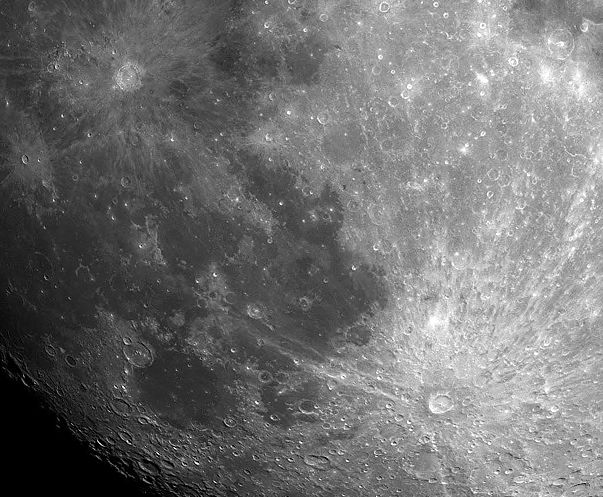
And nothing like the pattern produced by an electric discharge(no branches).RC wrote
Have a long close look at some of the rayed craters (they do have some bearing on the spider crater as the mechanism's maybe similar) and look at the termination point of the rays in relation to the central "impact"? most are off center?
http://antwrp.gsfc.nasa.gov/apod/image/0503/moon8_mandel.jpg Tycho and Copernicus: Lunar Ray Craters
Credit & Copyright: Steve Mandel, Hidden Valley Observatory
You know just an observation
Google: formation of impact craters.Maybe you could help me here, I've done a fair bit of searching on the net and I am having trouble finding any papers or even pictures of test done involving the science behind impact cratering.
and further where on Earth did you get that conclusion, I think you are confused here.
Mercury is just an example of what a tiny itsy bitsy little planets magnetic field can do!
Sol88, as a kindness I'll correct your childish misunderstanding of the term "cosmology". In physics and astrophysics, cosmology is the study of the universe on the very largest scales and at the very earliest times. That means not planets, not stars, not solar systems, not even galaxies - but clusters of galaxies.
To give you a sense of the scale, your crater on Mercury is about 1/10,000,000,000,000,000,000 the size of the observable universe. Your contention that it has anything at all to do with cosmology is much more absurd than claiming the study of elephant populations is relevant to molecular biology.


DD wrote
10 x 1012V sounds a lot is it? where'd that figure come from?
I gave fairly good description in post 2282 even had a crack at some maths, but which variables shall we use in which equation since Peeks Law was more to do with corona discharge on a wire inside the Earths atmosphere.
We want one for a sphere in a plasma stream.