• Quick note - the problem with Youtube videos not embedding on the forum appears to have been fixed, thanks to ZiprHead. If you do still see problems let me know.

Plasma Cosmology - Woo or not

The behavior of the electromagnetic field can be resolved into four different parts of a loop: (1) the electric and magnetic fields are generated by electric charges, (2) the electric and magnetic fields interact only with each other, (3) the electric and magnetic fields produce forces on electric charges, (4) the electric charges move in space.

A particle at rest feels only the force due to the electric field.

At rest relative to what, a moving or changing magnetic field?
 
Thank you for finally giving a clear answer to the question "in PC, what force governs the Sun's orbit around the galaxy". See how easy that was?

Once we have a detailed-enough hypothesis, Sol88, we can use it to make predictions. One of the predictions of your model is an enormous oscillation of frequency 23h 56m 4.090530833s in the test mass of the Eot-Wash experiment. No such oscillation was seen and your theory is now ruled out. B.R. Heckel et. al., Ad. Space Res. 25, 1125 (2000).

In which dimension then?
 
Easy

[qimg]http://upload.wikimedia.org/math/5/3/a/53a6eadab619ab497d9ea53061fd6ec7.png[/qimg]

And

[qimg]http://upload.wikimedia.org/math/3/9/9/3991a7c07cd27388bf58539585eb07b3.png[/qimg]

And the power source we are looking for

[qimg]http://upload.wikimedia.org/math/b/b/b/bbb9935b60f547572b99de9968bc3674.png[/qimg]

The Universe (the plasma one) can both be driven and drive! i.e. a motor and a generator. Gravity can not do such a thing

Wow, you can copy and past Maxwell's equations! Good Boy!

Now, how does this explain the orbit of a star around the centre of the galaxy? Care to put any REAL effort in it, like how I calculated the gravitation and electric force between the two stars? Not that that was muc of an effort, except for typing in the numbers correctly in my calculator.

And actually, gravity CAN be a "motor" or "generator", a very good one indeed. In the convection layer in the Sun, where hot blobs rise and cold blobs sink (driven by, yes ... gravity) a dynamo is driven, a good example of gravity creating electromagnetic phenomena.
 
Last edited:
That one's trivially easy. When an asteroid or small comet which is held together loosely gets near a planet or moon, tidal forces can pull it apart into a string of objects. If that string then hits the planet or moon, in will create a line of impact points. We have observed this happen: google "comet Shoemaker-Levy Jupiter collision".

Just because you don't know the explanation doesn't mean there isn't one.

Can we see the surface of Jupiter now?

I call ********!
Comparing the behavior and pattern of SL9 from these NASA images to the crater chains such as http://antwrp.gsfc.nasa.gov/apod/ap971209.html 6 and http://www.jpl.nasa.gov/galileo/callisto/02281997_full.jpg 7 clearly demonstrates that tidal disruption of mud and ice comets or asteroids were not the cause of these remarkable catinas. SL9 broke up in varying sizes, thousands of kilometers apart and impacted over many days. Crater chains of the type we are investigating and questioning are not varied in size, are not thousands of kilometers apart and did not impact over days. The very complexity of uniform size, trajectory, alignment, and timing isn't coming from a comet that broke up.


Like these on Mars
marscc1.jpg
marscc2.jpg

Image: NASA/JPL/University of Arizona


Also
it will create a line of impact points
Waht including curved lines as some of the chains above are not straight lines!
 
Last edited:
Synchrotron radiation

@ sol invictus:

Sol invictus states: "If you knew any physics, you wouldn't need to take ben's "say so". Accelerated charged particles radiate. Magnetic fields accelerate charged particles. So obviously disordered movements of electrons will generate synchrotron radiation in the presence of B fields."

That's not what I asked. I asked, can you produce authority?

I've already had one individual state there aren't any published papers.

If you can't produce authority then I assume synchrotron radiation can't be produced by thermal friction. Remember, science can produce heat in a laboratory, if it can be done, I would think there would be a published paper to that effect.

When somebody says, "obviously" for a point they have been challenged on and all they can say is "obviously", be doubtful.

sol victus, you don't carry the point.

sol victus presents my [Anaconda's] statement: "It is my understanding that there exists no scientific observation & measurement in the laboratory that supports your contention."

sol victus responds: "What an absurd thing to say."

On the contrary, it is quite reasonable in a scientfic discussion to request authority.

It's naivete to suggest observation & measurement is absurd. sol victus, you reveal yourself as a pure mathematician, no physical scientist would be so bald as to assert observation & measurement is absurd.

sol victus states: "It's going to be hard to find a paper that says precisely that - it's too basic."

I disagree, if it doesn't exist then you were speaking without authority.

And I will conclude the point as mine: Synchrotron radiation is scientific evidence of electric currents.

ben m brought up "chaotic magnetic fields" why don't you ask him.
(bold added)

Anaconda has made this point many times, in perhaps all ten of his posts in this forum, and has said it's one (of only two) possible discussion points*, so let's take a look at it, shall we?

First, the number of astronomy (inc. astrophysics) papers on 'synchrotron radiation' is huge (my source is ADS); in the last ten years alone, ADS gives me nearly 1,000 entries with the word 'synchrotron' in the title (just imagine how many entries there with that as a keyword!). Of course, not all are papers published in peer-reviewed journals (ADS entries include conference proceedings, for example), and not all are directly relevant to the discussion topic as defined by Anaconda (e.g. Natural gas hydrate investigations by synchrotron radiation X-ray cryo-tomographic microscopy (SRXCTM)).

To give readers a feel for the range of papers, I've chosen a few, more or less at random (links are to abstracts, either those in ADS or arXiv):

-> Measuring interstellar magnetic fields by radio synchrotron emission (Sol88 cited this earlier)

-> Ultimate synchrotron cutoff in gamma-ray spectra of blazars as a signature of the converter mechanism

-> Discriminate different scenarios to account for the PAMELA and ATIC data by synchrotron and IC radiation

-> An Expanding Shell and Synchrotron Jet in RS Ophiuchi

-> Ejecta, Dust, and Synchrotron Radiation in SNR B0540-69.3: A More Crab-Like Remnant than the Crab

This last one provides a nice segue into a brief interlude, a chance for me to post a pretty picture (it's from Hubblesite)

hs-2005-37-a-web.jpg


An extract from the About this Image (bold added):
The orange filaments are the tattered remains of the star and consist mostly of hydrogen. The rapidly spinning neutron star embedded in the center of the nebula is the dynamo powering the nebula's eerie interior bluish glow. The blue light comes from electrons whirling at nearly the speed of light around magnetic field lines from the neutron star. The neutron star, like a lighthouse, ejects twin beams of radiation that appear to pulse 30 times a second due to the neutron star's rotation. A neutron star is the crushed ultra-dense core of the exploded star.

So, if "Synchrotron radiation is scientific evidence of electric currents", and if the interpretation of "the nebula's eerie interior bluish glow" as being synchrotron radiation is correct, then we can ask for description of the "electric currents" that are the cause of such radiation (according to Anaconda). Further, as the HST observations are quantitative, and complemented by ones in the x-ray waveband, the UV, IR, microwave, and radio bands, and as "EU theorists" have presumably published details of the quantitative relationship between synchrotron radiation and electric currents, the electric currents causing this Crab nebula radiation can be estimated with some precision, can't they?

Which leads me to the following question, for Anaconda (and also Z):

1) in which papers, published in relevant peer-reviewed journals, may we read of work done by EU theorists to characterise - quantitatively - the electric currents in the Crab Nebula, from observations of its synchrotron radiation (such as the HST one I linked to)?

I do hope this post is in line with the focus of the discussion you wanted, Anaconda; if not, would you be kind enough to say why not, and propose how it could be better focussed?

In my next post - assuming that this sort of thing is aligned with the focus Anaconda wants - I shall look at the diffuse synchrotron radiation from the Milky Way, also with the intention of learning what work has been done by EU theorists on estimating the characteristics of electric currents that cause it. Then I'll move on to the topic of the (electromagnetic) acceleration of charged particles.

* "The two questions I put forward as possible discussion points were synchrotron radiation being a product of electric currents and double layers" (source)
 
Last edited:
The Universe (the plasma one) can both be driven and drive! i.e. a motor and a generator. Gravity can not do such a thing :eek:

Oh, I see - plasma is a perpetual motion machine.

Is that the standard view of EU "theorists" - that the energy source is simply that energy isn't conserved and is coming out of nowhere?
 
The Universe (the plasma one) can both be driven and drive! i.e. a motor and a generator. Gravity can not do such a thing :eek:


Oh right, the orbits of the planets are driven by the gravitational attraction of the Sun but the Suns gravitational attraction does not drive those orbits. Funny how we can drive interplanetary probes to their destinations using gravity assist trajectories.
 
Can we see the surface of Jupiter now?

I call ********!


Like these on Mars
[qimg]http://www.craterchains.com/ns/marscc1.jpg[/qimg] [qimg]http://www.craterchains.com/ns/marscc2.jpg[/qimg]
Image: NASA/JPL/University of Arizona


Also Waht including curved lines as some of the chains above are not straight lines!

Say what happened to the other picture you posted that looked like just a surface rift with some sinkholes in it. It seems you just decided to edit your post by exchanging that picture with those of other geological features. Without even the common courtesy of noting the reason for your edit.
 
No one knows!

Much like saying what came before the big bang! :rolleyes:

theer are a number of differences, what happened before the BBE is not known, the BBe is a description of events after the BBE.

i know many people find it disturbing that all we can do is speculate as to what happened at the BBE and prior. I don't , I think it is great that are things we can not know.

But here is the issue Sol88 and I notice that you are handwaving to avoid the issue.

The current mainstream cosmology (which does include plasmas BTW) is nice at accounting 9as a model) for the current observations of many parameters in the universe.

It does not hopwever try to discss what occured prior to the BBE, it talks about the development and action of the Universe post BBE. And does a rather nice job, as an approximate model.

Now the questions that was asked was this:

If double layers exist in large scale plasmas, that may be related to cosmology,

and

for those double layers to exist there needs to be an energy source to maintain the status of the double layers

then


What energy sources maintains the double layer seperation in these large scale plasmas?

is a very reasonable question about what is happening now in the universe, not some metaphysics question.

You will note that DM tries to explain the behavior of bodies in orbit around galaxies and that
YOUR alleged PC/EU models has yet to be shown to be able to do so.

Asking how these double layers on a large scale are maintained is not like asking
"What happened before the BBE?"

it is more like asking

"What makes the sun shine?"

I notice that yoru have veered away from science into metaphysics, which does not help dispel the idea that PC/EU is woo.
 
Can we see the surface of Jupiter now?

Yes. It's not a solid surface, but we can see it. And we saw the breakup of Shoemaker-Levy prior to impact, as well as the impact itself. When the fragments hit Jupiter's atmosphere, they exploded, creating rather bright spots in the infrared.

I call ********!

Call it all you want. Yes, the impact craters you're looking at are probably not from a comet, they're probably from an asteroid. Tidal breakup of an asteroid may be different than tidal breakup of a comet.

Waht including curved lines as some of the chains above are not straight lines!

Straight lines projected onto curved surfaces often end up as curves. Not exactly rocket science here. But thanks for showing your ignorance of geometry.
 
Last edited:
Reality Check in post 1998 you said

IYHO how could that be if there were not charges trying to equalize?

Dont spose you'd offer up an explanation of Mercuries spider crater?

http://tbn1.google.com/images?q=tbn....net/images/2008-02/mercury-spider-crater.jpg

Or Tycho and Copernicus crater rays not centering on the impact?

http://zuserver2.star.ucl.ac.uk/~idh/apod/image/0108/moon8_mandel_big.jpg


Or crater chains

http://neo.jpl.nasa.gov/images/moonchain.jpg

http://www.thunderbolts.info/tpod/2005/images05/050810crater.jpg
Do you want to get back to Plasma Cosmology some time?
 
They are evidence of planetary scale electric discharges which would require a source of power and someway to transmit it!

I mean if our Moon can act like a large capacitor charging via the solar "wind", what happens to that charge?

http://science.nasa.gov/headlines/y2008/images/magnetotail/floatingdust_med2.jpg

LINK

I mean it' s just an airless rocky body immersed in a quasi neutral plasma flow, causing charge separation, does the charge just keep building?

By which mechanism would it try and seek equilibrium?

Would charge equalization leave any evidence?

I think so!!

Most of the time the power involved would produve something akin to Transient lunar phenomenon

And crank up the juice and...see post 2130
Nothing to do with this thread but:

The charge just sits there on the Moon. It is sustained by the solar wind and varies as the solar wind varies.

The charge equalization will leave no trace.

I think so!!
 
Did you read the paper in question?

electrostatics on idealized star?

How 'bout we go for electrodynamics on a real star, our Sun?
OK: Go ahead and do it Sol88 :D. We wait with bated breath for your results!
When you are finished then you will have another approximation so you better repeat the calcualtion using quantum electrodynamics. :rolleyes:

The fact is that the result will not change much. It definitionly will not become 100,000,000,000,000,000,000 times bigger to allow the magical PC/EU force on the Sun.
 
In which dimension then?

I don't understand your question.

In any case: read the literature, starting with the paper I cited. Torsion balances have been used for this type of measurement for a long time. If you find that the authors have done something incorrect, please say so.
 
Easy

[qimg]http://upload.wikimedia.org/math/5/3/a/53a6eadab619ab497d9ea53061fd6ec7.png[/qimg]

Small problem: when you plug in the numbers, it doesn't work. The force is far too small.

And the power source we are looking for

[qimg]http://upload.wikimedia.org/math/b/b/b/bbb9935b60f547572b99de9968bc3674.png[/qimg]

That's not a power source. In fact, you will note that neither power nor even energy are given by that equation (the E is electric field, not energy).

I'm afraid all you've done is demonstrate that you don't actually understand Maxwell's equations.

The Universe (the plasma one) can both be driven and drive! i.e. a motor and a generator. Gravity can not do such a thing :eek:

First off, there's no such thing as a perpetual motion machine, but your statements seem to indicate that you think the galaxy is a perpetual motion machine driven by electromagnetism.

Secondly, gravity isn't the only force, and the presence of other forces do play rather critical roles. First off, electromagnetic forces are indeed critical to astrophysics, but not in the manner you suppose. They are needed in order for ordinary matter to lose energy through collisions (gravitational forces can only release energy through gravity waves, which are phenomenally weak). This is why the galaxy has condensed into a disk, and why stars and planets can coalesce. Secondly, nuclear forces play a rather major role as well. Nuclear forces provide the energy for stars to burn, and for supernovae. But both of these other forces are short range: electromagnetic forces because of shielding (which is why you fall towards the earth because of gravity until you hit the ground, and electromagnetic forces only stop you when your separation from the ground is atomic-scale), nuclear forces because they're inherently short range. The dominant force at long ranges for the vast majority of mass in the universe is gravity. Calculations demonstrate this. Experiments demonstrate this. Why can you not comprehend the evidence in front of you?
 
Diffuse galactic synchrotron radiation

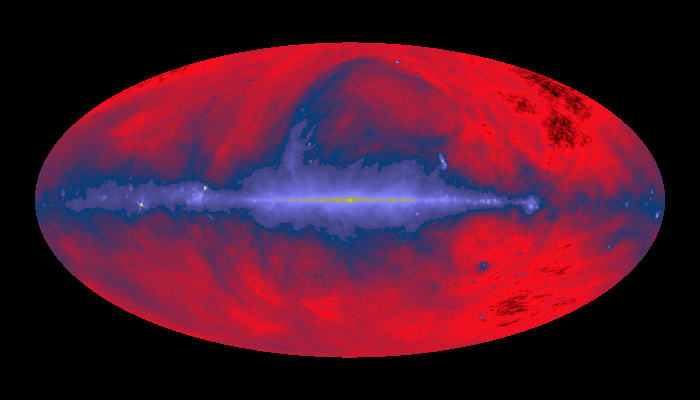
In 1982, ApJ published a paper, by Haslam et al., entitled "A 408 MHz all-sky continuum survey. II - The atlas of contour maps".

With some processing by SkyView, this atlas appeared as an image in Astronomy Picture of the Day (APOD)'s 14 Dec 1997 webpage*; and here it is (click the APOD link for the credits):

408_allsky_big.gif


The APOD caption reads, in part:

Near this frequency, cosmic radio waves are generated by high energy electrons spiraling along magnetic fields.

IOW, with some oversimplification, this is a map of the diffuse galactic synchrotron radiation, at a resolution of ~0.85o.

As this radiation is a foreground to the CMB (and so data from COBE, WMAP, Planck etc need to be processed to remove it), and as it is an excellent tracer of galactic magnetic fields (when combined with data from other observations), the diffuse galactic synchrotron radiation has been intensively studied. For example, the 1982 Haslam et al. paper has been cited nearly 600 times, according to ADS.

One paper that cites this is a 1998 ApJ one, by Platania et al.: "A Determination of the Spectral Index of Galactic Synchrotron Emission in the 1-10 GHz Range"; here is the abstract (some formatting is lost):
Platania et al (1998) said:
We present an analysis of simultaneous multifrequency measurements of the Galactic emission in the 1-10 GHz range with 18 deg angular resolution taken from a high-altitude site. Our data yield a determination of the synchrotron spectral index between 1.4 and 7.5 GHz of beta_syn = 2.81 +/- 0.16. Combining our data with maps made by Haslam et al. and Reich & Reich, we find beta_syn = 2.76 +/- 0.11 in the 0.4-7.5 GHz range. These results are in agreement with the few previously published measurements. The variation of beta_syn with frequency based on our results and compared with other data found in the literature suggests a steepening of the synchrotron spectrum toward high frequencies, as expected from theory because of the steepening of the parent cosmic-ray electron energy spectrum. Comparison between the Haslam data and the 19 GHz map of Cottingham also indicates a spatial variation of the spectral index on large angular scales. Additional high-quality data are necessary to provide a serious study of these effects.
(bold added)

Clicking on the link, in the ADS abstract, titled Citations to the Article, it would seem that considerable "serious study of these effects" has indeed been performed.

The references in the paper include papers presenting the theory which is referred to in the abstract, i.e. how the observed synchrotron radiation, at these frequencies, arises, namely (bold added) "At frequencies below about 30 GHz, Galactic emission is mainly due to synchrotron emission from cosmic-ray electrons interacting with the Galactic magnetic fields and to thermal bremsstrahlung (free-free) emission."

It would seem that this is a different explanation (cause) than that given by Anaconda (i.e. electric currents) ... or maybe not; perhaps Anaconda would like to comment?

In any case, following the same logic as in my previous post**, this leads me to the following question, for Anaconda (and also Z; continuing the numbering):

2) in which papers, published in relevant peer-reviewed journals, may we read of work done by EU theorists to characterise - quantitatively - the electric currents in the Milky Way, from observations of its synchrotron radiation (such as that in the Haslam et al. atlas I linked to)?

By now it should come as no surprise to learn that synchrotron radiation has been well-studied by astronomers, and well-modelled by astrophysicists, in many wave-bands, and from many objects. If any reader is interested, we could look in more details at some of the other wave-bands, and objects, as well as some of the papers presenting the models (and theories). I trust that this approach is aligned with the focus Anaconda requested, in his various posts to this forum to date.

What's next? I intend to move on to the topic of the (electromagnetic) acceleration of charged particles, which is directly pertinent to the second (and last) topic Anaconda stated he wished to focus on.

* you can get the data as a FITS file from LAMBDA
** "So, if "Synchrotron radiation is scientific evidence of electric currents", and if the interpretation of "the nebula's eerie interior bluish glow" as being synchrotron radiation is correct, then we can ask for description of the "electric currents" that are the cause of such radiation (according to Anaconda). Further, as the HST observations are quantitative, and complemented by ones in the x-ray waveband, the UV, IR, microwave, and radio bands, and as "EU theorists" have presumably published details of the quantitative relationship between synchrotron radiation and electric currents, the electric currents causing this Crab nebula radiation can be estimated with some precision, can't they?"

 
Oh right, the orbits of the planets are driven by the gravitational attraction of the Sun but the Suns gravitational attraction does not drive those orbits. Funny how we can drive interplanetary probes to their destinations using gravity assist trajectories.

Shall we talk about how many probes have been lost at Mars? Or maybe the Pioneer anomaly or Galileo or Ulysses?

Some unknown "dark" force is causing them to accelerate toward the sun!

Could it be
1 observational errors, including measurement and computational errors, in deriving the acceleration.

* Approximation/statistical errors
* Significant errors in computation are not likely since (at current count) 7 independent analyses have shown the effect.[4]

2 a real deceleration not accounted for in the current model, such as:

3 gravitational forces from unidentified sources such as the Kuiper belt or dark matter. However, an acceleration does not show up in the orbits of the outer planets, so any generic gravitational answer would need to violate the equivalence principle [5] (see modified inertia below).
* drag from the interplanetary medium, including dust, solar wind and cosmic rays. However, the measured densities are too small to cause the effect.
4 gas leaks, including helium from the spacecrafts' radioisotope thermoelectric generators (RTGs)
5 radiation pressure of sunlight, the spacecraft's radio transmissions, or thermal radiation pressure from the RTGs (See Radioisotope rocket), or asymmetrical radiation of the heat from the spacecraft electronics, reflecting from the back of the spacecraft’s dish-like main antenna, causing a recoil like sunlight striking a solar sail.
o The pressure of sunlight is too small at this distance, and points into the wrong direction. The same applies to the spacecraft's radio emissions.
o The others are prime suspects, as presented at the second ISSI meeting in Berne, Feb 2007.
o A recent presentation at the APS April 2008 meeting suggests that differential heating may account for as much of 1/3 rd of the observed acceleration.[6]
6 electromagnetic forces due to an electric charge on the spacecraft

7 New physics

So I call BS! It is very well explained without invoking new physics or trying to modify gravities magical pixy snot., or you have your gravitational understanding cocked up!
By the probe being charged, the Suns electric field and that the Universe is electric!

What's so hard to understand about that? :boggled:

And it would be easy to test!
 
Last edited:
Say what happened to the other picture you posted that looked like just a surface rift with some sinkholes in it. It seems you just decided to edit your post by exchanging that picture with those of other geological features. Without even the common courtesy of noting the reason for your edit.

It was too big, made you have to scroll sideways accross the screen. Might piss a few people off!

no jiggery pokery going on.

Classic mainstream dodge! surface rift with some sinkholes, collapsed lava tubes, old drainage channels any but electric discharge!

So the break up of a comet/asteroid would always produce nearly the same size fragments all flying in tight formation perpendicular into the ground? Sounds like a stretch to me?

Crater Chains


The chances of an impacting body breaking up to form a neat line of craters is very slim. The chances of this happening with the frequency that we see is practically zero. The crater chain pictured right is one of many that can be seen on Gannymede, a moon of Jupiter.

Crater chains result from electric arcs passing over a cathode surface. With slight variations in the current, the arc may cut a trench instead of jumping from one crater to the next. Because electrical arcs lift material from the surface, excavations are left relatively clean. The 'collapsed lava tube' explanation fails in this important respect. 'Missing debris' is just one defining characteristic that distinguishes electrical erosion from mechanical processes. These processes have been replicated in the laboratory.

We know charge separation can happen, so charge equalization must also happen, Simple!
 
Last edited:

Back
Top Bottom