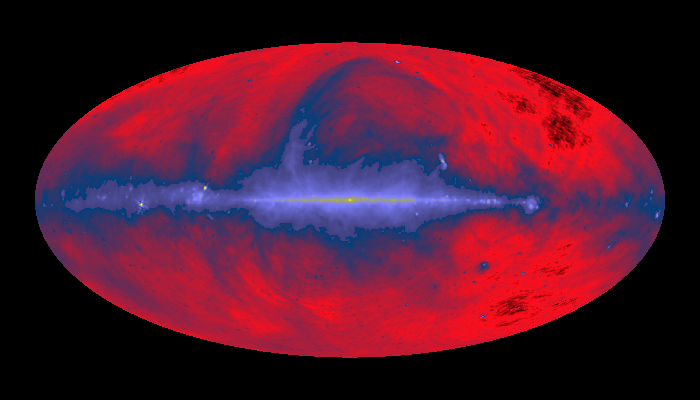
Diffuse galactic synchrotron radiation
In 1982,
ApJ published a paper, by Haslam et al., entitled "
A 408 MHz all-sky continuum survey. II - The atlas of contour maps".
With some processing by SkyView, this atlas appeared as an image in Astronomy Picture of the Day (APOD)'s
14 Dec 1997 webpage*; and here it is (click the APOD link for the credits):
The APOD caption reads, in part:
Near this frequency, cosmic radio waves are generated by high energy electrons spiraling along magnetic fields.
IOW, with some oversimplification, this is a map of the diffuse galactic synchrotron radiation, at a resolution of ~0.85
o.
As this radiation is a foreground to the CMB (and so data from COBE, WMAP, Planck etc need to be processed to remove it), and as it is an excellent tracer of galactic magnetic fields (when combined with data from other observations), the diffuse galactic synchrotron radiation has been intensively studied. For example, the 1982 Haslam et al. paper has been cited nearly 600 times, according to ADS.
One paper that cites this is
a 1998 ApJ one, by Platania et al.: "
A Determination of the Spectral Index of Galactic Synchrotron Emission in the 1-10 GHz Range"; here is the abstract (some formatting is lost):
Platania et al (1998) said:
We present an analysis of simultaneous multifrequency measurements of the Galactic emission in the 1-10 GHz range with 18 deg angular resolution taken from a high-altitude site. Our data yield a determination of the synchrotron spectral index between 1.4 and 7.5 GHz of beta_syn = 2.81 +/- 0.16. Combining our data with maps made by Haslam et al. and Reich & Reich, we find beta_syn = 2.76 +/- 0.11 in the 0.4-7.5 GHz range. These results are in agreement with the few previously published measurements. The variation of beta_syn with frequency based on our results and compared with other data found in the literature suggests a steepening of the synchrotron spectrum toward high frequencies, as expected from theory because of the steepening of the parent cosmic-ray electron energy spectrum. Comparison between the Haslam data and the 19 GHz map of Cottingham also indicates a spatial variation of the spectral index on large angular scales. Additional high-quality data are necessary to provide a serious study of these effects.
(bold added)
Clicking on the link, in the ADS abstract, titled
Citations to the Article, it would seem that considerable "
serious study of these effects" has indeed been performed.
The references in the paper include papers presenting the theory which is referred to in the abstract, i.e. how the observed synchrotron radiation, at these frequencies, arises, namely (bold added) "
At frequencies below about 30 GHz, Galactic emission is mainly due to synchrotron emission from cosmic-ray electrons interacting with the Galactic magnetic fields and to thermal bremsstrahlung (free-free) emission."
It would seem that this is a different explanation (cause) than that given by Anaconda (i.e. electric currents) ... or maybe not; perhaps Anaconda would like to comment?
In any case, following the same logic as in my previous post**, this leads me to the following question, for Anaconda (and also Z; continuing the numbering):
2) in which papers, published in relevant peer-reviewed journals, may we read of work done by EU theorists to characterise - quantitatively - the electric currents in the Milky Way, from observations of its synchrotron radiation (such as that in the Haslam et al. atlas I linked to)?
By now it should come as no surprise to learn that synchrotron radiation has been well-studied by astronomers, and well-modelled by astrophysicists, in many wave-bands, and from many objects. If any reader is interested, we could look in more details at some of the other wave-bands, and objects, as well as some of the papers presenting the models (and theories). I trust that this approach is aligned with the focus Anaconda requested, in his various posts to this forum to date.
What's next? I intend to move on to the topic of the (electromagnetic) acceleration of charged particles, which is directly pertinent to the second (and last) topic Anaconda stated he wished to focus on.
*
you can get the data as a FITS file from LAMBDA
**
"So, if "Synchrotron radiation is scientific evidence of electric currents", and if the interpretation of "the nebula's eerie interior bluish glow" as being synchrotron radiation is correct, then we can ask for description of the "electric currents" that are the cause of such radiation (according to Anaconda). Further, as the HST observations are quantitative, and complemented by ones in the x-ray waveband, the UV, IR, microwave, and radio bands, and as "EU theorists" have presumably published details of the quantitative relationship between synchrotron radiation and electric currents, the electric currents causing this Crab nebula radiation can be estimated with some precision, can't they?"



 . We wait with bated breath for your results!