applecorped
Banned

- Joined
- Mar 8, 2008
- Messages
- 20,145
Then up or shut up already. 


Of course I am right. It is up to you to prove anything else! In a friendly and lively way, of course.

Because this did not happen on Sept 11th to either of the WTC's. It is wilfully ignore to even suggest it did or that anybody thinks it did.
PS Red, Google WTC core, they survived the collapse, they did not get crushed, therefore 1/10th of the building DID NOT crush the other 9/10ths.
The core of the N. Tower did not survive anything. A small part of it, the spire, stood a few seconds after the collapse, then it collapsed.
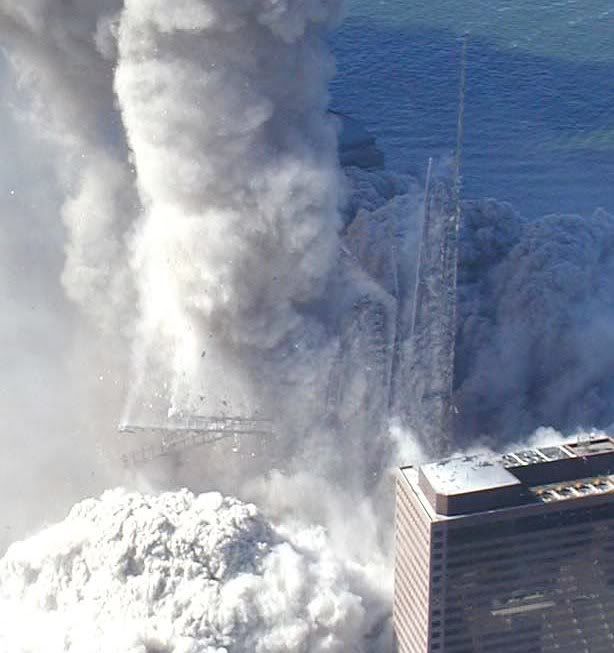
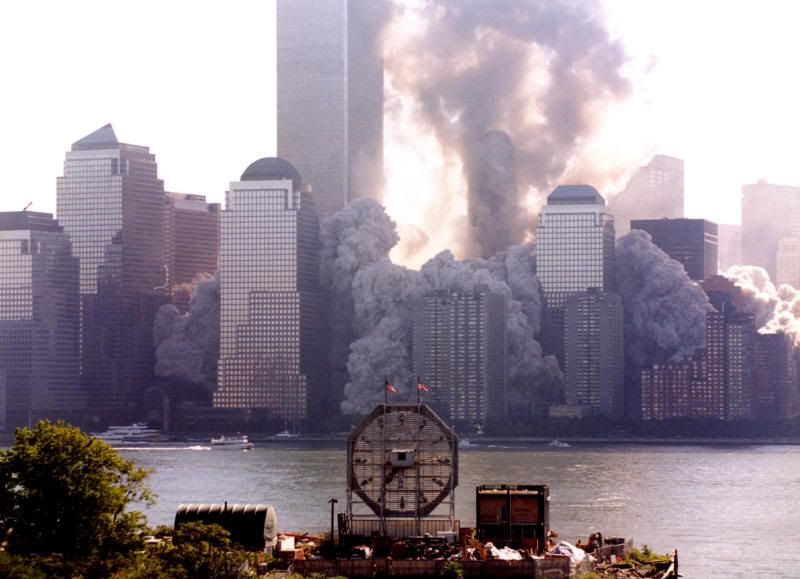
The core of the N. Tower did not survive anything. A small part of it, the spire, stood a few seconds after the collapse, then it collapsed.
It appears that no one has been able to produce an example of 1/10th of something crushing the other 9/10ths
A good deal of both cores survived until the lack of lateral support - plus general damage - caused them to collapse somewhat after the global collapse of the walls and floors. Can get you timings if you like, or you could get your finger out and find them yourself.
[qimg]http://i250.photobucket.com/albums/gg274/sap-guy/wtc1peelingcore.jpg[/qimg]
[qimg]http://i250.photobucket.com/albums/gg274/sap-guy/wtc2corestanding.jpg[/qimg]
You're asking for intellectual honesty from a CTist, good luck with that.Maybe you should apply your stringent criteria for correct wording to this challenge.
I already have, which is why I used the words, " a few seconds after".
What Heiwa fails to understand is that Bazant (or any other engineer/analyst) had to adopt some kind of model, and adopted one that was most favourable to collapse arrest. Total "crush down". Reality was more complex. In a horrible way, more elegant. But slower.

Of course I am right. It is up to you to prove anything else! In a friendly and lively way, of course.

In my view "a few" - discussing this subject - should mean 2,3,4 or thereabouts. What was the actual timing of the spire collapse relative to the global collapse wave reaching the ground.?
In any event, both remaining core structures (see photos above) were clearly not "crushed down" by a falling section C. They fell apart through lack of lateral support and lateral debris impact.
What Heiwa fails to understand is that Bazant (or any other engineer/analyst) had to adopt some kind of model, and adopted one that was most favourable to collapse arrest. Total "crush down". Reality was more complex. In a horrible way, more elegant. But slower.
Glenn are you saying that Bazant and NIST were wrong in the light of this new core infprmation ? If they were a new enuiry into the collapses is obviously needed. Do you agree ?
No, it's not. It is up to you to prove that you are right since you are making the claim that NIST, Bazant, et al... are wrong.
No, it's not. It is up to you to prove that you are right since you are making the claim that NIST, Bazant, et al... are wrong.
Dear lord .. no I'm not saying they are wrong. Read my post. I'm saying they took a conservative view of the collapse mechanism, but that reality was even more damaging than that.
And the "core information" is far from new. Or are you just having one of your little jokes?
Do NIST and Bazant include the still-standing sections of core in their collapse dynamic ? Do they explain it in other words ?
1. NIST didn't analyse the collapse dynamic. They analysed up to collapse initiation.
2. Bazant (and others) didn't need to and didn't set out to. As it happens it works in favour of their explanation, in that the energy requirement for felling those last-standing sections is much less than the model they used. Whereas it works totally against any CD theory which requires top-down demolition. Explosions in the basements, and all that jibberish.
Whatever - http://sendables.jibjab.com/view/0SC9GtqMkOAX6V1l
You wonder what other nut cases than NIST and Bazant are around.

Whatever - http://sendables.jibjab.com/view/0SC9GtqMkOAX6V1l
You wonder what other nut cases than NIST and Bazant are around.
