• Quick note - the problem with Youtube videos not embedding on the forum appears to have been fixed, thanks to ZiprHead. If you do still see problems let me know.

Plasma Cosmology - Woo or not

You know I may be wrong! I was not aware of a shock wave there, maybe you could tell the mechanism on how that works? How does a stellar explosion cause the observed structure?

I in my ignorance, just thought it LOOKED like an electric current passing thru a plasma!


That is a rather weak case for establishing PC as a theory, just because something looks like it might be something? The pages I linked to sure can lead you to ane xplanation of shockwaves and planetary spheres.

1. Model
2. Predictions
3. Data
 
Please see post 1630


I asked what basis there was to claim Arp has made a valid claim in the face of possible sample bias and error, you resorted to sarcasm instead of addressing the issue. Not a very good tactic.

Now you just say that you believe there is a case, despite the fact that the sample bias issue has not been addressed.

So no refutation of BBE/cosmological redshift? Just your belief?

Not much of a case, welcome to the JREF.
 
DRD

All right I may have made a cock up, As far as I knew it was telescope time. :eye-poppi

But are you saying he was denied puplication rights as well?

Oooh he didn't get the scope time he wanted.

That is teh basis of a conspiracy theory?

Him and 99.999% of all astronomers at some point.

Maybe you should try presenting your

1. Model
2. Predictions
3. Data

Quoting Thuderbolts of Woo is not much of a demonstration of PC as a theory.

There was no supression of Arp's work, he was not denied because of his theory.
 
Dude you are missing the point here, but as I'm a slow learner could you explain this statement from your quoted wiki page

How is the external magnetic field made?

So drop the fridge magnet thing eh!!

We see no permanent magnets in space aka ferromagnatisim


Sol88, you made the statement, without qualifiers that magnetism required an electric current.

You should learn to use the quote button and remember that your wrote it.

Welcome to the JREF, we all have to defend our thinking all the time.

try using the following to establish PC as a theory:

1. Model
2. Predictions
3. Data
 
DD wrote
That is a rather weak case for establishing PC as a theory, just because something looks like it might be something? The pages I linked to sure can lead you to an explanation of shockwaves and planetary spheres.

Maybe DAncing D u missed the list

or Tusenfem

How well versed are you in plasma physics, Sol88, how long have you studied it, did you go to college, or did you just skim the Wiki pages?

Versed enough to know about the basics as already noted :cool:


posted here again for posters to mull over

Space is a PLASMA. MAYBE

99% of Space is plasma. MAYBE

Plasma contains + (positive) & - (Negative) charges. YES

Charge separation occurs in lab plasma’s YES

Plasma is an excellent conductor. YES

Plasma has known, though difficult mathematical properties. YES

Plasma is self organizing. MAYBE

Plasma can be “cellular”. YES

Plasma can be “filamentary”. YES

Plasma we can observe in a lab/space YES

Plasma we can measure in a lab/space. YES

Dust can become a Plasma. YES

Magnetic fields require an electric current. YES (wrt electron flow thru a plasma, nothing to do with Ferromagnetisim!)

A flow of like charged particles constitutes an electric current. YES

We observe magnetic fields everywhere. MAYBE

Charged particles are accelerated in an electric field. YES

Charged particles Follow magnetic field lines. YES in general

Lots of charges particle = PLASMA. NO it's a cloud of charged particles.

Plasma/Electricity/Magnetic effects comprise the electromagnetic spectrum.

I later tried to clear that statement up, what I tried to convey is when any (Plasma/Electricity/Magnetic effects) all or some of those three do something we can detect it in the EM spectrum.
which was a YES as well.

Point one still remains unanswered by Tusenfem, can space be considered filled with plasma or just plasma in space?

I do not need the maths, to know this answer.
 
Last edited:
try using the following to establish PC as a theory:

1. Model
2. Predictions
3. Data

DD, read the list in post 1705!

tell me where my logic has gone out the window.

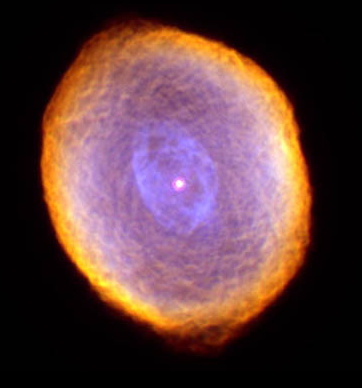
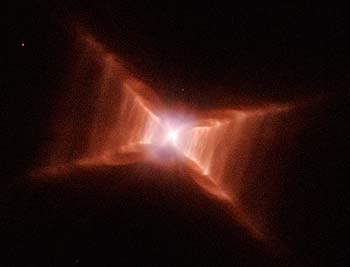
After you've read the list have a look at these pretty pictures

planetary_nebula.gif


image003.png


HD%2044179.jpg


hubble13-Planetary_Nebula_M2-9.jpg


pn


I'm think'n plasma and what it can do according to my list, not gravity! How would a force that is only attractive, be able to cause those structures?
 
Last edited:
Point one still remains unanswered by Tusenfem, can space be considered filled with plasma or just plasma in space?

Incomprehensible gibberish.

By the way, while it's true that there are no ferromagnetic materials in space (as far as I know), that was simply the example you chose to fixate on. Space is full of electromagnetic radiation. Do you know what EM radiation is? I didn't think so... it's oscillating electric and magnetic fields. And guess what - there are no currents (or even charges) in sight. EM radiation can and does exist in a perfect vacuum.

Moreover, your favorite substance - plasma - is capable of amplifying magnetic fields by huge factors, again with no significant currents involved.
 
If you would bother studying some of the stuff that even Lerner and Peratt write, you might even add constructively to the discussion.


If you would go back and read all the roughly 1600 or so posts in this thread you would find out that I have already discussed, at great length, Lerner and Peratts various PC related theories. You've joined this discussion too late i'm afraid my friend. If you want any specifics then I'll be more than happy to trawl back through the thread and find what you are looking for.
 
I'm think'n plasma and what it can do according to my list, not gravity! How would a force that is only attractive, be able to cause those structures?

Watch this: http://www.youtube.com/watch?v=FFlzyxSQhTc&feature=related

That's a simulation that includes only gravity, and yet produces all sorts of structures (some filamentary, some not) on all scales in the simulation. And it matches observations quite closely, because gravity is the only relevant force on cosmological scales.

To understand the origin of things like the spiral arms of galaxies, one obviously needs to include other forces besides gravity - because every single one of those images was taken using EM radiation, and therefore what you see are the luminous parts and not the dark parts.

Of course that's not a problem - it's only internet nutjobs that ignore the laws of physics they don't like. Professionals of course include them all, or make controlled approximations when it's valid to do so.
 
Last edited:
DD wrote
Maybe DAncing D u missed the list
or Tusenfem

Seen the list, whaddayawantwiddit?

lemme go through it, I put my answers in bold

Space is a PLASMA. MAYBE NO, space is space, plasma is plasma, plasma can fill a space though

99% of Space is plasma. MAYBE NO, 99% of all matter in the universe is plasma

Plasma contains + (positive) & - (Negative) charges. YES correct

Charge separation occurs in lab plasma’s YES sometimes in special cases

Plasma is an excellent conductor. YES correct

Plasma has known, though difficult mathematical properties. YES plasma can be described by the theories of plasma physics.

Plasma is self organizing. MAYBE self organized is a rather difficult term, it means different things to different people

Plasma can be “cellular”. YES okay

Plasma can be “filamentary”. YES okay

Plasma we can observe in a lab/space YES yes

Plasma we can measure in a lab/space. YES yes

Dust can become a Plasma. YES nah not really, one can have dusty plasmas in which the dust is a minor component. the heavier the particles get the more difficult it is to get them to do collective behaviour

Magnetic fields require an electric current. YES (wrt electron flow thru a plasma, nothing to do with Ferromagnetisim!) in that limited definition of magnetism okay I guess

A flow of like charged particles constitutes an electric current. YES not exactly only when the positive and negative particles flow at different speed, such that there is a NET charge flow

We observe magnetic fields everywhere. MAYBE not in my magnetic cleanliness room you won't

Charged particles are accelerated in an electric field. YES yes

Charged particles Follow magnetic field lines. YES in general no not in general, there are major exceptions. I guess I have to give the solution because your knowledges it too little to be of any use. When the magnetic field strength is too small then the thermal velocities of the particles can easily overcome the Lorentz force, and thus are NOT magnetized and THUS do not need to follow the field lines. On the other hand, there is the auroral electrojet, where currents are flowing perpendicular to the magnetic field of the Earth!

Lots of charges particle = PLASMA. NO it's a cloud of charged particles. NO, I have given the definition of a plasma (you copied it in another post) a cloud of charged particles is not a plasma per se

So, there is my answer to your "list".

Versed enough to know about the basics as already noted :cool:

Well, obviously you did not know that the magnetic field needs to be strong enough to magnetize the plasma. And when there are both a magnetic field and an electric field in a plasma, at an angle to eachother, the plasma will move in the direction perpendicular to both the magnetic and the electric field, no matter how strong the magnetic field is. INTERESTING!!

Point one still remains unanswered by Tusenfem, can space be considered filled with plasma or just plasma in space?

I do not need the maths, to know this answer.

Like I said above, space is space, plasma is plasma. Plasma can fill space, and it does. Indeed, no math needed for that, because plasma behaves like any gas in a space, it will fill it up if it can.

So, where does this leave us? I have no idea anymore why we have this useless discussion, other than you like to present your presumed knowledge about plasmas.
 
If you would go back and read all the roughly 1600 or so posts in this thread you would find out that I have already discussed, at great length, Lerner and Peratts various PC related theories. You've joined this discussion too late i'm afraid my friend. If you want any specifics then I'll be more than happy to trawl back through the thread and find what you are looking for.

and still you are spouting EU nonsense, and useless messages.
 
Looking at the list again we see some common ground emerging;

1 Space is a PLASMA. MAYBE

2 99% of Space is plasma. MAYBE

3 Plasma contains + (positive) & - (Negative) charges. YES

4 Charge separation occurs in lab plasma’s YES

5 Plasma is an excellent conductor. YES

6 Plasma has known, though difficult mathematical properties. YES

7 Plasma is self organizing. MAYBE

8 Plasma can be “cellular”. YES

9 Plasma can be “filamentary”. YES

10 Plasma we can observe in a lab/space YES

11 Plasma we can measure in a lab/space. YES

12 Dust can become a Plasma. YES

13 Magnetic fields require an electric current. YES (wrt electron flow)

14 A flow of like charged particles constitutes an electric current. YES

15 We observe magnetic fields everywhere. MAYBE

16 Charged particles are accelerated in an electric field. YES

17 Charged particles Follow magnetic field lines. YES in general

18 Lots of charges particle = PLASMA. NO it's a cloud of charged particles.

19 Plasma/Electricity/Magnetic effects comprise the electromagnetic spectrum.

I later tried to clear that statement up, what I tried to convey is when any (Plasma/Electricity/Magnetic effects) all or some of those three do something we can detect it in the EM spectrum.
which was a YES as well.

I'd like to progress this thread to it's logical conclusion in a timely fashion and to make things easy, which ones are not correct?

This is to aid me 'ol cobber DRD get a handle on the definitions, terms, spelling and grammar problems I has got?

Bearing in mind the whole ferro-magnatisim, FAC's and plasma globe filament episode.

While I admit a few of those points may not have been explained well enough before posting, leaving a little to much Grey area. If you read the list and you pick any you think I've misunderstood, I'd be more than happy to show my line of reasoning!
(I added numbers)

How does it go?

Ah yes ... whoaa there big boy, back the truck up!

First, only two folk responded to all the items on the list, si and DRD, and a few others - directly or indirectly - to some items (1 and 2: tusenfem (post#1646), edd (#1658), RC (1663), PS (1669);13: RC (1676)); in addition tusenfem commented on the list in general.

Next, you're making one of those mistakes in logic again, this time it's applying a meaning to statements that are beyond what the statements actually say (more later).

Then, in post#1679 you provided a definition of plasma, but no one has commented on your list in light of your clarification (as far as I can see).

Recall what I said, many posts ago now, about discussions needing to have a certain minimum common understanding? and that that minimum included the meanings of key words (or terms or phrases)?

In this respect, "common" means unanimous ... everyone engaged in the discussion needs to share the same understanding (modulo minor variations) of the key terms; otherwise it won't be a discussion.

So, counting you as a participant, and allowing only "YES", "NO", and "UNKNOWN" as the answers, where do we stand on your list, when the question is "Do participants in the discussion have a unanimous, agreed understanding of these key phrases?"?

Here's my take, to date:
- - - - - - - - - - - - - - - - - - - - - - - - - - - - - - - - - - - - - - - - - - - - -
1 Space is a PLASMA. NO

2 99% of Space is plasma. NO

3 Plasma contains + (positive) & - (Negative) charges. YES

4 Charge separation occurs in lab plasma’s UNKNOWN

5 Plasma is an excellent conductor. UNKNOWN

6 Plasma has known, though difficult mathematical properties. UNKNOWN

7 Plasma is self organizing. NO

8 Plasma can be “cellular”. NO

9 Plasma can be “filamentary”. NO

10 Plasma we can observe in a lab/space NO

11 Plasma we can measure in a lab/space. NO

12 Dust can become a Plasma. UNKNOWN

13 Magnetic fields require an electric current. NO

14 A flow of like charged particles constitutes an electric current. YES

15 We observe magnetic fields everywhere. UNKNOWN

16 Charged particles are accelerated in an electric field. YES

17 Charged particles Follow magnetic field lines. NO

18 Lots of charges particle = PLASMA. NO (it's a cloud of charged particles - NO)

19 Plasma/Electricity/Magnetic effects comprise the electromagnetic spectrum. NO
- - - - - - - - - - - - - - - - - - - - - - - - - - - - - - - - - - - - - - - - - - - - -

Now there is another question concerning the list that we can answer, at least tentatively, and it's a question that is close to what you originally asked, which was "which one(s) of these do I misunderstand?" (I'm paraphrasing).

We can rephrase this, and ask "In light of the clarifications Sol88 has provided, does Sol88 appear to understand these terms/phrases in a manner consistent with their common use by physicists?" This time we allow four answers, "YES", "NO", "UNCERTAIN", and "UNKNOWN".

Here's my take on the answer to those questions, to date:
- - - - - - - - - - - - - - - - - - - - - - - - - - - - - - - - - - - - - - - - - - - - -
1 Space is a PLASMA. NO

2 99% of Space is plasma. NO

3 Plasma contains + (positive) & - (Negative) charges. YES

4 Charge separation occurs in lab plasma’s UNCERTAIN

5 Plasma is an excellent conductor. YES

6 Plasma has known, though difficult mathematical properties. UNCERTAIN

7 Plasma is self organizing. UNKNOWN

8 Plasma can be “cellular”. UNKNOWN

9 Plasma can be “filamentary”. UNKNOWN

10 Plasma we can observe in a lab/space UNCERTAIN

11 Plasma we can measure in a lab/space. NO

12 Dust can become a Plasma. UNKNOWN

13 Magnetic fields require an electric current. NO

14 A flow of like charged particles constitutes an electric current. YES

15 We observe magnetic fields everywhere. UNCERTAIN

16 Charged particles are accelerated in an electric field. YES

17 Charged particles Follow magnetic field lines. NO

18 Lots of charges particle = PLASMA. UNCERTAIN

19 Plasma/Electricity/Magnetic effects comprise the electromagnetic spectrum. NO
- - - - - - - - - - - - - - - - - - - - - - - - - - - - - - - - - - - - - - - - - - - - -

(to be continued)

 
Last edited:
I see that tusenfem become the third person to have a go at your list, while I was posting; of course that will change my two lists somewhat ...
 
Oooh he didn't get the scope time he wanted.

That is teh basis of a conspiracy theory?


I would not call it a conspiracy theory, more a good case study of how people who have very controversial ideas can be sidelined by scientific institutions, corporate facility owners, and even scientific journals themselves.

Saying that, the whole arp fiasco is not a conspiracy theory at all, where one instituation or organisation turned its back on him or refused him telescope time due to his controversial findings there was always another one which welcomed his work and input. So he was far from silenced. I suggest reading his book, "seeing red", or reading some of the reviews about just how badly Arp was treated for simply challenging the status quo. Whether his material is right or not.

Many other scientists have been blackmailed, and told if they assosciate themselves with Chip Arp then they would have certain privelages rebuked, and problems getting positions or promotions in certain institutions. A few testimonies from people who recieved such blackmails can be seen here: http://www.youtube.com/watch?v=ZPrPmEYtplk

Not very scientific behaviour to say the least. But certainly not a conspiracy theory, as its all out in the open for anyone to see.

Maybe you should try presenting your

1. Model
2. Predictions
3. Data


Okay, theres a few separate ones to choose from, but in terms of predictions Lerners model has made the most sucessful predictions and probably fits the data best out of the various other PC models.

http://www.cosmologystatement.org/
Plasma cosmology and the steady-state model both hypothesize an evolving universe without beginning or end. These and other alternative approaches can also explain the basic phenomena of the cosmos, including the abundances of light elements, the generation of large-scale structure, the cosmic background radiation, and how the redshift of far-away galaxies increases with distance. They have even predicted new phenomena that were subsequently observed, something the big bang has failed to do.

Two world systems revisited: a comparison of plasma cosmology and the big bang, Lerner, E. J.
IEEE Transactions on Plasma Science, vol. 31, issue 6, pp. 1268-1275,
http://adsabs.harvard.edu/abs/2003ITPS...31.1268L [full text]

Despite its great popularity, the Big Bang framework for cosmology faces growing contradictions with observation. The predictions of the theory for the abundance of 4He, 7Li and D are more than 7s from the data for any assumed density of baryons and the probability of the theory fitting the data is less than 10-14. Observations of voids in the distribution of galaxies that are in excess of 100 Mpc in diameter, combined with observed low streaming velocities of galaxies, imply an age for these structure that is at least triple and more likely six times the hypothesized time since the Big Bang. Big Bang predictions for the anisotropy of the microwave background, which now involve seven or more free parameters, still are excluded by the data at the 2s level. The observed preferred direction in the background anisotropy completely contradicts Big Bang assumptions. In contrast, the predictions of plasma cosmology have been strengthened by new observations, including evidence for the stellar origin of the light elements, the plasma origin of large scale structures and the origin of the cosmic microwave background in a "radio fog" of dense plasma filaments. This review of the evidence shows that the time has come, and indeed has long since come, to abandon the Big Bang as the primary model of cosmology.


Well it certianly fits the data better than the original Big Bang predictions for element abundances, large scale structure of the universe, and the properties of the CMB, and other areas. Thats undisputable.

There was no supression of Arp's work, he was not denied because of his theory.


Incorrect. There was definate supression of Arps work, temporarily and by certain organisations, individuals and scientific journals, but this was short lived and other institutions soon let him get his telescope time back, let him publish all his material, and enabled his models to be publically available, all within a very short time period following the original supression.

Conspiracy? No. Just how corporate science works. You start publishing material that undermines the whole premise of the journal your publishing in, then the editors are not going to be happy. Neither are the people who let you use the telescope. Or the institutions that fund your reserch. Cosmology always tends to bring out a certain, shall we say, religous type of reaction in some people, even many top scientists that study it. Some snap out of it and realise the errors in their ways*, some just plow on with a cult like ferver, thinking that they are gaining some sort of divine special knowledge about the universe, and anyone like arp who questions their religous revelations about the nature of the universe has committed blasphemy and must be either silenced or ignored.

* http://arxiv.org/abs/astro-ph/0102057 Michael S. Turner snaps out of it after reading Mike Disneys sobering paper entitled The case against cosmology, making the comment: "Cosmology is the dot com of the sciences. Boom or bust. It is about nothing less than the origin and evolution of the Universe, the all of everything. It is the boldest of enterprises and not for the fainthearted. Cosmologists are the flyboys of astrophysics, and they often live up to all that image conjures up. It is hardly surprising then that words written about cosmology are rarely balanced. They verve to one extreme or the other. .... Once or twice, I have probably been guilty of irrational exuberance when it comes to cosmology."
 
Last edited:
(continued)

There's a broader context to your list, Sol88, one that several people have commented on ... physics.

In your list there are many words that have precise, specific meanings in physics*, among them:

space

plasma

charge

charge separation

conductor

self-organising

cellular

filamentary

dust

magnetic field

electric current

accelerated

electromagnetic spectrum.

Further, these meanings include quite clear limits; they are intended to be used in quite specific contexts. For example, microscopic vs macroscopic (crudely, where quantum effects dominate vs where they are mostly trivial).

And one big danger that you need to be always aware of - if you approach a topic in the manner of your list - is that you may overlook or misunderstand the precision and specificity of the definitions and/or the contexts and limits they may be used within.

The 'fridge magnets' discussion is a good example of this: within the context of plasma physics it may be OK to say "Magnetic fields require an electric current"; however, within the context of atomic physics or condensed matter physics it is not.

In one respect you are very brave, possibly foolhardy; you seem to be trying to develop a cosmological theory from the ground up, starting with postulates that are (it seems) ad hoc terms and phrases taken from different parts of physics and astronomy ... and you seem to want to sidestep much of the physics that these snippets come from.

(to be continued)

* sometimes more than one, per word; one part of physics may use a word with one meaning, and another part of physics use the same word with a different meaning ... 'charge' is an example, 'dust' is another
 
DeiRenDopa wrote:
I see that tusenfem become the third person to have a go at your list, while I was posting; of course that will change my two lists somewhat ...
:boggled:

Quantify "somewhat" within the context of this conversation?
 
I would not call it a conspiracy theory, more a good case study of how people who have very controversial ideas can be sidelined by scientific institutions, corporate facility owners, and even scientific journals themselves.

What "corporate" facilities? What are you talking about?

Scientists are people. As such, they are certainly susceptible to jealousy, fear, etc. No one likes the idea of having their life's work overturned. On the other hand, young scientists have a huge amount to gain from overturning established ideas - in fact that's the most rapid route to fame and success. So even if you ignore all the evidence (as you do) and focus just on sociology, there's always an unstable balance between the defense of established ideas and the assault of new ones, and as a result things are always changing. However if that were it, it would be possible for an establishment to take control and suppress new ideas, thereby greatly slowing the pace of change.

But when you add in the elements that make this science - primarily logical consistency, experimental evidence, and falsifiability - the picture changes somewhat. It is no longer possible to suppress new ideas if they're supported by data. If they're not, though, they die rather rapidly apart from a few individuals that cling to them no matter what.

Conspiracy? No. Just how corporate science works.

Again - what in the world is "corporate science", particularly with regard to astrophysics?

Your description of Turner's article is totally distorted. Here's what he actually says:

Michael Turner said:
Before I begin my sober assessment of cosmology, let me discuss the mission statement for
the enterprise. As one might expect, this is where the divergence of views often begins. By
my definition, cosmology is the scientific quest to understand the most salient features of the
Universe in which we live. Since most of the history of the Universe is uninteresting thermal
equilibrium, the interesting moments, those rare departures from thermal boringness which
lead to notable features today, are a manageable set.

Others take a much different view. As an extreme example consider Disney(2000), who
defines cosmology as the quest to understand the entire space-time history of the Universe (in
response to Disney, see Peebles 2000). Not surprisingly, he concludes that the achievements
of cosmologists have been minimal and that cosmology may not be a science at all. While
more than two decades ago the relativist Ellis (1975) educated us all on the impossibility
of Disney’s goal –we are absolutely limited in our knowledge of the Universe by our past
lightcone–that has not prevented significant progress toward understanding how the basic
features of our portionof the Universe came about as well as their implications for the
Universe as a whole.
(my bold).
 
Last edited:

Back
Top Bottom