• Quick note - the problem with Youtube videos not embedding on the forum appears to have been fixed, thanks to ZiprHead. If you do still see problems let me know.

A Question for Heiwa - WTC Safety Factors

Heiwa

And frankly I don't care.

But you seem to get upset about FoS! Now, try to debunk the real message in my paper - that C crushing A by gravity is not possible.

Make an effort! How can C crush A? It is a paranormal event. NIST could not explain it, Bazant assumed that C was rigid and then C crushed A but as everyone knows, C was not rigid. Bazant was cheating. Pls do not start new threads about irrelevant things.
 
But you seem to get upset about FoS! Now, try to debunk the real message in my paper - that C crushing A by gravity is not possible.

Make an effort! How can C crush A? It is a paranormal event. NIST could not explain it, Bazant assumed that C was rigid and then C crushed A but as everyone knows, C was not rigid. Bazant was cheating. Pls do not start new threads about irrelevant things.

And what a great quote to end the thread on. There we have it, readers. Heiwa, in considering the structural modelling of the collapse, does not think it important to consider safety factors. He did until we asked him to back it up, but now it's "irrelevant". All talk and no show.

Game, set, and match.
 
DGM et al; I suggest we set this thread to one side for now and leave it as it is, a perfect example of Heiwa's inability to support information which he presented in support of his own argument. A perfect metephor for the Truth Movement as a whole.

The Truth Movement as a whole is ... well ... a hole.
 
OK Heiwa,

It was a coincidence... :)

But the mistake was great : a buckling resistance overevaluated near 10 times (slenderness)² !!!!! :rolleyes:


Best regards

:)
 
OK Heiwa,

It was a coincidence... :)

But the mistake was great : a buckling resistance overevaluated near 10 times (slenderness)² !!!!! :rolleyes:


Best regards

:)

Or only 3 times? I was fascinated by: quote

Remember that the outer core columns are extremely solid, e.g. no. 501. It is an H-beam with two flanges 17x3.5 inch connected by a 2.2x12.6 inch web. In metric terms the flanges are 430x90 mm and the web is 56x320 mm. Such thick plates, 56 and 90 mm cannot buckle under any circumstance when the compressive stress is only 30% of yield stress, even if the temperature is 500°C.

Urich treat this monster column with length 3.5 m as 'slender' and apply the famous formula to it. But this core corner column, there are four!, is nothing but slender. It will not follow the idealistic formula. It would have been pretty simple to pick out this column from the rubble - 90 mm thick flanges!! - and see how they fractured ... due to bending? How apply an impact load on them? I am pretty certain that these columns were cut using some exotic controlled demolition device.

That the upper part C was destroyed prior to part A is affected is pretty obvious from all videos. I cannot understand that the liers do not accept that, but try to explain or develop some strange crush down model with gravity. Luckily it is not possible. When two structures of similar types, parts C and A, collide, both are affected and the stronger elements will damage the weaker elements. As these core corner columns are the strongest elements in the structure, they should have remained undamaged!
On the other hand, the structures being destroyed by controlled demolition, these columns are the first to be cut.

Heiwa

PS - your web site is pretty awful!
 
Heiwa, the relation between slenderness ratio and resistance to buckling is squared - so when you changed the values you were using by more than 3x, you admitted that the resistance to buckling was 10x lower than the original values you supposed. That's an order of magnitude.

I could refer you to page 149 of B.S. Benjamin's Statics, Strengths and Structures for Architects, which states:

If the column is long and slender, with a high slenderness ratio, the value for Fcr is very small, showing that the column will buckle long before the material crushes.

Or, I could refer you to Euler's formula specifically states that:


But, the subject of this thread is your own ridiculous assertion that the Safety Factor for the loads in all of the steel in the WTC structure was greater than 300%. You can't back that up and won't ever be able to. The only reason that I bring up the above is that it so aptly demonstrates how you've failed to consider various failure modes, have done simply awful math whenever you provided any whatsoever, and simply can't be depended upon to know what you're talking about when it comes to building structures.
 
Last edited:
Or only 3 times? I was fascinated by: quote

PS - your web site is pretty awful!

10 times of course for buckling resistance... :D

I better understand why you cannot justify your FoS... ;)

Thank you for my web site
 
Minadin said:
But, the subject of this thread is your own ridiculous assertion that the Safety Factor for the loads in all of the steel in the WTC structure was greater than 300%. You can't back that up and won't ever be able to. The only reason that I bring up the above is that it so aptly demonstrates how you've failed to consider various failure modes, have done simply awful math whenever you provided any whatsoever, and simply can't be depended upon to know what you're talking about when it comes to building structures.

In fact, it wasn't the steel that he claimed had a safety factor of over 300% but rather the entire structure. It wouldn't surprise me in the slightest if some elements were of this maginitude, however Heiwa fails - once again - to distinguish between the overall structural model and finite elements thereof. That he has failed to substantiate his figure comes as no great surprise; he's just made the figure up, and now he's been caught for all to see.

Let me stress that, Heiwa; you've been caught out, and for all to see.
 
It's still amazing to me that he can (pretend to) look at just the compressive load and assume that he's done some sort of comprehensive structural analysis.
 
Heiwa, the relation between slenderness ratio and resistance to buckling is squared - so when you changed the values you were using by more than 3x, you admitted that the resistance to buckling was 10x lower than the original values you supposed. That's an order of magnitude.

I could refer you to page 149 of B.S. Benjamin's Statics, Strengths and Structures for Architects, which states:


Or, I could refer you to Euler's formula specifically states that:

[qimg]http://www.efunda.com/formulae/solid_mechanics/columns/images/FcrB.gif[/qimg]

But, the subject of this thread is your own ridiculous assertion that the Safety Factor for the loads in all of the steel in the WTC structure was greater than 300%. You can't back that up and won't ever be able to. The only reason that I bring up the above is that it so aptly demonstrates how you've failed to consider various failure modes, have done simply awful math whenever you provided any whatsoever, and simply can't be depended upon to know what you're talking about when it comes to building structures.

If you check again, you will see that I applied the Euler formula for the columns and suggest that you cannot really apply it to e.g. column 501, &c.

That the perimeter wall columns have FoS>3 for static loads only, everyone seems to agree to. Reason being that the wall columns are also subject to dynamic loads when tower is subject to wind loads.

Re the core it should be clear that the outer core columns carry more load than the inner core ones (http://heiwaco.tripod.com/loaddistribution.htm ) and that we disagree on the total core load carried. I suggest 16 500 tonnes, Urich 19 500 tonnes (and Bazant much more). You should also see that the wall columns carry different static loads at each floor as floor spans differ.

So my description contains many simplifications just to get a feeling for the structure and its redundancy.

Because, regardless of FoS of various elements, upper part C is virtually identical to lower part A. Evidently upper part C can never free fall on lower part A due to the 280+ columns in between that must fail, which is not seen on any video. What is seen on all videos is that part C suddenly telescopes into itself - it gets shorter - while nothing happens to part A.

But even if part C would free fall on part A, part C cannot crush down part A. Reason being that part A will destroy part C at collision contact. &c, &c.

The liers, suggesting that progressive collapse produces a crush down of structure, cannot produce any evidence for their fantasies. They assume that part C is rigid, which it is not. They assume that the bottom floor of part C cannot get damaged at impact but it is completely unrealistic. They assume that part C remains virtually intact while it ploughs down through part A at 0.7g, &c, but it is impossible. No structure type part C can plough through similar structure in part A due to gravity or any force. It is very easy to prove with sponges or lemons or pizza boxes or similar structures and the same result applies to parts A/C structures.

I find it fascinating that so many people at JREF are prepared to support the official, paranormal lies. They cannot even do it in a friendly way.

I am prepared to offer $1M to anybody that can produce a structure with two parts C and A of similar/identical structural composition, where, initially part A, fixed to ground, carries part C on top, and later by dropping part C on part A, gravity will then assist part C to crush down part A completely. Maybe JREF will sponsor this program like the other paranormal study? Similar rules will apply.

 
I am prepared to offer $1M to anybody that can produce a structure with two parts C and A of similar/identical structural composition, where, initially part A, fixed to ground, carries part C on top, and later by dropping part C on part A, gravity will then assist part C to crush down part A completely. Maybe JREF will sponsor this program like the other paranormal study? Similar rules will apply.

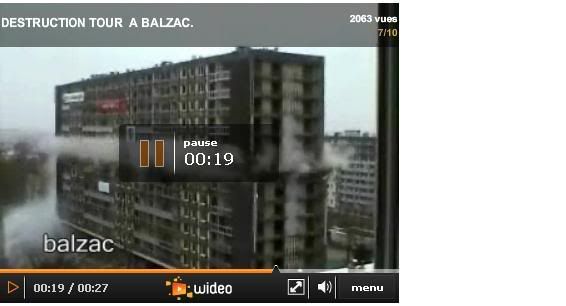
balzacdemolition.jpg


There. Can I have my $1,000,000 by PayPal please?
 
I am prepared to offer $1M to anybody that can produce a structure with two parts C and A of similar/identical structural composition, where, initially part A, fixed to ground, carries part C on top, and later by dropping part C on part A, gravity will then assist part C to crush down part A completely. Maybe JREF will sponsor this program like the other paranormal study? Similar rules will apply.
1) $1M usually means one million US dollars. Is this what you mean? If so, please produce evidence that you've got the cash. You say you're "prepared." I'll need proof of that.

2) Once that's done, draw up a legal contract stating your offer and conditions. You'll probably want to use a lawyer for that.

3) Then publish your offer, but you may want to limit it to the first person who delivers the evidence to you or something, unless you have many millions of dollars to part with.

Okay, Anders?
 
Last edited:
[qimg]http://i250.photobucket.com/albums/gg274/sap-guy/balzacdemolition.jpg[/qimg]

There. Can I have my $1,000,000 by PayPal please?

Well, in this model you destroy part A partly (not using gravity) before you drop part C on what is left of it, so it does not qualify.

It should also be understood that part C should volume/mass wise be, say 1/10th of part A, to make it more challenging and similar to WTC 1. Elements of both parts should have indentical connections to other parts. You cannot weaken, e.g. part A before the drop.

Good try, though.
 
Last edited:
1) $1M usually means one million US dollars. Is this what you mean?
Okay, Anders?

Money, as money. Are you worried about what currency I am offering? Go ahead with you structure! :)
Imaging also the honour involved.
 
Well, in this model you destroy part A partly (not using gravity) before you drop part C on what is left of it, so it does not qualify.

It should also be understood that part C should volume/mass wise be, say 1/10th of part A, to make it more challenging and similar to WTC 1. Elements of both parts should have indentical connections to other parts. You cannot weaken, e.g. part A before the drop.

Good try, though.
You're now claiming that the towers weren't weakened before collapse?
 
Money, as money. Are you worried about what currency I am offering? Go ahead with you structure! :)
Imaging also the honour involved.
You say you're prepared to "offer." I say you haven't got the money to "pay." Prove that you do or admit you're a liar.
 
Well, in this model you destroy part A partly (not using gravity) before you drop part C on what is left of it, so it does not qualify.

Heiwa is cheating with this definition. In the standard definition of crush-up and crush-down zones, part A and part C are separated by a part B composed of rubble. In this instance, a section between parts A and C is partly removed and partly converted to rubble, becoming part B. At the point where the upper block strikes the lower, the lower block is substantially intact.

It should also be understood that part C should volume/mass wise be, say 1/10th of part A, to make it more challenging and similar to WTC 1.

Here Heiwa is moving the goalposts. His initial offer was, "I am prepared to offer $1M to anybody that can produce a structure with two parts C and A of similar/identical structural composition, where, initially part A, fixed to ground, carries part C on top, and later by dropping part C on part A, gravity will then assist part C to crush down part A completely." Nothing about relative sizes of parts A and C is specified.

Elements of both parts should have indentical connections to other parts. You cannot weaken, e.g. part A before the drop.

The clip satisfies both these conditions, even though neither was specified in the initial offer.

It should be perfectly clear that Heiwa's intention all along was to redefine the offer retrospectively to exclude any successful responses.

Dave
 
Prove that you do or admit you're a liar.

Mark, just taking on a role you more commonly play yourself here: Is there any point to this challenge? Do you think there is the slightest possibility that either (a) Heiwa will admit to being a liar, or (b) any unbiased observer still believes he's honest?

Dave
 

Back
Top Bottom