A World of Life in a Drop of Water — My Father's Microscope

Bob Blaylock

Forklift Operator
Joined
Jan 29, 2008
Messages
3,005
Location
N38°35' W121°29'
When my father passed away in December, I inherited, among other things, his microscope. Lately, I've been going out and collecting bits of gutter water, moss, lichen, and such; mixing it together, and then looking at random drops of it through this microscope.

Just last night, I felt inspired to dig out my cheap digital camera, point it into the microscope's eyepiece, and see what kind of pictures I could get. My expectations were very low. I figured that to get decent pictures though a microscope would probably require more specialized equipment than this.

I was rather pleasantly surprised with the results that I got. Though one could wish for better pictures than these, I've been getting results much better than I thought I could get using such crude methods.

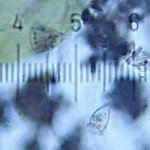
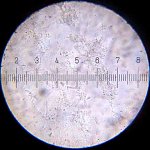
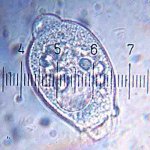
All of these pictures were taken with a Kodak DC3200 camera, using the 15X eyepiece and the 10X objective on the microscope. (The microscope has 5X, 10X and 60X objectives, and 5X, 10X, and 15X eyepieces. The 15X eyepiece has a scale built into it, part of which is visible in the last of the attached pictures here.


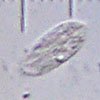
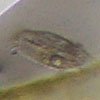
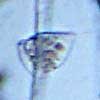
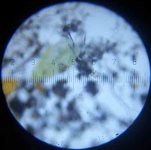
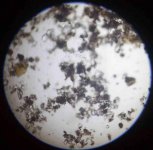
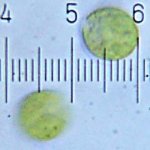
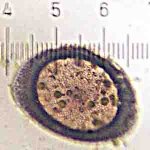
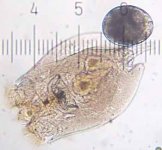
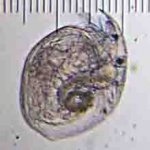
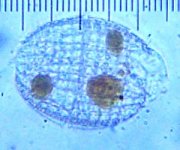
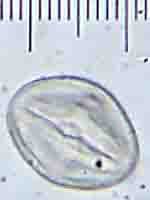
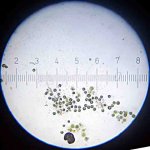
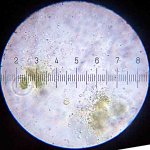
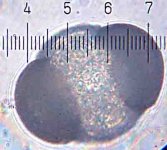
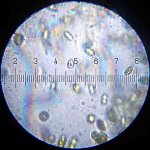
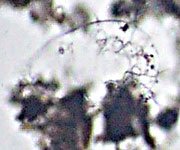
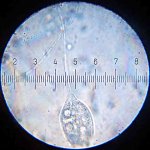
Of the attached pictures, the first and third are of paramecia (not the same one in each picture). I think the second is a dead tartigrade or “water bear”. It wasn't moving. The last two, I think, are of some sort of rotifers.

All of these images are to the same scale. According to notes in my father's hand, written on the inside of the microscope's case, with the 10X objective, each ten marks (that's the small marks, ten from one number to the next) on the scale in the 15X eyepiece is equal to 122 micrometers. That's about a hundred pixels on each of these images, so each pixel on these images is 1.22 micrometers.

My display has about 100 pixels per inch, so each inch on my display is approximately 122 micrometers in the scale of these images.

1_in
1_mm CONVERT
.122_mm
÷​

So these pictures, as they appear on my screen, are about 208X actual size.
 

Attachments
  • 20090308_1859_DeadWaterBear.jpg
    20090308_1859_DeadWaterBear.jpg
    9.7 KB · Views: 1,389
  • 20090308_0019_Paramecium.jpg
    20090308_0019_Paramecium.jpg
    2.9 KB · Views: 1,416
  • 20090308_1949_Paramecium.jpg
    20090308_1949_Paramecium.jpg
    2.4 KB · Views: 1,368
  • 20090308_2020_Rotifer.jpg
    20090308_2020_Rotifer.jpg
    1.6 KB · Views: 1,386
  • 20090308_2029_Rotifers.jpg
    20090308_2029_Rotifers.jpg
    6 KB · Views: 1,379
Last edited:
All of these pictures were taken with a Kodak DC3200 camera, using the 15X eyepiece and the 10X objective on the microscope. (The microscope has 5X, 10X and 60X objectives, and 5X, 10X, and 15X eyepieces. The 15X eyepiece has a scale built into it, part of which is visible in the last of the attached pictures here.
·
·
·​
All of these images are to the same scale.


I was just looking again at the full (non-cropped) versions of these images, and I have realized that the “dead water bear” picture was not taken with the 15X eyepiece. The 15X eyepiece, as I mentioned, has a scale in it, while the 5X and 10X eyepieces do not. The scale appears in every picture that I have taken and kept, except for the “Dead Water Bear” picture, so I must have taken that one with one of the other eyepieces.

See the attached pictures. The scale appears in the “Rotifers” picture, but not in the “Dead Water Bear” picture.

I should be able to figure out which one I did use, assuming I was still using the 10X objective. When I was observing this, I did, at some point, measure it and determine that it was about the right size to be an adult water bear. As it appears on my screen, it spans about 30 millimeters. A 208X magnification would mean that it was really 0.144 mm, which would be awfully small. If I had used the 5X eyepiece, staying with the 10X objective, then the magnification would be reduced by a factor of three. «208 3 ÷» gives me 69.3333… — call it 70.

«30 70 ÷» 0.42 of a millimeter. Still a bit small. I bet I used the 5X objective as well, so reduce the magnification to 35. «30 35 ÷» gives me 0.85 of a millimeter — a very plausible size for a tardigrade. So that picture was surely taken using the 5X eyepiece and the 5X objective.
 

Attachments

  • 20090308_2029_Rotifers_Full.jpg
    20090308_2029_Rotifers_Full.jpg
    15.2 KB · Views: 32
  • 20090308_1859_DeadWaterBear_Full.jpg
    20090308_1859_DeadWaterBear_Full.jpg
    53.8 KB · Views: 32
Today (well, now it was yesterday) I went to a nearby park to gather samples from a duck pond. Of course, I took more pictures. I seem to be getting better at producing usable pictures this way.


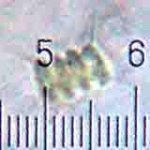
I found a lot of this sort of unicellular algae in the sample. It seemed to be, by far, the most dominant form of life in the water from this pond. The image here was taken using the 60X objective, with the 15X eyepiece. I estimate that each pixel on this image represents 0.2 of a micrometer. The two algae cells shown here are approximately 20 micrometers in diameter.
attachment.php


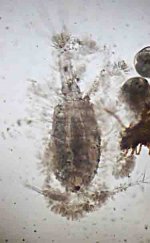
This cyclops was photographed using the 5X objective and the 10X eyepiece. I estimate each pixel to be 3.45 micrometers, and this Cyclops to have an overall length of about 135 micrometers.
attachment.php


Here's a rather interesting rotifer. I took this using the 10X objective and the 15X eyepiece. This seems to be the combination that I most often use, which produces an image in which each pixel is 1.22 micrometers. This rotifer is about 300 micrometers in length. The round object appears to be attached to the rotifer. I don't know if it's some sort of egg sac, or just some random object that the rotifer grabbed on to and had been towing around ever since.
attachment.php


I am sure that at some point in my distant past, I had a name for this critter. I cannot now come up with any name for it, nor can I find any help on the net. (It's much easier to find out about something if you know what it is called.) It's roughly 130 micrometers in diameter.
attachment.php


This last object, I have no idea what it is. When I first saw one, I though perhaps it had to do with the unicellular green algae in the first picture. It looked like there was a hollow space inside, with some of these algae inside of it. Indeed, the dark circular objects that you see are these green algae, but they are in front of this object, not inside of it. This was photographed using the 10X objective and 15X eyepiece, and it is approximately 170 micrometers in diameter.
attachment.php


Attachments

  • 20090314_1916_Algae.jpg
    20090314_1916_Algae.jpg
    37.5 KB · Views: 2,489
  • 20090315_0018.jpg
    20090315_0018.jpg
    40.6 KB · Views: 2,483
  • 20090314_2111_Cyclops.jpg
    20090314_2111_Cyclops.jpg
    36.6 KB · Views: 1,282
  • 20090315_0039_Rotifer.jpg
    20090315_0039_Rotifer.jpg
    43.4 KB · Views: 1,580
  • 20090315_0034.jpg
    20090315_0034.jpg
    37.2 KB · Views: 2,498
Last edited:
I had a microscope when I was a kid, and loved it. Of course, it didn't take long for me to disassemble it completely and put it back together, several times. It always worked after each time, often better than before because the quality control at the manufacturer was pretty bad -- dust inside, smears on the lenses, etc.

Nearly got me fired when I was working as a lab grunt in high school. The boss came back early from lunch and discovered I'd spread his $2000 pride-and-joy workhorse binocular microscope across the bench in pieces and was happily cleaning the interior optical surfaces. I was like, what? I've done this before. I sent him out for a smoke, put everything back together by the time he'd returned, and even he had to admit you could "see" better through it than before. I didn't tell him that the most likely culprit was tobacco smoke (that stuff gets everywhere, even inside hermetically-sealed units) condensed on the lenses. The guy smoked like a chimney, especially when writing.

I've been looking at the 'scopes at American Science and Surplus. Some of the Russian models are extremely tempting, price-and-quality-wise.

Beanbag
 
These three pictures were all taken using the 60X objective, and the 15X eyepiece. Each pixel is approximately 0.2 of a micrometer.

I'm not sure what those first two things are. They're two different instances of the same kind of critter. Looking at it in motion, it reminds one very much of a pillbug, but it is obviously nothing of the sort. Each of these examples is about 50 micrometers long.

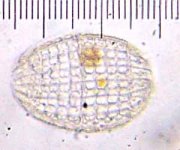
That last picture, I think, is of a diatom. t appears to be about 30 micrometers across.
 

Attachments

  • 20090315_1800_LooksLikeAPillbug.jpg
    20090315_1800_LooksLikeAPillbug.jpg
    40.5 KB · Views: 1,203
  • 20090315_1811_LooksLikeAPillbug.jpg
    20090315_1811_LooksLikeAPillbug.jpg
    47.2 KB · Views: 1,151
  • 20090315_1736_Diatom.jpg
    20090315_1736_Diatom.jpg
    29 KB · Views: 1,153
Diatoms have silica tests. They are often included in toothpaste as an abrasive / filler. You might try diluting a drop of tp and see what you find.
Ben Goldacre in his book "Bad Science" says...'
MRSA looks like a ball.Bacilli look like a rod. You can tell the difference between them using 100X magnification- the Edu Science Microscope Set at ToysRUs for £9.99 will do the job very well. (If you buy one, with the straightest face in the world, I recommend looking at your sperm: it's quite a soulful moment'.
 
The duck-pond sample that I gathered on Sunday has been sitting in a sealed container just outside my front window for a few days.

I took a look tonight at a drop therefrom. The unicellular green algae that I had previously described is behaving differently now. It's gathered into groups. Some of it is still alive and active, some of it seems to be dead, and some of it looks like it's been squished and broken open.

attachment.php


The above picture was taken using the 10X objective and the 15X eyepiece. One pixel = 1.22 micrometers. Each numbered tick on the scale is 122 micrometers.

All the other pictures I am posting tonight were taken with the 60X objective and the 15X eyepiece; 1 pixel = 0.2 micrometers. Where the scale is visible, each numbered tick is 20 micrometers.

Here's a closer look at some of the “squished” algae:

attachment.php


Those numerous tiny objects — about 2 micrometers in diameter — are very lively and active. I'm fairly sure they are some sort of bacteria. Perhaps they are killing the algae.


Here's a view of what I believe to be some other variety of bacteria:

attachment.php


And here's something else I've been seeing in these samples. I've seen them before, but this is the first time I've photographed them:


attachment.php
attachment.php


These are very small, much smaller than the unicellular green algae. Perhaps they are some form of cyanobacteria, (formerly known as “blue-green algae”, but recently reclassified as a bacteria, and no longer considered algae). Most instances of this that I have seen look more like the first example than the second, but it always has four cells, no more and no less.


Attachments

  • 20090318_0033_BacteriaKillingAlgae.jpg
    20090318_0033_BacteriaKillingAlgae.jpg
    46.9 KB · Views: 1,126
  • 20090318_0043_BacteriaKillingAlgae.jpg
    20090318_0043_BacteriaKillingAlgae.jpg
    58.8 KB · Views: 1,123
  • 20090318_0033_Bacteria.jpg
    20090318_0033_Bacteria.jpg
    61 KB · Views: 1,123
  • 20090318_0011_4CellAlgae.jpg
    20090318_0011_4CellAlgae.jpg
    37.8 KB · Views: 2,170
  • 20090318_0025_4CellAlgae.jpg
    20090318_0025_4CellAlgae.jpg
    35 KB · Views: 2,152
This cyclops was photographed using the 5X objective and the 10X eyepiece. I estimate each pixel to be 3.45 micrometers, and this Cyclops to have an overall length of about 135 micrometers.
[qimg]http://www.internationalskeptics.com/forums/attachment.php?attachmentid=13253&stc=1&d=1237105550[/qimg]


Hmmm…

I managed to go badly astray in estimating the size of this critter before. I was off by a factor of more than ten. Depending on whether you count the apparent fringes off of the tail, this critter is, in this image, about 470 to 570- pixels in length. At 3.45 micrometers per pixel, this means the actual length of the critter was about 1.6 to 2 millimeters.

I wonder how I came up with 135 micrometers as my previous estimate.
 
Brings back memories... When I was a kid in the late 50s and early 60s, I was very fond of microscopy; I'd had at least some sort of instrument from childhood. Spent many hours peering at everything I could think of.
Read "Microbe Hunters" around freshman high-school, and found it really inspiring.

Funny story... My mom worked at a "convalescent" hospital that dealt mostly with TB patients. (No effective drugs back then) It was a Catholic hospital, and mom told the nun who ran the lab of my hobby. The lady was very helpful, and would send home tons of slides, test-tubes, pipettes, etc.
One day mom brought home a water sample with the instruction to take a look at it.
I did, and it was filled with all manner of bugs I'd never seen before.

It was holy water from the font.....
 
It appears I have a correction to make. These creatures, which I initially identified as rotifers, I now believe to be Vorticellas.

attachment.php
attachment.php


This creature, which I also identified as a rotifer, I still believe to be a rotifer.

attachment.php


Here is a closer view of a creature that I believe to be a Vorticella:

attachment.php


They also exist in a free-swimming form, called a “telotroch”. I believe that this is an example of that:

attachment.php


These are from the duck-pond sample that I took about a week ago. The two previous pictures were taken with the 60X objective, and the 15X eyepiece. Each pixel is 0.2 of a micrometer. Each numbered tick on the scale is 20 micrometers.

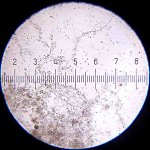
After nearly a week, in a sealed container, nearly all of the unicellular green algae (which had been the dominant life form in this sample) has died off; and no bacteria are by far the most dominant form of life to be found. Most of them have been free-swimming, and not terribly interesting in and of themselves. I did find this unusual arrangement, which consist of bacteria clinging to some very, very fine filaments. I don't know what these filaments are, or how they came into existence. Perhaps the bacteria had something to do with creating them. This picture was taken using the 10X objective and the 15X eyepiece. Each pixel is 1.22 micrometers. Each numbered tick on the scale is 122 micrometers.

attachment.php


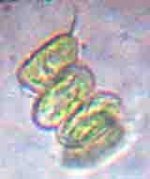
I'm not sure what this is. I've seen several of these; each one appears to consist of three cells. This picture was taken with the 60X objective and the 15X eyepiece.

attachment.php


Attachments

  • 20090322_0206_Vorticella.jpg
    20090322_0206_Vorticella.jpg
    53.6 KB · Views: 1,044
  • 20090322_0210_Vorticella-Telotroch.jpg
    20090322_0210_Vorticella-Telotroch.jpg
    47.3 KB · Views: 1,044
  • 20090321_2327_BacteriaFilaments.jpg
    20090321_2327_BacteriaFilaments.jpg
    76.1 KB · Views: 1,034
  • 20090321_2216_3CellAlgae.jpg
    20090321_2216_3CellAlgae.jpg
    41.8 KB · Views: 1,032
Ben Goldacre in his book "Bad Science" says...'
I recommend looking at your sperm: it's quite a soulful moment'.

And somebody on the Badscience forums has complained about it - won't give the book to her children because of it and demands he remove it from the next edition. :boggled:

ETA: Which is silly, 'cause it's probably one of the first things a teenage male looks at when he gets a microscope.
 
At North 38°33'51.40" West 121°26'42.17", there is this odd little park. It's just a small island in the middle of a misshapen intersection where the streets apparently didn't line up as they were intended. On this island, someone's put in park benches, and fancy landscaping, and even a fountain.

Today, on my way home from church, I stopped there, to get a sample from that fountain. I found the fountain to have considerably less water than it was supposed to have. I could hear the pump running, but there wasn't enough water to feed it. What water was there, however, was very green, with some nice green scum on the top, leading me to expect that I'd find it to be rich with microscopic critters for me to observe and photograph.

Oddly, the only container I could muster up in which to contain a sample was an empty Simple Green bottle, which was interesting since this water was almost exactly the same color as the product that originally came in that bottle.

I expected that I was going to find a lot of the same unicellular algae that I found in the duck pond sample; and probably a good variety of other things as well.

All that I did find was some sort of non-motile CyanobacteriaWP. That was it. I saw a few dead DaphniaWP, but other than that, no sign of anything that is or was ever alive except for the cyanobacteria.

This picture was taken with the 60X objective and the 15X eyepiece. The numbered ticks on the scale indicate a distance of 20 micrometers.
 

Attachments

  • 20090322_1836_Cyanobacteria.jpg
    20090322_1836_Cyanobacteria.jpg
    60.1 KB · Views: 11
Last edited:
Back
Top Bottom