Bigfoot: The Patterson Gimlin Film - Part 3

Status
Not open for further replies.
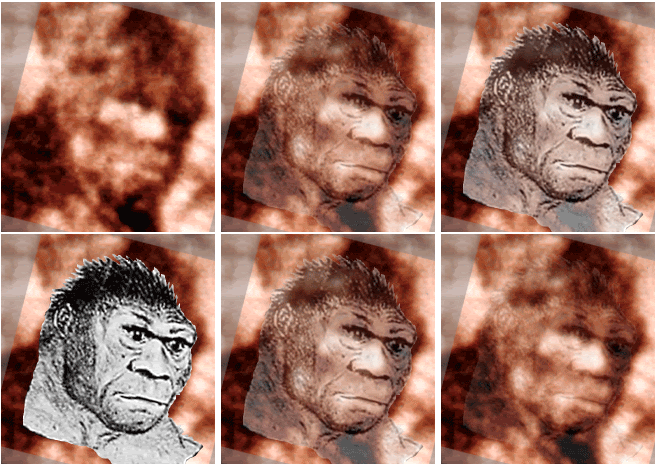
This?

fc590c86.gif
 
Thanks, guys. Yes it is worth posting twice! I found some gold while rummaging around with the search. Like this post with material found and reposted by Starthinker about cryptological "success stories":

http://www.internationalskeptics.com/forums/showpost.php?p=4126608&postcount=94

Sorry Scott, but comparing the Giant Squid to "Bigfoot" goes beyond apples and oranges.

Giant squid bodies have been well documented since the 19th century. Over 100 carcasses have been examined by scientists. Its larval form has been captured. The animal has been photograped and filmed by expeditions setting out to do exactly that. That visual evidence is clear, with no "Blobsquids" requiring circles and arrows. The only difficulty in obtaining hard data on either the Giant or Collosal squid has been the extreme envirnoment they live in and the sheer size of the world's oceans.

Now, as to other "cryptozoological success stories", what might those be?

The Giant Panda? Well known to the Chinese, only a "cryptid" in the West, and when western scientists went looking for it, they soon came back with live specimens.The Komodo Dragon? The Mountain Gorilla? The Okapi? Again, once somebody decided to go look for it, specimens were brought back.

Or perhaps you refer to the coelacanth, which was discovered purely by chance in a fish market? There was no search, no legend to track down. To the locals they were simply a big deepwater fish they caught from time to time.

The closest thing I can think of a "cryptozoological success story" is the search for the Ivory Billed Woodpecker, and the jury still seems to be out on that one.

Now, let's take a look at "hairy hominids" in North America. We still have no better photographic evidence than the PG film. In the centuries since European settlers first came here, we don't have a single body to show for it. In that same time, the Passenger Pigeon was driven to extinction, the mountain lion virtually exterminated over half the continent, huge herds of bison wiped out, wolves driven to the brink, grizzlies greatly reduced in habitat, and most importantly, smart, "woods-wise" populations of our own species wiped out or clinging by the barest of threads to existance.

In that time, technology has increased incredibly. We can use satellites to fix our positions accurately. Fairly cheap, readily available devices remove the shield of darkness. DNA testing allows small samples of mammoth hair stored for years at room temperature to be sequenced. One of an estimated 500 wolverines in the "Lower 48" is caught on a trail camera in California, where it wasn't thought to exist. .

But in the years since the PG film, what we mainly have is hoaxes and beef jerky commercials. There are a few bits of evidence that turn up from time to time to keep us interested, or that are hard to simply dismiss as hoaxes. Those tend to get lost in the "noise" of silliness like 4 foot long "tracks" or the stupidity of the recent events from Georgia.

And...

"However, in answer to your second point: Mountain Gorilla (unconfirmed until the beginning of the 19th century), Bili Ape AKA "Ngoloko"(2004 but known before that albeit not "scientifically" confirmed), Okapi, Vu Quag Ox, Laos Rock Rat, Komodo Dragon (1917), and Megamouth Shark (1971), to name a few I can readily recall. Most of these are larger than a bread box and are, indeed, of human size."

Mountain Gorilla ... first collected at the beginning of the 20th century. not the 19th, by essentially the first European explorer to enter their territory. No "cryptozoologists" involved. Also, gorillas in general had been known to science for over 50 years before that.

Laotian Rock Rat ... no history as a cryptid, found in a food market by someone who recognized there was something special about the little critter. In other words, pretty much the same story as the coelacanth. Note that within 10 years of the accidental discovery of the first specimen, we had video of a live one.

Okapi ... first sighted by Stanley in the 1870s (again, one of the first Western explorers to enter the territory). Specimens collected and classified in 1902. Specimen in zoo in 1918.

Vu Qang Ox ... again, well known to and hunted by the locals. No "cryptid" history. Described by zoologists shortly after their horns were brought to said zoologists attention in 1992. Not long after that, images of the living animal were published everywhere.

Komodo Dragon ... first brought to western attention in 1910. Described from a photo and skin in 1912. The first recorded expedition I could find that went to Komodo Island for the express purpose of obtaining specimens (1926) came back with 12 dead ones and 2 live ones.

Megamouth Shark ... completely unknown to science or even legend until the first one was discovered tangled in an anchor chain in 1976. Hard to be a "cryptid" when nobody even dreams you exist. Since the initial discovery, 41 specimens of what is presumed to be an extremely rare fish have been described to date.

Bili Ape ... seems to enter the literature in 1996. By 2006 DNA analysis had been done.

So, in summary, in the case of the Mountain Gorilla, Komodo Dragon, Okapi, and Bili Ape, not long after they were brought to western attention and someone went seriously looking for them, they found them. The Saola (Vu Quang Ox), Laotian Rock Rat, and Megamouth Shark were never cryptids to begin with, unless you want to claim that ANY undiscovered species is a cryptid.

In every case, no "cryptozoologists" were involved.

Now, by contrast, let's turn again to Bigfoot. How many years have people been looking for an animal which is supposedly distributed all across North America, and has been here long enough to have widespread native legends about it? 40 years? 50 years? That's a long time for little or no return, especially in contrast with your "cryptozoological success stories", which mostly involved people going to the area the reports came from, and coming back with a specimen,sometimes on the first try.

Take that, little mak (I think he's grounded again).
 
I say this from time to time but I really wish wolftrax would get over here. Tube says he's tried to sign up but couldn't. Weird.

There was a time that you couldn't sign up. It was not long before I did sign up. You had to read and agree to a TOS, or something like that, but when you clicked the link to read and agree, it wouldn't work because whatever service they were using had expired. Tried to email them about it, but you had to be a member to send them an email, lol. Luckily for me, they finally straightened it out. Maybe this Wolftrax guy should try again.
 
I guess they would be filed under thumb with a little black drop effect.

In the mean time are we now talking about muscle mass like in the images above, or am I all screwed up as is customary. Do we understand the calorie intake and protein level that would have to be consumed in order for this to be happening. Why would a bigfoot have upper body strength like that in the first place, is it a tree/rock climber, maybe a boxin bigfoot?


m


BTW Vort, if you need any images, odds are I have them, just PM me. I also have a few/several clips I could probably post someplace where you could snag them.


m
 
Why would a bigfoot have upper body strength like that in the first place, is it a tree/rock climber, maybe a boxin bigfoot?

Depends on the bigfoot expert. Some believe he spends a lot of time in trees.
 
Okay, fair enough. I changed the question to include your point:

QUESTION: What factors could explain the presence of visible muscles on the P-G figure, given a. the likely thickness of fur and skin, whether real or synthetic, and b. the known limitations in the resolution of the film (which Fahrenbach pegs at 2 inches*)?

EDIT: I should have thought that my inclusion of #4. It's an optical illusion akin to pareidolia.... would have sufficiently indicated a conditional tone, but regardless, once more I appreciate being taken to task.

you need to put it in reverse there scientist

>>>What factors could explain the presence of visible muscles on the P-G figure, given a. the likely thickness of fur and skin, whether real or synthetic,

First of all, that isnt an autopsy film so you dont see the first "muscle". You see lights and shading from a multi enhanced out of focus film. You are taking a GUESS as what a hypothetical muscle MIGHT look like IF ( insert whatever) based on human anatomy and artistic license.

Dont start off with the old subtle trick of implying your point is valid by discussing "what factors could explain the presence of visible muscles" when you have YET to show a MUSCLE there in the first place.

That doesnt fly in REAL science. Assumptions are the Mother of all F/U's. Lets stick with the basics and start falsifying that hypothesis.

>>>the known limitations in the resolution of the film (which Fahrenbach pegs at 2 inches*)?

Rule # 2 in real science. NEVER quote someone as an authority when he is speaking out of the realm of his expertise. Fahrenbach is a marine biologist. He is NOT qualified to judge hair,film or much else either. Remember, this is the "expert" who made himself and most of the world of BF look like fools a few months ago in Texas with his BF orgies, BF taking 30 ft steps ( yes a 30 FOOT step), goat toting, tickle fighting, peacock eating "fruits of his investigation".

>>>I should have thought that my inclusion of #4. It's an optical illusion akin to pareidolia.... would have sufficiently indicated a conditional tone, but regardless, once more I appreciate being taken to tas

Nope, see posting a few lines addressing a possibility then focusing on your point is the oldest woo trick in the book. Its an attempt to make one look as if they are being objective by "addressing" all sides but the following emphasis gives them away.

Heres your next "scientific" task if you choose to accept it ( humming theme from mission impossible)- show HOW and WHY they are more likely muscles rather than film artifacts, how you tested your hypothesis, show both sides and your conclusion.
 
Where did I say they all have observable abrasions? The wear and tear, callous butt is not even that apparent in my picture. I am perfectly aware of this already. I have seen plenty of animals up close and personal. But thanks anyways. :)
Next time I see a necrotic and maggot infested rectum I'll take a picture, and post it. Oh! but that would mean I am implying that that all rectums are in this state.

The wording and character of your post showing abrasions is such as to convey that you hold an opinion that Patty not showing abrasions is a damning element in the PGF being a hoax. You didn't need to say every or all primates exibit abrasion patterns. All was implied in the tone of the wording you used.
 
Last edited:
It's probably a bigfoot.

If it leaves an imprint resembling an elk lay, leaves elk tracks, and elk hair....it's probably a bigfoot.

Yes, it's all very convenient.


Seeing all those BF posts makes my head hurt. As far as I'm concerned this subject died when I was in high-school and got tired of waiting for people to find the damn thing.
 
Vort, when you're ready, I still need for you to provide me with a series of the best examples unaltered that you think show the muscle simulation on Patty. This is the best way I can help you (by putting them out there for the anatomically trained to either confirm or deny your observations).
 
Vortigern-

The muscles look an awful lot like these foam pads. In fact they look extraordinarily similar to Patty' shoulder/arm. If you already addressed this I missed it.
 
There was a time that you couldn't sign up. It was not long before I did sign up. You had to read and agree to a TOS, or something like that, but when you clicked the link to read and agree, it wouldn't work because whatever service they were using had expired. Tried to email them about it, but you had to be a member to send them an email, lol. Luckily for me, they finally straightened it out. Maybe this Wolftrax guy should try again.

It was working fine as of yesterday.
 
..The problem with that scenario is the bulk of Patty's leg.
It seems like the amount of padding required to achieve that bulk would hide any movement of the actor's calf muscle.
I see it (in the gif referred to) as merely the bulk of the padding bunching up when the knee is bending, not anyone(things)s calf muscle. Note that the "bunching" is at the top of the calf, near the knee. To me it looks like material folding or padding bunching and nothing like the action of any calf muscles I've observed (and I am a leg man...). My 2c
 
Why would a bigfoot have upper body strength like that in the first place, is it a tree/rock climber, maybe a boxin bigfoot?


m

Yeah, boxing. It's actually one of the few things about bigfoot that makes sense. A big, slow, solitary critter would need some form of natural defense. Bigfoot's would be to wail on its enemies with it's fists.
 
A couple of quick points for what they're worth:
1) It IS a living creature in Patterson's film. No argument. Zero. It's an upright hominind that is wearing a costume (in the opinion of 99.99% of viewers).

2) Vort, I see you following the Grover Krantz school of anatomy. Not meaning to sound sarcastic or rude, but you're doing exactly what he did with the Cripple Foot casts. Specifically, you're not inferring an anatomy based on what's visible. You're creating an anatomy based on observations of humans and other primates, then superimposing that upon the figure, using light and shadow as a guide. Eric beckjord did the same thing and found baboon heads and alien, metallic tubes because that's what he was looking for. Your interpretation is very open for discussion (as you see here on the forums).

3) If you stick with what is visible and documentable, you can't go wrong. Many of the people here have spent far too much time looking into footprints, hairs, films, etc. They may know a LOT more than you think. We're here to discuss and share information, not try to convince each other of anything. If the observation and interpretation is persuasive and backed by solid data, there will be no argument, only disagreement (which is itself insignificant since it's based on personal opinion, not facts).
 
Here are four ostensibly rational, possible answers to the question:

1. It's a suit with developed, "Gorn"-like musculature. a. The synthetic muscles are so large and well-defined that they either I. show through the fur or II. push the fur into clumps that appear distinct because of displacement, and b. at two inches, the film resolution is high enough to record the image.

2. It's a standard, non-muscular suit, but there is a bulky, muscular person underneath. a. The real muscles are so large and well-defined that they either I. pull the fur suit tight or II. push the fur into clumps that appear distinct because of displacement, and b. at two inches, the film resolution is high enough to record the image.

3. It's a living creature with bulky muscles. a. The real muscles are so large and well-defined that they either I. show through the fur or II. push the fur into clumps that appear distinct because of displacement, and b. at two inches, the film resolution is high enough to record the image.

4. It's an optical illusion akin to pareidolia, in which a viewer projects his/her own interior beliefs and expectations onto a sighted object, or is otherwise fooled by the mind into believing that a non-existent image exists within the observed area.

Considering issues of film resolution (remember we are dealing with at least a copy of the original and it may be a copy of a copy) and what is most likely, I think #4 is the most probable answer. I just don't see how you can state that muscle groups can stand out in a "creature" that has fur covering it. You are also using human muscle groups as a reference. Why? The creature is not human and therefore, could have different muscle arrangements. Isn't the creatures achilles tendon supposed to be different? Why not other muscles? Where you see muscle groups, I bet I can find the face of Bob Gimlin.
 
Status
Not open for further replies.

Back
Top Bottom