Moderated Steel structures cannot globally collapse due to gravity alone

Bill's missing something else: Thermite needs iron to react. Even if someone impregnated concrete with it, how's it going to ignite? The only places it would react at would be where steel is. Someone else can apply that to the specific construction of the towers - did the concrete have steel rebar in it, or was the concrete simply sitting on top of a floor "pan"? I don't remember - but the point is that trying to "impregnate" concrete with "nano" thermite would be silly because it wouldn't necessarily be applying it to where the steel is.

This is yet another attempt to shoehorn one of Steven Jones's silly proposals into the towers collapse. Thermite needs to be applied to the steel to react. Otherwise, it's not going to react. That's just basic chemistry.

One of he ingredients of thermite is iron oxide from what I've read. I didn't think about the rebar which would certainly have been in a one-acre floor. Were there huge lattices of rebar in the wreckage ? I don't think so. There should have been 110 tangled acres of it when ou think about it But not if the floors were blasted with 5,000 degrees C from the thermite.They would have melted like a candle in a furnace.
This adds another dimension. Where did 110 acres of rebar reinforcing latticework go ?
 
Last edited:
The incredibly finely-ground thermite could have been added to some kind of sprayable gel. Something hat would hold the nanothermite layer in place. The gel itself would likely also be a nano material which would mean that it could be drawn into the concrete by capilliary action or under pressure, The gel cold hve been applied to the underside of the floors by workers or robot srayers on rails. Detonators might have been also attched to the underside of the floors too.

What kind of detonators? Thermite needs to be heated to white heat in order to burn. A blow-torch will do it, but a standard detonator won't.

If you read Kevein Ryan's paper on nano-thermite you will see that it's properties are greatly enhanced qua speed of ignition and coverage.

If you understand elementary chemistry, you'll realise that it can't possibly contain any more chemical energy. And that's the limitation on this theory.

At 5,700 degrees C the water residue would most likely boil instantly explode and pulverise most of the concrete into a fine dust upon ignition.

And with appropriate wing area, porcines would aviate. The problem is that thermite can't heat water to 5,700 degrees unless there's a lot more thermite than water. Do the calculations, and you'll find out that your suggestion that significant quantities of water could be heated to 5,700 degrees is scientifically impossible.

It's good to have scientists such as yourself for plugging in the numbers.

I think you'd learn a lot more if you plugged in the numbers yourself, than if I plugged them in for you, you referred it to Heiwa, he gave you some flim-flam about how steel is indestructible, and you decided to ignore me.

As for why they had to pulverise the concrete I can think of a couple of possibilities. One : to shroud and conceal the nature of the collapse

Why? There wasn't enough dust in the early stages to prevent the observation being made that there was no flash or sufficiently large report from explosives, and no sufficiently strong light source to suggest thermite. The dust only obscured the later stages of the collapse, after the collapse zone had already propagated downwards some distance. In other words, it didn't conceal anything until well after the point where Heiwa thinks the impossibilities started.

and Two: Two: because pulverising the floors may have promoted a more efficent demolition

despite the fact that demolition contractors don't ever need to do it, and let's face it, they've got a rather powerful financial incentive to promote a more efficient demolition.

There iis a third less likely possibility but that is a story all on it's own.

Do tell, somebody may enjoy reading it.

Dave
 
The video gives people an opportunity to really understand
nano-technology rather than just vaguely thinking 'very small'.
If you want to have a idea about how effective and different from standard thermite the nano version is this isessential viewing, just as Kevin Ryan's paper on nano thermite is essential readng.

http://www.journalof911studies.com/volume/2008/Ryan_NIST_and_Nano-1.pdf NIST and nano-thermite

http://www.kqed.org/quest/television/view/189?gclid=CKSqy9mqypgCFQZqswodF1Pb1Q nanotechnology

Every first-hand description of nano-thermite I've been able to find says it is of high brisance or words to that effect. To you, that means the stuff goes "boom". Nobody heard any explosions at WTC consistant with man-made demolition.

There is no evidence I have seen that says that nano-thermite existed in 2001.

Even if it did, anyone that speaks of getting materials and access into secure Manhattan buildings with the certainty that they wouldn't be discovered has clearly never been involved with 24x7 operation is a large Manhattan building and they don't even have a clue as to the problems involved.

Nobody knows how to cut a WTC core beam with any sort of thermite.

You want man-made demolition of a WTC tower to be real so bad that it must hurt. It certainly has clouded your thinking process.
 
The incredibly finely-ground thermite could have been added to some kind of sprayable gel. Something hat would hold the nanothermite layer in place. The gel itself would likely also be a nano material which would mean that it could be drawn into the concrete by capilliary action or under pressure, The gel could hve been applied to the underside of the floors by workers or robot srayers on rails. Detonators might have been also attched to the underside of the floors too.

That is 100% unsupported conjecture on your part. You show no evidence of having any relvant expertise and appear to have a very rich fantacy life. You clearly have not worked in any large secure building in any way that involved getting people and materials inside.


If you read Kevein Ryan's paper on nano-thermite you will see that it's properties are greatly enhanced qua speed of ignition

"Speed of ignition" is brisance and brisance is BOOM. High brisance is a very distinctive type of boom.

At WTC, nobody heard any explosions consistent with man-made demolition in timing, loudness an brisance .
 
With respect, this is all unsubstantiated conjecture.

On the one hand, we have a highly detailed series of models demonstrating how failure could - did - occur due to damage to structural steelwork and fire damage. It has been reviewed and discussed by learned bodies such as the universities at some length, and the results not found particularly wanting.

What you have is unsubstantiated conjecture. Perhaps it could be some sort of spray-on therm*te gel, but then perhaps it could also be a martian death-ray. Unless you have tangible evidence then it comes to naught.

Moreover in discussing the reason for pulverisation (your term) of the concrete, you completely overlook the impact (pun inteded) of a fall from a great height.

It's a hypothesis that goes quite a way towards explaining for instance the shortage of explosions you would expect for such massive pulverisation and the reduction of so much concrete into a fine dust. You can check the animated gif I posted further back to get the idea of how much concrete there ISN'T in the rubble pile. It went somewhere.

Besides, if we do not speculate we do not accumulate.
 
Last edited:
Thermite reaction

Fe2O3 + 2Al --> Al2O3 + 2Fe

the energy released calculation

sum of delta H of products= -1676 kJ/mol *1 mol + 0
sum of delta H of reactants= -822.2 kJ/mol * 1mol + 0
delta H for this reaction = -1676 kJ + 822.2 kJ = -853.8 kJ

so, reacting 1 mol of Fe2O3 or 2 mols of Al (completely) would give you 853.8 kJ.

H is enthalpy. Delta is the change in. The minus sign before 853.8kJ shows you that the reaction is exothermic (gives off heat).

Sources calculate similar figures.

Table 1 #5

http://mysite.verizon.net/d_marin/SP/PDF/Thermite_Reaction.pdf

Now here is a question for Bill. How can you increase the amount of energy this reaction releases?
 
What kind of detonators? Thermite needs to be heated to white heat in order to burn. A blow-torch will do it, but a standard detonator won't.


If you understand elementary chemistry, you'll realise that it can't possibly contain any more chemical energy. And that's the limitation on this theory.


And with appropriate wing area, porcines would aviate. The problem is that thermite can't heat water to 5,700 degrees unless there's a lot more thermite than water. Do the calculations, and you'll find out that your suggestion that significant quantities of water could be heated to 5,700 degrees is scientifically impossible.


I think you'd learn a lot more if you plugged in the numbers yourself, than if I plugged them in for you, you referred it to Heiwa, he gave you some flim-flam about how steel is indestructible, and you decided to ignore me.


Why? There wasn't enough dust in the early stages to prevent the observation being made that there was no flash or sufficiently large report from explosives, and no sufficiently strong light source to suggest thermite. The dust only obscured the later stages of the collapse, after the collapse zone had already propagated downwards some distance. In other words, it didn't conceal anything until well after the point where Heiwa thinks the impossibilities started.


despite the fact that demolition contractors don't ever need to do it, and let's face it, they've got a rather powerful financial incentive to promote a more efficient demolition.


Do tell, somebody may enjoy reading it.

Dave

The detonators would likely include magnesium.


Nano thermite is mostly surface area which means much more reactive surface area. More burn for your buck.


There would only be water residue in the concrete and I'd say it would be possible to inmrgnate more of the thermite into the microstructure (it being nano). Apart from that if a layer on the underside iwas gnited at 5,000 degreees C, that would probably make the water residue cause all the concrete to explode anyway.


If the thermite was on the underside of the floors any light would have been shielded by the suspended ceilings. The light would have been only momentary anyway.


The beginning of the dust clouds happened right where it should have to conceal the nature of the collapse. Besides , it would have been impossible to explain that happening with the top floor for instance.


I leave the numbers to you and Heiwa.


I don't think you are ready for that other story yet.
 
One of he ingredients of thermite is iron oxide from what I've read. I didn't think about the rebar which would certainly have been in a one-acre floor. Were there huge lattices of rebar in the wreckage ? I don't think so. There should have been 110 tangled acres of it when ou think bout it But not if the floors were blasted with 5,000 degrees C from the thermite.They would have melted like a candle in a furnace.
This adds another dimension. Where did 110 acres of rebar reinforcing latticework go ?

Rebar and especially the wire used for crossties are not infinitely strong.

The pile is what it is. Why don't you learn more about it and tell us. Don't just make stuff up.
 
All right. In that case, those words are probably better to use than common sense, since that term may be a bit misleading.

1. When I hear common sense, I think it means general knowledge, or instinct. I think most people generally have the same response. But in any case, I know what you personally mean now by those words.


2. What do you mean by "clear thinking," exactly? I was only guessing that you meant rationality.


So it seems we agree. Instinct can be helpful, but at the same time it can lead you astray. I would say that for practical things, instinct is a good "starting place," but if those instincts should come under question we have to be prepared to re-examine them, and dismiss them if the science disagrees.


I see, that's interesting.

3. So what you're saying is, the children's instinct about how buildings would fall was wrong, and you corrected them using science? Am I correct in understanding that?

4. May I ask you another question? What led you to originally suspect that 911 was an inside job? Was it rationality, or instinct? And by "originally," what I mean is, the very first time you had suspicious thoughts, which do you identify as being the cause? The reason I ask is because, it seems that for most people, the answer would be "instinct," because they instinctively knew that buildings couldn't fall that way, or some other such thing. But maybe it's different for you?

1. Funny you would associate common sense with instinct. I do not.

2. What I suggest is that clear thinking promotes knowledge. When you have sorted out your thoughts about a problem and reached a reasonable conclusion you have become more knowledgable; better informed.

3. Children's instinct just caused worry, fear, unhappiness. They could not sleep. Science would not help ... just commen sense, clear thinking, correct info.

4. Inside job? Whatever! What really opened my eyes was the 911 Commission report! A fairy tale even a child would not believe. You see, I tried to apply common sense and clear thinking when I read that report ... and they convinced me the report was rubbish. 100% lies. Bad Hollywood. I got temporarily depressed. What a lousy world = 911 Commission. Then I got involved starting with educating the children about structures. Very healthy! To be happy you have to be active to a desired end. A ski vaccation now and then also clears he mind.
 
Thermite reaction

Fe2O3 + 2Al --> Al2O3 + 2Fe

the energy released calculation

sum of delta H of products= -1676 kJ/mol *1 mol + 0
sum of delta H of reactants= -822.2 kJ/mol * 1mol + 0
delta H for this reaction = -1676 kJ + 822.2 kJ = -853.8 kJ

so, reacting 1 mol of Fe2O3 or 2 mols of Al (completely) would give you 853.8 kJ.

H is enthalpy. Delta is the change in. The minus sign before 853.8kJ shows you that the reaction is exothermic (gives off heat).

Sources calculate similar figures.

Table 1 #5

http://mysite.verizon.net/d_marin/SP/PDF/Thermite_Reaction.pdf

Now here is a question for Bill. How can you increase the amount of energy this reaction releases?

I didn't say you could. But you can get a massive aount of that energy into a much smaller space...ike contained in the microstructure of the concrete floors and with a layer underneath. Ignite it and it will boil that water residue in a nanosecond ...POOF....no more concrete floor, no more 110 acres of rebar latticework.
 
No. I've just posted a detailed explanation of why the actual safety factor is not 3, including facts/figures. You have blindly stated "FoS>3" without any explanation. Please clarify, in detail, how you arrived at this figure.

If you read my articles you will find calculations of loads/forces, dimensions of elements, the corresponding design stresses, the critical stress (buckling or yield) and dividing the critical stress with the design stress you get FoS! Voilà. Not difficult. Read my articles - it is all there.
 
It's a hypothesis that goes quite a way towards explaining for instance the shortage of explosions you would expect for such massive pulverisation and the reduction of so much concrete into a fine dust.

How much pulverisation? And how fine?

And what is your source for your answer?
 
Ok, the thermite discussion is getting a bit off-topic now. Please can you take it to another thread. Thanks.
Replying to this modbox in thread will be off topic  Posted By: Gaspode
 
Rebar and especially the wire used for crossties are not infinitely strong.

The pile is what it is. Why don't you learn more about it and tell us. Don't just make stuff up.

Hey Al....you are probably the very man to confirm whether a 4'' thick 1 acre concrete floor in the WTC would have had rebar reinforcng more or less throughout. Didn't you say something bout working with floor systems in skyscrapers ? Can you confirm it and do you know what the dimensions of the rebar would likely be ?
 
Hey Al....you are probably the very man to confirm whether a 4'' thick 1 acre concrete floor in the WTC would have had rebar reinforcng more or less throughout. Didn't you say something bout working with floor systems in skyscrapers ? Can you confirm it and do you know what the dimensions of the rebar would likely be ?

I wouldn't conjecture and don't know, offhand where to research it. There are many people here more qualified than I am on this. WTC1 and 2 were unlike any other buildings in the world in relevant aspects. Any experience I had in other big buildings would not apply.

Don't fixate on rebar. Welded wire mesh is also used in concrete flooring and it would have no strength whatsoever when the floors gave way.

I try not to make assertions for which I don't have a citation.

You should try it sometime.

Pure conjecture is fine, just phrase it as an open-ended question and listen to the answers you get and don't dismiss them without researching them first. Follow-up questions are fine and would be refreshing from a Truther.
 
I didn't say you could. But you can get a massive aount of that energy into a much smaller space...ike contained in the microstructure of the concrete floors and with a layer underneath. Ignite it and it will boil that water residue in a nanosecond ...POOF....no more concrete floor, no more 110 acres of rebar latticework.

Boiling water "in a nanosecond" would result in an explosion.

Nobody heard any such explosion.

The entire paragraph is utter fantasy.
 
Hey Al....you are probably the very man to confirm whether a 4'' thick 1 acre concrete floor in the WTC would have had rebar reinforcng more or less throughout. Didn't you say something bout working with floor systems in skyscrapers ? Can you confirm it and do you know what the dimensions of the rebar would likely be ?

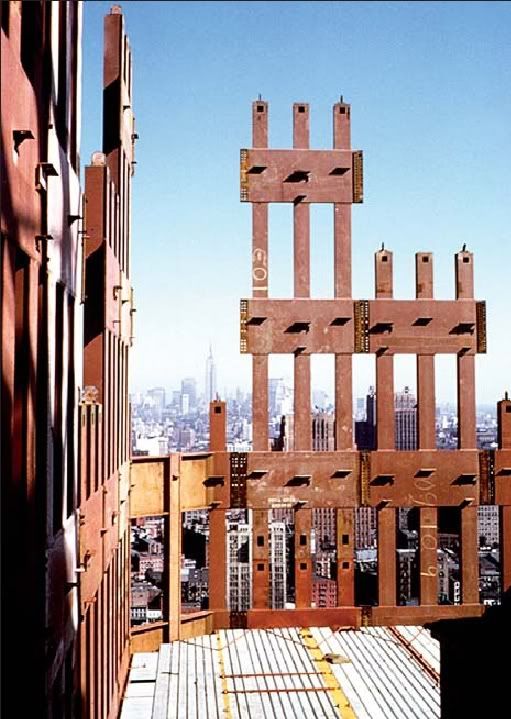
http://i286.photobucket.com/albums/ll116/tjkb/wtcside.jpg

wtcside.jpg


That is floor before being laid with LIGHTweight concrete for the floors, heavier concrete in the core floor. 95 percent of the tower was AIR.

The OP premise is not true after impacts and fire. I know of no buildings that survived an out of control fire.
 
1. Funny you would associate common sense with instinct. I do not.

Well... I just try to go by context... as far as I can tell, when most people use the word "common sense," a lot of times what they are talking about is something close to instinct. Perhaps "general knowedge," or "instinctive knowledge," is closer. But that's just my personal observation. I must confess, I did find your definition of common sense as "neutrality" to be surprising... but now that I know what you mean, hopefully I can understand you better.

2. What I suggest is that clear thinking promotes knowledge. When you have sorted out your thoughts about a problem and reached a reasonable conclusion you have become more knowledgable; better informed.

I see. So by "clear thinking" you mean sorting out your thoughts, to reach a reasonable conclusion. That's what I personally would call thinking rationally.

3. Children's instinct just caused worry, fear, unhappiness. They could not sleep. Science would not help ... just commen sense, clear thinking, correct info.

I'm a little confused here. If by common sense you mean "neutrality," how does neutrality help with the children? I understand what you're saying here, but I would probably say it differently. I would say that for kids, the science just needs to be explained in simple terms.

4. Inside job? Whatever! What really opened my eyes was the 911 Commission report! A fairy tale even a child would not believe. You see, I tried to apply common sense and clear thinking when I read that report ... and they convinced me the report was rubbish. 100% lies. Bad Hollywood. I got temporarily depressed. What a lousy world = 911 Commission. Then I got involved starting with educating the children about structures. Very healthy! To be happy you have to be active to a desired end. A ski vaccation now and then also clears he mind.

Oh, pardon me. I was just guessing that you believed it was an inside job, but if I'm wrong, thanks for correcting me. So you applied common sense and clear thinking... based on how you have defined your terms up to this point, I'm interpreting that to mean that you tried to read it in an unbiased way and rationally discern the truth of the report... have I managed to get that correct?

When you say "they" convinced you it was 100% lies, who are you referring to? Did you mean that the report itself gave you no choice but to come to that conclusion? Myself, I usually don't like to define things in absolute terms... I'm sure that there must be some things in the report that are correct, and some that aren't. It's hard for me to identify the difference, though.

It's great that you're active in educating kids. So, I gather that you are interested in architecture, or construction? Am I right? What kind of courses or studying have you done? Also, I'm sure you've noticed, but there are a few people in this thread who seem to be very well educated on those subjects. ("Architect" is apparently an architect, go figure!) I've noticed that you like to bring up a lot of hypothetical examples and get feedback. Have you found the information from them interesting?
 
Hey Al....you are probably the very man to confirm whether a 4'' thick 1 acre concrete floor in the WTC would have had rebar reinforcng more or less throughout. Didn't you say something bout working with floor systems in skyscrapers ? Can you confirm it and do you know what the dimensions of the rebar would likely be ?

This is a basic structural issue. Let me explain.

Concrete is very strong is compression but poor in tension. In a floor slab, the top face is in compression (there is a downwards vector arrising from both dead and live loadings) and the lower face in tension. We therefore have to make the concrete so massivly thick that it spans itself - a nearly impossible task - or we introduce reinforcement.

In the case of the towers this comprisesd a lightweight permanent profiled steeled formwork, then layers of reinforcement, then the concrete (which was comparatively thin) was cast.

The size and spacing of the reinforcement varies depending upon a wide range of issues including loading, intermediate support, impact of the formwork, and so on. It's not like doing a simple domestic foundation where we might use just a plain 12 or 15mm mesh.

As Al says, this reinforcement isn't infinitely strong. It's designed to work as part of an overall structural system. And it's only designed for credible loads (which generally will not include the floor above landing on it).
 
Yes, material of dropped part C and hit part A doesn't matter! It can be composite steel structures, pizza paper boxes, sponges of syntethic or natural fibres, lemons, etc. as described before. Part C can never crush down part A! There are two basic cases!

1. The energy applied is only sufficient to elastically deform parts A and C. Result - part C bounces on part A.

2. The energy applied is sufficient to cause failures of parts A and C. Then parts A and C are damaged at the contact area, the interface changes and the energy is consumed by local faulures of both parts A and C.

Quite basic actually. Part C can never destroy part A.

Then perhaps you could explain exactly what is happening in the following video, in which an upper part of a structure is dropped on the lower part of the same structure, destroying both.

http://www.wideo.fr/video/iLyROoaftc9z.html

Part A looks pretty well destroyed here, doesn't it? Watch carefully, as the upper part initially crushes down the lower, in exactly the way everybody in the truth movement says it shouldn't, then crushes up as it hits the ground. According to your repeated assertions, this is impossible. Is this video entirely faked, or are you wrong? Or are you, perhaps, going to invent some third possibility, in which you admit that the upper part of a structure can destroy the lower part when dropped on it, but (for some reason that you also haven't made up yet) this doesn't apply to the WTC towers?

Dave
 

Back
Top Bottom