• Security incident: ISF was recently accessed by intruders. Please change your password, and change it anywhere else you used it. Read more

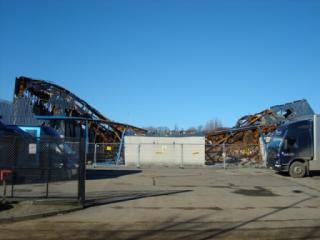
Steel failing in hydrocarbon fires.

BenBurch

Gatekeeper of The Left
Joined
Sep 27, 2007
Messages
37,538
Location
The Universe 35.2 ms ahead of this one.
I touched upon this in another topic, but I think it deserves a topic of its own, so here it is.

One of the tiresome refrains of the third-string truthers who pass through here like meat through the sausage grinder is that a hydrocarbon fire can never make steel fail.

Now, we give them diagrams and charts and quote temperatures to them, none of which ever make any more impression upon them than a mosquito does upon a windshield, so I here present a real world example.

A technology that has nearly vanished from the world is the steam locomotive.

Since Stephenson's Rocket, boilers of steam locomotives, with few exceptions, have been on the same plan; A firebox surrouned by water with a grate below the fire to admit air and to release ash, with combustion gasses passing through a barrel-shaped boiler via multiple fire tubes to a smoke box where exhaust steam from the operation of the engine is blown up the stack to create a draft that sucks the combustion gasses from the firebox and causes air to come in through the grates to feed the fire.

At the top of the firebox, and subject to the most heating from the fire because heat rises, is the crown sheet. The crown sheet is attached to the top of the boiler shell by long stay bolts that keep the internal pressure of the boiler from deforming the sheet, which otherwise would have to be very thick and not very good at its job of transmitting heat into the water.

When the crown sheet of a boiler becomes dry, it is no longer cooled by the phase change of the boiling water, and very quickly heats to the temperature of the fire. As it does so, it loses much of its strength, softens and in spite of the stay bolts can be deformed by the pressure in the boiler to pull away from the stay bolts to ultimate failure.

When a crown sheet fails you have a boiler explosion. This is nearly invariably fatal to the operators of the engine and anybody nearby and can hurl the boiler off the frames of the locomotive some considerable distance.

And this is true no matter what fuel the locomotive consumes; Wood, Peat, Coal, or Oil.

But if we believed our volunteer sausages here, the last fuel should never have the capacity to damage a boiler under any circumstances. It should just not be possible for a oil fire to reach a heat sufficient to cause that steel to weaken and deform.

So, what are we to believe? That the truthers are correct that such a locomotive is universally safe with oil fuel and a dry crown sheet? Or the tragic history of railroading which includes several such failures?

(See http://books.google.com/books?id=RZ...SWtZcD&sa=X&oi=book_result&resnum=1&ct=result for one such failure.)

If indeed such failures happen, and they do, then the truthers are proven 100% wrong on this topic.
 
I'm not sure if restrictin ourselves to hydrocarbon fires is particularly worthwhile. Let's widen the scope to consider the impact of all normal fire loadings on structural steelwork.

In this respect I'm going to repost my previous comments in respect of the Truther belief in the inherrently fire resistant qualities of steel. Apologies for thos who've ploughed through them already, although I note in passing that no Truther has ever posted a substantive rebuttal of any of the points made.


Testing Criteria

Firstly, the lay reader may be interested to learn that there are, of course, formal standards to test the fire performance of structural steelwork.

The general procedures used for determining the fire resistance of load-bearing elements of structure are specified in BS476 series. In assessing the performance of fire protection materials the relevant parts are:

Part 20 Method of determination of the fire resistance of elements of construction (general principles)

Part 21 Method of determination of the fire resistance of load-bearing elements of construction

Whilst BS 476 Part 20 is concerned with general principles and covers requirements which are common to the other parts of BS 476, the BS 476 Part 21 fire resistance testing covers load-bearing elements of construction, such as steel beams, columns or walls, whilst BS 476 Part 22 fire resistance tests are intended for non load-bearing elements of construction.

European fire testing standards have also been published. In assessing the performance of fire protection materials the relevant part is presently ENV 13381-4 “Test methods for determining the contribution to the fire resistance of structural members Part 4: Applied protection to steel members”. This standard makes reference to the EN 1363 Series of standards which contain general information about conducting fire resistance tests. However, as all the procedures for assessing fire protection are currently specified in ENV13381-4, it is this standard which is generally referred to.

Performance of Steel in Fires

Hot finished carbon steel begins to lose strength at temperatures above 300°C and reduces in strength at steady rate up to 800°C. The small residual strength then reduces more gradually until the melting temperature at around 1500°C. This behaviour is similar for hot rolled reinforcing steels. For cold worked steels including reinforcement, there is a more rapid decrease of strength after 300°C (Lawson & Newman 1990). In addition to the reduction of material strength and stiffness, steel displays a significant creep phenomena at temperatures over 450°C. The phenomena of creep results in an increase of deformation (strain) with time, even if the temperature and applied stress remain unchanged (Twilt 1988).

High temperature creep is dependent on the stress level and heating rate. The occurrence of creep indicates that the stress and the temperature history have to be taken into account in estimating the strength and deformation behaviour of steel structures in fire. Including creep explicitly within analytical models, is complex. For simple design methods, it is widely accepted that the effect of creep is implicitly considered in the stress-strain-temperature relationships.

For those who require further information or, as the case may be, persuasion regarding the actual performance of steelwork under such conditions we are fortunate that a predictably large numbers of leading bodies have looked at the issue in depth.

http://www.shef.ac.uk/fire-research/..._meetings.html (http://www.shef.ac.uk/fire-research/..._meetings.html)

http://www.corusconstruction.com/page_1416.htm (http://www.corusconstruction.com/page_1416.htm)

http://www.bfrl.nist.gov/866/CIB_W14/workprog.htm (http://www.bfrl.nist.gov/866/CIB_W14/workprog.htm)

http://www.civil.canterbury.ac.nz/fi...rts/KLewis.pdf (http://www.civil.canterbury.ac.nz/fi...rts/KLewis.pdf)

Note in particular the strength/temperature/yield grading charts in the final link, which have obvious implications for the structure of any steel framed building exposed to fire conditions.

Practical Implications - Design Codes and Building Regulations

The fire design codes BS 5950-8, Eurocode 3 Part 1-2 and Eurocode 4 Part 1-2 provide the framework for designers to calculate the temperature at which a given steel member will fail in a fire situation. These design methods incorporate more realistic estimates of the applied load during a fire and include the effects of non-uniform heating through and along the member. The design methods are based on either fire
resistance, which is a measure of an element to withstand given criteria in a standard furnace test, or natural fires where the size of the fire compartment, available combustible material, characteristics of the compartment boundaries andair supply are considered.

The requirements and calculations so arising are necessarily complex.

As the reader might anticipate, because structural steelwork is at risk of failure in a fire building regulations also introduce fireproofing requirements.

The Scottish Regs, section D, are a bit detailed - http://www.scotland.gov.uk/build_regs/sect-d.pdf (http://www.scotland.gov.uk/build_regs/sect-d.pdf) - but you'll notice do flag up the need for fire protection in structural components and steelwork.

In England, Part B of the Regs flags up a similar position - its not available on-line free but Corus (who do know a thing about steel) have a useful and relatively non-technical summary at http://www.corusconstruction.com/leg...s_section1.pdf (http://www.corusconstruction.com/leg...s_section1.pdf) . Some of you will note on page 5 the admission that most unportected steel sections only have fire integrity for about 15 minutes.

The Canadian Regs aren't available on-line free either, but their national buildings institute flags up across all their documents the risk posed by fire and the need for protection - see, by way of example, http://irc.nrc-cnrc.gc.ca/cbd/cbd071e.html (http://irc.nrc-cnrc.gc.ca/cbd/cbd071e.html) .

The New Zealand and Australian steel codes, (SNZ, 1997 and SAA 1990) are very similar to each other. The NZ regs section C4 requires....wait for it......structural protection of steel in fire ( http://www.building.govt.nz (http://www.building.govt.nz/))

Summary

It is recognised through empirical analysis across a recognised series of standards that structural steelwork weakens significantly under normal fire conditions, and as a consequence codes require additional protection through (for example) the incorporation of passive fire protection systems.
 
Here is a question.

If hydrocarbons can not heat steel enough to allow it to become malleable, how was steel used before the invention on an arc furnace?
I mean, I seem to recall something about a trade known as blacksmiths who were pretty good at making things out of steel after heating it in a wood/coal fire. So next time someone says that fire cannot melt/deform steel, just throw them a horseshoe as you laugh at them and walk away.

MrQ
 
lol...

a better question.

If hydrocarbon fires cannot make steel fail, then why on earth waste all that money on fire proofing the steel?

TAM:)
 
Here is a question.

If hydrocarbons can not heat steel enough to allow it to become malleable, how was steel used before the invention on an arc furnace?
I mean, I seem to recall something about a trade known as blacksmiths who were pretty good at making things out of steel after heating it in a wood/coal fire. So next time someone says that fire cannot melt/deform steel, just throw them a horseshoe as you laugh at them and walk away.

MrQ

or wave this at them
 
Sheesh. Everybody knows that ancient horse shoes were made of aluminum. SHILLS!
 
SS Sultana sank in 1865 because of a boiler explosion. According to twoofer science, explosion = bomb, as no fire would be able to weaken the metal.
 
Isn't it strange how they have avoided this thread?

That's because there isn't much to discuss on this topic. If you take this topic and start taking it to the next step and start calculating the shear and ductile failures due to heating then we might get some interesting conversation going.
 
Hey. That's not fair. I barely know what the word ductile means!
 
Ah, that must have something to do with "if it LOOKS like a duck, and WALKS like a duck..." It all makes sense now
 
Tduck2.jpg
 
Isn't it strange how they have avoided this thread?

The Truthers always avoid this particular topic when it goes into technical detail. Remember, steel is meant to be amazingly fireproof. No steel framed building has ever failed due to fire. Well, except the towers. But they don't count.
 
Fools, I just put some water (hydro) and than a piece of charcoal (carbon) on a piece of steel and nothing happened. Then I tried lemons, cheese, wool, and pizza boxes, The wool and pizza boxes got soggy, but the lemons and cheese were unscathed.
 

ISF - Join now!

Every member here is approved by hand. No bots, no spam, just people who care about evidence and honest debate.

Membership is free!

Create your free account

Back
Top Bottom