Highlights of Stimulus Plan

Here's my problem. No matter what the business cycle has never been defeated. Every attempt to interfere has only made downturns more severe and long lasting.

The other day, I heard an economist on the radio talking about the problem with economics as a science. We can never truly do an experiment and measure the results. Can you possibly quantify how long some downturn would have been if the government hadn't interfered?

I honestly don't know what to do about the current economic crisis, or any other economic crisis. It is my inclination to believe that borrowing money to fix economic problems is almost always a bad idea. Therefore, I'm not very keen on this bill. On the other hand, there's no denying that the immediate effect will be to putat least some people back to work. I just worry about the long term effects.

Unfortunately, we will not be truly able to measure them. One thing is predictable. In 2012 when Obama is running for reelection, if the economy is bad, Democrats will say it would have been even worse without their plan. If the economy is good, Republicans will say it would be even better if Democrats hadn't spent so much money.

The free market is truly a Darwinian concept and when left alone the weak fail and the strong survive. If a bank is too large to fail and is failing then it should fail


There's one problem with this thought. The reason something is "too big to fail" is that it has effectively destroyed the competition. When it fails, there might be nothing to take its place. At the very least, it will be some time before some new bank/auto company/other failure manages to pull itself up from the financial primordial ooze.
 
There are some troubling things in these highlights.

One thing that caught my eye was in "Health Care". There's a government subsidy for COBRA payments.

It seems a reasonable thing to do, and if the truth be told I somewhat lean toward national health care anyway, but I can't help noting that this is in no way a "stimulus" provision. In fact, it's an "anti-stimulus" provision if you ask me.

There have been times in my life when I was well set financially. Indeed, sufficiently well set that I might have been contemplating telling my boss what I really thought about his stupid ideas. What stopped me? Health care. I was in such a place that I figured I could weather the time of unemployment and still pay the rent, buy the food, go out for just enough beer to keep me sane, and if my plans for hypothetical self employment didn't pan out, I could get a job before I ended up homeless.

Unless, that is, I had to pay for my own health insurance. Factoring that into the mix, suddenly i realized that quitting my job just wouldn't work out.

I'm not saying that it is a bad idea to pay health care for the unemployed, but it isn't a stimulus package. The grim truth is that this will enable people to stay unemployed just a little bit longer. Maybe they'll turn down one or two extra low paying offers while holding out for an office with nicer carpet. That means one or two more weeks of people not working. That means no economic stimulus.
 
"Honey I have some bad news: They're coming to repossess our cars. Our utilities are going to be shut off. We're maxed out on 3 different credit cards. We don't have enough money to put food on the table. Oh, and I just got fired..

Let's go to the mall."


They've gone mad with power.
 
Unfortunately, we will not be truly able to measure them. One thing is predictable. In 2012 when Obama is running for reelection, if the economy is bad, Democrats will say it would have been even worse without their plan. If the economy is good, Republicans will say it would be even better if Democrats hadn't spent so much money.

True, but incomplete:

If the economy is bad, the Democrats will say it would have been worse without their plan and it was Bush's fault. The republicans will claim that the Democrat's plan made everything worse and their plan or doing nothing would have been much better.

If the economy is good, the Democrats will claim their bold plan is the cause. The Republicans will claim that whatever good came from the stimulus plan came from their modifications, like increased tax cuts, and regardless if there had been no stimulus or more tax cuts everything would be even better.
 
Here's my problem. No matter what the business cycle has never been defeated. Every attempt to interfere has only made downturns more severe and long lasting.
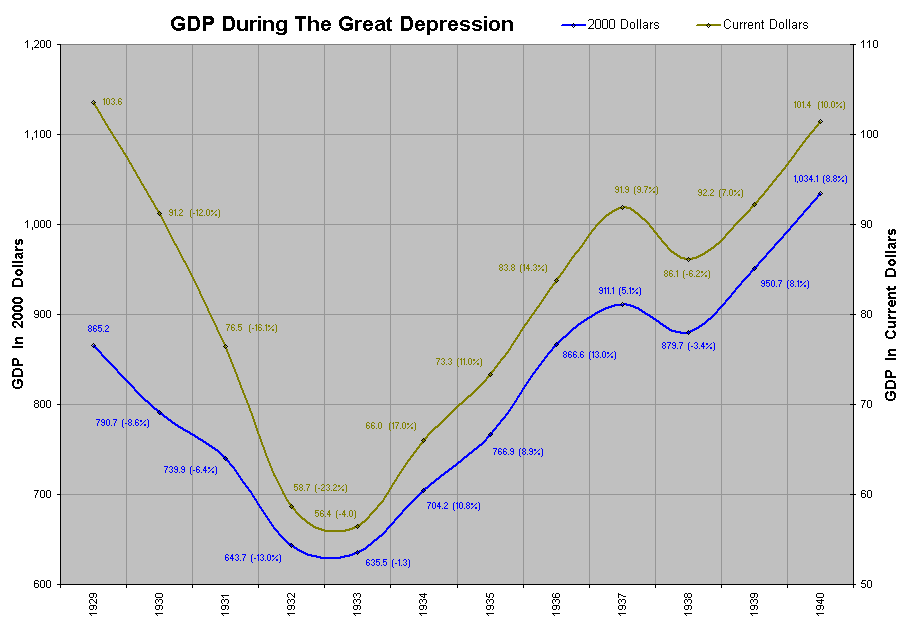
Depression.PNG


US-jobs2040.jpg


Roosevelt took office and instituted the New Deal in 1933. Contrary to your assertions, I don't see that he made the downturn more severe.

---

Amusingly enough, this date seems to have slipped the mid of Rep. Steve Austria:

When Roosevelt did this, he put our country into a Great Depression. He tried to borrow and spend, he tried to use the Keynesian approach, and our country ended up in a Great Depression. That’s just history.

Oops, I forgot to put the little (R) next to his name ... but I guess it wasn't really necessary.
 
Last edited:
[qimg]http://www.housingbubblebust.com/GDP/Depression.PNG[/qimg]

[qimg]http://upload.wikimedia.org/wikipedia/commons/0/02/US-jobs2040.jpg[/qimg]

Roosevelt took office and instituted the New Deal in 1933. Contrary to your assertions, I don't see that he made the downturn more severe.

---

Amusingly enough, this date seems to have slipped the mid of Rep. Steve Austria:

When Roosevelt did this, he put our country into a Great Depression. He tried to borrow and spend, he tried to use the Keynesian approach, and our country ended up in a Great Depression. That’s just history.

Oops, I forgot to put the little (R) next to his name ... but I guess it wasn't really necessary.


Yes we went from a peak of 20% unemplyment to 14% 7 years just before WW2 and your GDP chart only brought GDP back close to 1929 levels so there was no net gain after 11 years.


This is what the CBO has to say:

http://www.washingtontimes.com/news/2009/feb/04/cbo-obama-stimulus-harmful-over-long-haul/

President Obama's economic recovery package will actually hurt the economy more in the long run than if he were to do nothing, the nonpartisan Congressional Budget Office said Wednesday.
CBO, the official scorekeepers for legislation, said the House and Senate bills will help in the short term but result in so much government debt that within a few years they would crowd out private investment, actually leading to a lower Gross Domestic Product over the next 10 years than if the government had done nothing.

CBO estimates that by 2019 the Senate legislation would reduce GDP by 0.1 percent to 0.3 percent on net. [The House bill] would have similar long-run effects, CBO said in a letter to Sen. Judd Gregg, New Hampshire Republican, who was tapped by Mr. Obama on Tuesday to be Commerce Secretary
 
Yes we went from a peak of 20% unemplyment to 14% 7 years just before WW2 and your GDP chart only brought GDP back close to 1929 levels so there was no net gain after 11 years.
The effects of the New Deal should be calculated from the time that the New Deal started, not from the time that the recession that it was designed to cure started.

You might as well complain: "After the course of chemotherapy, the patient was no healthier than before he came down with cancer". That would actually be a win.

Ooh, look, you found a red cherry. But how red is it?

Estimates that by 2019 the Senate legislation would reduce GDP by 0.1 percent.

Good heavens, do they really? A few questions spring to mind.

(1) Do you really think that there is anyone in the world who can predict the economy ten years ahead to an accuracy of one part in a thousand? 'Cos that's what they're talking about.

(2) Do you not understand that the point of such Keynesian intervention is to iron out the peaks and troughs? Might not this hypothetical one part in a thousand might be worthwhile if it prevents another Great Depression right now? Which is worse?

(3) Is there any chance I could see the actual report, rather than how the Washington Times is spinning it? Only the last story I saw them run on the stimulus plan turned out to be disingenuous crap.
 
The effects of the New Deal should be calculated from the time that the New Deal started, not from the time that the recession that it was designed to cure started.

You might as well complain: "After the course of chemotherapy, the patient was no healthier than before he came down with cancer". That would actually be a win.

Ooh, look, you found a red cherry. But how red is it?

Estimates that by 2019 the Senate legislation would reduce GDP by 0.1 percent.

Good heavens, do they really? A few questions spring to mind.

(1) Do you really think that there is anyone in the world who can predict the economy ten years ahead to an accuracy of one part in a thousand? 'Cos that's what they're talking about.

(2) Do you not understand that the point of such Keynesian intervention is to iron out the peaks and troughs? Might not this hypothetical one part in a thousand might be worthwhile if it prevents another Great Depression right now? Which is worse?

(3) Is there any chance I could see the actual report, rather than how the Washington Times is spinning it? Only the last story I saw them run on the stimulus plan turned out to be disingenuous crap.
The Depression started in 1929. Hoover was spending money hands over fist long before FDR got his hands on it. So with Hoover's spending coupled with FDR's spending the country had depression level unemployment for 11 long years and GDP growth of net zero. It took the war to bring the economy out of the depression not the New Deal.
 
The Depression started in 1929. Hoover was spending money hands over fist long before FDR got his hands on it. So with Hoover's spending coupled with FDR's spending the country had depression level unemployment for 11 long years and GDP growth of net zero. It took the war to bring the economy out of the depression not the New Deal.
Funny how they called it the New Deal, if it had in fact been in place since 1929.

Or could it be that FDR did something, y'know, different? "New", even?
 
The levels of illogic in this thread are simply staggering. Did someone just seriously argue that the new deal started before FDR took office in order to justify it causing the great depression?

I've heard of post hoc ergo propter hoc, but this has elevated it to the level of magical thinking. The depression was more likely to be caused by Unicorns than the New Deal or Government spending.
 
Last edited:
The funny part is...

a) You're assuming that with the housing crisis being the main target for finger pointing, that there are a bunch of builders that still have work.
No, I'm "assuming" that the porkulus bill will bring about at least some of the construction/renovations Obama promises it will.

b) You're assuming that investment bankers came from "investment baker families".
No, I didn't.

c) You're assuming that building roads/buildings means that every one on the site knows how to do it.
I sure as **** hope so.

d) It's just funny to me because I have an MFA in acting... ACTING... yet I grew up, mixing mortar, hauling brick, building dead men, (odd, I've never heard the plural for that.) and laying brick/stone.

Why is it investment bankers couldn't do that?
I don't know that they can't. I just pondered whether or not they could.
 
Funny how they called it the New Deal, if it had in fact been in place since 1929.

Or could it be that FDR did something, y'know, different? "New", even?
I Will say it slower this time. The depression started in 1929. Hoover went into a massive spending spree on the Hoover Dam and the Bay Area Bridge along with forcing companies not to lower wages to reduce costs. When FDR was elected, he enacted the New Deal and managed to bring the GDP back to just under the 1929 level but Unemployment was only reduced 6 points from the height of the depression until 1940. There was massive government spending from 1929 to 1940 and the end result was 11 years of zero growth and massive unemployment. Both Hoover and FDR raised taxes and imposed trade tariffs at critical times that ended up adding to unemployment and contraction.
 
I Will say it slower this time. The depression started in 1929. Hoover went into a massive spending spree on the Hoover Dam and the Bay Area Bridge along with forcing companies not to lower wages to reduce costs. When FDR was elected, he enacted the New Deal and managed to bring the GDP back to just under the 1929 level but Unemployment was only reduced 6 points from the height of the depression until 1940. There was massive government spending from 1929 to 1940 and the end result was 11 years of zero growth and massive unemployment. Both Hoover and FDR raised taxes and imposed trade tariffs at critical times that ended up adding to unemployment and contraction.

In what way was WW2 NOT a massive spending spree?
 
I'm happy to see such brevity from you. I can't wait for WW3 can you?

How about we spend the same amount of money as WW3, but on something more useful, like bridges and solar power research?
 
How about we spend the same amount of money as WW3, but on something more useful, like bridges and solar power research?
LOL. in today's dollars that would be about 3 trillion. Tell me, how do we come up with that amount of money? After WW2 the United States emerged with the only country in the world with a manufacturing capacity. We had a world wide monopoly for over a decade that resulted in the ability to pay off the war debt. Are you getting the picture yet?
 
Last edited:
So becoming a net exporter for a decade after WW2 is what helped the US pay for the war? It was paid for with corporate taxes?

ETA: (I don't think we paid it off quite that fast myself)

ETA2: Here

Since all Presidents from Truman on have reduced the gross federal debt except Reagan and the Bushes, the part remaining from WWII is found by subtracting their debt contributions (and the FRS contribution) from the current federal debt total.
 
Last edited:

Back
Top Bottom