• Security incident: ISF was recently accessed by intruders. Please change your password, and change it anywhere else you used it. Read more

THE PHYSICS OF FLIGHT; a thread for CIT

I think Reheat could fly with one wing. Reheat can do it. Which wing on a high-powered prop would you want to loose? (if it had to go) (and it looks like if they faked the wing thing, they took out the "right" wing…)


Now that you mention it, which way is the engine torgue trying to spin the airframe, roll left or right?


The F-15 guy was lucky he was at a speed above loss of control, and was able to scope out the controllability and land. But the shape of the F-15 is fantastic for high and slow flight with most of the plane contributing to lift in some way; and those big rudders so to speak. But he did fly it himself, there are no special gadgets to help him.

awww come on Beachnut, you sell yourself short. I am sure that if a wing snapped of a KC135 you'd bring her in to a safe landing to save the AF the cost of losing all that fuel.:D
 
Last edited:
It is a great primer on flight. Weren't we putting in time so that the TM can get up-to-speed on this? Maybe the CiT can now check on the ability of aircraft to fly the manouvers they say it did:rolleyes:

On the other hand, coming up with examples of how aircraft can and cannot fly would seem to add to X's technical brief.
 
Well, the derail did help show illustrate some of the dynamics of flight discussed in X's article, e.g. why the plane in the video could not have flown the way it is depicted. And it did help keep X's thread (which he surely spent much time writing) at the top of the threads for the time being.
 
Not to derail the derail, but is X ever going to talk to us again for taking his thread way the hell away from where he started? :o


No. :p


Actually, I haven't got around to updating the report yet. Saturday looks good, though.

Until that time, there is little for me to add.


But I can give you the equation for bank angle in a level (constant altitude) turn:

[latex]\phi = \arccos (\frac{W}{L})[/latex]

Where
L is the total lift
W is the weight of the aircraft
and "phi" is the bank angle (from vertical)​

This formula is pretty useless on it's own. You need a little more information.

Let's define Fr as the radial force on the aircraft (toward the centre of the turn).

[latex]F_{r} = W \sqrt{n^2 - 1}[/latex]
(It's the resultant vector of the lift and weight vectors. I won't derive it for you. But you should be able to derive it on your own. Hint: Level turn.)

The other way of determining radial force is via Newton's Second Law (for rotational motion.

[latex]F_{r} = m \omega = m \frac{V^2_{\infty}}{R}[/latex]
(this is what the equation for turn radius was derived from)

Recombining all these equations, you can determine the lift required for a turn of a given radius at a given speed.

[latex]L_{required} = \sqrt{(m \frac{V^2_{\infty}}{R})^2 + W^2}[/latex]

From the required lift, you can easily determine the bank angle needed. Note, however, that if the lift required is greater than the aircraft can provide at that speed (see below), then the turn is not possible.

[latex]L_{available} = 0.5 \rho_{\infty} V^2_{\infty} S C_{L}[/latex]
 
Last edited:
Now that you mention it, which way is the engine torgue trying to spin the airframe, roll left or right?

awww come on Beachnut, you sell yourself short. I am sure that if a wing snapped of a KC135 you'd bring her in to a safe landing to save the AF the cost of losing all that fuel.:D
REDDUR THGIR, counter the p-factor, plane wants to yaw left.

No you would see a flash to a parachute if we had one on board, after I dumped the pressure, and pulled the spoiler to bail out. Get parachute leave plane! Who cares about the fuel? I would only stay with the plane to finish the refueling, but only a few pilots would try to refuel behind a single wing KC.

Even if we could get the rudder in the high pressure by tricking it, the tail would fall off. Size, and scale do matter.

Wait! If an F-15 pilot can do it! I can do it. Where is my parachute?

The F-15 cheated, he had an ejection seat.

No, the KC-135 is not older than I. Do I have to buy the beer and soda again.

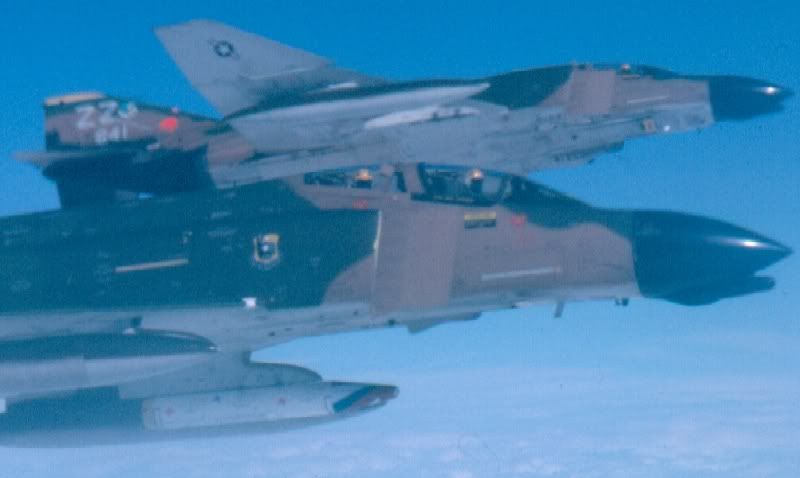
Is this a aero lesson? Nice thread; I knew that lifty stuff they taught us at Pilot Training (UPT then), was bogus. But how does an F-4 fly?
f4onwingAR.jpg
 
Is this a aero lesson? Nice thread; I knew that lifty stuff they taught us at Pilot Training (UPT then), was bogus. But how does an F-4 fly?
[qimg]http://i286.photobucket.com/albums/ll116/tjkb/f4onwingAR.jpg[/qimg]


There are actually a few theories that try to explain exactly how lift is generated. I merely gave the simplest explanation for the pressure differential.

As for the F-4: They flew by sheer brute force.
 
looks like it flys quite well and IIRC the pilots who flew them liked them even if they were a bit slow.
They were actually quite fast. The first one, IIRC, broke the speed record for a coast-to-coast flight.
 
Not to derail the derail, but is X ever going to talk to us again for taking his thread way the hell away from where he started? :o

Mea culpa.

I derailed the thread and apologize to X for that and for not acknowledging his excellent work.
 
Educational threads ROCK!

But, that bothered me. From what tiny little bit I know, an RC can have a much, much higher thrust-to-weight ratio than a fulll sized aircraft (if I'm wrong about this, someone please correct me). That alone changes many of the dynamics involved. So I kept looking, eventually stumbled across that Hoax-Slayer site, and whaddaya know! It dealt with that exact video.
The very first time I watched it I thought the landing didn't look right. The motion was just... wrong. I was also wondering where the lift was coming from to keep the plane in the air as it was coming in to land. Stunt planes can hang from their props for a brief time, but nothing like the video purports to show.

The video is pretty clearly fake, but there are extreme performance prop planes that could theoretically perform such a recovery, and the aerobatic plane that it's pretending to be is plausible.

For example, back in the mists of time, I once saw Scott Crosby pilot his (replica) Gee Bee E in the Watsonville Antique Fly-In (c. 1991). This aircraft is a Golden Age racer, with the later variants reaching about 1 hp for every five pounds of weight! Also had nearly as much surface area on the body as on the wings. Such an aircraft could easily fly sideways after loss of a wing if you caught it in time, though landing it that way would be spectacularly difficult. According to Mr. Crosby's comments at the time, it was actually easier to fly knife-edge than flat and level, albeit slower...

Here's a link to video from 1995 (link goes to Google Video; Gee Bee E is at 43:30, other insane aircraft follies throughout). Truly a marvellous vehicle, better exemplifying form-over-function than any I can think of.

While looking for links, I learned that he crashed it in 1997 when the engine failed. Very sad. Fortunately he was OK, but I don't know if he got it in the air again, or perhaps built another.

Eagles are fly-by-wire? I didn't know that. But wouldn't that be a detriment? After all, wouldn't sending an instruction to a control surface that's no longer there just push the programming beyond its capacity? I don't know how a programmer could build an exception handler for a problem that large. Then again, I'm no programmer...

F-15's are not fly-by-wire, with only a single exception. They do have a control "assist" system (CAS) in F-15A-D, and an updated digital assist in the F-15E, but this is not true fly-by-wire because the controls are still coupled to the surfaces directly. A strained analogy would be to an adaptive power steering system in a modern luxury car -- it's a boost, not a replacement.

That lone exception I mentioned is the F-15 IFCS research vehicle at NASA Dryden, which had true fly-by-wire retrofitted as part of its modifications. See here, Page 6, for a description of the aircraft.

There are actually a few theories that try to explain exactly how lift is generated. I merely gave the simplest explanation for the pressure differential.

Just to clarify before anyone asks, there is no scientific mystery about lift, just that most of the simplified explanations one usually encounters in educational materials are not quite correct. Some of the details, in particular how the boundary layer forms from rest and whether or not it remains attached, are rather complicated, but the derivation of lift (the force) from a snapshot of steady flow is pretty simple; whether you approach it from the Bernoulli pressure perspective (as in the writeup here) or in a Newtonian sense (equal and opposite, etc.) you will get the right answer.

 
Last edited:
Ummm ...

Which thread are you reading? 'Cause in my reality nobody in this thread said anything remotely resembling something that might possibly be misconstrued as similar in meaning, tone or content as what you're claiming.

There is a history of a few threads on this subject here. In one of them just first focusing on the speeds claimed you will find pictures of planes flying around with parts missing and posted by debunkers. One of them has no wing. This was suppose to support how the 9/11 planes could hit the speed and maneuvers performed no problem by an amateur pilot.

Now all of a sudden when it comes to the pull-up it's not possible? It's now limited? Make up your minds.
 

ISF - Join now!

Every member here is approved by hand. No bots, no spam, just people who care about evidence and honest debate.

Membership is free!

Create your free account

Back
Top Bottom