• Security incident: ISF was recently accessed by intruders. Please change your password, and change it anywhere else you used it. Read more

Does science fiction help kids learn to like science?

I find the conventions of science fiction to be the most annoying. Dressing up faster than light travel/wormholes/time travel to be anything other than magical plot devices similar to the cod-medieval use of magic spells and potions is to be delusional. Whatever they may be, they are not scientific nor do they teach much science.
Says who?
http://www.grc.nasa.gov/WWW/bpp/
http://dsc.discovery.com/news/2008/07/28/warp-speed-engine.html
http://news.bbc.co.uk/1/hi/sci/tech/364496.stm
The last one is kind of scary because I know that concept formed the joke of an episode of Futurama. So yeah when scientists write papers about warp drives it kind of shots a big hole in your argument. This is the reason why theoretical physics tends to give me a big headache.
EDIT: Oooo I get the joke now. I have to say thats really dam cool.
 
Last edited:
A voice of reason. Thank you, Diamond!
And there are settings in science fiction that are even worse than 'cod-medieavalism':
Starship Troopers versus Starship Stormtroopers.
Oooo don't get me started on that. Ewwwww....... Though it just sort of reaffirms my position that you have no clue what you are talking about if that's the worst you could come up with. Ewwww.... Ewwww.... Ewwww... And then we start going into the whole area of NOT RELEGATED TO SCIFI aspect of the issue. This issue spans the whole entire spectrum of literature.
 
Last edited:
Why become defensive and be pissed off by something you don't seem to understand at all? You seem to be going the way of GreyICE: inventing insinuations and getting all worked up about them.
Inventing? Dann, you're convincing nobody. You followed up your insinuations with a flat out statement that science fiction was teaching people to kill themselves.

You can't unwrite your insanity.

A voice of reason. Thank you, Diamond!
And there are settings in science fiction that are even worse than 'cod-medieavalism':
Starship Troopers versus Starship Stormtroopers.

I think there's a point buried in here, but I really lost it somewhere. Moorcock is not who you wish to be citing methinks.
 
Perhaps if you had said what you meant at the beginning instead of just posting a lot of quotes from con-going types and following that up with more quotes from dangerously unbalanced people.

OK, but please go back and look at the context in which I posted quotes from and references to "dangerously unbalanced people".
 
Inventing? Dann, you're convincing nobody. You followed up your insinuations with a flat out statement that science fiction was teaching people to kill themselves.

You can't unwrite your insanity.


No, I followed up my alleged insinuations with a quotation from a very dedicated group of scifi fans: http://www.internationalskeptics.com/forums/showthread.php?postid=4036994#post4036994
”We watch a lot of Star Trek, a lot of Star Wars, it's just, to us, it's just like going on a holodeck. We've been training on a holodeck . . . [and] now it's time to stop. The game's over. It's time to put into practice what we've learned.” (Students of Heaven's Gate Expressing Their Thoughts before Exit, March 21, 1997).
http://jcmc.indiana.edu/vol3/issue3/robinson.html


Unfortunately the rest is not silence but your strawman. If you aren't able to understand what you read, you should stop posting about it.

I think there's a point buried in here, but I really lost it somewhere. Moorcock is not who you wish to be citing methinks.


Yes, Michael Moorcock is who I wish to be citing, which is why I post a link to his article. Is it that hard for you to grasp?
 
Last edited:
No, I followed up my alleged insinuations with a quotation from a very dedicated group of scifi fans: http://www.internationalskeptics.com/forums/showthread.php?postid=4036994#post4036994

Unfortunately the rest is not silence but your strawman. If you aren't able to understand what you read, you should stop posting about it.
Being a scifi fan ("apparently we're (!) learning to kill ourselves") you appear to become paranoid when somebody brings up proof that science fiction does not necessarily inspire people to become engineers (the myth), but sometimes instead turns them on to self-mutilation, suicide or mass murder.
Stating what your insane argument is isn't a strawman. It's not really my fault your argument is insane.
Yes, Moorcock is who I wish to be citing, which is why I post a link to his article. Is it that hard for you to grasp?
Okay. I have to wonder if you're making the point you think you're making though.
 
I have to wonder which point you think I'm making. You have been very good at inventing insinuations and insanity so far, so it's hard to tell.
 
I have to wonder which point you think I'm making. You have been very good at inventing insinuations and insanity so far, so it's hard to tell.
Unfortunately you are the one inventing them. I am merely quoting them, which is disturbing enough, I assure you.

I was wondering if you wanted to be posting an essay which was part of an ongoing political, social, and philosophical debate carried out partially through science fiction when your point was science fiction was disconnected from reality. But, whatever. It would fit with the general level of nonsense going on here.
 
A voice of reason. Thank you, Diamond!
And there are settings in science fiction that are even worse than 'cod-medieavalism':
Starship Troopers versus Starship Stormtroopers.

Its rare for me to be called "A voice of reason" so I might as well enjoy it.

Starship Troopers (the film) is interesting in that it blends criticism of democracy from the point of view of an idealized fascist state combined with the World War Two film genre.

I was astonished to hear Paul Verhoeven claim that he was trying to subvert the fascist state through hidden satire because if he did, it failed miserably. The Fascist State of ST had no racism, no sexism, no poverty and appeared to function extremely well. All of its citizens appeared to have perfect skin and straight teeth.

I enjoyed the film for what it was, without inhaling any political message. Someone wrote of ST that the lesson appeared to be that "War makes fascists of us all", which is a fair summation. It certainly wasn't deep.

The book (which I've only partially read) is good compendium of beliefs about United States military supremacy from the 1950s (when the book was written) projected into the future.

Some SF has real literary value, but its scientific value is pretty small.

I could argue that "An Inconvenient Truth" was science fiction, but that would be a whole other thread....

My favourite movie, hands down, is also SF: "Blade Runner"

The point is that science fiction generally does not help kids learn science. Does MacGyver teach science? Or CSI?

I do know that there are quite a few doctors who chose their profession because of Dr "Bones" McCoy of Star Trek.

As Michael Crichton observes, science does not do well in popular culture, because the movies need plot devices, not scientific exposition, to move the story along.

That said, my conversion from religion to scientific worldview came from a book about science, not from science fiction.
 
From the very beginning Starship Troopers (the movie) seemed to be a fascist version of Beverly Hills 90210 (with the nudity typical of Heinlein), and it was not till the end that it became (fairly) obvious that it had been tongue-in-cheek all along: the obvious glee with which the Goebbels scientist talks about the useful information they are able to extract by means of torture from the ugly alien POW.
For this reason I’m also not sure if it did not actually appeal to the 90210 generation - making fascism seem cool. I’m afraid that many young people won’t notice that it’s not a faithful rendition of Heinlein’s book but actually a pastiche.
We had a thread discussing this a couple of years ago, but I cannot find it.

I also think that Blade Runner is one of the best movies ever made (The Seven Samurai is better, though), but I miss Harrison Ford’s voice-over in the later versions.

Doing science is very boring a lot of the time. A realistic presentation of science and scientists would have people fleeing movie theatres. It is irony that Indiana Jones has made so many people interested in archeology ...
But on the other hand: In detective movies you rarely see the hours and days spent doing surveillance.
 
Does MacGyver teach science?
Yes. Oddball weird science but I believe everything on that show was based on reality with only some slight exaggeration. In fact that is a horrible horrible horrible example because as Adam Savage said,"Everything that Mcguyver did was based on science."
 
Last edited:
“... the show, which was praised for generating interest in the applied sciences, and particularly engineering, as well as providing entertaining story lines. All of MacGyver's exploits on the show were ostensibly vetted to be based on real scientific principles (even though, the creators acknowledged, in real life one would have to be extraordinarily lucky for most of MacGyver's ideas to succeed).”
(...)
"In February 2008, the popular science show Mythbusters featured a MacGyver special which tested several of MacGyver's tactics. The first test examined MacGyver's famous cold capsule bomb, which utilized the explosive reaction of alkaline metals with water. Supposedly, dropping 1 gram of sodium metal into water will cause an explosive reaction powerful enough to blow a hole through a cinderblock wall. However, despite using 100 grams of sodium metal, the wall remained completely intact. It was "busted," along with MacGyvers's ultralight aircraft built from bamboo, garbage bags, duct tape and a cement mixer engine which failed to sustain flight and immediately crashed after travelling off a cliff.
However, some of MacGyver's tactics were confirmed. The Mythbusters were able to pick a lock using the filament of an incandescent lightbulb. Another "confirmed" MacGyver tactic was building an electromagnet using ordinary household batteries, tape and insulated wire (the insulated rubber surrounding the wire was removed with a cheese grater.) They then successfully used this device to magnetize an unfolded paper clip (by passing it repeatedly over the magnet) and then, by embedding the paperclip in a piece of cork and placing it in a small bowl of water, the paperclip acted as a compass (because it was magnetized, it pointed to the North Magnetic Pole.)"
http://en.wikipedia.org/wiki/MacGyver
Even though my field is languages I think that I might have been able to come up with the latter idea due the afternoons of my childhood spent browsing through the collection of the Danish edition of Popular Mechanics I inherited from my father.
 
Yes, they do find inspiration in the literature. If they didn't, it would not have inspired them!
I think you are missing the point of the quote. Writers do not seek to invoke certain types of inspiration from people, but some people find in the litterature an excuse or reason to either justify thier behaviour or claim inspiration.

Take for instance "Catcher in the rye". I don't think J.D. Salinger meant for his work to inspire any act of violence even though Mark David Chapman cited it as an explination for his assaination of John Lennon.
 
But what people feel is the absolute WORST judge of what influences them that I can possibly imagine.
Well I think that would depend on if you are talking about a concious or unconciouse behaivour or choice and the individual.

Here's just one tiny example. For years, various people studying prisoners were preaching the evils of porn. They did dozens of studies showing rapists blamed pornography, ect.

Then someone said "Hey, what if, I dunno, people are bad at self-examination?" Yup, turns out they on the whole are actually exposed to porn at a slightly older age, and porn viewing has no correlation with rape.
True millions of people view porn every day without there being a rape involved. I personlay do not think that porn has anything to do with a person becoming a rapist.
But when a person says that everytime he looks at porn he feels the need to rape someone that has to be look at more seriously. The reasons the person became a rapist is obviously not due to viewing porn, but the porn becomes a trigger in the persons mind and therefore an influence in the committing of rape.

Wether the self-evaluation is bad or not doesn't matter in this case. The rapist sees it a trigger so it becomes a trigger in his mind.

There are dozens of these things. People absolutely LOVE to assign causation where it doesn't exist. Meanwhile they will absolutely insist that causation doesn't exist where statistically something funky is going on.
What was it that Benjamin Desraili said about statistics? ;P People who have agendas usually find a way to support those agendas with statistics. It's all in the criteria and interpretation, especially when the statistics involve human behaivour.

A good look at how reading habits shaped kids lives would use the objective information of what books they read, and how that evolved and eventually how their life turned out.
No argument there. It would definitly show correlations. but would it easily answer questions like, does the person like science fiction because of a prior existing interest in science or did reading science fiction instill an interest in science? I think that would still have to rely on an element of self-evaluation. Sounds a bit chicken or egg I'll admit.
For me, that would be a hard question to answer. I've been watching and reading science fiction about the same time I was watching and reading science programs and books. For me it was hand-in-hand.

The statistics will show that I have a strong interest in both science and scienc fiction and that my career is science based, but what else would it show concerning my frame of mind between the three items? Would it show that I made a concious or unconcious choice in my career?

I originaly wanted to get into commercial art (honestly, my other great consuming interest is art) but other factors in my life not related to art or science lead me to to teach electronics and computer maintenance. I got into that field because of my interest in science and engineering made that subject easier for me to understand and utillise in a job. So what effect exactly did science fiction have on my choice of careers? Well it depends on how you look at it. My present choice in science related career was a concious choice but not my first choice. And my first choice was not science related, although I probably would have preferred concept design and illustration for the science fiction media.

Other people would have a more direct, concious connection between science fiction and thier career choice. There is an element of self evaluation that has to be taken into account in this case even if it is a good or bad evaluation because there is an influnce however small.
 
I think you are missing the point of the quote. Writers do not seek to invoke certain types of inspiration from people, but some people find in the litterature an excuse or reason to either justify thier behaviour or claim inspiration.

Take for instance "Catcher in the rye". I don't think J.D. Salinger meant for his work to inspire any act of violence even though Mark David Chapman cited it as an explination for his assaination of John Lennon.


I think that you are missing the point that nobody ever claimed that witers "seek to invoke certain types of inspiration from people". (Although they sometimes do, but ...) Nobody claimed that Salinger wanted somebody to kill John Lennon, nobody claimed that Gene Roddenberry wanted the members of a cult to castrate and kill themselves. (I don't know how the author of The Turner Diaries felt about the bomb in Oklahoma.)
You seem to have a problem with the word inspiration and therefore want to stress that the artists are not guilty of anything other than the fiction they produce:
"some people find in the litterature an excuse or reason to either justify thier behaviour or claim inspiration".
and
"The literature does not inspire them, they find the inspiration in the literature."

Instead of coming to terms with the word (and the facts), you seem to attack it without really knowing what you are attacking:
So what is supposed to be the difference between being inspired and finding inspiration or finding a reason to claim inspiration?
The latter attempt at reinterpretation seems to imply that neither the Heaven's Gaters nor Mark Chapman were inspired at all but only claimed to be so.
Do you think that people always lie when they say that they were inspired by something?
Or are you trying to say that inspiration from literature or movies can only take if the autor or director intends it to?

PS Please fix the quotes in post 134 while the save option is still open. :)
 
Last edited:
I think that you are missing the point that nobody ever claimed that witers "seek to invoke certain types of inspiration from people". (Although they sometimes do, but ...) Nobody claimed that Salinger wanted somebody to kill John Lennon, nobody claimed that Gene Roddenberry wanted the members of a cult to castrate and kill themselves. (I don't know how the author of The Turner Diaries felt about the bomb in Oklahoma.)
You seem to have a problem with the word inspiration and therefore want to stress that the artists are not guilty of anything other than the fiction they produce:
"some people find in the litterature an excuse or reason to either justify thier behaviour or claim inspiration".
and
"The literature does not inspire them, they find the inspiration in the literature."

Instead of coming to terms with the word (and the facts), you seem to attack it without really knowing what you are attacking:
So what is supposed to be the difference between being inspired and finding inspiration or finding a reason to claim inspiration?
The latter attempt at reinterpretation seems to imply that neither the Heaven's Gaters nor Mark Chapman were inspired at all but only claimed to be so.
Do you think that people always lie when they say that they were inspired by something?
Or are you trying to say that inspiration from literature or movies can only take if the autor or director intends it to?

PS Please fix the quotes in post 134 while the save option is still open. :)

Sorry my bad. my intention was to show that the authors do not intentionaly try to invoke certain inspiration from the readers. Although the argument can be made of the author of the Turner Diaries.

The sentance was poorly formed.
 
”moronically”??! You are too full of yourself for your own good, tecnobabble!
You do realize that there’s a very big difference between “Beam me up, Scotty” and “Entangled particles can therefore be used to "teleport" information”, i.e. between teleportation and “teleport” in quotation marks and only of information, don't you?!
Well, I guess that you probably don’t know the difference … which is a little … not moronic, but ignorant.
There is a big difference between science fiction and science. Some people claim that Jules Verne predicted the missions to the moon of the late 1960s in his From the Earth to the Moon, but he used a (albeit fictitious) cannon to shoot his bullet/capsule to the moon, which, of course, would instantly have killed any living organism onboard.
Dreaming of going to the moon and actually doing so are two very different things, but being a resident of dreamland you probably don’t know the difference.
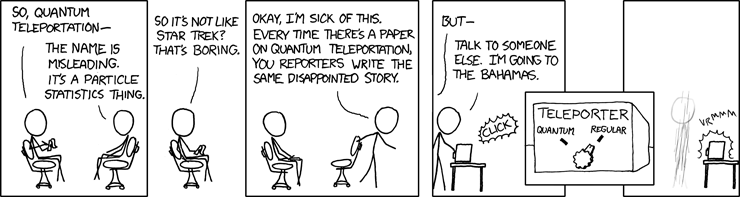
XKCD:
Permanent link to this comic: http://xkcd.com/465/
Image URL (for hotlinking/embedding)

quantum_teleportation.png


"http://imgs.xkcd.com/comics/quantum_teleportation.png" title="Science should be exactly as cool as the headlines sound. Like the 'RUSSIANS CUT APART AND REASSEMBLE DOGS' thing.""
 
Last edited:
Just found this:

'According to renowned physicist Stephen Hawking, "science fiction is useful both for stimulating the imagination and for diffusing fear of the future."'

How's that? I'm stepping out of tiny sample size and into argument from authority:o


It would depend on the specific story: Utopian or dystopian? Does it consider science and technology a blessing or a curse? (the ultimate essay question!) It very rarely portrays science and the scientists as they usually are in the real world: paid to do certain jobs, the mere assistants of governents or corporations. (If it did, it probably wouldn't be science fiction.)
Instead it tends to turn the scientist into the ultimate hero or villain.

Einstein and Bohr may have helped create the nuclear bomb, but they were not the ones who decided that it was going to be produced and used. Their employers obviously knew why they wanted it and why they dropped in on an enemy. The pangs of conscience of scientists did not have any impact on anything - other than fiction.
 

ISF - Join now!

Every member here is approved by hand. No bots, no spam, just people who care about evidence and honest debate.

Membership is free!

Create your free account

Back
Top Bottom