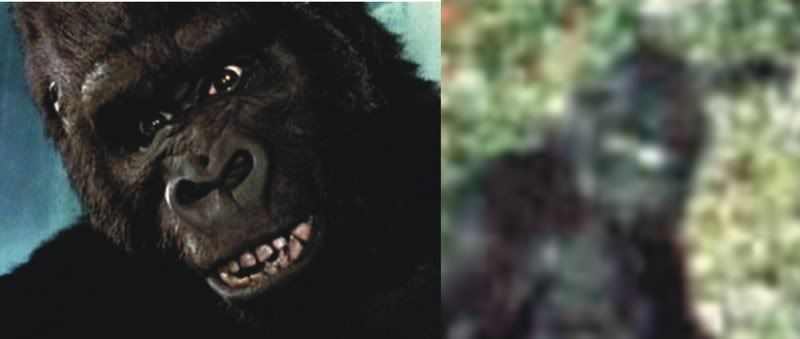
Oh look, a Bill Munns interview. In that interview Bill tells us he wondered if someone with his level of knowledge and experience had brought that experience forward in examining the PGF. What we know is that FX makers with far greater experience have examined the PGF and proclaimed it a fake based on their professional opinion. So Bill Munns observations disqualify those professional opinions? In that same interview Bill Munns tells us that Chris Walas is a "very, very brilliant and talented make up artist
himself. Right, him too. Let's again have a look at some of Chris Walas' professional qualifications.
Info on Chris Walas:
http://en.wikipedia.org/wiki/Chris_Walas
http://www.imdb.com/name/nm0906901/
Academy award for Special Effects Make-Up on "The Fly" and director of "The Fly II."
Some of his work -
Make-Up Department:
DeepStar Six (1989) (creature effects)
The Kiss (1988) (special makeup effects artist)
Enemy Mine (1985) (special makeup effects artist)
Gremlins (1984) (special makeup effects artist)
Raiders of the Lost Ark (1981) (special makeup effects: ILM) (as Christopher Walas)
Special Effects:
Dark Heaven (2002) (designer: angels)
Naked Lunch (1991) (special creatures & effects) (uncredited)
Curse III: Blood Sacrifice (1991) (monster design)
Arachnophobia (1990) (creature effects supervisor)
The Fly II (1989) (effects designer and creator: Chris Walas Inc.)
House II: The Second Story (1987) (special effects foreman)
The Fly (1986) (creature effects)
Enemy Mine (1985) (aliens creator and designer: Chris Walas Inc.) (special creature makeup and effects director: Chris Walas Inc.)
Humanoids from the Deep (1980) (special effects) (uncredited)
Miscellaneous Crew:
Enemy Mine (1985) (aliens designer and creator)
Gremlins (1984) (creator: "Gremlins")
Star Wars: Episode VI - Return of the Jedi (1983) (creature consultant)
Dragonslayer (1981) (close-up dragon) (as Christopher Walas)
Caveman (1981) (creator: abominable snowman)
Piranha (1978) (armatures) (uncredited) (special properties)
Now in that interview with Melissa Hovey when asked what movie creatures Bill Munns is responsible for he lists the Swamp Thing and Arcane Monster, Beast Master Bird Warrior bodies, replication of the Dawn of Man sequence from 2001 for a computer commercial, and making but not conceptual design of Tar Man from The Return of the Living Dead. Let's check in with imdb for a better look at Bill's qualifications in comparison to Chris Walas':
http://www.imdb.com/name/nm0612989/
Bill was, BTW, nominated for a Saturn Award in 1986 for his work on The Return of the Living Dead.
Make-Up Department:
The Return of the Living Dead (1985) (special makeup effects artist)
Superstition (1982) (special makeup effects supervisor)
... aka The Witch (USA)
The Beastmaster (1982) (special makeup designer)
... aka Beastmaster - Der Befreier (West Germany)
Swamp Thing (1982) (special makeup effects designer)
Miscellaneous Crew:
1980s
1970s
Swamp Thing (1982) (prosthetics constructor)
Blackenstein (1973) (prosthetics constructor)
... aka Black Frankenstein
... aka Return of Blackenstein
Art Department:
The Boogens (1981) (design and construction: Boogen)
Special Effects:
The Peace Killers (1971) (special effects)
In the interview with Bill Munns that LAL linked Munns tells us that he "drew a blank" at Walas' description of a suit of two pieces, top and bottom. That he had never heard of that with such a suit and couldn't imagine it. He then goes into detailing why. In this instance I'm much more inclined to accept the observations of the vastly more experience Chris Walas than I am for those of Bill Munns. In addition to this is the agreement of Walas' observation of a suit by master Rick Baker after frame by frame analysis. Now let's have a look at JohnWS' post in which he notes Chris Cowan describing ape suits for the movie Congo being done in the way that makes Bill Munns draw a blank:
In view of LAL's comment re Chris Walas above, I re read Chris' posts that he made on BFF (You have to search for them, they aren't pinned

).
Here is his description of how such a suit would go together:
The pants section goes on first. This may or may not be supported by elastic suspenders, belt or other fastener. The pants can be made out of the surface material (here it would be fur), or if there is padding to be done, it was often built up on cotton long johns.
The top went on next; and in this instance would have been built up on some "shirt" base such as a long sleeve cotton top. The top section would have fasteners at the crotch to hold front and back together, similar to some infant clothes. This would cover enough of the pants section to insure "underwear" wouldn't show through
Compare this to a description by Chris Cowan of some ape suits constructed for Congo at Stan Winston Studio:
The bottom part of the muscle suit had the leg, gluteus and butt muscles, while the upper part went from the shoulders to the forearms and down to the crotch. The hair suit was also in two pieces. The pants, with the feet attached, slid on; then the torso section snapped along the upper thigh and under the crotch.
I think that sounds
very similar though obviously the Congo suits appear much more sophisticated.
Cowan information from
HERE
Now it has already been mentioned in the past here that Munns' involvement on Return of the Living Dead did not end well and I had no intention of bringing it up but I found this one bit of trivia that I found ironic enough that I wanted to share it.
http://cinefantastiqueonline.com/2007/09/12/return-of-the-living-dead/
Because RETURN OF THE LIVING DEAD was a modestly budgeted film, the production could not afford the services of one of Hollywood’s premier makeup artists (like Dick Smith or Rick Baker). Instead, they hired William Munns, who had provided low-budget makeup effects for several small films around that time (e.g., THE BOOGENS). Director O’Bannon was so unhappy with Munn’s work that Munns was fired, and Kenny Myers came into to finish up the project (additional makeup effects, such as the talking half-corpse, were supplied by Tony Gardner). Most of Munns work remains in long-shots and group-shots; his version of the decapitated zombie is almost entirely replaced except for one brief cut of it pinned to the ground. Strangely, one of the makeup highlights in the film is the Tar Man; except for a few insert close-ups, the version scene in the film is entirely Munns’ work.
In order to avoid a possible X-rating, makeup man William Munns supplied a flesh-colored bikini-shaped prosthetic device to cover Linnea Quigley’s groin during her nude striptease in the cemetery. The result made her resemble a hairless “Barbie doll” (in Munns’ words).
The production was designed by William Stout, who book of dinosaur drawings inspired Michael Crichton to write JURASSIC PARK.
I just found it interesting that Bill Munns best known work is arguably the Tar Man from The Return of the Living Dead. Tar Man was designed by production designer Bill Stout. Reportedly Bill Stout did a book of dinosaur drawings which inspired Michael Crichton to write Jurassic Park. Bill Munns cites the Jurassic Park film and advent of CG domination as his reason for leaving that business.